
Macrophage-centered bone regeneration: A review of in vivo efficacy across tailored, hybrid, and 3D-printed biomaterial platforms

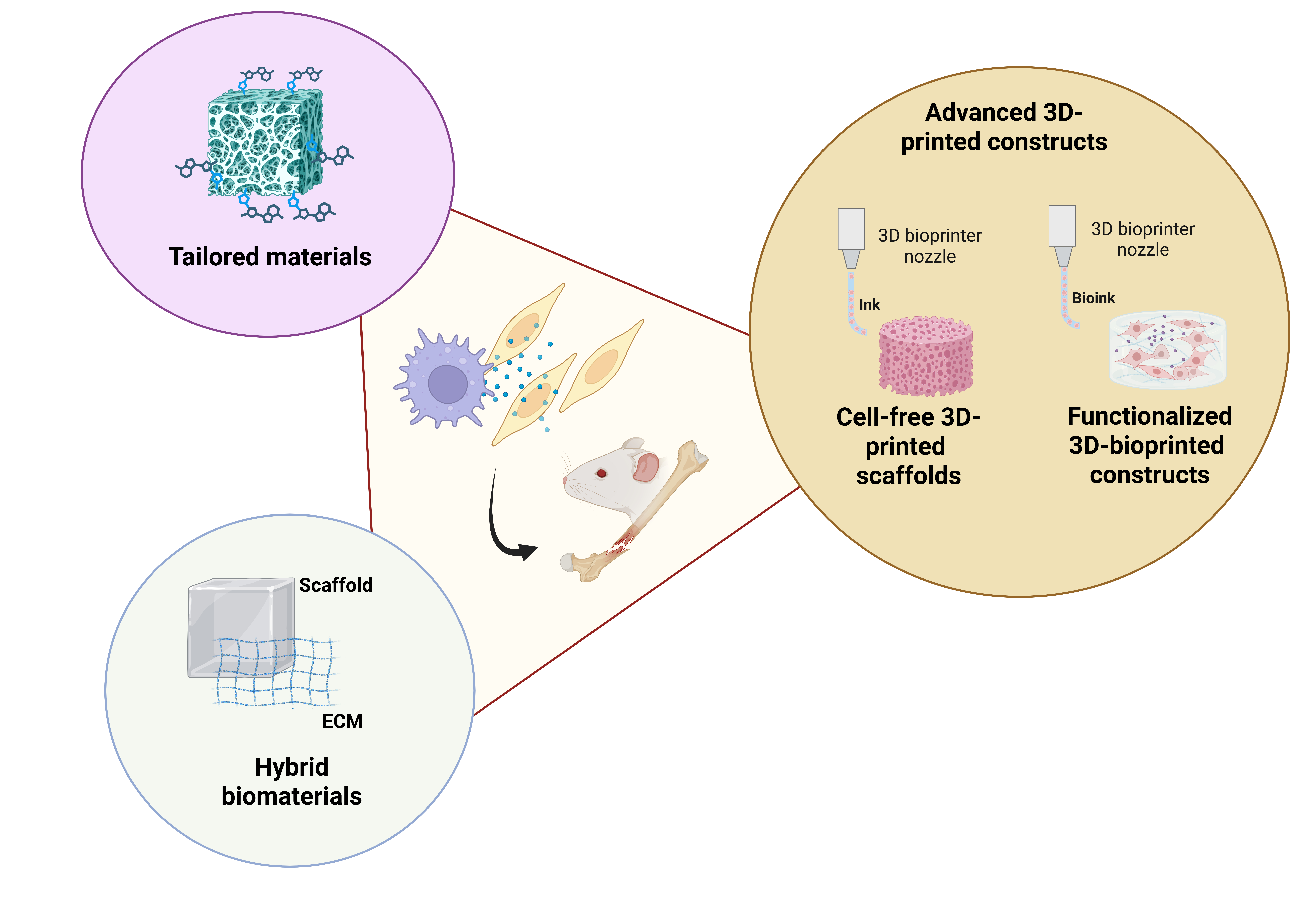
Bone tissue engineering has evolved from the passive use of structural fillers to a sophisticated discipline that actively harnesses endogenous regenerative mechanisms. At the core of this paradigm shift lies the immune system, particularly macrophages, as dynamic regulators of repair. Rather than merely suppressing inflammation, contemporary biomaterials are designed to modulate its trajectory, orchestrating the timely transition from a pro-inflammatory (M1) phenotype toward a pro-resolutive (M2) state. This review synthesizes a decade of progress in macrophage-centered bioengineering, focusing on strategies validated in preclinical in vivo models to ensure biological relevance and translational potential. These approaches are categorized across three levels of increasing complexity: (i) tailored biomaterials, where intrinsic physical and chemical properties direct cell fate; (ii) hybrid scaffolds, integrating diverse material classes and advanced delivery systems; and (iii) 3D-printed bioactive constructs, combining structural precision with ions, drugs, or cellular components. Together, these strategies define the emerging field of osteoimmunomodulation, characterized by the design of immuno-instructive materials. By critically evaluating the evolution of these principles, including their translational barriers and potential pitfalls, this review provides key insights into the field’s progression, identifying effective strategies to guide the development of next-generation bone therapies.
- Einhorn TA, Gerstenfeld LC. Fracture healing: mechanisms and interventions. Nat Rev Rheumatol. 2015;11(1):45-54. doi: 10.1038/nrrheum.2014.164
- Maruyama M, Rhee C, Utsunomiya T, et al. Modulation of the Inflammatory Response and Bone Healing. Front Endocrinol. 2020;11:386. doi: 10.3389/fendo.2020.00386
- Saul D, Khosla S. Fracture Healing in the Setting of Endocrine Diseases, Aging, and Cellular Senescence. Endocr Rev. 2022;43(6):984-1002. doi: 10.1210/endrev/bnac008
- Schlundt C, Fischer H, Bucher CH, Rendenbach C, Duda GN, Schmidt-Bleek K. The multifaceted roles of macrophages in bone regeneration: A story of polarization, activation and time. Acta Biomater. 2021;133:46-57. doi: 10.1016/j.actbio.2021.04.052
- Frade BB, Dias RB, Piperni SG, Bonfim DC. The role of macrophages in fracture healing: a narrative review of the recent updates and therapeutic perspectives. Stem Cell Investig. 2023;10(4). doi: 10.21037/sci-2022-038
- Kolar P, Schmidt-Bleek K, Schell H, et al. The Early Fracture Hematoma and Its Potential Role in Fracture Healing. Tissue Eng Part B Rev. 2010;16(4):427-434. doi: 10.1089/ten.teb.2009.0687
- Zhang D, Dang Y, Deng R, et al. Research Progress ofMacrophages in Bone Regeneration. J Tissue Eng Regen Med. 2023;2023:1-13. doi: 10.1155/2023/1512966
- Weivoda MM, Bradley EW. Macrophages and Bone Remodeling. J Bone and Miner Res. 2023;38(3):359-369. doi: 10.1002/jbmr.4773
- Zhao SJ, Kong FQ, Jie J, et al. Macrophage MSR1 promotes BMSC osteogenic differentiation and M2-like polarization by activating PI3K/AKT/GSK3β/β-catenin pathway. Theranostics. 2020;10(1):17-35. doi: 10.7150/thno.36930
- Schlundt C, El Khassawna T, Serra A, et al. Macrophages in bone fracture healing: Their essential role in endochondral ossification. Bone. 2018;106:78-89. doi: 10.1016/j.bone.2015.10.019
- Costalonga M, Herzberg MC. The oral microbiome and the immunobiology of periodontal disease and caries. Immunol Lett. 2014;162(2):22-38. doi: 10.1016/j.imlet.2014.08.017
- Lu V, Zhang J, Patel R, Zhou AK, Thahir A, Krkovic M. Fracture Related Infections and Their Risk Factors for Treatment Failure—A Major Trauma Centre Perspective. Diagnostics. 2022;12(5):1289. doi: 10.3390/diagnostics12051289
- Claes L, Recknagel S, Ignatius A. Fracture healing under healthy and inflammatory conditions. Nat Rev Rheumatol. 2012;8(3):133-143. doi: 10.1038/nrrheum.2012.1
- Jiao H, Xiao E, Graves DT. Diabetes and Its Effect on Bone and Fracture Healing. Curr Osteoporos Rep. 2015;13(5):327-335. doi: 10.1007/s11914-015-0286-8
- Saiz AM, Rahmati M, Gresham RCH, et al. Polytrauma impairs fracture healing accompanied by increased persistence of innate inflammatory stimuli and reduced adaptive response. J Orthop Res 2025;43(3):603-616. doi: 10.1002/jor.26015
- Ou J, Wang T, Lei R, et al. Association between cardiovascular health and osteoporotic fractures: a national population-based study. Sci Rep. 2025;15(1):3844. doi: 10.1038/s41598-025-88020-5
- Yao D, Qiao F, Song C, Lv Y. Matrix stiffness regulates bone repair by modulating 12-lipoxygenase-mediated early inflammation. Mater Sci Eng C. 2021;128:112359. doi: 10.1016/j.msec.2021.112359
- Gao A, Liao Q, Xie L, et al. Tuning the surface immunomodulatory functions of polyetheretherketone for enhanced osseointegration. Biomaterials. 2020;230:119642. doi: 10.1016/j.biomaterials.2019.119642
- Ni C, Zhou J, Kong N, et al. Gold nanoparticles modulate the crosstalk between macrophages and periodontal ligament cells for periodontitis treatment. Biomaterials. 2019;206:115-132. doi: 10.1016/j.biomaterials.2019.03.039
- Dai X, Bai Y, Heng BC, et al. Biomimetic hierarchical implant surfaces promote early osseointegration in osteoporotic rats by suppressing macrophage activation and osteoclastogenesis. J Mater Chem B. 2022;10(11):1875-1885. doi: 10.1039/D1TB02871E
- Ma QL, Zhao LZ, Liu RR, et al. Improved implant osseointegration of a nanostructured titanium surface via mediation of macrophage polarization. Biomaterials. 2014;35(37):9853-9867. doi: 10.1016/j.biomaterials.2014.08.025
- Xing Y, Zhong X, Chen S, et al. Optimized osteogenesis of porcine bone-derived xenograft through surface coating of magnesium-doped nanohydroxyapatite. Biomed Mater. 2023;18(5):055025. doi: 10.1088/1748-605X/acf25e
- Zeng D, Zhang X, Wang X, et al. The osteoimmunomodulatory properties of MBG scaffold coated with amino functional groups. Artif Cells Nanomed Biotechnol. 2018;46(7):1425- 1435. doi: 10.1080/21691401.2017.1369428
- Ma B, Chen F, Liu X, et al. Modified Titanium Implants Satisfy the Demands of Diabetic Osseointegration via Sequential Regulation of Macrophages and Mesenchymal Stem Cells. Adv Healthc Mater. 2024;13(30):e2401556. doi: 10.1002/adhm.202401556
- Li YM, Jiang J, Dong SK, et al. Chondroitin sulfate-polydopamine modified polyethylene terephthalate with extracellular matrix-mimetic immunoregulatory functions for osseointegration. J Mater Chem B. 2019;7(48):7756- 7770. doi: 10.1039/c9tb01984g
- Ding Y, Liu G, Liu S, et al. A Multifunction Hydrogel- Coating Engineered Implant for Rescuing Biofilm Infection and Boosting Osseointegration by Macrophage-Related Immunomodulation. Adv Healthc Mater. 2023;12(24). doi: 10.1002/adhm.202300722
- Stratton S, Shelke NB, Hoshino K, Rudraiah S, Kumbar SG. Bioactive polymeric scaffolds for tissue engineering. Bioact Mater. 2016;1(2):93-108. doi: 10.1016/j.bioactmat.2016.11.001
- Sabir MI, Xu X, Li L. A review on biodegradable polymericmaterials for bone tissue engineering applications. J Mater Sci. 2009;44(21):5713-5724. doi: 10.1007/s10853-009-3770-7
- Li D, Chen K, Tang H, et al. A Logic-Based Diagnostic and Therapeutic Hydrogel with Multistimuli Responsiveness to Orchestrate Diabetic Bone Regeneration. Adv Mater. 2022;34:2108430. doi: 10.1002/adma.202108430
- Hu Y, Tang L, Wang Z, et al. Inducing in situ M2 macrophage polarization to promote the repair of bone defects via scaffold-mediated sustained delivery of luteolin. J Control Release. 2024;365:889-904. doi: 10.1016/j.jconrel.2023.11.015
- Li J, Li L, Wu T, et al. An Injectable Thermosensitive Hydrogel Containing Resveratrol and Dexamethasone- Loaded Carbonated Hydroxyapatite Microspheres for the Regeneration of Osteoporotic Bone Defects. Small Methods. 2024;8(1). doi: 10.1002/smtd.202300843
- Li W, Wang C, Wang Z, et al. Physically Cross-Linked DNA Hydrogel-Based Sustained Cytokine Delivery for in Situ Diabetic Alveolar Bone Rebuilding. ACS Appl Mater Interfaces. 2022;14(22):25173-25182. doi: 10.1021/acsami.2c04769
- Lourenço AH, Torres AL, Vasconcelos DP, et al. Osteogenic, anti-osteoclastogenic and immunomodulatory properties of a strontium-releasing hybrid scaffold for bone repair. Mater Sci Eng C. 2019;99:1289-1303. doi: 10.1016/j.msec.2019.02.053
- Wu P, Shen L, Liu HF, et al. The marriage of immunomodulatory, angiogenic, and osteogenic capabilities in a piezoelectric hydrogel tissue engineering scaffold for military medicine. Mil Med Res. 2023;10(1). doi: 10.1186/s40779-023-00469-5
- Li B, Liu F, Ye J, et al. Regulation of Macrophage Polarization Through Periodic Photo-Thermal Treatment to Facilitate Osteogenesis. Small. 2022;18(38). doi: 10.1002/smll.202202691
- Vieira S, da Silva Morais A, Garet E, et al. Self-mineralizing Ca-enriched methacrylated gellan gum beads for bone tissue engineering. Acta Biomater. 2019;93:74-85. doi: 10.1016/j.actbio.2019.01.053
- Liu X, Dou G, Li Z, et al. Hybrid Biomaterial Initiates Refractory Wound Healing via Inducing Transiently Heightened Inflammatory Responses. Adv Sci. 2022;9(21). doi: 10.1002/advs.202105650
- Li Z, Wang H, Zhang K, et al. Bisphosphonate-based hydrogel mediates biomimetic negative feedback regulation of osteoclastic activity to promote bone regeneration. Bioact Mater. 2022;13:9-22. doi: 10.1016/j.bioactmat.2021.11.004
- Chen Z, Wang L, Guo C, et al. Vascularized polypeptide hydrogel modulates macrophage polarization for wound healing. Acta Biomater. 2023;155:218-234. doi: 10.1016/j.actbio.2022.11.002
- Guo S, Yu D, Xiao X, et al. A vessel subtype beneficial for osteogenesis enhanced by strontium-doped sodium titanate nanorods by modulating macrophage polarization. J Mater Chem B. 2020;8(28):7822. doi: 10.1039/D0TB90133D
- Wang D, Chen MW, Wei YJ, et al. Construction of Wogonin Nanoparticle-Containing Strontium-Doped Nanoporous Structure on Titanium Surface to Promote Osteoporosis Fracture Repair. Adv Healthc Mater. 2022;11(21). doi: 10.1002/adhm.202201405
- Mahon OR, Browe DC, Gonzalez-Fernandez T, et al. Nano-particle mediated M2 macrophage polarization enhances bone formation and MSC osteogenesis in an IL-10 dependent manner. Biomaterials. 2020;239:119833. doi: 10.1016/j.biomaterials.2020.119833
- Ming P, Liu Y, Yu P, et al. A Biomimetic Se-nHA/PC Composite Microsphere with Synergistic Immunomodulatory and Osteogenic Ability to Activate Bone Regeneration in Periodontitis. Small. 2024;20(9). doi: 10.1002/smll.202305490
- Qiao D, Cheng S, Song S, et al. Polarized M2 macrophages induced by glycosylated nano-hydroxyapatites activate bone regeneration in periodontitis therapy. J Clin Periodontol. 2024;51(8):1054-1065. doi: 10.1111/jcpe.13999
- Chen H, Liu N, Hu S, et al. Yeast β-glucan-based nanoparticles loading methotrexate promotes osteogenesis of hDPSCs and periodontal bone regeneration under the inflammatory microenvironment. Carbohydr Polym. 2024;342:122401. doi: 10.1016/j.carbpol.2024.122401
- Yu Y, Li X, Ying Q, Zhang Z, Liu W, Su J. Synergistic Effects of Shed-Derived Exosomes, Cu2+, and an Injectable Hyaluronic Acid Hydrogel on Antibacterial, Anti-inflammatory, and Osteogenic Activity for Periodontal Bone Regeneration. ACS Appl Mater Interfaces. 2024;16(26):33053-33069. doi: 10.1021/acsami.4c05062
- Toledano M, Toledano-Osorio M, Osorio R, et al. Doxycycline and zinc loaded silica-nanofibrous polymers as biomaterials for bone regeneration. Polymers. 2020;12(5):1201. doi: 10.3390/polym12051201
- Zheng Y, Tan L, Chen H, et al. Hierarchical Integration of Curcumin-Loaded CaCO3 Nanoparticles and Black Phosphorus Nanosheets in Core/Shell Nanofiber for Cranial Defect Repair. Adv Healthc Mater. 2024;13(30):2401786. doi: 10.1002/adhm.202401786
- Zhao Y, Cheng C, Wang X, et al. Aspirin-Loaded Anti- Inflammatory ZnO-SiO2 Aerogel Scaffolds for Bone Regeneration. ACS Appl Mater Interfaces. 2024;16(14):17092-17108. doi: 10.1021/acsami.3c17152
- He Y, Yang X, Yuan Z, et al. Regulation of MSC and macrophage functions in bone healing by peptide LL-37- loaded silk fibroin nanoparticles on a titanium surface. Biomater Sci. 2019;7(12):5492-5505. doi: 10.1039/C9BM01158G
- Jin SS, He DQ, Luo D, et al. A Biomimetic Hierarchical Nanointerface Orchestrates Macrophage Polarization and Mesenchymal Stem Cell Recruitment to Promote Endogenous Bone Regeneration. ACS Nano. 2019;13(6):6581-6595. doi: 10.1021/acsnano.9b00489
- Spiller KL, Nassiri S, Witherel CE, et al. Sequential delivery of immunomodulatory cytokines to facilitate the M1-to-M2 transition of macrophages and enhance vascularization of bone scaffolds. Biomaterials. 2015;37:194-207. doi: 10.1016/j.biomaterials.2014.10.017
- Yao D, Lv Y. A cell-free difunctional demineralized bone matrix scaffold enhances the recruitment and osteogenesis of mesenchymal stem cells by promoting inflammation resolution. Biomater Adv. 2022;139:213036. doi: 10.1016/j.bioadv.2022.213036
- Ding Y, Liu X, Zhang J, et al. 3D printing polylactic acid polymer-bioactive glass loaded with bone cement for bone defect in weight-bearing area. Front Bioeng Biotechnol. 2022;10. doi: 10.3389/fbioe.2022.947521
- Ali M, He Y, Chang ASN, et al. Osteoimmune-modulating and BMP-2-eluting anodised 3D printed titanium for accelerated bone regeneration. J Mater Chem B. 2023;12(1):97-111. doi: 10.1039/D3TB01029E
- Yang X, Wu L, Li C, et al. Synergistic Amelioration of Osseointegration and Osteoimmunomodulation with a Microarc Oxidation-Treated Three-Dimensionally Printed Ti-24Nb-4Zr-8Sn Scaffold via Surface Activity and Low Elastic Modulus. ACS Appl Mater Interfaces. 2024;16(3):3171-3186. doi: 10.1021/acsami.3c16459
- Xuan Y, Li L, Zhang C, Zhang M, Cao J, Zhang Z. The 3D-Printed Ordered Bredigite Scaffold Promotes Pro- Healing of Critical-Sized Bone Defects by Regulating Macrophage Polarization. Int J Nanomed. 2023;20;18:917-932. doi: 10.2147/IJN.S393080.
- Zang C, Che M, Xian H, et al. 3D-printed silicate porous bioceramics promoted the polarization of M2-macrophages that enhanced the angiogenesis in bone regeneration. J Biomed Mater Res B Appl Biomater. 2024;112(9):e35469. doi: 10.1002/jbm.b.35469
- Oberdiek F, Vargas CI, Rider P, et al. Ex vivo and in vivo analyses of novel 3d-printed bone substitute scaffolds incorporating biphasic calcium phosphate granules for bone regeneration. Int J Mol Sci. 2021;22(7):3588. doi: 10.3390/ijms22073588
- Qiu D, Cao C, Prasopthum A, et al. Elucidating osseointegration in vivo in 3D printed scaffolds eliciting different foreign body responses. Mater Today Bio. 2023;22:100771. doi: 10.1016/j.mtbio.2023.100771
- Nalesso PRL, Vedovatto M, Gregório JES, et al. Early In Vivo Osteogenic and Inflammatory Response of 3D Printed Polycaprolactone/Carbon Nanotube/Hydroxyapatite/ Tricalcium Phosphate Composite Scaffolds. Polymers. 2023;15(13):2952. doi: 10.3390/polym15132952
- Patel DK, Dutta SD, Hexiu J, Ganguly K, Lim KT. 3D-printable chitosan/silk fibroin/cellulose nanoparticle scaffolds for bone regeneration via M2 macrophage polarization. Carbohydr Polym. 2022;281:119077. doi: 10.1016/j.carbpol.2021.119077
- Yang SY, Zhou YN, Yu XG, et al. A xonotlite nanofiber bioactive 3D-printed hydrogel scaffold based on osteo-/ angiogenesis and osteoimmune microenvironment remodeling accelerates vascularized bone regeneration. J Nanobiotechnology. 2024;22(1). doi: 10.1186/s12951-024-02323-9
- Sultan S, Thomas N, Varghese M, et al. The Design of 3D-Printed Polylactic Acid–Bioglass Composite Scaffold: A Potential Implant Material for Bone Tissue Engineering. Molecules. 2022;27(21):7214. doi: 10.3390/molecules27217214
- Chen J, Huang Y, Tang H, Qiao X, Sima X, Guo W. A xenogeneic extracellular matrix-based 3D printing scaffold modified by ceria nanoparticles for craniomaxillofacial hard tissue regeneration via osteo-immunomodulation. Biomed Mater. 2024;19(4):045007. doi: 10.1088/1748-605X/ad475c
- Tan J, Chen Z, Xu Z, et al. A 3D-printed scaffold composed of Alg/HA/SIS for the treatment of diabetic bone defects. J Orthop Translat. 2024;48:25-38. doi: 10.1016/j.jot.2024.07.006
- Jiang G, Li S, Yu K, et al. A 3D-printed PRP-GelMA hydrogel promotes osteochondral regeneration through M2 macrophage polarization in a rabbit model. Acta Biomater. 2021;128:150-162. doi: 10.1016/j.actbio.2021.04.010
- Jiang Q, Bai G, Liu X, et al. 3d gelma icc scaffolds combined with sw033291 for bone regeneration by modulating macrophage polarization. Pharmaceutics. 2021;13(11):1934. doi: 10.3390/pharmaceutics13111934
- Zhou L, Zhang C, Shi T, et al. Functionalized 3D-printed GelMA/Laponite hydrogel scaffold promotes BMSCs recruitment through osteoimmunomodulatory enhance osteogenic via AMPK/mTOR signaling pathway. Mater Today Bio. 2024;29:101261. doi: 10.1016/j.mtbio.2024.101261
- Wang Y, Wang J, Gao R, et al. Biomimetic glycopeptide hydrogel coated PCL/nHA scaffold for enhanced cranial bone regeneration via macrophage M2 polarization-induced osteo-immunomodulation. Biomaterials. 2022;285:121538. doi: 10.1016/j.biomaterials.2022.121538
- Deng L, Huang L, Pan H, et al. 3D printed strontium-zinc-phosphate bioceramic scaffolds with multiple biological functions for bone tissue regeneration. J Mater Chem B. 2023;11(24):5469-5482. doi: 10.1039/d2tb02614g
- Li X, Wang Y, Wang Z, et al. Composite PLA/PEG/nHA/ Dexamethasone Scaffold Prepared by 3D Printing for Bone Regeneration. Macromol Biosci. 2018;18(6). doi: 10.1002/mabi.201800068
- Wang Y, Feng Z, Liu X, et al. Titanium alloy composited with dual-cytokine releasing polysaccharide hydrogel to enhance osseointegration via osteogenic and macrophage polarization signaling pathways. Regen Biomater. 2022;9. doi: 10.1093/rb/rbac003
- Chung JJ, Yoo J, Sum BST, et al. 3D Printed Porous Methacrylate/Silica Hybrid Scaffold for Bone Substitution. Adv Healthc Mater. 2021;10(12). doi: 10.1002/adhm.202100117
- Liu X, Gaihre B, Park S, et al. 3D-printed scaffolds with 2D hetero-nanostructures and immunomodulatory cytokines provide pro-healing microenvironment for enhanced bone regeneration. Bioact Mater. 2023;27:216-230. doi: 10.1016/j.bioactmat.2023.03.021
- Jiang W, Zhan Y, Zhang Y, et al. Synergistic large segmental bone repair by 3D printed bionic scaffolds and engineered ADSC nanovesicles: Towards an optimized regenerative microenvironment. Biomaterials. 2024;308:122566. doi: 10.1016/j.biomaterials.2024.122566
- Liu X, Chen M, Luo J, et al. Immunopolarization-regulated 3D printed-electrospun fibrous scaffolds for bone regeneration. Biomaterials. 2021;276:121037. doi: 10.1016/j.biomaterials.2021.121037
- Liu X, Chen W, Shao B, et al. Mussel patterned with 4D biodegrading elastomer durably recruits regenerative macrophages to promote regeneration of craniofacial bone. Biomaterials. 2021;276:120998. doi: 10.1016/j.biomaterials.2021.120998
- Wang X, Ma C, Zhang X, et al. Mussel inspired 3D elastomer enabled rapid calvarial bone regeneration through recruiting more osteoprogenitors from the dura mater. Regen Biomater. 2024;11:rbae059. doi: 10.1093/rb/rbae059
- Ji X, Yuan X, Ma L, et al. Mesenchymal stem cell-loaded thermosensitive hydroxypropyl chitin hydrogel combined with a three-dimensional-printed poly(ε-caprolactone) / nano-hydroxyapatite scaffold to repair bone defects via osteogenesis, angiogenesis and immunomodulation. Theranostics. 2020;10(2):725-740. doi: 10.7150/thno.39167
- Harawaza K, Cousins B, Roach P, Fernandez A. Modification of the surface nanotopography of implant devices: A translational perspective. Mater Today Bio. 2021;12:100152. doi: 10.1016/j.mtbio.2021.100152
- Sonowal L, Gautam S, Mambiri LT, Depan D. Advancements of bioceramics in biomedical applications. Next Mater. 2025;9:101010. doi: 10.1016/j.nxmate.2025.101010
- Amaral C, Paiva M, Rodrigues AR, Veiga F, Bell V. Global Regulatory Challenges for Medical Devices: Impact on Innovation and Market Access. Appl Sci. 2024;14(20):9304. doi: 10.3390/app14209304
- Ramezani M, Mohd Ripin Z. 4D Printing in Biomedical Engineering: Advancements, Challenges, and Future Directions. J Funct Biomater. 2023;14(7):347. doi: 10.3390/jfb14070347
- Zhang S, Teo KYW, Chuah SJ, Lai RC, Lim SK, Toh WS. MSC exosomes alleviate temporomandibular joint osteoarthritis by attenuating inflammation and restoring matrix homeostasis. Biomaterials. 2019;200:35-47. doi: 10.1016/j.biomaterials.2019.02.006
- Topol EJ. High-performance medicine: the convergence of human and artificial intelligence. Nat Med. 2019;25(1):44- 56. doi: 10.1038/s41591-018-0300-7