

3D printing of aligned cellulose nanofiber hydrogels for enhanced AuNP-based SERS sensing

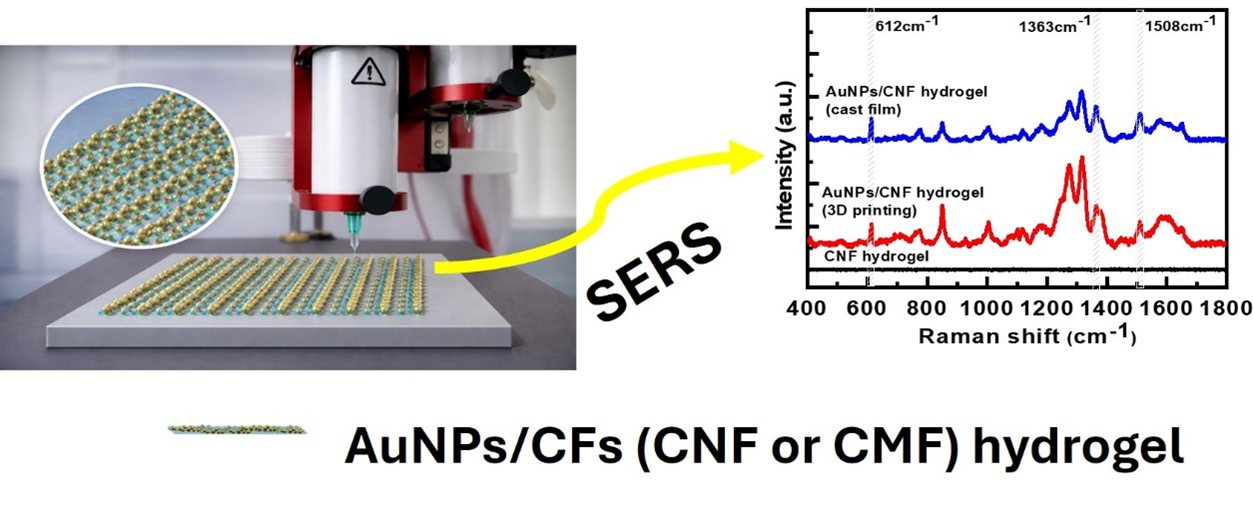
The development of flexible and 3D‐printable surface-enhanced Raman scattering (SERS) substrates requires hydrogel architectures that support uniform nanoparticle distribution, structural robustness, and controlled filament formation. In this study, cellulose nanofibers (CNFs) and cellulose microfibers (CMFs) were incorporated into a poly(vinyl alcohol)/sodium alginate (PVA/SA) hydrogel crosslinked through borax to elucidate how fiber geometry, interfacial chemistry, and flow behavior collectively govern printability and plasmonic performance. CNFs form an interconnected and dynamically recoverable network that enhances viscosity, elastic recovery, and structural cohesion, enabling stable extrusion during 3D printing. The shear field within the printing nozzle further induces partial alignment of CNFs, generating more continuous microdomains that influence subsequent distribution of in situ grown gold nanoparticles (AuNPs). Spectroscopic and rheological analyses show that AuNP incorporation modulates local hydrogen bonding while preserving the dynamic borate crosslinking essential for filament fidelity. The 3D-printed CNF hydrogels exhibit clear and distinguishable SERS responses, with detectable rhodamine 6G (R6G) signals down to 10−6 M. This work provides a mechanistic understanding of how fiber morphology, flow-induced alignment, and nanoparticle-matrix interactions jointly define SERS behavior in printable hydrogels, offering a scalable design framework for next‐generation soft-material sensing platforms.
- Zong C, Xu M, Xu LJ, et al. Surface-Enhanced Raman Spectroscopy for Bioanalysis: Reliability and Challenges. Chem Rev. 2018;118(10):4946-4980. doi: 10.1021/acs.chemrev.7b00668
- Sinha SS, Jones S, Pramanik A, Ray PC. Nanoarchitecture Based SERS for Biomolecular Fingerprinting and Label-Free Disease Markers Diagnosis. Acc Chem Res. 2016;49(12):2725- 2735. doi: 10.1021/acs.accounts.6b00384
- Wu C, Li F, Lv F, Yao P, Bi M, Xue T. Fabrication of hydrogels with nanoparticles as surface-enhanced Raman scattered (SERS) substrates and their application in Raman imaging. Mater Res Express. 2021;8(1):015008. doi: 10.1088/2053-1591/abd5d0
- Dallari C, Lenci E, Trabocchi A, et al. Multilayered bioorthogonal SERS nanoprobes selectively aggregating in human fluids: a smart optical assay for β-amyloid peptide quantification. ACS Sens. 2023;8(10):3693-3700. doi: 10.1021/acssensors.3c00225
- Kant K, Beeram R, Cao Y, et al. Plasmonic nanoparticle sensors: current progress, challenges, and future prospects. Nanoscale Horiz. 2024;9:2085-2166. doi: 10.1039/D4NH00226A
- Wu J, Zhou X, Li P, et al. Ultrasensitive and simultaneous SERS detection of multiplex microRNA using fractal gold nanotags for early diagnosis and prognosis of hepatocellular carcinoma. Anal Chem. 2021;93(25):8799-8809. doi: 10.1021/acs.analchem.1c00478
- Joseph MM, Narayanan N, Nair JB, et al. Exploring the margins of SERS in practical domain: an emerging diagnostic modality for modern biomedical applications. Biomaterials. 2018;181:140-181. doi: 10.1016/j.biomaterials.2018.07.045
- Xu J, Du J, Jing C, Zhang Y, Cui J. Facile Detection of Polycyclic Aromatic Hydrocarbons by a Surface-Enhanced Raman Scattering Sensor Based on the Au Coffee Ring Effect. ACS Appl Mater Interfaces. 2014;6(9):6891-6897. doi: 10.1021/am500705a
- Liu Z, Su R, Xiao X, Li G. Boronic acid ester-based hydrogel as surface-enhanced Raman scattering substrates for separation, enrichment, hydrolysis and detection of hydrogen peroxide residue in dairy product all-in-one. Talanta. 2025;281:126900. doi: 10.1016/j.talanta.2024.126900
- Wang H, Xu P, Chen Y, et al. “Partner” cellulose gel with “dialysis” function: Achieve the integration of filtration-enrichment-SERS detection. Biosens Bioelectron. 2025;267:116775. doi: 10.1016/j.bios.2024.116775
- Zhang J, Wang Y, Wei Q, et al. A 3D printable, highly stretchable, self-healing hydrogel-based sensor based on polyvinyl alcohol/sodium tetraborate/sodium alginate for human motion monitoring. Int J Biol Macromol. 2022;219:1216-1226. doi: 10.1016/j.ijbiomac.2022.08.175
- Zhang H, Fu C, Yong LC, Sun N, Liu FG. Flexible and Transparent PVA/CNF Hydrogel with Ultrahigh Dielectric Constant. ACS Appl Polym Mater. 2024;6(10):5706-5713. doi: 10.1021/acsapm.4c00302
- Chen M, Zhang J, Zhu X, et al. Hybridizing Silver Nanoparticles in Hydrogel for High-Performance Flexible SERS Chips. ACS Appl Mater Interfaces. 2022;14(22):26216- 26224. doi: 10.1021/acsami.2c04087
- Zhang B, Yang J, Jiang Q, et al. AuNPs/C-CNF/PVA hydrogel SERS sensor for comprehensive detection of antitumor drug separation and enrichment. Chem Eng J. 2025;516:164282. doi: 10.1016/j.cej.2025.164282
- Ling H, Zhao Z, Zhang Z, Chen S, Maimaiti Z. PVA/AgNP hydrogel SERS substrate combined with machine learning for highly sensitive detection of organic selenium species. Anal Methods. 2026. doi: 10.1039/D5AY02045J
- Ma T, Lv L, Ouyang C, et al. Rheological behavior and particle alignment of cellulose nanocrystal and its composite hydrogels during 3D printing. Carbohydrate Polymers. 2021;253:117217. doi: 10.1016/j.carbpol.2020.117217
- Troncoso-Afonso L, Henríquez-Banegas YM, Vinnacombe- Willson GA, et al. Using thiol–ene click chemistry to engineer 3D printed plasmonic hydrogel scaffolds for SERS biosensing. Biomater Sci. 2025;13(11):2936-2950. doi: 10.1039/D4BM01529K
- Wang W, Vikesland PJ. SERS-Active Printable Hydrogel for 3D Cell Culture and Imaging. Anal Chem. 2023;95(49):18055- 18064. doi: 10.1021/acs.analchem.3c02641
- Ventisette I, Mattii F, Dallari C, et al. Gold-Hydrogel Nanocomposites for High-Resolution Laser-Based 3D Printing of Scaffolds with SERS-Sensing Properties. ACS Appl Bio Mater. 2024;7(7):4497-4509. doi: 10.1021/acsabm.4c00379
- Heggset EB, Strand BL, Sundby KW, Simon S, Chinga- Carrasco G, Syverud K. Viscoelastic properties of nanocellulose based inks for 3D printing and mechanical properties of CNF/alginate biocomposite gels. Cellulose. 2018;26(1):581-595. doi: 10.1007/s10570-018-2142-3
- Li M, Wang Y, Wei Q, Zhang J, Chen X, An Y. A High- Stretching, Rapid-Self-Healing, and Printable Composite Hydrogel Based on Poly(Vinyl Alcohol), Nanocellulose, and Sodium Alginate. Gels. 2024;10(4):258. doi: 10.3390/gels10040258
- Li Y, Zhu H, Wang Y, et al. Cellulose‐Nanofiber‐Enabled 3D Printing of a Carbon‐Nanotube Microfiber Network. Small Methods. 2017;1(10):1700222. doi: 10.1002/smtd.201700222
- Almohammed S, Alruwaili M, Reynaud EG, Redmond G, Rice JH, Rodriguez BJ. 3D-Printed Peptide-Hydrogel Nanoparticle Composites for Surface-Enhanced Raman Spectroscopy Sensing. ACS Appl Nano Mater. 2019;2(8):5029-5034. doi: 10.1021/acsanm.9b00940
- He H, Chen R, Zhang L, Shen W. Growth of gold nanoparticles on cellulose nanofibers. Cellulose. 2020;27(9):5041-5053. doi: 10.1007/s10570-020-03142-5
- Yang Y, Li D, Yan N, Guo F. A new 3D printing strategy by enhancing shear-induced alignment of gelled nanomaterial inks resulting in stronger and ductile cellulose films. Carbohydr Polym. 2024;340:122269. doi: 10.1016/j.carbpol.2024.122269
- Lal SS, Mhaske ST. AgBr and AgCl nanoparticle doped TEMPO-oxidized microfiber cellulose as a starting material for antimicrobial filter. Carbohydr Polym. 2018;191:266-279. doi: 10.1016/j.carbpol.2018.03.011
- Lu B, Lin F, Jiang X, et al. One-Pot Assembly of Microfibrillated Cellulose Reinforced PVA–Borax Hydrogels with Self- Healing and pH-Responsive Properties. ACS Sustain Chem Eng. 2016;5(1):948-956. doi: 10.1021/acssuschemeng.6b02279
- Xu K, Wang Y, Zhang B, Zhang C, Liu T. Stretchable and self-healing polyvinyl alcohol/cellulose nanofiber nanocomposite hydrogels for strain sensors with high sensitivity and linearity. Compos Commun. 2021;24:100677. doi: 10.1016/j.coco.2021.100677