
Sustainable removal of Pb(II), Zn(II), and Ni(II) from aqueous solutions using date-pit-derived biochar: Performance evaluation under batch conditions

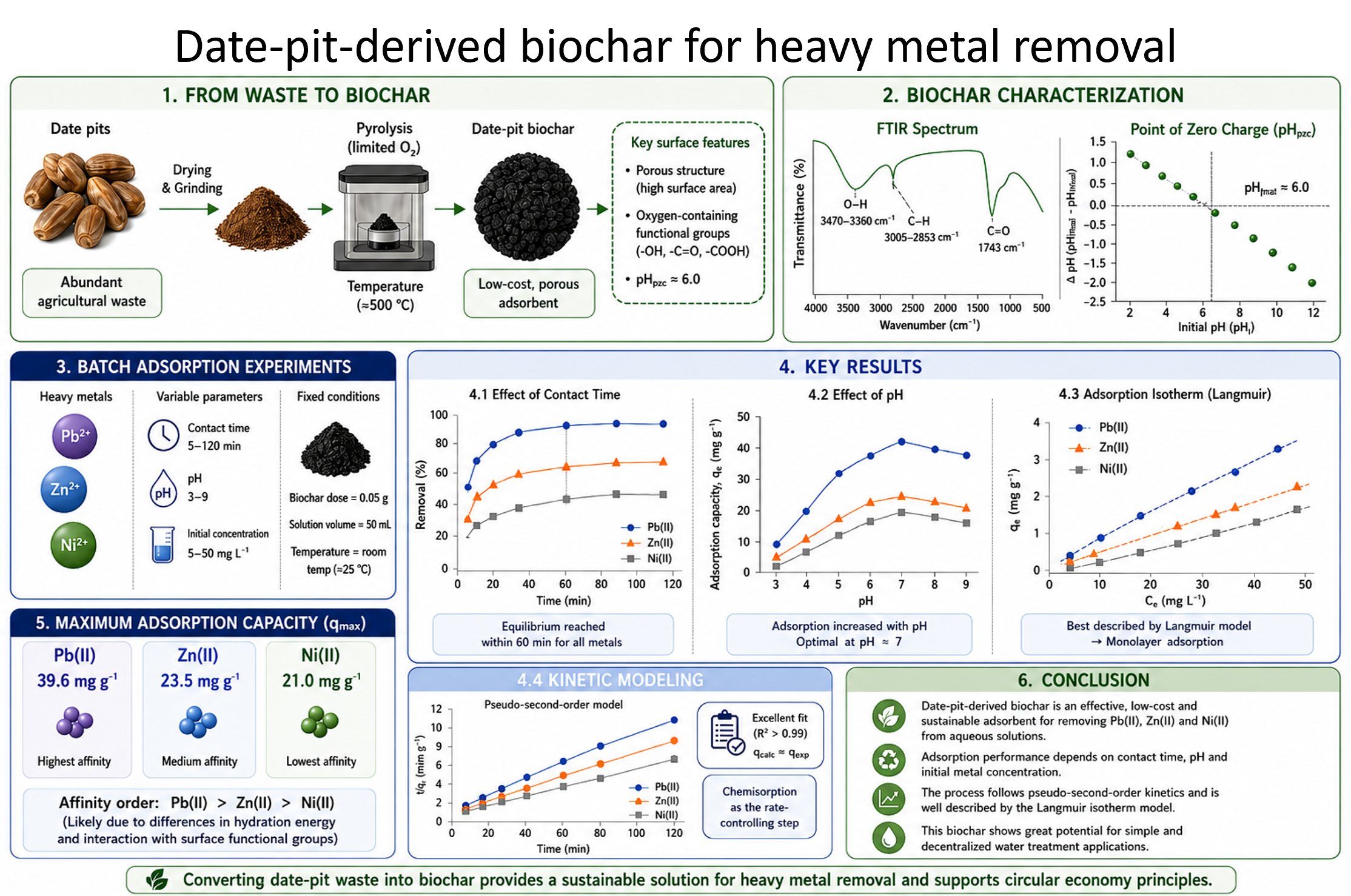
Heavy metal contamination in water remains a persistent environmental concern, particularly in regions where access to advanced treatment technologies is limited. In this study, biochar produced from date pits, an agricultural waste material, was investigated as a low-cost adsorbent for the removal of Pb(II), Zn(II), and Ni(II) from aqueous solutions. Batch experiments were conducted to evaluate the effects of contact time (5–120 min), solution pH (3–9), and initial metal concentration (5–50 mg L–1). The results showed that adsorption equilibrium was reached within 60 min for all metals. The maximum adsorption capacities were 39.6 mg g–1 for Pb(II), 23.5 mg g–1 for Zn(II), and 21.0 mg g–1 for Ni(II) at pH 7. Adsorption increased with increasing pH, and the affinity followed the order Pb(II) > Zn(II) > Ni(II), likely due to differences in hydration energy and interaction with surface functional groups. Kinetic analysis indicated that the adsorption process followed a pseudo-second-order model, while the equilibrium data were best described by the Langmuir isotherm model, suggesting monolayer adsorption behavior. Overall, the findings indicate that date-pit-derived biochar can serve as an effective and accessible material for removing divalent heavy metals from water, with potential application in simple and decentralized treatment systems.
- Daripa A, Malav LC, Yadav DK, Chattaraj S. Metal contamination in water resources due to various anthropogenic activities. In: Metals in Water: Global Sources, Significance, and Treatment. Elserier; 2023:111 - 127. doi: 10.1016/B978-0-323-95919-3.00022-7
- Singh BJ, Chakraborty A, Sehgal R. A systematic review of industrial wastewater management: Evaluating challenges and enablers. J Environ Manage. 2023;348. doi: 10.1016/j.jenvman.2023.119230
- Hashim ESH, Al-Yassein RN. Effect of sublethal concentrations of cadmium on the histo-pathological changes of muscles of planiliza abu juveniles (Heckel, 1843). Basrah J Agric Sci. 2020;33(2):207-217. doi: 10.37077/25200860.2020.33.2.18
- Khudair MY, Alyassein RN, Jasim FM. Improving the Quality of Ground Water in Some Areas of Al-Anbar Governorate by Recharging with Rainwater. In: IOP Conference Series: Earth and Environmental Science. Bristol, UK: IOP Publishing Ltd; 2021;761(1):012009. doi: 10.1088/1755-1315/761/1/012009
- Al-yassein RN, Younis KH, Al-Najare GA, Farnar KW, Obaid ZJ, Shakir ZK. Bioaccumulation of Some Heavy Metals in the Tissues of Needlefish Tylosurus crocodilus (Péron and Lesueur, 1821) from Iraqi Marine Waters. Sarhad J Agric. 2026;42(1). doi: 10.17582/journal.sja/2026/42.1.24.34
- Lazăr NN, Simionov IA, Petrea Ștefan M, et al. The influence of climate changes on heavy metals accumulation in Alosa immaculata from the Danube River Basin. Mar Pollut Bull. 2024;200:116145. doi: 10.1016/j.marpolbul.2024.116145
- Zlati ML, Georgescu LP, Iticescu C, Ionescu RV, Antohi VM. New Approach to Modelling the Impact of Heavy Metals on the European Union’s Water Resources. Int J Environ Res Public Health. 2022;20(1):45. doi: 10.3390/ijerph20010045
- Shakoor MB, Ali S, Rizwan M, et al. A review of biochar-based sorbents for separation of heavy metals from water. Int J Phytoremediation. 2020;22(2):111-126. doi: 10.1080/15226514.2019.1647405
- Khudair MY, Ethaib S, Jasim FM, Kamel AH. Developing Sustainable Wastewater Treatment Systems Using Biofiltration Process. Int J Environ Impacts. 2024;7(4):781-790. doi: 10.18280/ijei.070418
- Amalina F, Razak ASA, Krishnan S, Sulaiman H, Zularisam AW, Nasrullah M. Biochar production techniques utilizing biomass waste-derived materials and environmental applications – A review. J Hazard Mater Adv. 2022;7:100134. doi: 10.1016/j.hazadv.2022.100134
- Ali Alshehri M, Pugazhendhi A. Biochar for wastewater treatment: Addressing contaminants and enhancing sustainability: Challenges and solutions. J Hazard Mater Adv. 2024;16:100504. doi: 10.1016/j.hazadv.2024.100504
- Ippolito JA, Cui L, Kammann C, et al. Feedstock choice, pyrolysis temperature and type influence biochar characteristics: a comprehensive meta-data analysis review. Biochar. 2020;2(4):421-438. doi: 10.1007/s42773-020-00067-x
- Shaheen J, Fseha YH, Sizirici B. Performance, life cycle assessment, and economic comparison between date palm waste biochar and activated carbon derived from woody biomass. Heliyon. 2022;8(12):e12388. doi: 10.1016/j.heliyon.2022.e12388
- Al-Wasity RT, Ahmed AF, Albadawi SA. An economic analysis of the competitiveness of dates and their role in international agricultural marketing in Iraq for the period 2005-2019. Iraqi J Agric Sci. 2023;54(1):205-215. doi: 10.36103/ijas.v54i1.1691
- Hayder G, Naim RM. Biochar-based nanocomposites from waste biomass: a sustainable approach for wastewater treatment and renewable bioenergy. Front Agric Sci Eng. 2025;12(1):117-147. doi: 10.15302/J-FASE-2024592
- Ahmad M, Rajapaksha AU, Lim JE, et al. Biochar as a sorbent for contaminant management in soil and water: A review. Chemosphere. 2014;99:19-33. doi: 10.1016/j.chemosphere.2013.10.071
- Azam M, Wabaidur SM, Khan MR, Al-Resayes SI, Islam MS. Heavy Metal Ions Removal from Aqueous Solutions by Treated Ajwa Date Pits: Kinetic, Isotherm, and Thermodynamic Approach. Polymers. 2022;14(5):914. doi: 10.3390/polym14050914
- Dichiara AB, Weinstein SJ, Rogers RE. On the Choice of Batch or Fixed Bed Adsorption Processes for Wastewater Treatment. Ind Eng Chem Res. 2015;54(34):8579-8586. doi: 10.1021/acs.iecr.5b02350
- Majeed OS, Ibraheem AK. Using Heavy Metals Pollution Indices for Assessment of Tigris River Water within Al-Tarmiya City, Northern Baghdad, Iraq. Ecol Eng Environ Technol. 2024;25(3):113-123. doi: 10.12912/27197050/178457
- Ouyang R, Zhu Z, Tatum CE, Chambers JQ, Xue ZL. Simultaneous stripping detection of Zn(II), Cd(II) and Pb(II) using a bimetallic Hg-Bi/single-walled carbon nanotubes composite electrode. J Electroanal Chem. 2011;656(1-2):78-84. doi: 10.1016/j.jelechem.2011.01.006
- Wang Q, Wang B, Lee X, Lehmann J, Gao B. Sorption and desorption of Pb(II) to biochar as affected by oxidation and pH. Sci Total Environ. 2018;634:188-194. doi: 10.1016/j.scitotenv.2018.03.189
- Zhao M, Dai Y, Zhang M, et al. Mechanisms of Pb and/or Zn adsorption by different biochars: Biochar characteristics, stability, and binding energies. Sci Total Environ. 2020;717:136894. doi: 10.1016/j.scitotenv.2020.136894
- Al-Ghouti MA, Li J, Salamh Y, Al-Laqtah N, Walker G, Ahmad MNM. Adsorption mechanisms of removing heavy metals and dyes from aqueous solution using date pits solid adsorbent. J Hazard Mater. 2010;176(1-3):510-520. doi: 10.1016/j.jhazmat.2009.11.059
- Lackmann C, Brendt J, Seiler TB, et al. The Green toxicology approach: Insight towards the eco-toxicologically safe development of benign catalysts. J Hazard Mater. 2021;416:125889. doi: 10.1016/j.jhazmat.2021.125889
- Zamora R, McEvoy J, Colbert C, Chacana Olivares J, Kaewlom P, Khan E. Blocking bacterial appendage attachment to wastewater treatment membranes using anti-adhesins. Chemosphere. 2023;323:138246. doi: 10.1016/j.chemosphere.2023.138246
- Nouri M. Potentials and challenges of date pits as alternative environmental clean-up ingredients. Biomass Convers Biorefin. 2023;13(2):1429-1456. doi: 10.1007/s13399-020-01215-w
- Charoenkal K, Yang Z, Wang Z, et al. Engineered Zn-enriched biochars for controlled nutrient delivery: Elucidating interfacial mechanisms and mitigating environmental risk. J Environ Chem Eng. 2025;13(6):119606. doi: 10.1016/j.jece.2025.119606
- Frau F, Atzori R, Ardau C, et al. A two-step pH control method to remove divalent metals from near-neutral mining and metallurgical waste drainages by inducing the formation of layered double hydroxide. J Environ Manage. 2020;271:111043. doi: 10.1016/j.jenvman.2020.111043
- Song X, Zhang Y, Yan C, Jiang W, Chang C. The Langmuir monolayer adsorption model of organic matter into effective pores in activated carbon. J Colloid Interface Sci. 2013;389(1):213-219. doi: 10.1016/j.jcis.2012.08.060
- Aita SA, Mahmoud R, Hafez SHM, Zaher A. Investigating adsorption of aqueous heavy metals through isotherms and kinetics with Zn-Co-Fe/LDH for remarkable removal efficiency. Appl Water Sci. 2025;15(4). doi: 10.1007/s13201-025-02390-9
- Buonomenna MG, Mousavi SM, Hashemi SA, Lai CW. Water Cleaning Adsorptive Membranes for Efficient Removal of Heavy Metals and Metalloids. Water. 2022;14(17):2718. doi: 10.3390/w14172718
- Ho YS, McKay G. Pseudo-second order model for sorption processes. Process Biochem. 1999;34(5):451-465. doi: 10.1016/S0032-9592(98)00112-5
- Tran HN, You SJ, Hosseini-Bandegharaei A, Chao HP. Mistakes and inconsistencies regarding adsorption of contaminants from aqueous solutions: A critical review. Water Res. 2017;120:88-116. doi: 10.1016/j.watres.2017.04.014
- Foo KY, Hameed BH. Insights into the modeling of adsorption isotherm systems. Chem Eng J. 2010;156(1):2-10. doi: 10.1016/j.cej.2009.09.013
- Tan X, Liu Y, Zeng G, et al. Application of biochar for the removal of pollutants from aqueous solutions. Chemosphere. 2015;125:70-85. doi: 10.1016/j.chemosphere.2014.12.058