

Methanol as an ecological regulator enhancing anaerobic degradation of nitrogenous heterocyclic compounds: Insights into community structure and metabolic function

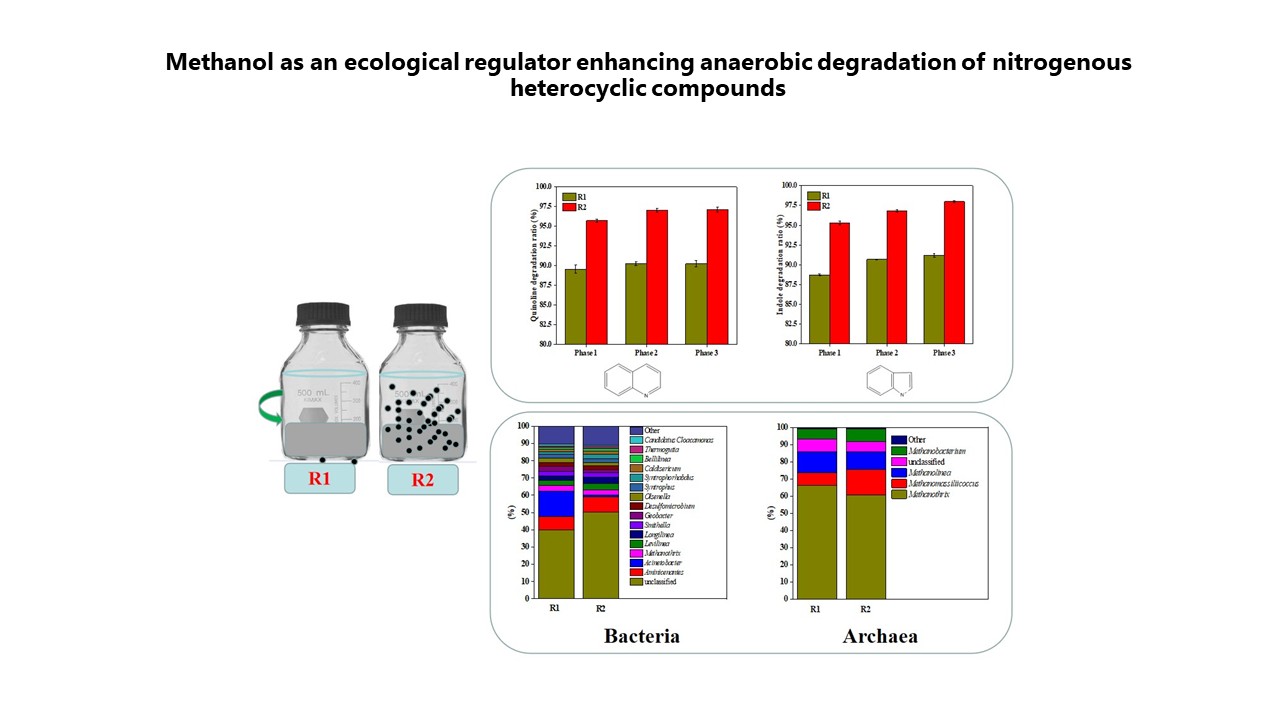
Coal gasification wastewater contains a large amount of refractory nitrogenous heterocyclic compounds (NHCs), which are toxic and difficult to biodegrade. These substances are poorly removed by traditional biological treatment processes, such as anaerobic treatment. Therefore, the anaerobic degradation of NHCs, such as quinoline and indole, presents a significant challenge. This study investigated the efficacy and mechanism of methanol as a co-metabolic substrate for enhancing this process. Two anaerobic reactors—R1 as a control and R2 containing methanol—were operated to treat synthetic wastewater containing quinoline and indole. The results demonstrated that methanol supplementation significantly improved the degradation efficiency of both compounds. Mechanistic studies revealed that methanol fundamentally modified the system’s ecology—it altered the physicochemical properties of anaerobic granular sludge by increasing the protein-to-polysaccharide ratio in extracellular polymeric substances, thereby enhancing microbial cohesion. Furthermore, methanol induced a targeted microbial community succession, notably enriching key specialist degraders such as Levilinea and Longilinea while suppressing generalist competitors. Functional gene prediction analysis indicated a comprehensive activation of metabolic pathways, energy production, and cellular processes. For the archaeal community, methanol increased diversity and facilitated a shift toward a multi-pathway methanogenic pattern, enriching methylotrophic methanogens (Methanomassiliicoccus) alongside acetoclastic pathways. This study highlights that methanol acts as a comprehensive ecological modulator, enhancing NHCs degradation by optimizing the sludge matrix, restructuring the microbial community for efficient metabolic division of labor, and activating overall metabolic potential, thereby providing a robust strategy for the treatment of industrial wastewater containing refractory organics.
- Shi J, Han Y, Xu C, Han H. Biological coupling process for treatment of toxic and refractory compounds in coal gasification wastewater. Rev Environ Sci Biotechnol. 2018;17(4):765-790. doi: 10.1007/s11157-018-9481-2
- Zhu X, Ni J, Lai P. Advanced treatment of biologically pretreated coking wastewater by electrochemical oxidation using boron-doped diamond electrodes. Water Res. 2009;43(17):4347-4355. doi: 10.1016/j.watres.2009.06.030
- Zhang Z, Han Y, Xu C, et al. Microbial nitrate removal in biologically enhanced treated coal gasification wastewater of low COD to nitrate ratio by coupling biological denitrification with iron and carbon micro-electrolysis. Bioresour Technol. 2018;262:65-73. doi: 10.1016/j.biortech.2018.04.059
- Shi J, Xu C, Han Y, Han H. Enhanced anaerobic biodegradation efficiency and mechanism of quinoline, pyridine, and indole in coal gasification wastewater. Chem Eng J. 2019;361:1019-1029. doi: 10.1016/j.cej.2018.12.162
- Shi J, Xu C, Han Y, Han H. Anaerobic bioaugmentation hydrolysis of selected nitrogen heterocyclic compound in coal gasification wastewater. Bioresour Technol. 2019;278:223-230. doi: 10.1016/j.biortech.2018.12.113
- Yang Y, Huang F, Kang S. Mechanism of Penetration Rate Improvement in Hot Dry Rock Under the Coupling of Impact Load and Confining Pressure Release. Reserv Sci. 2026;2(1):52-64. doi: 10.62762/RS.2025.804345
- Wu J, Ansari U. From CO2 Sequestration to Hydrogen Storage: Further Utilization of Depleted Gas Reservoirs. Reserv Sci. 2025;1(1):19-35. doi: 10.62762/RS.2025.860510
- Hu Y, Yang Y. A Comparative Study on Drag Reduction Methods for Continental Shale Drilling in the Fuxing Block, Southeastern Sichuan Basin. Reserv Sci. 2026;2(2):81-96. doi: 10.62762/RS.2025.790790
- Fan C, Wang SC. Co-metabolic enhancement of organic removal from waste water in the presence of high levels of alkyl paraben constituents of cosmetic and personal care products. Chemosphere. 2017;179:306-315. doi: 10.1016/j.chemosphere.2017.03.120
- Xiao M, Yin X, Gai H, et al. Effect of hydroxypropyl- β-cyclodextrin on the cometabolism of phenol and phenanthrene by a novel Chryseobacterium sp. Bioresour Technol. 2019;273:56-62. doi: 10.1016/j.biortech.2018.10.087
- Kumabe K, Fujimoto S, Yanagida T, Ogata M, Fukuda T. Environmental and economic analysis of methanol production process via biomass gasification. Fuel. 2008;87(7):1422-1427. doi: 10.1016/j.fuel.2007.06.008
- Perez M, Rodriguez-Cano R, Romero L, Sales D. Anaerobic thermophilic digestion of cutting oil wastewater: Effect of co-substrate. Biochem Eng J. 2006;29(3):250-257. doi: 10.1016/j.bej.2006.01.011
- APHA. Standard Methods for the Examination of Water and Wastewater. 20th ed. Washington, DC, USA: American Public Health Association; 1998.
- Zhu H, Han Y, Ma W, Han H, Ma W. Removal of selected nitrogenous heterocyclic compounds in biologically pretreated coal gasification wastewater (BPCGW) using the catalytic ozonation process combined with the two-stage membrane bioreactor (MBR). Bioresour Technol. 2017;245:786-793. doi: 10.1016/j.biortech.2017.09.029
- Zhen GY, Lu XQ, Li YY, Zhao YC. Innovative combination of electrolysis and Fe(II)-activated persulfate oxidation for improving the dewaterability of waste activated sludge. Bioresour Technol. 2013;136:654-663. doi: 10.1016/j.biortech.2013.03.007
- Lowry OH, Rosebrough NJ, Farr AL, Randall RJ. Protein measurement with the Folin phenol reagent. J Biol Chem. 1951;193(1):265-275. doi: 10.1016/S0021-9258(19)52451-6
- Boyd TJ, Montgomery MT, Steele JK, et al. Dissolved oxygen saturation controls PAH biodegradation in freshwater estuary sediments. Microb Ecol. 2005;49(2):226-235. doi: 10.1007/s00248-004-0279-0
- Rothermich MM, Hayes LA, Lovley DR. Anaerobic, sulfate-dependent degradation of polycyclic aromatic hydrocarbons in petroleum-contaminated harbor sediment. Environ Sci Technol. 2002;36(22):4811-4817. doi: 10.1021/es0200241
- Torres LG, Rojas N, Bautista G, Iturbe R. Effect of temperature, and surfactant’s HLB and dose over the TPH-diesel biodegradation process in aged soils. Process Biochem. 2005;40(10):3296-3302. doi: 10.1016/j.procbio.2005.03.032
- Teng Y, Luo Y, Ping L, Zou D, Li Z, Christie P. Effects of soil amendment with different carbon sources and other factors on the bioremediation of an aged PAH-contaminated soil. Biodegradation. 2010;21(2):167-178. doi: 10.1007/s10532-009-9291-x
- Bacosa HP, Inoue C. Polycyclic aromatic hydrocarbons (PAHs) biodegradation potential and diversity of microbial consortia enriched from tsunami sediments in Miyagi, Japan. J Hazard Mater. 2015;283:689-697. doi: 10.1016/j.jhazmat.2014.09.068
- Xu P, Ma W, Han H, Hou B, Jia S. Biodegradation and interaction of quinoline and glucose in dual substrates system. Bull Environ Contam Toxicol. 2015;94(3):365-369. doi: 10.1007/s00128-014-1388-1
- Li WW, Yu HQ. Insight into the roles of microbial extracellular polymer substances in metal biosorption. Bioresour Technol. 2014;160:15-23. doi: 10.1016/j.biortech.2013.11.074
- Sheng GP, Yu HQ, Li XY. Extracellular polymeric substances (EPS) of microbial aggregates in biological wastewater treatment systems: A review. Biotechnol Adv. 2010;28(6):882- 894. doi: 10.1016/j.biotechadv.2010.08.001
- Ying W, Yang F, Bick A, Oron G, Herzberg M. Extracellular polymeric substances (EPS) in a hybrid growth membrane bioreactor (HG-MBR): Viscoelastic and adherence characteristics. Environ Sci Technol. 2010;44(22):8636-8643. doi: 10.1021/es102309y
- Tay JH, Liu QS, Liu Y. The role of cellular polysaccharides in the formation and stability of aerobic granules. Lett Appl Microbiol. 2001;33(3):222-226. doi: 10.1046/j.1472-765x.2001.00986.x
- Zhu L, Qi H, Lv M, Kong Y, Yu Y, Xu X. Component analysis of extracellular polymeric substances (EPS) during aerobic sludge granulation using FTIR and 3D-EEM technologies. Bioresour Technol. 2012;124:455-459. doi: 10.1016/j.biortech.2012.08.059
- Wang ZW, Liu Y, Tay JH. The role of SBR mixed liquor volume exchange ratio in aerobic granulation. Chemosphere. 2006;62(5):767-771. doi: 10.1016/j.chemosphere.2005.04.081
- Oba Y, Futagami T, Amachi S. Enrichment of a microbial consortium capable of reductive deiodination of 2,4,6-triiodophenol. J Biosci Bioeng. 2014;117(3):310-317. doi: 10.1016/j.jbiosc.2013.08.011
- Wang W, Wu B, Pan S, Yang K, Hu Z, Yuan S. Performance robustness of the UASB reactors treating saline phenolic wastewater and analysis of microbial community structure. J Hazard Mater. 2017;331:21-27. doi: 10.1016/j.jhazmat.2017.02.025
- Jetten M. Methanogenesis from acetate: a comparison of the acetate metabolism in Methanothrix soehngenii and Methanosarcina spp. FEMS Microbiol Lett. 1992;88(3- 4):181-198. doi: 10.1111/j.1574-6968.1992.tb04987.x
- Yin C, Shen Y, Yu Y, Yuan H, Lou Z, Zhu N. In-situ biogas upgrading by a stepwise addition of ash additives: Methanogen Adaption and CO2 sequestration. Bioresour Technol. 2019;282:1-8. doi: 10.1016/j.biortech.2019.02.110
- Imachi H, Sakai S, Sekiguchi Y, et al. Methanolinea tarda gen. nov., sp. nov., a methane-producing archaeon isolated from a methanogenic digester sludge. Int J Syst Evol Microbiol. 2008;58(1):294-301. doi: 10.1099/ijs.0.65394-0