
Transcriptomic and proteomic profiling of antibiotic resistance gene expression in bacteria exposed to uranium stress

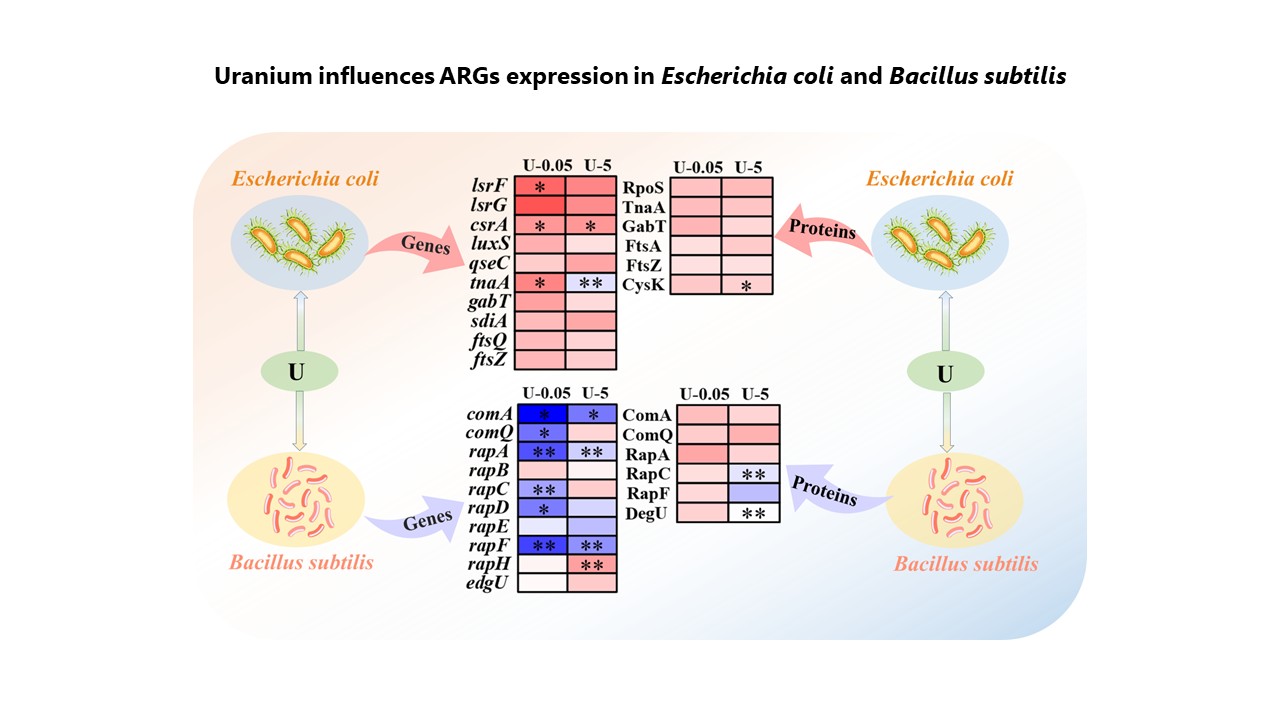
Uranium (U) exerts combined chemical and radiological toxicity to bacteria, yet its regulatory impact on the expression of antibiotic resistance genes (ARGs) remains poorly understood. In this study, we profiled the transcriptomic and proteomic responses of Gram-negative Escherichia coli and Gram-positive Bacillus subtilis under exposure to U at environmentally relevant concentrations. At 0.05 and 5 mg/L U, E. coli exhibited 6 (4 up, 2 down) and 80 (29 up, 51 down) differentially expressed genes (DEGs), respectively, while B. subtilis showed 566 (193 up, 373 down) and 432 (125 up, 307 down) DEGs. Each bacterium adopted distinct strategies for modulating the expression of ARGs, including those encoding efflux pumps. E. coli coordinately upregulated toxin–antitoxin modules, quorum‑sensing machinery, and two‑component systems, shifting to a tolerance state. Conversely, B. subtilis repressed these systems transcriptionally while reinforcing cell wall‑associated two‑component pathways at the protein level, thereby maintaining active growth and repair. Together, our findings reveal the molecular mechanisms through which radioactive heavy metals may promote the evolution of antibiotic resistance, providing a framework for assessing resistance risks in U‑contaminated environments.
- Zhang Z, Zhang Q, Wang T, et al. Assessment of global health risk of antibiotic resistance genes. Nat Commun. 2022;13(1):1553. doi: 10.1038/s41467-022-29283-8
- Khan S, Ahmad K, Farooq M, et al. Investigating the teratogenic potential of diclofenac sodium on chick embryos: A warning for pregnant women. Toxicol Rep. 2024;12:292-298. doi: 10.1016/j.toxrep.2024.02.010
- Sinegani AAS, Younessi N. Antibiotic resistance of bacteria isolated from heavy metal-polluted soils with different land uses. J Glob Antimicrob Resist. 2017;10:247-255. doi: 10.1016/j.jgar.2017.05.012
- Yu S, Wang Y, Shen F, et al. Copper-based fungicide copper hydroxide accelerates the evolution of antibiotic resistance via gene mutations in Escherichia coli. Sci Total Environ. 2022;815:152885. doi: 10.1016/j.scitotenv.2021.152885
- Islam TN, Meem FS, Yasmin R, et al. Co-exposure of chromium or cadmium and a low concentration of amoxicillin are responsible to emerge amoxicillin resistant Staphylococcus aureus. J Glob Antimicrob Resist. 2023;35:279-288. doi: 10.1016/j.jgar.2023.10.011
- Zeng X, Cao Y, Wang L, et al. Viability and transcriptional responses of multidrug resistant E. coli to chromium stress. Environ Pollut. 2023;324:121346. doi: 10.1016/j.envpol.2023.121346
- El Meouche I, Dunlop MJ. Heterogeneity in efflux pump expression predisposes antibiotic-resistant cells to mutation. Science. 2018;362(6415):686-690. doi: 10.1126/science.aar7981
- Blanco P, Hernando-Amado S, Reales-Calderon JA, et al. Bacterial multidrug efflux pumps: much more than antibiotic resistance determinants. Microorganisms. 2016;4(1):14. doi: 10.3390/microorganisms4010014
- Ahmad K, Shah HUR, Qureshi K, et al. Arsenic contaminants of groundwater and its mitigation. In: Soil, Water Pollution and Mitigation Strategies: A Spatial Approach. Springer; 2024:389. doi: 10.1007/978-3-031-63296-9
- Zhou S, Xiong C, Su Y, et al. Antibiotic-resistant bacteria and antibiotic resistance genes in uranium mine: Distribution and influencing factors. Environ Pollut. 2022;304:119158. doi: 10.1016/j.envpol.2022.119158
- Zhou S, Huang Z, Song J, et al. Metagenomic analysis of the dichotomous role of uranium in regulating intracellular and extracellular antibiotic resistance genes in activated sludge. Environ Pollut. 2024;363:125258. doi: 10.1016/j.envpol.2024.125258
- Sun F, Xu Z, Fan L. Response of heavy metal and antibiotic resistance genes and related microorganisms to different heavy metals in activated sludge. J Environ Manage. 2021;300:113754. doi: 10.1016/j.jenvman.2021.113754
- Yuan W, She J, Liu J, et al. Insight into microbial functional genes’ role in geochemical distribution and cycling of uranium: The evidence from covering soils of uranium tailings dam. J Hazard Mater. 2024;461:132630. doi: 10.1016/j.jhazmat.2023.132630
- Xu N, Qiu D, Zhang Z, et al. A global atlas of marine antibiotic resistance genes and their expression. Water Res. 2023;244:120488. doi: 10.1016/j.watres.2023.120488
- Gao Y, Zhou S, Yang Z, et al. Unveiling the role of uranium in enhancing the transformation of antibiotic resistance genes. J Hazard Mater. 2024;479:135624. doi: 10.1016/j.jhazmat.2024.135624
- Zhou X, Kang F, Qu X, et al. Role of extracellular polymeric substances in microbial reduction of arsenate to arsenite by Escherichia coli and Bacillus subtilis. Environ Sci Technol. 2020;54(10):6185-6193. doi: 10.1021/acs.est.0c01186
- Samuel J, Paul ML, Ravishankar H, et al. The differential stress response of adapted chromite mine isolates Bacillus subtilis and Escherichia coli and its impact on bioremediation potential. Biodegradation. 2013;24(6):829-842. doi: 10.1007/s10532-013-9631-8
- Ma W, Gao B, Guo Y, et al. Occurrence and distribution of uranium in a hydrological cycle around a uranium mill tailings pond, Southern China. Int J Environ Res Public Health. 2020;17(3):773. doi: 10.3390/ijerph17030773
- Wagner SE, Burch JB, Bottai M, et al. Groundwater uranium and cancer incidence in South Carolina. Cancer Causes Control. 2011;22(1):41-50. doi: 10.1007/s10552-010-9669-4
- Pinel-Cabello M, Jroundi F, López-Fernández M, et al. Multisystem combined uranium resistance mechanisms and bioremediation potential of Stenotrophomonas bentonitica BII-R7: transcriptomics and microscopic study. J Hazard Mater. 2021;403:123858. doi: 10.1016/j.jhazmat.2020.123858
- Orellana R, Hixson KK, Murphy S, et al. Proteome of Geobacter sulfurreducens in the presence of U (VI). Microbiology. 2014;160(12):2607-2617. doi: 10.1099/mic.0.081398-0
- Kolhe N, Zinjarde S, Acharya C. Responses exhibited by various microbial groups relevant to uranium exposure. Biotechnol Adv. 2018;36(7):1828-1846. doi: 10.1016/j.biotechadv.2018.07.002
- Sulaiman JE, Long L, Qian PY, et al. Proteomics and transcriptomics uncover key processes for elasnin tolerance in methicillin-resistant Staphylococcus aureus. mSystems. 2022;7(1):e01393-21. doi: 10.1128/msystems.01393-21
- Wu H, Yu Y, Su Q, et al. Combined impact of antibiotics and Cr (VI) on antibiotic resistance, ARGs, and growth of Bacillus sp. SH-1: A functional analysis from gene to protease. Bioresour Technol. 2024;414:131579. doi: 10.1016/j.biortech.2024.131579
- Khemiri A, Carrière M, Bremond N, et al. Escherichia coli response to uranyl exposure at low pH and associated protein regulations. PLoS One. 2014;9(2):e89863. doi: 10.1371/journal.pone.0089863
- Hufton J, Harding J, Smith T, et al. The importance of the bacterial cell wall in uranium (VI) biosorption. Phys Chem Chem Phys. 2021;23(2):1566-1576. doi: 10.1039/D0CP04067C
- Gallois N, Alpha-Bazin B, Ortet P, et al. Proteogenomic insights into uranium tolerance of a Chernobyl’s Microbacterium bacterial isolate. J Proteomics. 2018;177:148- 157. doi: 10.1016/j.jprot.2017.11.021
- Yung MC, Ma J, Salemi MR, et al. Shotgun proteomic analysis unveils survival and detoxification strategies by Caulobacter crescentus during exposure to uranium, chromium, and cadmium. J Proteome Res. 2014;13(4):1833-1847. doi: 10.1021/pr400880s
- Lopez D, Vlamakis H, Kolter R. Generation of multiple cell types in Bacillus subtilis. FEMS Microbiol Rev. 2009;33(1):152-163. doi: 10.1111/j.1574-6976.2008.00148.x
- Jang J, Hur HG, Sadowsky MJ, et al. Environmental Escherichia coli: ecology and public health implications—a review. J Appl Microbiol. 2017;123(3):570-581. doi: 10.1111/jam.13468
- Liu C, Wen L, Cui Y, et al. Metal transport proteins and transcription factor networks in plant responses to cadmium stress. Plant Cell Rep. 2024;43(10):218. doi: 10.1007/s00299-024-03310-y
- Blair JM, Webber MA, Baylay AJ, et al. Molecular mechanisms of antibiotic resistance. Nat Rev Microbiol. 2015;13(1):42-51. doi: 10.1038/nrmicro3380
- Lewis K. Platforms for antibiotic discovery. Nat Rev Drug Discov. 2013;12(5):371-387.doi: 10.1038/nrd3975
- Jaswal R, Pathak A, Edwards III B, et al. Metagenomics-guided survey, isolation, and characterization of uranium resistant microbiota from the Savannah River Site, USA. Genes. 2019;10(5):325. doi: 10.3390/genes10050325
- Kumar S, Mukherjee MM, Varela MF. Modulation of bacterial multidrug resistance efflux pumps of the major facilitator superfamily. Int J Bacteriol. 2013;2013:1-5. doi: 10.1155/2013/204141
- Nolivos S, Cayron J, Dedieu A, et al. Role of AcrAB-TolC multidrug efflux pump in drug-resistance acquisition by plasmid transfer. Science. 2019;364(6442):778-782. doi: 10.1126/science.aav6390
- Brantl S, Müller P. Toxin–antitoxin systems in Bacillus subtilis. Toxins. 2019;11(5):262. doi: 10.3390/toxins11050262
- Zeng X, Hu L, Ai Q, et al. Helicobacter macacae MazF interplays with Escherichia coli homologs and enhances antibiotic tolerance. Helicobacter. 2023;28(5):e13014. doi: 10.1111/hel.13014
- Zhao X, Yu Z, Ding T. Quorum-sensing regulation of antimicrobial resistance in bacteria. Microorganisms. 2020;8(3):425. doi: 10.3390/microorganisms8030425
- Wang S, Zhao C, Xue B, et al. Nanoalumina triggers the antibiotic persistence of Escherichia coli through quorum sensing regulators lrsF and qseB. J Hazard Mater. 2022;436:129198. doi: 10.1016/j.jhazmat.2022.129198
- Jia R, Wang Y, Wang H, et al. The role of quorum sensing effector ComA in regulating biofilm formation and surfactin production in Bacillus subtilis ASAG 010. Food Biosci. 2025;69:106842. doi: 10.1016/j.fbio.2025.106842
- Bhagirath AY, Li Y, Patidar R, et al. Two component regulatory systems and antibiotic resistance in Gram-negative pathogens. Int J Mol Sci. 2019;20(7):1781. doi: 10.3390/ijms20071781
- Srinivasan VB, Vaidyanathan V, Mondal A, et al. Role of the two component signal transduction system CpxAR in conferring cefepime and chloramphenicol resistance in Klebsiella pneumoniae NTUH-K2044. PLoS One. 2012;7(4):e33777. doi: 10.1371/journal.pone.0033777
- Liu MC, Tsai YL, Huang YW, et al. Stenotrophomonas maltophilia PhoP, a two-component response regulator, involved in antimicrobial susceptibilities. PLoS One. 2016;11(5):e0153753. doi: 10.1371/journal.pone.0153753
- Wang H, Zhang H, Zhang H, et al. Outer membrane channel protein TolC regulates Escherichia coli K12 sensitivity to plantaricin BM-1 via the CpxR/CpxA two-component regulatory system. Probiotics Antimicrob Proteins. 2021;13(1):238-248. doi: 10.1007/s12602-020-09671-6
- Jordan S, Rietkötter E, Strauch MA, et al. LiaRS-dependent gene expression is embedded in transition state regulation in Bacillus subtilis. Microbiology. 2007;153(8):2530-2540. doi: 10.1099/mic.0.2007/006817-0
- Yu C, Qiao J, Ali Q, et al. degQ associated with the degS/ degU two-component system regulates biofilm formation, antimicrobial metabolite production, and biocontrol activity in Bacillus velezensis DMW1. Mol Plant Pathol. 2023;24(12):1510-1521. doi: 10.1111/mpp.13389