
The impact of cross-border e-commerce on urban air quality: Evidence from China’s pilot zones

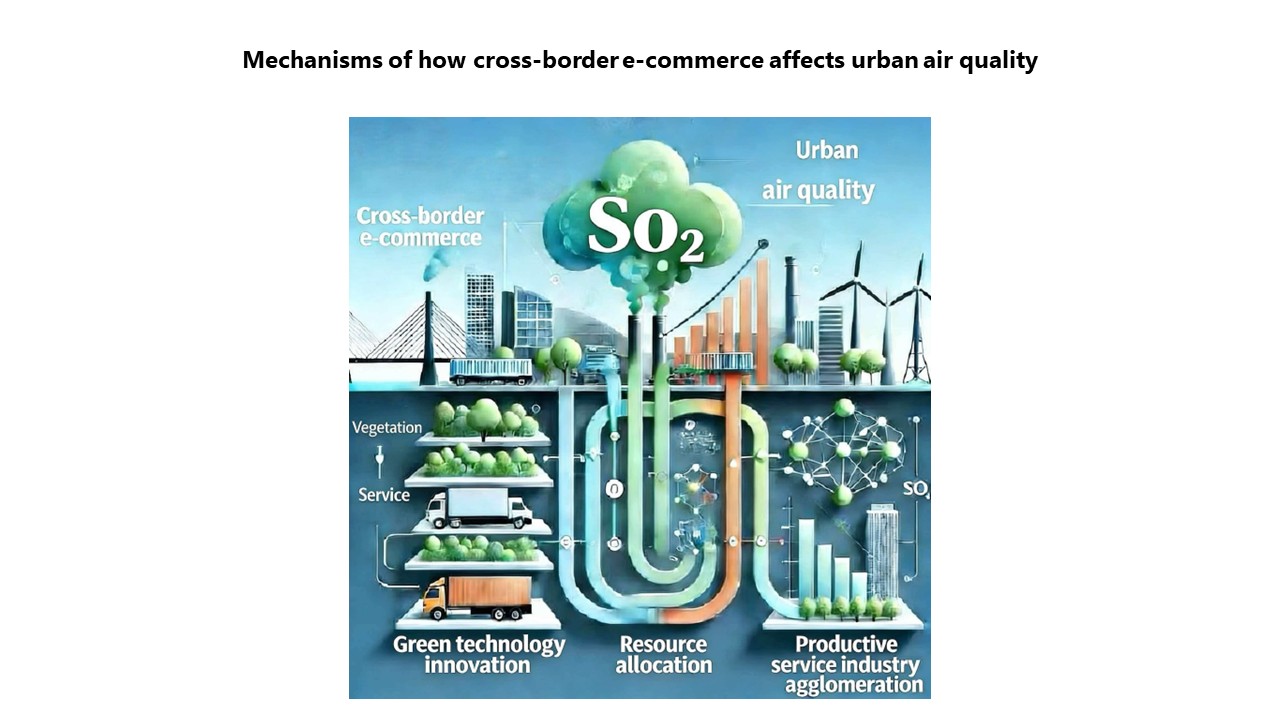
Amid rapid urbanization and industrialization, the pressing challenge of air pollution, cross-border e-commerce (CBEC) has emerged as a potential driver of environmental governance in China. Using CBEC pilot zones as a quasi-natural experiment, this study employs a multi-period difference-in-differences model on panel data from 284 Chinese cities (2009–2022) to assess the effect of CBEC on urban air quality, measured by sulfur dioxide (SO2) emissions. The findings revealed that CBEC significantly reduced SO2 emissions, thereby improving air quality. Heterogeneity analysis indicated that this positive effect was more substantial in eastern regions, cities with better digital infrastructure, and those with relatively weaker environmental regulations. Mechanism analysis further identified three key pathways: green technology innovation, productive service industry agglomeration, and resource allocation optimization. The study suggests that deepening CBEC reforms and expanding pilot zones can serve as effective policy tools for synergistically advancing economic growth and environmental sustainability.
- Tooze A. Crashed: How a Decade of Financial Crises Changed the World. New York, NY: Penguin; 2018. Available from: https://minerva.union.edu/motahare/Eco352/Tooze%20Crashed.pdf [Last accessed on 2025 May 20].
- Manioudis M, Meramveliotakis G. Broad strokes towards a grand theory in the analysis of sustainable development: a return to the classical political economy. New Polit Econ. 2022;27(5):866-878. doi: 10.1080/13563467.2022.2038114
- Meramveliotakis G, Manioudis M, eds. Sustainable Economic Development: Perspectives from Political Economy and Economics Pluralism. Oxford: Taylor & Francis; 2024. doi: 10.4324/9781003349402
- Zhang X, Han L, Wei H, et al. Linking urbanization and air quality together: A review and a perspective on the future sustainable urban development. J Clean Prod. 2022;346:130988. doi: 10.1016/j.jclepro.2022.130988
- Sicard P, Agathokleous E, Anenberg SC, De Marco A, Paoletti E, Calatayud V. Trends in urban air pollution over the last two decades: A global perspective. Sci Total Environ. 2023;858:160064. doi: 10.1016/j.scitotenv.2022.160064
- Liu A, Osewe M, Shi Y, Zhen X, Wu Y. Cross-border e-commerce development and challenges in China: A systematic literature review. J Theor Appl Electron Commer Res. 2021;17(1):69-88. doi: 10.3390/jtaer17010004
- He Y, Wang Z, Liu S, Du X. Construction and implementation of cross-border e-commerce supply chain system under the background of green and low-carbon. J Internet Digit Econ. 2024;4(1):1-11. doi: 10.1108/JIDE-01-2024-0002
- Zhang H, Xie Y, Yao G. Institutional opening up and consumer welfare enhancement: based on the evidence of cross- border e-commerce comprehensive pilot zones. Econ Res J. 2023;58(8):155-173. Available from: https://erj.ajcass.com/#/ issue?id=109004&year=2023&issue=8&title=%E6%9C%80%E6%96%B0%E7%9B%AE%E5%BD%95 [Last accessed on 2025 May 20].
- Grossman GM, Krueger AB. Economic growth and the environment. Q J Econ. 1995;110(2):353-377. doi: 10.2307/2118443
- Levinson A, Taylor MS. Unmasking the pollution haven effect. Int Econ Rev. 2008;49(1):223-254. doi: 10.1111/j.1468-2354.2008.00478.x
- Janow ME, Mavroidis PC. Digital trade, e-commerce, the WTO and regional frameworks. World Trade Rev. 2019;18(suppl 1):S1-S7. doi: 10.1017/S1474745618000526
- Ji H, Xiong B, Zhou F. Impact of digital trade on regional carbon emissions. Environ Sci Pollut Res. 2023;30(48):105474- 105488. doi: 10.1007/s11356-023-29858-y
- Li Y, Zheng Z, Zhao M, Liu Z. How does digital trade impact urban carbon emissions efficiency? Evidence from China’s cross-border e-commerce pilot zones. J Clean Prod. 2024;456:142363. doi: 10.1016/j.jclepro.2024.142363
- Wang Y, Wang Y, Lee SH. The effect of cross-border e-commerce on China’s international trade: An empirical study based on transaction cost analysis. Sustainability. 2017;9(11):2028. doi: 10.3390/su9112028
- Wang C, Liu T, Wang J, et al. Cross-border e-commerce trade and industrial clusters: evidence from China. Sustainability. 2022;14(6):3576. doi: 10.3390/su14063576
- Yang L, Liu J, Yang W. Impacts of the sustainable development of cross-border e-commerce pilot zones on regional economic growth. Sustainability. 2023;15(18):13876. doi: 10.3390/su151813876
- Chen K, Luo S, Tong D. Cross border e-commerce development and enterprise digital technology innovation— empirical evidence from listed companies in China. Heliyon. 2024;10(15):e34744. doi: 10.1016/j.heliyon.2024.e34744
- Zhang X, Liu S. Action Mechanism and Model of Cross- Border E-Commerce Green Supply Chain Based on Customer Behavior. Math Probl Eng. 2021;2021:6670308. doi: 10.1155/2021/6670308
- Ma LR, Zhang Y. Study on the impact of CBEC comprehensive pilot zone policy on urban sulfur dioxide emission. Ecol Econ. 2022;38(11):184-189. Available from: https://stjj.cbpt.cnki.net/portal/journal/portal/client/ paper/32caa73981ca7648d41f4f0d218b702a [Last accessed on 2025 May 20].
- Ogwu MC, Izah SC. Air pollution and the sustainable development goals. In: Sustainable Strategies for Air Pollution Mitigation: Development, Economics, and Technologies. Cham: Springer Nature; 2024:201-233. doi: 10.1007/698_2024_1118
- He J, Liu H, Salvo A. Severe air pollution and labor productivity: Evidence from industrial towns in China. Am Econ J Appl Econ. 2019;11(1):173-201. doi: 10.1257/app.20170286
- Song L, Yuan J, Li T. Harmonizing digital trade for sustainable stride: Unveiling the industrial pollution reduction effect of China’s cross-border E-commerce comprehensive pilot zones. J Environ Manage. 2024;370:122834. doi: 10.1016/j.jenvman.2024.122834
- Tu Y, Shangguan JZ. Cross-border E-commerce: A new driver of global trade. In: Emerging Issues in Global Marketing: A Shifting Paradigm. Cham: Springer International Publishing; 2018:93-117. doi: 10.1007/978-3-319-74129-1_4
- Xu Y, Zhang WS, Wang JH, Ji SP, Wang C, Streets DG. Investigating the spatially heterogeneous impacts of urbanization on city-level industrial SO2 emissions: Evidence from night-time light data in China. Ecol Indic. 2021;133:108430. doi: 10.1016/j.ecolind.2021.108430
- Lu B, Wang H. Research on the competitive strategy of cross-border e-commerce comprehensive pilot area based on the spatial competition. Sci Program. 2016;2016:6216052. doi: 10.1155/2016/6216052
- Zeng W, Li L, Huang Y. Industrial collaborative agglomeration, marketization, and green innovation: Evidence from China’s provincial panel data. J Clean Prod. 2021;279:123598. doi: 10.1016/j.jclepro.2020.123598
- Luo Q, Miao C, Sun L, Meng X, Duan M. Efficiency evaluation of green technology innovation of China’s strategic emerging industries: An empirical analysis based on Malmquist-data envelopment analysis index. J Clean Prod. 2019;238:117782. doi: 10.1016/j.jclepro.2019.117782
- Li ZH, Bai TT. Government environmental protection expenditure, green technology innovation and smog pollution. Sci Res Manag. 2021;42(2):52-63. Available from: https://www.kygl.net.cn/CN/Y2021/V42/I2/52 [Last accessed on 2025 May 20].
- Guo BN, Wang Y, Zhang H. Does digital economy improve urban air quality: Quasi natural experiment based on national big data comprehensive pilot zone. J Guangdong Univ Finance Econ. 2022;37(1):58-74. Available from: https://xb.gdufe.edu.cn/article/id/137ab003-4ab5-4b22- 9396-a367cf20d6f0 [Last accessed on 2025 May 20].
- Wang Y, Jia F, Schoenherr T, Gong Y, Chen L. Cross- border e-commerce firms as supply chain integrators: The management of three flows. Ind Mark Manag. 2020;89:72- 88. doi: 10.1016/j.indmarman.2019.09.004
- Koomey JG, Scott Matthews H, Williams E. Smart everything: Will intelligent systems reduce resource use? Annu Rev Environ Resour. 2013;38(1):311-343. doi: 10.1146/annurev-environ-021512-110549
- Zhang B, Chen Y, Jing Z, et al. Cross-border E-commerce comprehensive pilot areas and regional coordinated development: Window radiation or siphon effect. J Finance Econ. 2023;49(7):34-47. doi: 10.16538/j.cnki.jfe.20230221.101
- Zhuang R, Mi K, Feng Z. Industrial co-agglomeration and air pollution reduction: an empirical evidence based on provincial panel data. Int J Environ Res Public Health. 2021;18(22):12097. doi: 10.3390/ijerph182212097
- Bartolomeo DM, dal Maso D, De Jong P, et al. Eco- efficient producer services—what are they, how do they benefit customers and the environment and how likely are they to develop and be extensively utilised? J Clean Prod. 2003;11(8):829-837. doi: 10.1016/S0959-6526(02)00157-9
- Hosoe M, Naito T. Trans-boundary pollution transmission and regional agglomeration effects. Pap Reg Sci. 2006;85(1):99-119. doi: 10.1111/j.1435-5957.2006.00062.x
- Yang H, Zhang F, He Y. Exploring the effect of producer services and manufacturing industrial co-agglomeration on the ecological environment pollution control in China. Environ Dev Sustain. 2021;23(11):16119-16144. doi: 10.1007/s10668-021-01339-7
- Dai B, Min S. Can cross-border e-commerce reform reduce supply chain risks? Quasi-natural experiment based on cross-border e-commerce comprehensive pilot zone. J Knowl Econ. 2024;15(3):14998-15026. doi: 10.1007/s13132-023-01689-9
- Zhang Y, Xing C, Wang Y. Does green innovation mitigate financing constraints? Evidence from China’s private enterprises. J Clean Prod. 2020;264:121698. doi: 10.1016/j.jclepro.2020.121698
- Bilal A, Li X, Zhu N, Sharma R, Jahanger A. Green technology innovation, globalization, and CO2 emissions: recent insights from the OBOR economies. Sustainability. 2021;14(1):236. doi: 10.3390/su14010236
- Fare R, Grosskopf S, Lovell CK. Production Frontiers. Cambridge: Cambridge University Press; 1994. Available from: https://www.cambridge.org/core/books/production-frontiers/7D53D886BE11345FEE3DF7A41BC0CFB1 [Last accessed on 2025 May 20].
- Guo W, Huang F. How does the co-agglomeration of high-tech industries and producer services affect the quality of economic growth? Ind Econ Res. 2020;6:128-142. Available from: https://cqvip.com/doc/ journal/7103901642?sign=ca03f67da27d51210a69cfabdc 762636d9df9a7e15f05f5d8266405ee924acfe&exp ireTime=1801878916742&resourceId=7103901642 &type=1 [Last accessed on 2025 May 20].
- Nunn N, Qian N. US food aid and civil conflict. Am Econ Rev. 2014;104(6):1630-1666. doi: 10.1257/aer.104.6.1630
- Yang PY. Whether national innovative city construction can promote carbon emission efficiency-Theoretical construction, mechanism analysis and spatial effect evaluation. J Guizhou Univ Finance Econ. 2023;41(2):93-102. Available from: https://gcxb.gufe.edu.cn/CN/abstract/abstract9397.shtml [Last accessed on 2025 May 20].
- Guo F, Shi Q. Official turnover, collusion deterrent, and temporary improvement of air quality. Econ Res J. 2017;52(7):155-168.
- Lu Y, Tao Z, Zhu L. Identifying FDI spillovers. J Int Econ. 2017;107:75-90. doi: 10.1016/j.jinteco.2017.01.006
- Shi C, Guo F, Shi Q. Ranking effect in air pollution governance: Evidence from Chinese cities. J Environ Manage. 2019;251:109600. doi: 10.1016/j.jenvman.2019.109600
- Qi Z, Yang S, Feng D, Wang W. The impact of local government debt on urban environmental pollution and its mechanism: Evidence from China. PLoS One. 2022;17(3):e0263796. doi: 10.1371/journal.pone.0263796
- Yuan F, Zhai Y, Sun X, Dong Y. Air pollution mitigation: Evidence from China’s central environmental inspection. Environ Impact Assess Rev. 2022;96:106835. doi: 10.1016/j.eiar.2022.106835
- Bowker GC, Baker K, Millerand F, Ribes D. Toward information infrastructure studies: Ways of knowing in a networked environment. In: International Handbook of Internet Research. Dordrecht: Springer Netherlands; 2010:97-117. doi: 10.1007/978-1-4020-9789-8_5
- Nie J, Shen J, Ren X. Digital infrastructure, new digital infrastructure, and urban carbon emissions: evidence from China. Atmosphere. 2025;16(2):199. doi: 10.3390/atmos16020199
- Baller S, Dutta S, Lanvin B. Global Information Technology Report 2016. Geneva: Ouranos; 2016. Available from: https://www.wsj.com/public/resources/documents/GITR2016.pdf [Last accessed on 2025 May 20].
- Ma Y, Dong D, Ma Y, Zhang F. Effect and mechanism of digital infrastructure impacts the urban synergistic reduction of pollutant and carbon emissions. Sci Rep. 2025;15(1):33720. doi: 10.1038/s41598-025-06195-3
- Brunel C, Levinson A. Measuring the stringency of environmental regulations. Rev Environ Econ Policy. 2016;10(1):47-67. doi: 10.1093/reep/rev019
- Chen SY, Chen DK. Air pollution, government regulations and high-quality economic development. Econ Res J. 2018;53(2):20-34. Available from: https://erj.ajcass.com/#/ issue?id=109887&year=2018&issue=2&title=%E6% 9C%80%E6%96%B0%E7%9B%AE%E5%BD%95 [Last accessed on 2025 May 20].
- Jiang T. Mediating effects and moderating effects in causal inference. China Ind Econ. 2022;39(5):100-120. doi: 10.19581/j.cnki.ciejournal.2022.05.005
- Chen K, Xie J. Digital trade and corporate ESG performance—evidence from China. Int Rev Econ Finance. 2025;104417. doi: 10.1016/j.iref.2025.104417
- Hu H, Zhang Y, Rao X, Jin Y. Impact of technology innovation irical study on new energy vehicles China. Int J Environ Res Public Health. 2021;18(8):4025. doi: 10.3390/ijerph18084025
- Chen R, Wu L. Calculation and analysis of the efficiency of resource allocation for technological innovation in China. PLoS One. 2024;19(8):e0308960. doi: 10.1371/journal.pone.0308960
- Sun J, Wang Z, Zhu Q. Analysis of resource allocation and environmental performance in China’s three major urban agglomerations. Environ Sci Pollut Res. 2020;27(27):34289- 34299. doi: 10.1007/s11356-020-09665-5
- Peng D, Elahi E, Khalid Z. Productive service agglomeration, human capital level, and urban economic performance. Sustainability. 2023;15(9):7051. doi: 10.3390/su15097051
- Ma Y, Yao Q. Impact of producer service agglomeration on carbon emission efficiency and its mechanism: a case study of urban agglomeration in the Yangtze river delta. Sustainability. 2022;14(16):10053. doi: 10.3390/su141610053
- Wang X, Wang M, Pang S, Wei ZY, Liu Z. Does producer services agglomeration affect environmental quality? New findings from a spatial spillover effect analysis. J Environ Plan Manag. 2023;66(8):1601-1621. doi: 10.1080/09640568.2022.2036600