

Understanding artificial intelligence acceptability among Moroccan healthcare professionals: A multidimensional cross-sectional study

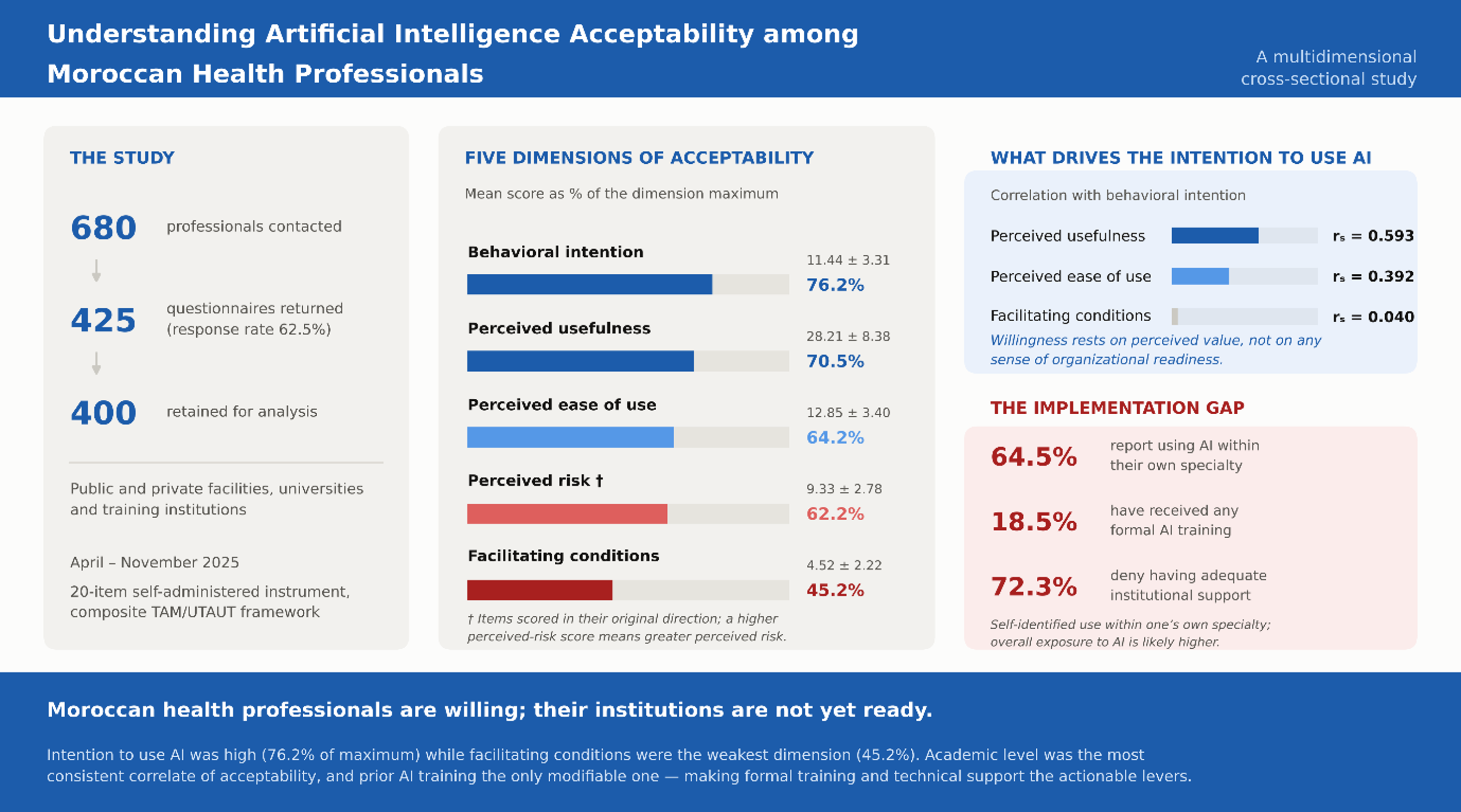
Artificial intelligence (AI) is increasingly integrated into healthcare, and its implementation depends on its acceptability among healthcare professionals; Moroccan evidence remains limited and profession-specific. This cross-sectional study assessed AI acceptability among Moroccan healthcare professionals and its associated factors. Between April and November 2025, 680 professionals were contacted, of whom 425 returned questionnaires (response rate: 62.5%). Of these, 400 questionnaires were retained for analysis. A self-administered 20-item instrument based on a composite technology-acceptance framework measured five dimensions: perceived usefulness, perceived ease of use, perceived risk, facilitating conditions, and behavioral intention (primary outcome); the total score was secondary. Analyses comprised reliability, exploratory factor analysis, correlations, Kruskal–Wallis tests, and multiple linear regression. The total descriptive score was 66.33 ± 15.12, while the behavioral intention score, the primary score, was 11.44 ± 3.31. Internal consistency was high overall (α = 0.908) but ranged from 0.597 to 0.935 across dimensions, and factor analysis supported three factors rather than five. Behavioral intention correlated more strongly with perceived usefulness (rs = 0.593) and perceived ease of use (rs = 0.392, both p < 0.001) than with facilitating conditions (rs = 0.040). Academic level was the most consistent correlate of behavioral intention (B = 0.981, β = 0.286, p < 0.001), and prior AI training of facilitating conditions (B = 1.141, p < 0.001); the models explained 1.2%–9.8% of the variance. Attitudes were favorable but cautious, with organizational readiness being the least favorable dimension. The contrast between the high prevalence of self-reported AI use within respondents’ specialties (64.5%) and the low prevalence of formal training (18.5%) identifies a concrete implementation target. The cross-sectional design and convenience sample preclude causal inference and limit generalizability.
- Bajwa J, Munir U, Nori A, Williams B. Artificial intelligence in healthcare: transforming the practice of medicine. Future Healthc J. 2021;8(2):e188-e194. doi: 10.7861/fhj.2021-0095
- Lambert SI, Madi M, Sopka S, et al. An integrative review on the acceptance of artificial intelligence among healthcare professionals in hospitals. npj Digital Med. 2023;6(1):111. doi: 10.1038/s41746-023-00852-5
- Shevtsova D, Ahmed A, Boot IWA, et al. Trust in and Acceptance of Artificial Intelligence Applications in Medicine: Mixed Methods Study. JMIR Hum Factors. 2024;11:e47031. doi: 10.2196/47031
- Dean TB, Seecheran R, Badgett RG, Zackula R, Symons J. Perceptions and attitudes toward artificial intelligence among frontline physicians and physicians’ assistants in Kansas: a cross-sectional survey. Jamia Open. 2024;7(4):ooae100. doi: 10.1093/jamiaopen/ooae100
- Fritsch SJ, Blankenheim A, Wahl A, et al. Attitudes and perception of artificial intelligence in healthcare: A cross-sectional survey among patients. Digit Health. 2022;8:20552076221116772. doi: 10.1177/20552076221116772
- Cornelissen L, Egher C, van Beek V, Williamson L, Hommes D. The Drivers of Acceptance of Artificial Intelligence–Powered Care Pathways Among Medical Professionals: Web-Based Survey Study. JMIR Form Res. 2022;6(6):e33368. doi: 10.2196/33368
- Dingel J, Kleine AK, Cecil J, Sigl AL, Lermer E, Gaube S. Predictors of Health Care Practitioners’ Intention to Use AI-Enabled Clinical Decision Support Systems: Meta-Analysis Based on the Unified Theory of Acceptance and Use of Technology. J Med Internet Res. 2024;26:e57224. doi: 10.2196/57224
- Jauk S, Kramer D, Avian A, Berghold A, Leodolter W, Schulz S. Technology Acceptance of a Machine Learning Algorithm Predicting Delirium in a Clinical Setting: a Mixed-Methods Study. J Med Syst. 2021;45(4):48. doi: 10.1007/s10916-021-01727-6
- Hamedani Z, Moradi M, Kalroozi F, et al. Evaluation of acceptance, attitude, and knowledge towards artificial intelligence and its application from the point of view of physicians and nurses: A provincial survey study in Iran: A cross‐sectional descriptive‐analytical study. Health Sci Rep. 2023;6(9):e1543. doi: 10.1002/hsr2.1543
- Azzam S, El-Morsy EMA, Said ASA, Eissa N, Khalil DM. Perception and awareness of healthcare professionals toward the applications of artificial intelligence in Egyptian healthcare settings. Front Artif Intell. 2026;8:1700493. doi: 10.3389/frai.2025.1700493
- Dalky A, Osaid Malkawi RM, Alrawashdeh A, ALBashtawy M, Hani SB. Perceptions, barriers, and risk of artificial intelligence Among healthcare professionals: A cross-sectional study. Digit Health. 2025;11:20552076251360924. doi: 10.1177/20552076251360924
- Jing J, Fu Y, Liu D, et al. AI Technology Acceptance, Decent Work Perception, and Job Crafting Among Nurses: A Three‐Wave Cross‐Lagged Study. International Nursing Review. 2026;73(1):e70150. doi: 10.1111/inr.70150
- Erkayıran O, Aslan R. Evaluation of Nurses’ Perceptions and Readiness for Artificial Intelligence Integration in Healthcare: A Cross‐Sectional Study in Turkey. Journal of Advanced Nursing. 2026;82(6):6082-6094. doi: 10.1111/jan.70256
- Amin SM, El‐Gazar HE, Zoromba MA, El‐Sayed MM, Atta MHR. Sentiment of Nurses Towards Artificial Intelligence and Resistance to Change in Healthcare Organisations: A Mixed‐Method Study. Journal of Advanced Nursing. 2025;81(4):2087-2098. doi: 10.1111/jan.16435
- Alruwaili MM, Abuadas FH, Alsadi M, et al. Exploring nurses’ awareness and attitudes toward artificial intelligence: Implications for nursing practice. Digital Health. 2024;10:20552076241271803. doi: 10.1177/20552076241271803
- Fazakarley CA, Breen M, Leeson P, Thompson B, Williamson V. Experiences of using artificial intelligence in healthcare: a qualitative study of UK clinician and key stakeholder perspectives. BMJ Open. 2023;13(12):e076950. doi: 10.1136/bmjopen-2023-076950
- Belharar O, Amrani S, Chakor A. Facilitators and barriers to the adoption of artificial intelligence by Moroccan nurses: an exploratory qualitative study. Policies Adm. Mark. J. 2025;1(1-2):83-103. doi: 10.34874/PRSM.pamj-vol1iss1-2.5427
- Namdar Areshtanab H, Rahmani F, Vahidi M, Saadati SZ, Pourmahmood A. Nurses perceptions and use of artificial intelligence in healthcare. Sci Rep. 2025;15:27801. doi: 10.1038/s41598-025-11002-0
- Yousif M, Asghar S, Akbar J, et al. Exploring the perspectives of healthcare professionals regarding artificial intelligence; acceptance and challenges. BMC Health Services Research. 2024;24(1):1200. doi: 10.1186/s12913-024-11667-9
- World Bank. New Program in Morocco Supports Improved Access to Quality Healthcare for All. World Bank. Published June 19, 2023. Accessed April 6, 2026. https://www.worldbank.org/en/news/press-release/2023/06/19/new-program-in-morocco-supports-improved-access-to-quality-healthcare-for-all
- World Health Organization. Morocco. WHO Midterm Results Report 2024–2025 for Morocco. Accessed April 6, 2026. https://www.who.int/about/accountability/results/who-results-report-2024-2025/country-profile/2024/morocco
- Kingdom of Morocco. Public policies on health and social protection. Published online 2023. Accessed April 4, 2026. https://www.maroc.ma/en/strategies-and-public-policies/public-policies-health-and-social-protection
- Berrami H, Serhier Z, Jallal M, Bennani Othmani M. Understanding and Use of Artificial Intelligence Among Doctors in a University Hospital in Morocco. Stud Health Technol Inform. 2023;309:215-219. doi: 10.3233/shti230781
- Semghouli S, El Fahssi M, Zerfaoui M, Hadaoui A, Amaoui B. Knowledge and perceptions of Moroccan medical physicists regarding the contribution of artificial intelligence in medical imaging and radiotherapy. Radiat. Med. Prot. 2025;6(2):75-80. doi: 10.1016/j.radmp.2025.02.003
- Khalyfa M, Amane M, Echchakery M. Perceived barriers to artificial intelligence integration among Moroccan public health care professionals: A cross-sectional study. AIH. Published online September 14, 2026. doi: 10.36922/aih026290095
- Swathi KS, Aswathy S, Kavitha TC, Chadaga K, Sampathila N. Behavioural Intentions to Adopt Artificial Intelligence in Healthcare: Exploring the Perception of Healthcare Professionals. J Technol Behav Sci. Published online January 31, 2025. doi: 10.1007/s41347-025-00483-5
- Davis FD. Perceived Usefulness, Perceived Ease of Use, and User Acceptance of Information Technology. MIS Q. 1989;13(3):319-340. doi: 10.2307/249008
- Venkatesh V, Morris MG, Davis GB, Davis FD. User Acceptance of Information Technology: Toward A Unified View. MIS Q. 2003;27(3):425-478. doi: 10.2307/30036540
- Eisinga R, te Grotenhuis M, Pelzer B. The reliability of a two-item scale: Pearson, Cronbach, or Spearman-Brown? Int J Public Health. 2013;58(4):637-642. doi: 10.1007/s00038-012-0416-3
- Horn JL. A Rationale and Test for the Number of Factors in Factor Analysis. Psychometrika. 1965;30(2):179-185. doi: 10.1007/bf02289447
- Grieder S, Grob A. Exploratory Factor Analyses of the Intelligence and Development Scales–2: Implications for Theory and Practice. Assessment. 2020;27(8):1853-1869. doi: 10.1177/1073191119845051
- Kingdom of Morocco. Law No. 28-13 on the Protection of Persons Participating in Biomedical Research (Promulgated 2015) and Implementing Decree No. 2.20.326, Bulletin Officiel No. 6978 Bis, 22 April 2021. Accessed September 14, 2026. https://www.sante.gov.ma/Reglementation/
REGLEMENTATIONDESPRATIQUESMEDICALES/28-
13.pdf - Khan Rony MK, Akter K, Nesa L, et al. Healthcare workers’ knowledge and attitudes regarding artificial intelligence adoption in healthcare: A cross-sectional study. Heliyon. 2024;10(23):e40775. doi: 10.1016/j.heliyon.2024.e40775
- Khalid Al-Kahtani N, Subbarayalu AV, Raman V, et al. Healthcare professionals’ and students’ perspectives on artificial intelligence in clinical documentation in eastern Saudi Arabia: Factors influencing adoption and utilization. Inform Med. Unlocked. 2025;59:101710. doi: 10.1016/j.imu.2025.101710
- Hassan M, Kushniruk A, Borycki E. Barriers to and Facilitators of Artificial Intelligence Adoption in Health Care: Scoping Review. JMIR Hum Factors. 2024;11:e48633. doi: 10.2196/48633
- Benfatah M. Exploring the Barriers to Artificial Intelligence Integration in Nursing Practice: A Survey of Nurses. J Radiol Nurs. 2025;44(2):190-194. doi: 10.1016/j.jradnu.2024.12.010
- Akter F, Rony MKK, Peu UR, et al. Nurses’ perspectives on barriers to artificial intelligence integration in clinical practice: a qualitative phenomenological study. Contemporary Nurse. 2026;62(1):65-83. doi: 10.1080/10376178.2025.2590147
- Nouis SC, Uren V, Jariwala S. Evaluating accountability, transparency, and bias in AI-assisted healthcare decision- making: a qualitative study of healthcare professionals’ perspectives in the UK. BMC Med Ethics. 2025;26(1):89. doi: 10.1186/s12910-025-01243-z
- Liao L, Lai I, Chang L. Exploring Taiwanese Dietitians’ Acceptance and Use of ChatGPT in Nutrition Practice: A Cross‐Sectional Survey. J Human Nutrition Diet. 2025;38(4):e70108. doi: 10.1111/jhn.70108
- Dai Q, Li M, Yang M, et al. Attitudes, Perceptions, and Factors Influencing the Adoption of AI in Health Care Among Medical Staff: Nationwide Cross-Sectional Survey Study. J Med Internet Res. 2025;27:e75343. doi: 10.2196/75343
- Ye C, Wang Z, Wu M, Kang R, Yuan F, Chen C. Behavioral drivers of AI nursing acceptance in the Greater Bay Area: a family-caregiver perspective on trust and risk. Front Public Health. 2025;13:1650804. doi: 10.3389/fpubh.2025.1650804
- Matthes J, Reinhardt A, Hodzic S, et al. Predicting the Intention to Use Generative Artificial Intelligence for Health Information: Comparative Survey Study. J Med Internet Res. 2026;28:e75648. doi: 10.2196/75648
- Thanthrige A, Lu B, Sako Z, Wickramasinghe N. Determinants of Health Care Technology Adoption Using an Integrated Unified Theory of Acceptance and Use of Technology and Task Technology Fit Model: Systematic Review and Meta-Analysis. J Med Internet Res. 2025;27:e64524. doi: 10.2196/64524
- Abdelwanis M, Simsekler MCE, Gabor AF, Sleptchenko A, Omar M. Artificial intelligence adoption challenges from healthcare providers’ perspectives: A comprehensive review and future directions. Safety Sci. 2026;193:107028. doi: 10.1016/j.ssci.2025.107028
- Nair M, Svedberg P, Larsson I, Nygren JM. A comprehensive overview of barriers and strategies for AI implementation in healthcare: Mixed-method design. PLoS ONE. 2024;19(8):e0305949. doi: 10.1371/journal.pone.0305949
- Poon EG, Lemak CH, Rojas JC, Guptill J, Classen D. Adoption of artificial intelligence in healthcare: survey of health system priorities, successes, and challenges. J Am Med Inform Assoc. 2025;32(7):1093-1100. doi: 10.1093/jamia/ocaf065
- Finkelstein J, Gabriel A, Schmer S, Truong TT, Dunn A. Identifying Facilitators and Barriers to Implementation of AI-Assisted Clinical Decision Support in an Electronic Health Record System. J Med Syst. 2024;48(1):89. doi: 10.1007/s10916-024-02104-9
- Cangelosi G, Conti A, Caggianelli G, et al. Barriers and Facilitators to Artificial Intelligence Implementation in Diabetes Management from Healthcare Workers’ Perspective: A Scoping Review. Medicina. 2025;61(8):1403. doi: 10.3390/medicina61081403
- Chustecki M. Benefits and Risks of AI in Health Care: Narrative Review. Interact J Med Res. 2024;13:e53616. doi: 10.2196/53616
- Hanna MG, Pantanowitz L, Jackson B, et al. Ethical and Bias Considerations in Artificial Intelligence/Machine Learning. Mod Pathol. 2025;38(3):100686. doi: 10.1016/j.modpat.2024.100686
- Pham T. Ethical and legal considerations in healthcare AI: innovation and policy for safe and fair use. R Soc Open Sci. 2025;12(5):241873. doi: 10.1098/rsos.241873
- Joo JY, Liu MF, Ho MH. Nurses’ perceptions of artificial intelligence adoption in healthcare: A qualitative systematic review. Nurse Educ Pract. 2025;88:104542. doi: 10.1016/j.nepr.2025.104542
- Sommer D, Schmidbauer L, Wahl F. Nurses’ perceptions, experience and knowledge regarding artificial intelligence: results from a cross-sectional online survey in Germany. BMC Nurs. 2024;23:205. doi: 10.1186/s12912-024-01884-2
- Henzler D, Schmidt S, Koçar A, et al. Healthcare professionals’ perspectives on artificial intelligence in patient care: a systematic review of hindering and facilitating factors on different levels. BMC Health Serv Res. 2025;25(1):633. doi: 10.1186/s12913-025-12664-2
- Jalal SM, Jalal SH, Alasmakh KE, Alnasser ZH, Alhamdan WY, Alabdullatif AA. Nurses’ Perception of Artificial Intelligence-Driven Monitoring Systems for Enhancing Compliance With Infection Prevention and Control Measures in Al-Ahsa, Saudi Arabia. Cureus. 2025;17(4):e82943. doi: 10.7759/cureus.82943
- Boyacı H, Söyük S. Healthcare workers’ readiness for artificial intelligence and organizational change: a quantitative study in a university hospital. BMC Health Serv Res. 2025;25:813. doi: 10.1186/s12913-025-12846-y
- Alnomasy N, Pangket P, Alreshidi B, et al. Artificial intelligence in health care: Assessing impact on professional roles and preparedness among hospital nurse leaders. Digit Health. 2025;11:20552076251356362. doi: 10.1177/20552076251356362
- Irgang L, Sestino A, Barth H, Holmén M. Healthcare workers’ adoption of and satisfaction with artificial intelligence: The counterintuitive role of paradoxical tensions and paradoxical mindset. Technol Forecast Soc Change. 2025;212:123967. doi: 10.1016/j.techfore.2024.123967
- Nofal HA, Mohamed AE, Almadani N, et al. The impact of an artificial intelligence enhancement program on healthcare providers’ knowledge, attitudes, and workplace flourishing. Front Public Health. 2025;13:1639333. doi: 10.3389/fpubh.2025.1639333
- Pare G, Raymond L, Etindele Sosso FA. Nurses’ Intention to Integrate AI Into Their Practice: Survey Study in Canada. JMIR Nurs. 2025;8:e76795. doi: 10.2196/76795
- Ahmadov N, Muradova A, Aliyeva A. “MELMA” in otolaryngology: Medical evaluation of large language model answers. Clinician-rated scoring (MELMA-Q) and web-based auditing (MELMA-W) novel tools for AI assessment. Eur Arch Otorhinolaryngol. Published online 2026. doi: 10.1007/s00405-026-10245-5