

The calibration and energy cost of tabular foundation models in clinical prediction

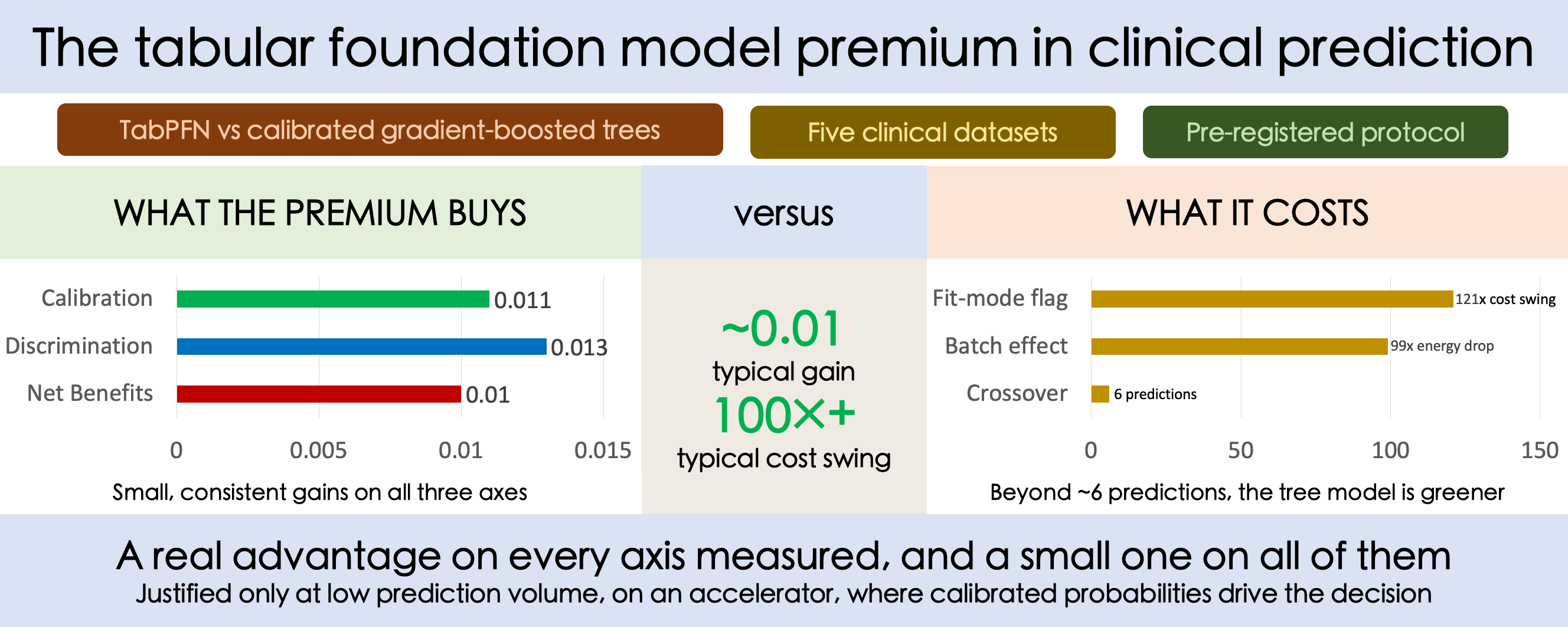
Artificial intelligence (AI) is increasingly used in healthcare decision-making, where predictive models must accurately distinguish patient risk, provide reliable probabilities, and remain computationally feasible for routine clinical deployment. Despite the emergence of tabular foundation models, evaluation has focused predominantly on predictive accuracy, providing limited evidence of their practical advantages in healthcare. This study evaluates the tabular foundation model TabPFN and calibrated gradient-boosted decision tree (GBDT) ensembles across multiple publicly available clinical prediction datasets. The calibration comparison followed a pre-registration fixing the equivalence margin, an inclusion gate that removed models that had not learned, and an explicit falsifier. Energy was read from processor power counters, each figure tagged by hardware, configuration, and batch regime. TabPFN was better calibrated on all five datasets across four calibration metrics. A saturated dataset carries no discriminating weight, so the confirmatory conclusion rests on the other four. Rejecting the pre-registered equivalence hypothesis indicates a calibration difference favoring TabPFN, rather than equivalence, although the gap was small (mean adaptive expected calibration error = 0.011). TabPFN showed better discrimination on four of five datasets, with a mean AUROC difference of 0.013 and intervals that exclude zero. Decision-curve analysis showed a small positive net benefit at most thresholds. Its modest gains in calibration, discrimination, and net benefit came at substantially higher computational cost. Tree models were more energy-efficient beyond approximately six predictions; per-prediction cost jumped 121-fold with a single configuration flag, and a validated cost model showed inference growing steeply with context size, making CPU-only deployment impractical at clinical scale. Thus, TabPFN’s advantage is narrow and most justified when calibrated probabilities carry clinical weight, volume is low, and an accelerator is available, where cost is characterized by timing rather than measured power.
- World Health Organization. Cardiovascular diseases (CVDs). 2025. Accessed August 6, 2026. https://www.who.int/news-room/fact-sheets/detail/cardiovascular-diseases-(cvds)
- Grinsztajn L, Oyallon E, Varoquaux G. Why do tree-based models still outperform deep learning on typical tabular data? Adv Neural Inf Process Syst. 2022;35:507-520. doi: 10.52202/068431-0037
- Shwartz-Ziv R, Armon A. Tabular data: deep learning is not all you need. Inf Fusion. 2022;81:84-90. doi: 10.1016/j.inffus.2021.11.011
- Borisov V, Leemann T, Seßler K, Haug J, Pawelczyk M, Kasneci G. Deep neural networks and tabular data: a survey. IEEE Trans Neural Netw Learn Syst. 2024;35(6):7499-7519. doi: 10.1109/TNNLS.2022.3229161
- Chen T, Guestrin C. XGBoost: a scalable tree boosting system. In: Proceedings of the 22nd ACM SIGKDD International Conference on Knowledge Discovery and Data Mining. 2016:785-794. doi: 10.1145/2939672.2939785
- Ke G, Meng Q, Finley T, et al. LightGBM: a highly efficient gradient boosting decision tree. In: von Luxburg U, Guyon I, Bengio S, Wallach H, Fergus R, eds. Proceedings of the 31st International Conference on Neural Information Processing Systems. Curran Associates Inc.; 2017:3149-3157. Accessed August 6, 2026. https://proceedings.neurips.cc/paper_files/paper/2017/file/6449f44a102fde848669bdd9eb6b76fa-Paper.pdf
- Prokhorenkova L, Gusev G, Vorobev A, Dorogush AV, Gulin A. CatBoost: unbiased boosting with categorical features. In: Bengio S, Wallach HM, Larochelle H, Grauman K, Cesa-Bianchi N, eds. Proceedings of the 32nd International Conference on Neural Information Processing Systems. Curran Associates Inc.; 2018:6639-6649. Accessed August 6, 2026. https://proceedings.neurips.cc/paper_files/paper/2018/file/14491b756b3a51daac41c24863285549-Paper.pdf
- Hollmann N, Müller S, Eggensperger K, Hutter F. TabPFN: a transformer that solves small tabular classification problems in a second. In: The Thirty-Sixth Annual Conference on Neural Information Processing Systems. 2022. Accessed August 6, 2026. https://table-representation-learning.github.io/assets/papers/tabpfn_a_transformer_that_solv.pdf
- Hollmann N, Müller S, Purucker L, et al. Accurate predictions on small data with a tabular foundation model. Nature. 2025;637(8045):319-326. doi: 10.1038/s41586-024-08328-6
- Zia MA, Mahnoor, Hussain A, Abual-Rub M, Almousa NA, Al-Shaikh Khalil A. Bin-Wise Quantized CatBoost for Energy-Efficient Drug-Review Rating Prediction in Biomedical E-Commerce. J Comput Biomed Inform. 2026;11(2). doi: 10.56979/1102/2026/1477
- Friedman JH. Greedy function approximation: a gradient boosting machine. Ann Stat. 2001;29(5):1189-1232. doi: 10.1214/aos/1013203451
- Alhawarat M, Alkhatib A, Nijem Q. Calibrated and explainable gradient boosting for road traffic crash severity prediction: SHAP audit and cross-jurisdiction transfer evaluation. Appl Sci. 2026;16(12):5876. doi: 10.3390/app16125876
- Arabiat A, Abu Owida H, Altayeb M. A comparative analysis of hypertension risk detection using machine learning and deep learning techniques. J Adv Inf Technol. 2026;17(5):846-856. doi: 10.12720/jait.17.5.846-856
- Moshawih S, Gharaibeh L, Alfreahat I, Shnoudeh AJ. Real-world pharmacotherapy-driven cardiovascular risk prediction using interpretable machine learning and Jordanian EHR data. Med Sci. 2026;14(3):343. doi: 10.3390/medsci14030343
- Shehu Aliyu B, Isuwa J, Abdulrahim A, Abdullsahi M, Hayatu Hassan I, Momi TS. Enhanced feature selection for imbalanced microarray cancer gene classification using chaotic salp swarm algorithm. Int J Theor Appl Comput Intell. 2025;2025:258-283. doi: 10.65278/IJTACI.2025.16
- Karimi M, Karimi Z, Khosravi M, et al. Feature selection methods in big medical databases: a comprehensive survey. Int J Theor Appl Comput Intell. 2025;2025:181-209. doi: 10.65278/IJTACI.2025.21
- Kurdi SZ. Machine learning-based classification framework for human health care monitoring. Int J Theor Appl Comput Intell. 2026;2026:1-15. doi: 10.65278/IJTACI.2026.1
- Nagler T. Statistical foundations of prior-data fitted networks. In: Proceedings of the 40th International Conference on Machine Learning. 2023:25660-25676. Accessed August 6, 2026. https://proceedings.mlr.press/v202/nagler23a.html
- Qu J, Holzmüller D, Varoquaux G, Le Morvan M. TabICL: a tabular foundation model for in-context learning on large data. Preprint. Posted online February 8, 2025. arXiv. doi: 10.48550/arXiv.2502.05564
- Van Calster B, McLernon DJ, van Smeden M, Wynants L, Steyerberg EW. Calibration: the Achilles heel of predictive analytics. BMC Med. 2019;17(1):230. doi: 10.1186/s12916-019-1466-7
- Collins GS, Reitsma JB, Altman DG, Moons KGM. Transparent reporting of a multivariable prediction model for individual prognosis or diagnosis (TRIPOD): the TRIPOD statement. Ann Intern Med. 2015;162(1):55-63. doi: 10.7326/M14-0697
- Christodoulou E, Ma J, Collins GS, Steyerberg EW, Verbakel JY, Van Calster B. A systematic review shows no performance benefit of machine learning over logistic regression for clinical prediction models. J Clin Epidemiol. 2019;110:12-22. doi: 10.1016/j.jclinepi.2019.02.004
- Platt JC. Probabilities for SV Machines. In: Smola AJ, Bartlett PL, Schölkopf B, Schuurmans D, eds. Advances in Large-Margin Classifiers. MIT Press; 2000:61-74. doi: 10.7551/mitpress/1113.003.0008
- Zadrozny B, Elkan C. Transforming classifier scores into accurate multiclass probability estimates. In: Proceedings of the Eighth ACM SIGKDD International Conference on Knowledge Discovery and Data Mining. Association for Computing Machinery; 2002:694-699. doi: 10.1145/775047.775151
- Kull M, Silva Filho TM, Flach P. Beta calibration: a well-founded and easily implemented improvement on logistic calibration for binary classifiers. In: Proceedings of the 20th International Conference on Artificial Intelligence and Statistics. 2017;54:623-631. Accessed August 6, 2026. https://proceedings.mlr.press/v54/kull17a.html
- Nixon J, Dusenberry MW, Zhang L, Jerfel G, Tran D. Measuring calibration in deep learning. In: Proceedings of the IEEE/CVF Conference on Computer Vision and Pattern Recognition (CVPR) Workshops. 2019:38-41. Accessed August 6, 2026. https://openaccess.thecvf.com/content_CVPRW_2019/html/Uncertainty_and_Robustness_in_Deep_Visual_Learning/Nixon_Measuring_Calibration_in_Deep_Learning_CVPRW_2019_paper.html
- Schwartz R, Dodge J, Smith NA, Etzioni O. Green AI. Commun ACM. 2020;63(12):54-63. doi: 10.1145/3381831
- Khan KN, Hirki M, Niemi T, Nurminen JK, Ou Z. RAPL in action: experiences in using RAPL for power measurements. ACM Trans Model Perform Eval Comput Syst. 2018;3(2):9. doi: 10.1145/3177754
- Kelly M, Longjohn R, Nottingham K. The UCI Machine Learning Repository. University of California, Irvine. Accessed August 6, 2026. https://archive.ics.uci.edu
- Vanschoren J, van Rijn JN, Bischl B, Torgo L. OpenML: networked science in machine learning. ACM SIGKDD Explor Newsl. 2014;15(2):49-60. doi: 10.1145/2641190.2641198
- Smith JW, Everhart JE, Dickson WC, Knowler WC, Johannes RS. Using the ADAP learning algorithm to forecast the onset of diabetes mellitus. Proc Annu Symp Comput Appl Med Care. 1988:261-265.
- Detrano R, Janosi A, Steinbrunn W, Pfisterer M, Schmid JJ, Sandhu S, et al. International application of a new probability algorithm for the diagnosis of coronary artery disease. Am J Cardiol. 1989;64(5):304-310. doi: 10.1016/0002-9149(89)90524-9
- Chicco D, Jurman G. Machine learning can predict survival of patients with heart failure from serum creatinine and ejection fraction alone. BMC Med Inform Decis Mak. 2020;20(1):16. doi: 10.1186/s12911-020-1023-5
- Wolberg WH, Street WN, Mangasarian OL. Nuclear feature extraction for breast tumor diagnosis. In: Acharya RS, Goldgof DB, eds. SPIE Proceedings. Vol 1905. SPIE; 1993:861-870. doi: 10.1117/12.148698
- Antal B, Hajdu A. An ensemble-based system for automatic screening of diabetic retinopathy. Knowl Based Syst. 2014;60:20-27. doi: 10.1016/j.knosys.2013.12.023
- Reimers N, Gurevych I. Sentence-BERT: sentence embeddings using Siamese BERT-networks. In: Proceedings of the 2019 Conference on Empirical Methods in Natural Language Processing and the 9th International Joint Conference on Natural Language Processing (EMNLP-IJCNLP). Association for Computational Linguistics; 2019:3980-3990. doi: 10.18653/v1/D19-1410
- Schuirmann DJ. A comparison of the two one-sided tests procedure and the power approach for assessing the equivalence of average bioavailability. J Pharmacokinet Biopharm. 1987;15(6):657-680. doi: 10.1007/BF01068419
- DeLong ER, DeLong DM, Clarke-Pearson DL. Comparing the areas under two or more correlated receiver operating characteristic curves: a nonparametric approach. Biometrics. 1988;44(3):837-845. doi: 10.2307/2531595
- Fischer R. Ground-truthing AI energy consumption: validating CodeCarbon against external measurements. it Inf Technol. 2026;67(4-6):155-163. doi: 10.1515/itit-2025-0031
- Zia MA. MuhammadAhmadZia/tabpfn_clinical_reproducible: tabpfn_clinical_reproducible v2 (Version v2) [Computer software]. Zenodo. 2026. doi: 10.5281/zenodo.21819032