

Machine learning risk stratification for major adverse cardiovascular events after acute myocardial infarction in patients receiving early empagliflozin therapy

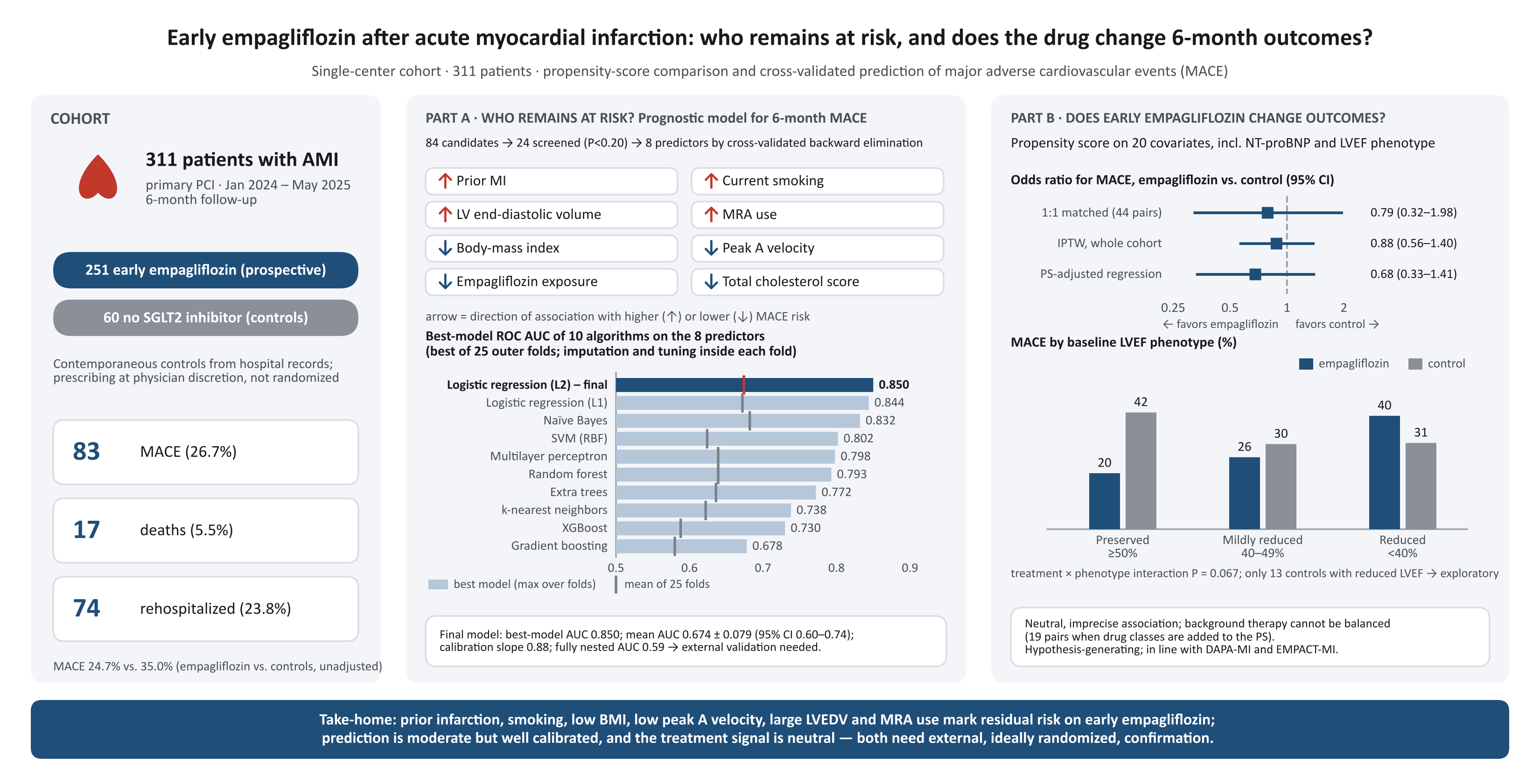
Sodium-glucose cotransporter-2 (SGLT2) inhibitors are increasingly prescribed after acute myocardial infarction (AMI), yet residual risk on this therapy is rarely examined alongside the drug’s association with outcomes in one cohort. We investigated 311 patients with AMI at one center (January 2024–May 2025): 251 received early empagliflozin 10 mg/day with standard therapy and were followed prospectively for six months; 60 contemporaneous patients without an SGLT2 inhibitor formed a non-randomized control group. The endpoint was six-month major adverse cardiovascular events (MACEs): all-cause death, non-fatal reinfarction, urgent percutaneous coronary intervention, or unplanned cardiovascular hospitalization. Classical and machine learning classifiers were compared under repeated nested cross-validation, with imputation, scaling, and tuning inside each fold; the empagliflozin–MACE association was estimated by propensity-score matching on 20 covariates. MACE occurred in 83 patients (26.7%; 24.7% with empagliflozin vs. 35.0% in controls), including 17 deaths (5.5%). Cross-validated backward elimination reduced 24 candidate predictors to eight: body mass index, prior infarction, current smoking, mineralocorticoid-receptor antagonist use, peak A velocity, left-ventricular end-diastolic volume, empagliflozin exposure, and discretized total cholesterol. On these features, L2-regularized logistic regression reached a pooled out-of-fold area under the curve of 0.673 (95% confidence interval 0.601–0.741) with good calibration (slope 0.88), matching random forest, gradient boosting, XGBoost, support-vector machine, k-nearest neighbors, and a multilayer perceptron. After matching (44 pairs), the odds ratio for MACE with empagliflozin was 0.79 (95% CI 0.32–1.98). Discrimination was moderate and needs external validation; the association between empagliflozin and fewer events was small and hypothesis-generating.
- Timmis A, Vardas P, Townsend N, et al. European Society of Cardiology: cardiovascular disease statistics 2021. Eur Heart J. 2022;43(8):716-799. doi: 10.1093/eurheartj/ehab892
- Byrne RA, Rossello X, Coughlan JJ, et al. 2023 ESC guidelines for the management of acute coronary syndromes. Eur Heart J. 2023;44(38):3720-3826. doi: 10.1093/eurheartj/ehad191
- McMurray JJV, Solomon SD, Inzucchi SE, et al. Dapagliflozin in patients with heart failure and reduced ejection fraction. N Engl J Med. 2019;381(21):1995-2008. doi: 10.1056/NEJMoa1911303
- Packer M, Anker SD, Butler J, et al. Cardiovascular and renal outcomes with empagliflozin in heart failure. N Engl J Med. 2020;383(15):1413-1424. doi: 10.1056/NEJMoa2022190
- Heerspink HJL, Stefánsson BV, Correa-Rotter R, et al. Dapagliflozin in patients with chronic kidney disease. N Engl J Med. 2020;383(15):1436-1446. doi: 10.1056/NEJMoa2024816
- von Lewinski D, Kolesnik E, Tripolt NJ, et al. Empagliflozin in acute myocardial infarction: the EMMY trial. Eur Heart J. 2022;43(41):4421-4432. doi: 10.1093/eurheartj/ehac494
- James S, Erlinge D, Storey RF, et al. Dapagliflozin in myocardial infarction without diabetes or heart failure. NEJM Evid. 2024;3(2). doi: 10.1056/EVIDoa2300286
- Butler J, Jones WS, Udell JA, et al. Empagliflozin after acute myocardial infarction. N Engl J Med. 2024;390(16):1455-1466. doi: 10.1056/NEJMoa2314051
- Carberry J, Petrie MC, Lee MMY, et al. Empagliflozin to prevent worsening of left ventricular volumes and systolic function after myocardial infarction (EMPRESS-MI). Eur J Heart Fail. 2024;27(3):566-576. doi: 10.1002/ejhf.3560
- Santos-Gallego CG, Vargas-Delgado AP, Requena-Ibanez JA, et al. Randomized trial of empagliflozin in nondiabetic patients with heart failure and reduced ejection fraction (EMPA-TROPISM). J Am Coll Cardiol. 2021;77(3):243-255. doi: 10.1016/j.jacc.2020.11.008
- Lee MMY, Brooksbank KJM, Wetherall K, et al. Effect of empagliflozin on left ventricular volumes in patients with type 2 diabetes, or prediabetes, and heart failure with reduced ejection fraction (SUGAR-DM-HF). Circulation. 2021;143(6):516-525. doi: 10.1161/circulationaha.120.052186
- Hammer A, Sossalla S, Sulzgruber P. Early initiation of SGLT2 inhibitors after acute myocardial infarction. Eur Heart J Cardiovasc Pharmacother. 2025;11(4):365-366. doi: 10.1093/ehjcvp/pvaf020
- Umar BU, Ajao LA, Dogo EM, Ajao FJ, Atama M. Artificial intelligence model for prediction of cardiovascular disease: an empirical study. Artif Intell Health. 2023;1(1):42-56. doi: 10.36922/aih.1746
- Baashar Y, Alkawsi G, Alhussian H, et al. Effectiveness of artificial intelligence models for cardiovascular disease prediction: network meta-analysis. Comput Intell Neurosci. 2022;2022:5849995. doi: 10.1155/2022/5849995
- Teshale AB, Htun HL, Vered M, Owen AJ, Freak-Poli R. A systematic review of artificial intelligence models for time-to-event outcome applied in cardiovascular disease risk prediction. J Med Syst. 2024;48(1):68. doi: 10.1007/s10916-024-02087-7
- Aşkın L, Polat E, Hoşoğlu Y, Tanrıverdi O. The application of artificial intelligence in the field of cardiovascular diseases focuses on both diagnostic and therapeutic aspects. Exp Appl Med Sci. 2024;5(2):22-35. doi: 10.46871/eams.1438927
- Xiang Y, Liu D, Guo L, et al. Accuracy of machine learning models for early prediction of major cardiovascular events post myocardial infarction: a systematic review and meta-analysis. Rev Cardiovasc Med. 2025;26(6):37224. doi: 10.31083/RCM37224
- Splinter R. Artificial intelligence in cardiac rhythm diagnostics and management: challenges and opportunities. Artif Intell Health. 2025;2(3):107-124. doi: 10.36922/aih.8468
- Collins GS, Moons KGM, Dhiman P, et al. TRIPOD+AI statement: updated guidance for reporting clinical prediction models that use regression or machine learning methods. BMJ. 2024;385. doi: 10.1136/bmj-2023-078378
- Lang RM, Badano LP, Mor-Avi V, et al. Recommendations for cardiac chamber quantification by echocardiography in adults: an update from the ASE and the EACVI. J Am Soc Echocardiogr. 2015;28(1):1-39. doi: 10.1016/j.echo.2014.10.003
- Nagueh SF, Smiseth OA, Appleton CP, et al. Recommendations for the evaluation of left ventricular diastolic function by echocardiography: an update from the ASE and the EACVI. J Am Soc Echocardiogr. 2016;29(4):277-314. doi: 10.1016/j.echo.2016.01.011
- McDonagh TA, Metra M, Adamo M, et al. 2021 ESC guidelines for the diagnosis and treatment of acute and chronic heart failure. Eur Heart J. 2021;42(36):3599-3726. doi: 10.1093/eurheartj/ehab368
- Hirshberg B, Katz A. Cardiovascular outcome studies with novel antidiabetes agents: scientific and operational considerations. Diabetes Care. 2013;36(suppl 2):S253-S258. doi: 10.2337/dcS13-2041
- Austin PC. An introduction to propensity score methods for reducing the effects of confounding in observational studies. Multivariate Behav Res. 2011;46(3):399-424. doi: 10.1080/00273171.2011.568786
- Varma S, Simon R. Bias in error estimation when using cross-validation for model selection. BMC Bioinformatics. 2006;7(1):91. doi: 10.1186/1471-2105-7-91
- Breiman L. Random forests. Mach Learn. 2001;45(1):5-32. doi: 10.1023/A:1010933404324
- Chen T, Guestrin C. XGBoost: a scalable tree boosting system. Proceedings of the 22nd ACM SIGKDD International Conference on Knowledge Discovery and Data Mining. 2016:785-794. doi: 10.1145/2939672.2939785
- Van Calster B, Nieboer D, Vergouwe Y, De Cock B, Pencina MJ, Steyerberg EW. A calibration hierarchy for risk models was defined: from utopia to empirical data. J Clin Epidemiol. 2016;74:167-176. doi: 10.1016/j.jclinepi.2015.12.005
- Steyerberg EW, Harrell FE Jr. Prediction models need appropriate internal, internal-external, and external validation. J Clin Epidemiol. 2016;69:245-247. doi: 10.1016/j.jclinepi.2015.04.005
- Riley RD, Snell KIE, Ensor J, et al. Minimum sample size for developing a multivariable prediction model: part II – binary and time-to-event outcomes. Stat Med. 2019;38(7):1276-1296. doi: 10.1002/sim.7992
- Lundberg SM, Lee SI. A unified approach to interpreting model predictions. Adv Neural Inf Process Syst (NeurIPS 2017). 2017;30:4765-4774. doi: 10.48550/arXiv.1705.07874
- Collins GS, Reitsma JB, Altman DG, Moons KGM. Transparent reporting of a multivariable prediction model for individual prognosis or diagnosis (TRIPOD). BMJ. 2015;350:g7594. doi: 10.1136/bmj.g7594
- Steyerberg EW, Vergouwe Y. Towards better clinical prediction models: seven steps for development and an ABCD for validation. Eur Heart J. 2014;35(29):1925-1931. doi: 10.1093/eurheartj/ehu207
- Mach F, Koskinas KC, Roeters van Lennep JE, et al. 2025 focused update of the 2019 ESC/EAS guidelines for the management of dyslipidaemias. Atherosclerosis. 2025;409:120479. doi: 10.1016/j.atherosclerosis.2025.120479
- Kato ET, Ono K, Lewis BS. SGLT2 inhibitors in acute myocardial infarction: what can we learn from the DAPA-MI trial? Eur Heart J Cardiovasc Pharmacother. 2024;10(2):95-97. doi: 10.1093/ehjcvp/pvad099
- Hernandez AF, Udell JA, Jones WS, et al. Effect of empagliflozin on heart failure outcomes after acute myocardial infarction: insights from the EMPACT-MI trial. Circulation. 2024;149(21):1627-1638. doi: 10.1161/circulationaha.124.069217
- Tripolt NJ, Kolesnik E, Benedikt M, et al. Timing of SGLT2 inhibitor initiation after acute myocardial infarction. Cardiovasc Diabetol. 2023;22(1):269. doi: 10.1186/s12933-023-02000-5
- Trigulova R, Akhmedova D, Akhmedova S, Mukhtarova S, Ikramov A, Alimova D. Early use of sodium-glucose cotransporter 2 inhibitors after acute myocardial infarction: 2023-2025 data and clinical implications. Cardiol Belarus. 2026;18(2):312-320. doi: 10.34883/PI.2026.18.2.011
- Ferrannini E, Baldi S, Frascerra S, et al. Shift to fatty substrate utilization in response to sodium-glucose cotransporter 2 inhibition. Diabetes. 2016;65(5):1190-1195. doi: 10.2337/db15-1356
- Benedikt M, Mangge H, Aziz F, et al. Impact of the SGLT2 inhibitor empagliflozin on inflammatory biomarkers after acute myocardial infarction: a post-hoc analysis of the EMMY trial. Cardiovasc Diabetol. 2023;22(1):166. doi: 10.1186/s12933-023-01904-6
- Hovenga E, Atalag K. Optimizing electronic health records to support artificial intelligence. Artif Intell Health. 2024;1(3):10-25. doi: 10.36922/aih.3056
- Zribi A, Ayaad O. Challenges in incorporating artificial intelligence into daily healthcare practice. Artif Intell Health. 2025;3(2):025350070. doi: 10.36922/AIH025350070