
An explainable deep learning-based computational framework for stroke prediction using multimodal radiomics features: A retrospective machine learning study

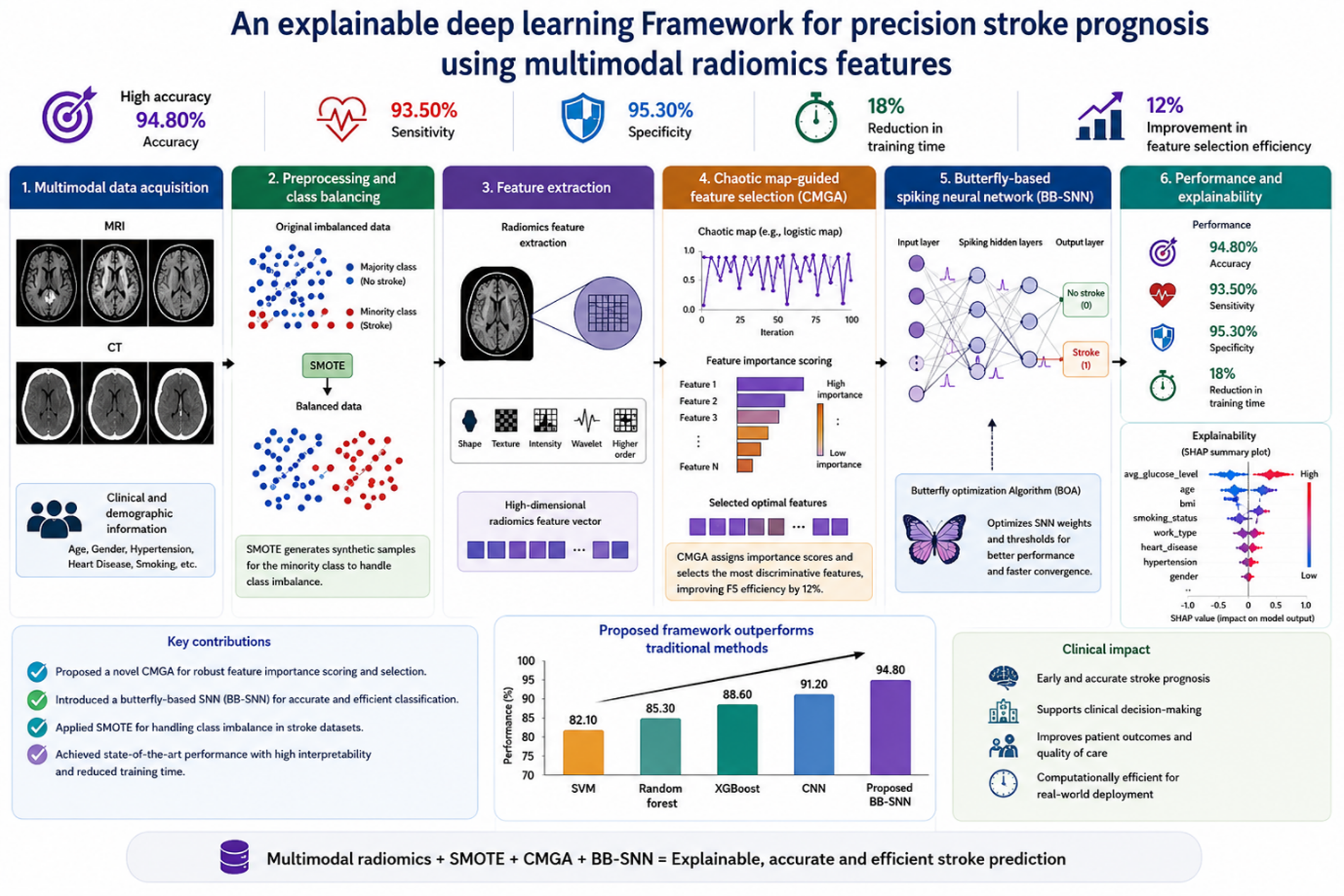
Stroke prediction models (SPMs) serve two important roles: accurately recognizing stroke symptoms and informing treatment decisions. The Synthetic Minority Oversampling Technique is typically used for analysis. An improved deep learning model for multimodal radiomic features and data preprocessing on imbalanced datasets is recommended. The chaotic map-guided approach (CMGA) has been applied to generate a feature-importance score, designed to improve the predictability and performance of a traditional model for feature selection (FS). The current study proposes a new butterfly-based spiking neural network (BB-SNN) to improve classification accuracy and reduce computational time. The efficiency of FS increased by 12% with CMGA-based scoring, and the model’s interpretability improved. The proposed SPM achieved 94.80% accuracy, 93.50% sensitivity, and 95.30% specificity, outperforming traditional methods. The deployment of the BB-SNN reduced the training time by 18%, demonstrating the method’s efficiency. The comparative analysis of the proposed SPM showed its efficacy in handling radionics data and addressing class imbalance, making it suitable for the SPM. Using CMGA and BB-SNN substantially enhanced medical diagnostics by effectively predicting strokes. These findings show that the proposed model can be integrated with diagnostic systems to improve the quality of patient care, as it effectively predicts stroke rates.
- Huang S, Diao S, Wan Y. Application of machine learning methods in predicting functional recovery in ischemic stroke patients. In: Innovative Scientific Research: Theory, Methodology, Practice: Proceedings of the 1st International Scientific and Practical Conference; September 3-6, 2024; Boston, MA. International Science Group; 2024:240-252. doi: 10.46299/ISG.2024.2.1
- Barron K, Blaivas M, Blaivas L, Sadler J, Deal I. Bedside ultrasound to identify and predict severity of dysphagia following ischemic stroke: human versus artificial intelligence. Ultrasound Med Biol. 2024;50(1):99-104. doi: 10.1016/j.ultrasmedbio.2023.09.008
- Chen M, Qian D, Wang Y, et al. Systematic review of machine learning applied to the secondary prevention of ischemic stroke. J Med Syst. 2024;48(1):8. doi: 10.1007/s10916-023-02020-4
- GBD 2021 Stroke Risk Factor Collaborators. Global, regional, and national burden of stroke and its risk factors, 1990–2021: a systematic analysis for the Global Burden of Disease Study 2021. Lancet Neurol. 2024;23(10):973-1003. doi: 10.1016/S1474-4422(24)00369-7
- Adams HP Jr, Bendixen BH, Kappelle LJ, et al. 3rd. Classification of subtype of acute ischemic stroke. Definitions for use in a multicenter clinical trial. TOAST. Trial of Org 10172 in Acute Stroke Treatment. Stroke. 1993;24(1):35-41. doi: 10.1161/01.STR.24.1.35
- Thorvaldsen P, Asplund K, Kuulasmaa K, Rajakangas AM, Schroll M. Stroke incidence, case fatality, and mortality in the WHO MONICA Project. Stroke. 1995;26(3):361-367. doi: 10.1161/01.STR.26.3.361
- Krongsut S, Piriyakhuntorn P. Unlocking the potential of HB/RDW ratio as a simple marker for predicting mortality in acute ischemic stroke patients after thrombolysis. J Stroke Cerebrovasc Dis. 2024;33(9):107874. doi: 10.1016/j.jstrokecerebrovasdis.2024.107874
- Yi JS, Ki HJ, Jeon YS, et al. The collateral map: prediction of lesion growth and penumbra after acute anterior circulation ischemic stroke. Eur Radiol. 2024;34(3):1411-1421. doi: 10.1007/s00330-023-10084-6
- Truong B, Zheng J, Hornsby L, Fox B, Chou C, Qian J. Development and validation of machine learning algorithms to predict 1-year ischemic stroke and bleeding events in patients with atrial fibrillation and cancer. Cardiovasc Toxicol. 2024;24(4):365-374. doi: 10.1007/s12012-024-09843-8
- Mochetti MM, Silva EGP, Correa AAF, et al. Neuron-specific enolase at admission as a predictor for stroke volume, severity and outcome in ischemic stroke patients: a prognostic biomarker review. Sci Rep. 2024;14(1):2688. doi: 10.1038/s41598-024-53080-6
- Shen H, Huasen BB, Killingsworth MC, Bhaskar SM. Introducing the futile recanalization prediction score (FRPS): a novel approach to predict and mitigate ineffective recanalization after endovascular treatment of acute ischemic stroke. Neurol Int. 2024;16(3):605-619. doi: 10.3390/neurolint16030045
- Wang Q, Yin J, Xu L, Lu J, Chen J, Chen Y, et al. Development and validation of outcome prediction model for reperfusion therapy in acute ischemic stroke using nomogram and machine learning. Neurol Sci. 2024;45(7),3255-3266. doi: 10.1007/s10072-024-07329-7
- Li N, Li YL, Shao JM, Wang CH, Li SB, Jiang Y. Optimizing early neurological deterioration prediction in acute ischemic stroke patients following intravenous thrombolysis: a LASSO regression model approach. Front Neurosci. 2024;18:1390117. doi: 10.3389/fnins.2024.1390117
- Wang Y, Zhou Y, Hu H, et al. Development and validation of a clinical prediction model for ischemic stroke recurrence after successful stent implantation in symptomatic intracranial atherosclerotic stenosis. J Clin Neurosci. 2024;123:137-147. doi:10.1016/j.jocn.2024.03.028
- Dierksen F, Sommer JK, Tran AT, et al. Machine learning models for 3-month outcome prediction using radiomics of intracerebral hemorrhage and perihematomal edema from admission head computed tomography (CT). Diagnostics. 2024;14(24):2827. doi: 10.3390/diagnostics14242827
- Lu M, Wang Y, Tian J, Feng H. Application of deep learning and radiomics in the prediction of hematoma expansion in intracerebral hemorrhage: a fully automated hybrid approach. Diagn Interv Radiol. 2024;30(5):299-312. doi: 10.4274/dir.2024.222088
- Wang Z, Shen Y, Zhang X, et al. Prognostic value of multi-PLD ASL radiomics in acute ischemic stroke. Front Neurol. 2025;15:1544578. doi: 10.3389/fneur.2024.1544578
- Guan L, Wei B, Guo D, et al. A clinical-radiomics nomogram for predicting early ischemic stroke risk in patients with transient ischemic attack. World Neurosurg. 2024;190:e199-e211. doi: 10.1016/j.wneu.2024.07.090
- Shi MG, Feng XM, Zhi HY, Hou L, Feng DF. Machine learning-based radiomics in neurodegenerative and cerebrovascular disease. MedComm. 2024;5(11):e778. doi:10.1002/mco2.778
- Abujaber AA, Imam Y, Balkhi I, Yaseen S, Nashwan AJ, Akhtar N. Utilizing machine learning to facilitate the early diagnosis of posterior circulation stroke. BMC Neurol. 2024;24(1):156. doi: 10.1186/s12883-024-03638-8
- Abujaber AA, Albalkhi I, Imam Y, Nashwan A, Akhtar N, Alkhawaldeh IM. Machine learning-based prognostication of mortality in stroke patients. Heliyon. 2024;10(7):e28869. doi:10.1016/j.heliyon.2024.e28869
- Abdul Raheem AK, Dhannoon BN. A novel deep learning model for drug-drug interactions. Curr Comput Aided Drug Des. 2024;20(5):666-672. doi: 10.2174/0115734099265663230926064638
- Mohammed MA, Abdulkareem KH, Dinar AM, Garcia Zapirain B. Rise of deep learning clinical applications and challenges in omics data: a systematic review. Diagnostics. 2023;13(4):664. doi: 10.3390/diagnostics13040664
- Mohammed MA, Lakhan A, Abdulkareem KH, Garcia-Zapirain B. A hybrid cancer prediction based on multi-omics data and reinforcement learning state action reward state action (SARSA). Comput Biol Med. 2023;154:106617. doi: 10.1016/j.compbiomed.2023.106617
- Ananthakrishnan G, Ghanimi HMA, Babu KS, et al. Mathematical cognitive modelling enhanced by deep learning for understanding human decision making in complex sequential tasks. JIM. 2026;29(4):1033-1044. doi: 10.47974/jim-2573
- Ghanimi HMA, Akilandeswari K, Hanumat PA, Sengan S, Prakash BP, Bommisetti RK, An Ensemble Cognitive Model for Stroke Prediction Using Unstructured Health Information Powered by Machine Learning. J. Mach.Comput. 2025;5(1):611-621. doi: 10.53759/7669/jmc202505048
- Eskandari M, Alkhafaji AHA, Al-Asady AM, et al. Mebendazole as an Adjunct Therapy with Mesalamine to Increase Efficacy and Maintenance Therapy for Ulcerative Colitis Patients: A Pilot Study. Curr Pharm Des.. 2026;32(8):609-616. doi: 10.2174/0113816128372513250616182826.
- Bakhshi A, Akbari M, Maleki F, et al. Artificial Intelligence in Non-Alcoholic Fatty Liver Disease and Fibrosis: A Narrative Review. Curr Pharm Des. 2026;32. doi: 10.2174/0113816128422676260219073220
- Demirci S, Uludüz E, Eyüboğlu S, et al. Linking photophobia, sleep disturbances, and migraine chronicity: Evidence from a retrospective analysis. Brain Behav. 2026;16(3):e71252. doi: 10.1002/brb3.71252
- Rahmani MKI, Ghanimi HMA, Jilani SF, et al. Early Pathogen Prediction in Crops Using Nano Biosensors and Neural Network-Based Feature Extraction and Classification. Big Data Res. 2023;34:100412. doi: 10.1016/j.bdr.2023.100412
- Sai PHVST, Bharathi VVP, Nandanan U, et al. Detection of Chronic Heart Failure Using Deep Learning and Machine Learning. In: Smart Innovation, Systems and Technologies. Springer Nature Singapore; 2025:535-543. doi: 10.1007/978-981-97-8355-7_46
- Samypen Y, Chakkaravarthy M. Adversarially-Robust Secure Scheduling Algorithm for Big Data Analytics in Healthcare IoT Networks. In: 2025 International Conference on Intelligent Innovations in Engineering and Technology (ICIIET). IEEE; 2025:1-5. doi: 10.1109/iciiet65921.2025.11378465
- Rajaram R, Chakkaravarthy M, Selvam J. Cutting-Edge Lung Cancer Detection with VGG-19. In: Lecture Notes in Networks and Systems. Springer Nature Singapore; 2025:205-216. doi: 10.1007/978-981-96-3102-5_15
- Midhunchakkaravarthy D, Shirke-Deshmukh S, Deshpande V. NAS-QDCNN: Neuron attention stage-by-stage quantum dilated convolutional neural network for iris recognition at a distance. Biomed Eng Appl Basis Commun. 2025;38(01). doi: 10.4015/s1016237225500218
- Midhunchakkaravarthy D, RangaNarayana K, Narayana VL. Underwater low-light image enhancement using a hybrid CNN–transformer framework with multi-scale feature fusion and cheetah optimization. Discov Comput. 2026;29(1). doi: 10.1007/s10791-026-09925-x
- Degadwala S, Midhunchakkaravarthy D, Khan S. Automating Histologic Assessment of Prostate Cancer with a ResNet50-Based Hybrid Vision Model. TCSST. 2025;7(3):295-311. doi: 10.36548/jtcsst.2025.3.001
- Midhunchakkaravarthy D, Kumar CK, Narayana L. Design of an Improved Model for Liver Transplantation Outcome Prediction Using Graph Embedding and Counterfactual Fusions. In: 2025 9th International Conference on Inventive Systems and Control (ICISC). IEEE; 2025:374-382. doi: 10.1109/icisc65841.2025.11188077
- Midhunchakkaravarthy D, Nagamani GM, Narayana VL. Quantitative benchmarking and cross-modal analysis of deep learning, machine learning, and biosensor frameworks for early colorectal cancer diagnosis and prognosis. J Theor Appl Inf Technol. 2025;103(18);7544-7564. https://www.jatit.org/volumes/Vol103No18/21Vol103No18.pdf
- Memon AG, Chandran SP, Nawaz R, Talpur RA, Memon F. Comparative Effects of Neuromuscular Training and Mobilization with Movement on Pain, Range of Motion, Balance, and Function in Footballer with Ankle Sprain. Malays J Med Health Sci. 2025;21(5). doi: 10.47836/mjmhs.21.5.7
- Memon AG, Chandran SP, Annosha, Zakir T, Sulaman M. Effects of Neuromuscular Training with and Without Kinesio-Tape on Pain, Range of Motion, Balance and Function in Footballer with Ankle Sprain. Journal of Liaquat University of Medical & Health Sciences, 2025;24(01):38-44. doi: 10.22442/jlumhs.2024.01174
- Rosyad YS, Aljaberi MA, Natarajan SB, Pramesona BA. The Coping Self-efficacy Scale Among People Living With HIV: Validity and Reliability Indonesian Version. MJMHS. 2025;21(s3):136-140. doi: 10.47836/mjmhs.21.s3.21
- Karmakar M, Panduragan SL, Said FM. A Case Report on Meeting the Spiritual Need of Intubated Conscious Patient. Patient Exp J. 2025;12(3):196-200. doi: 10.35680/2372-0247.2042
- Supriatin, Dioso RI, Che Hassan H, Maretalinia. Determinants of Caregiver’s Knowledge of Infant’s Early Nutrition in Indonesia. MJMHS. 2025;21(s3):105-110. doi: 10.47836/mjmhs.21.s3.16
- Sarvalingam P, Vajravelu A, Bin Abdul Jamil MM, Ambar RB, Selvam J, P R. A Novel Hybrid CNN-GRU Framework with Wavelet-Based Feature Optimization for Automated Autism Spectrum Disorder Detection Using EEG Signals. Adv Eng Intell Syst. 2026;005(02). doi: 10.22034/aeis.2026.576366.1514
- Moorthi M, Vanithalakshmi M, Hariharan N, Shyam KK, Yong LC, Athithan A. EEG based Brain-Computer Interface For Robotic Application. In: 2025 6th International Conference on Smart Electronics and Communication (ICOSEC). IEEE; 2025:574-579. doi: 10.1109/icosec67334.2025.11459790
- Marrugat J, Arboix A, García-Eroles L, et al. Estimación de la incidencia poblacional y la mortalidad de la enfermedad cerebrovascular establecida isquémica y hemorrágica en 2002 [The estimated incidence and case fatality rate of ischemic and hemorrhagic cerebrovascular disease in 2002 in Catalonia]. Rev. Española Cardiol. 2007;60(6):573-580. [In Spanish]. doi: 10.1157/13107113
- Gasull T, Arboix A. Molecular mechanisms and pathophysiology of acute stroke: emphasis on biomarkers in the different stroke subtypes. Int J Mol Sci. 2022;23(16):9476. doi: 10.3390/ijms23169476