
Quantum-infused deep learning for dual-task thyroid ultrasound diagnostics

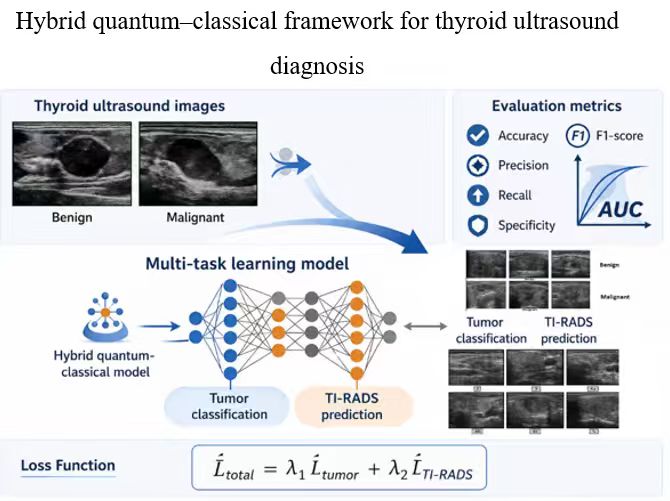
Accurate classification of thyroid nodules is essential for early intervention and improved clinical outcomes; however, its diagnostic performance remains limited by inter-observer variability, limited data availability, and class imbalance in ultrasound imaging. Although existing deep learning models have demonstrated strong performance, they often struggle to capture both global semantic context and fine-grained structural details under limited data. This study introduces a hybrid quantum– classical deep learning framework that leverages quantum variational filtering in tandem with transfer learning via ViT-B16 and EfficientNet-B3 to enhance feature representation. A multi-stage preprocessing pipeline was designed to improve input diversity and class balance. The model jointly performs binary tumor classification and Thyroid Imaging Reporting and Data System (TI-RADS) level prediction, achieving 94.2% accuracy for benign-versus-malignant tumor classification and 91.8% macro-accuracy for TI-RADS prediction. The proposed approach demonstrates promising robustness and generalization in limited-data environments, highlighting the potential of integrating quantum encoding with classical deep learning architectures for medical image diagnostics.
- Mnatsakanian A, Al-Khalili Y. Anatomy, Head and Neck, Thyroid muscles. In: StatPearls. Treasure Island, FL, USA: StatPearls Publishing; 2023.
- Tessler FN, Middleton WD, Grant EG, et al. ACR Thyroid Imaging, Reporting and Data System (TI-RADS): White Paper of the ACR TI-RADS Committee. J Am Coll Radiol. 2017;14(5):587-595. doi: 10.1016/j.jacr.2017.01.046
- Tessler FN, Middleton WD, Grant EG. Thyroid Imaging Reporting and Data System (TI-RADS): A User’s Guide. Radiology. 2018;287(1):29-36. doi: 10.1148/radiol.2017171240
- Lixandru-Petre IO, Dima A, Musat M, et al. Machine Learning for Thyroid Cancer Detection, Presence of Metastasis, and Recurrence Predictions—A Scoping Review. Cancers. 2025;17(8):1308. doi: 10.3390/cancers17081308
- Ha EJ, Lee JH, Mak N, et al. A Deep Learning-Based Artificial Intelligence Model Assisting Thyroid Nodule Diagnosis and Management: Pilot Results for Evaluating Thyroid Malignancy in Pediatric Cohorts. Thyroid. 2025;35(6):652-661. doi: 10.1089/thy.2024.0627
- Fontana E, Rudolph MS, Duncan R, Rungger I, Cîrstoiu C. Classical simulations of noisy variational quantum circuits. npj Quantum Inf. 2025;11(1):84. doi: 10.1038/s41534-024-00955-1
- Liu CY, Chen SYC, Chen KC, Huang WJ, Chang YJ. Programming Variational Quantum Circuits with Quantum-Train Agent. In: Proceedings of the 2025 International Conference on Quantum Communications, Networking, and Computing (QCNC). New York, NY, USA: IEEE; 2025:544-548. doi: 10.1109/qcnc64685.2025.00091
- Cao CL, Li QL, Tong J, et al. Artificial intelligence in thyroid ultrasound. Front Oncol. 2023;13:1060702. doi: 10.3389/fonc.2023.1060702
- Khan T. Application of Two-Class Neural Network-based classification model to predict the onset of Thyroid Disease. In: Proceedings of the 2021 11th International Conference on Cloud Computing, Data Science & Engineering (Confluence). New York, NY, USA: IEEE; 2021:114-118. doi: 10.1109/confluence51648.2021.9377097
- Srivastava R, Kumar P. Optimizing CNN based model for thyroid nodule classification using data augmen- tation, segmentation and boundary detection techniques. Multimed Tools Appl. 2023;82(26):41037-41072. doi: 10.1007/s11042-023-15068-8
- Sun J, Wu B, Zhao T, et al. Classification for thyroid nodule using ViT with contrastive learning in ultrasound images. Comput Biol Med. 2023;152:106444. doi: 10.1016/j.compbiomed.2022.106444
- Wang Y, Gan J. Benign and Malignant Classification of Thyroid Nodules Based on ConvNeXt. In: Proceedings of the 2022 3rd International Conference on Control, Robotics and Intelligent System. New York, NY, USA: Association for Computing Machinery; 2022:56-60. doi: 10.1145/3562007.3562017
- Zhang J, Zhang H, Jiang P, et al. High efficiency classification of thyroid cytopathological images based on knowledge distillation and vision transformer. Sci Rep. 2025;15(1):30059. doi: 10.1038/s41598-025-15728-9
- Zheng Z, Su T, Wang Y, et al. A novel ultrasound image diagnostic method for thyroid nodules. Sci Rep. 2023;13(1):1654. doi: 10.1038/s41598-023-28932-2
- Aboudi N, Khachnaoui H, Moussa O, Khlifa N. Bilinear Pooling for Thyroid Nodule Classification in Ultrasound Imaging. Arab J Sci Eng. 2023;48(8):10563-10573. doi: 10.1007/s13369-023-07674-3
- Gong H, Chen J, Chen G, Li H, Li G, Chen F. Thyroid region prior guided attention for ultrasound segmentation of thyroid nodules. Comput Biol Med. 2023;155:106389. doi: 10.1016/j.compbiomed.2022.106389
- Xiao X, Zhou Y, Zhu Y, Li Y, Qi T, Wang W. A multimodal prompt-tuning method of ultrasound diagnosis for thyroid nodule. Front Med. 2025;12:1686374. doi: 10.3389/fmed.2025.1686374
- Fang M, Ma Q, Xu B. Automated multi-class classification of thyroid nodules in ultrasound imaging using transformer-based segmentation and hybrid feature learning. J Radiat Res Appl Sci. 2025;18(4):101782. doi: 10.1016/j.jrras.2025.101782
- Zhou YT, Yang TY, Han XH, Piao JC. Thyroid-DETR: Thyroid nodule detection model with transformer in ultrasound images. Biomed Signal Processing Control. 2024;98:106762. doi: 10.1016/j.bspc.2024.106762
- Liu Q, Li Y, Hao Y, et al. Multimodal ultrasound multistage classification of PTC cervical lymph node metastasis via DualSwinThyroid. Front Oncol. 2024;14:1349388. doi: 10.3389/fonc.2024.1349388
- Rashed A, Medhat T, Elgarayhi A. Enhancing automatic diagnosis of thyroid nodules from ultrasound scans leveraging deep learning models. Sci Rep. 2025;15(1):40364. doi: 10.1038/s41598-025-25780-0
- Chi J, Chen J hui, Wu B, Zhao J, Wang K, Yu X, et al. A Dual-Branch Cross-Modality-Attention Network for Thyroid Nodule Diagnosis Based on Ultrasound Images and Contrast-Enhanced Ultrasound Videos. IEEE J Biomed Health Inform. 2025;29(2):1269-1282. doi: 10.1109/jbhi.2024.3472609
- Jiang S, Zhang N, Li C, Tong L, Yang X. Application of deep learning based on convolutional neural network model in multimodal ultrasound diagnosis of unexplained cervical lymph node enlargement. Front Oncol. 2025;15:1542265. doi: 10.3389/fonc.2025.1542265
- Shen P, Yang Z, Sun J, et al. Explainable multimodal deep learning for predicting thyroid cancer lateral lymph node metastasis using ultrasound imaging. Nat Commun. 2025;16(1):7052. doi: 10.1038/s41467-025-62042-z
- Maheshwari D, Ullah U, Marulanda PAO, et al. Quantum Machine Learning Applied to Electronic Healthcare Records for Ischemic Heart Disease Classification. Hum Cent Comput Inf Sci. 2023;13(06):1-8. doi: 10.22967/HCIS.2023.13.006
- Sajeev V, Hima Vyshnavi AM, Krishnan Namboori PK. Thyroid Cancer Prediction Using Gene Expression Profile, Pharmacogenomic Variants And Quantum Image Processing In Deep Learning Platform-A Theranostic Approach. In: Proceedings of the 2020 International Conference for Emerging Technology (INCET). New York, NY, USA: IEEE; 2020:1-5. doi: 10.1109/incet49848.2020.9154041
- Gomes Ataide EJ, Ponugoti N, Illanes A, Schenke S, Kreissl M, Friebe M. Thyroid Nodule Classification for Physician Decision Support Using Machine Learning- Evaluated Geometric and Morphological Features. Sensors. 2020;20(21):6110. doi: 10.3390/s20216110
- Liu T, Xie S, Zhang Y, Yu J, Niu L, Sun W. Feature selection and thyroid nodule classification using transfer learning. In: Proceeding of the 2017 IEEE 14th International Symposium on Biomedical Imaging (ISBI 2017). New York, NY, USA: IEEE; 2017:1096-1099. doi: 10.1109/isbi.2017.7950707
- Kwon SW, Choi IJ, Kang JY, Jang WI, Lee GH, Lee MC. Ultrasonographic Thyroid Nodule Classification Using a Deep Convolutional Neural Network with Surgical Pathology. J Digit Imaging. 2020;33(5):1202-1208. doi: 10.1007/s10278-020-00362-w
- Zhu Y, Fu Z, Fei J. An image augmentation method using convolutional network for thyroid nodule classification by transfer learning. In: Proceedings of the 2017 3rd IEEE International Conference on Computer and Communications (ICCC). New York, NY, USA: IEEE; 2017:1819-1823. doi: 10.1109/compcomm.2017.8322853
- Hang Y. Thyroid Nodule Classification in Ultrasound Images by Fusion of Conventional Features and Res-GAN Deep Features. Singh D, ed. J Healthc Eng. 2021;2021:1-7. doi: 10.1155/2021/9917538
- Pedraza L, Vargas C, Narváez F, Durán O, Muñoz E, Romero E. An open access thyroid ultrasound image database. In: Romero E, Lepore N, eds. Proceedings of the SPIE 9287,10th International Symposium on Medical Information Processing and Analysis, 92870W. SPIE; 2015. doi: 10.1117/12.2073532
- Xu C, Sun Y, Zhang Y, et al. Stain Normalization of Histopathological Images Based on Deep Learning: A Review. Diagnostics. 2025;15(8):1032. doi: 10.3390/diagnostics15081032
- Kim YS, Kim MK, Fu N, Liu J, Wang J, Srebric J. Investigating the impact of data normalization methods on predicting electricity consumption in a building using different artificial neural network models. Sustain Cities Soc. 2025;118:105570. doi: 10.1016/j.scs.2024.105570
- Liaw LCM, Tan SC, Goh PY, Lim CP. A histogram SMOTE-based sampling algorithm with incremental learning for imbalanced data classification. Inf Sci. 2025;686:121193. doi: 10.1016/j.ins.2024.121193
- Hou M, Wu Y, Zhang S. Two-Party Quantum Private Comparison with Pauli Operators. Axioms. 2025;14(8):549. doi: 10.3390/axioms14080549
- Hirano Y, Fujii K. Locality-Aware Pauli-Based Computation for Local Magic State Preparation. In: Proceedings of the 2025 IEEE International Conference on Quantum Computing and Engineering (QCE). New York, NY, USA: IEEE; 2025:670-680. doi: 10.1109/qce65121.2025.00078
- Pavithra KC, Kumar P, Geetha M, et al. Transformer-Based DME Classification Using Retinal OCT Images Without Data Augmentation: An Evaluation of ViT-B16 and ViT-B32 With Optimizer Impact. IEEE Access. 2025;13:180781- 180798. doi: 10.1109/access.2025.3620945
- Younis EM, Ibrahim IA, Mahmoud MN, Albarrak AM. Hybrid of VGG-16 and FTVT-b16 Models to Enhance Brain Tumors Classification Using MRI Images. Diagnostics. 2025;15(16):2014. doi: 10.3390/diagnostics15162014
- Navaneethakrishnan M, Robinson Joel M, Kalavai Palani S, Gnanaprakasam GJ. EfficientNet-deep quantum neural network-based economic denial of sustainability attack detection to enhance network security in cloud. Netw Comput Neural Syst. 2024;36(4):1360-1384. doi: 10.1080/0954898x.2024.2361093
- Altaf AR, Altaf A, Rehman FU. Modified EfficientNet-B0 Architecture Optimized with Quantum-Behaved Algorithm for Skin Cancer Lesion Assessment. Diagnostics. 2025;15(24):3245. doi: 10.3390/diagnostics15243245