

A scope of the literature on artificial intelligence in oncology

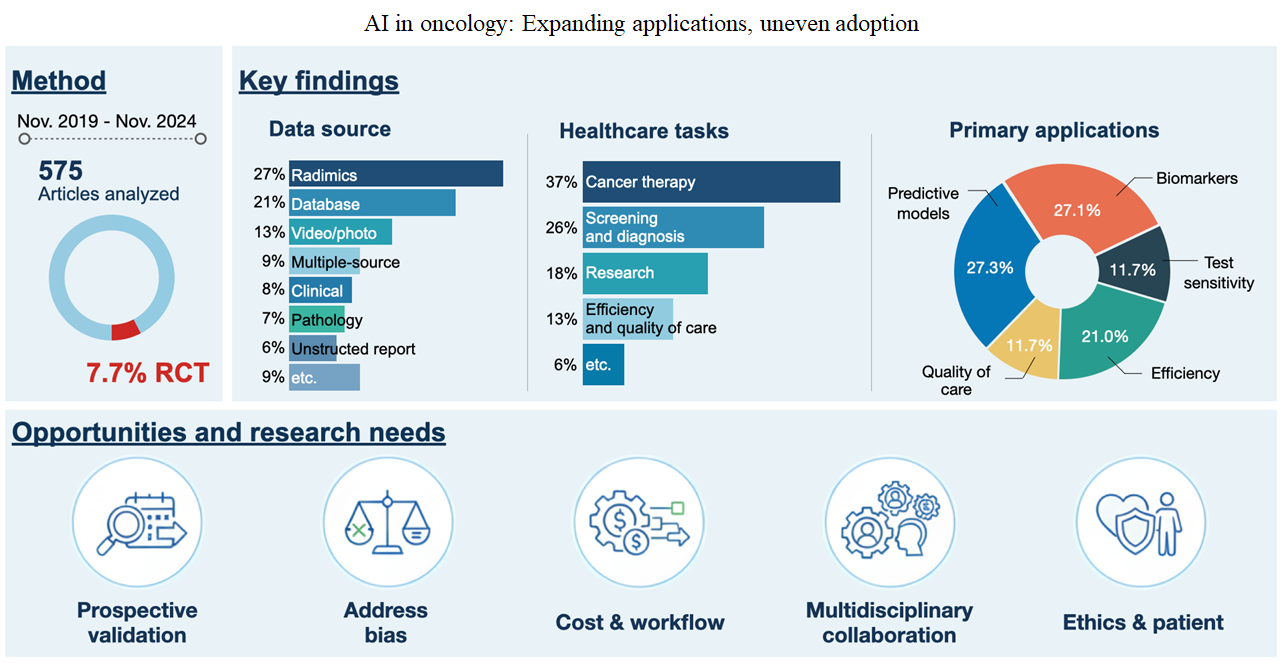
Artificial intelligence (AI) is transforming healthcare and is increasingly applied across the cancer care continuum. However, prior studies of its use have focused on relatively narrow applications. This scoping review characterizes the current landscape of AI applications in oncology published over the past five years. A two-part literature search was conducted in November 2024. First, nine high-impact journals were manually reviewed for articles published from November 2019 to November 2024 containing the term “artificial intelligence.” Second, a structured PubMed search using “artificial intelligence” AND “cancer” was performed, limited to the same period and filtered by study type, to classify studies by their primary area of application. Of 1,305 records screened, 575 studies met the inclusion criteria. Most studies spanned multiple medical subspecialties (n = 154, 27%) or focused on cancer detection (n = 145, 25%). The most frequently studied tumor categories were multiple tumor types (16%), breast (14%), genitourinary (13%), lower gastrointestinal cancers (12%), and lung (12%). Radiomics (n = 153, 27%) and unstructured clinical data (n = 123, 21%) were the most common data sources. The most common primary applications were predictive modeling (n = 157, 27.3%) and biomarker development (n = 156, 27.1%). Current AI research in oncology is dominated by a focus on cancer therapy and diagnosis. Future research requires prospective, multi-institutional validation and evaluation frameworks that incorporate factors such as clinical impact, workflow integration, cost-effectiveness, and ethics. Collaboration among patients, clinicians, ethicists, and healthcare leaders will be key to prioritizing research into underrepresented cancer types, mitigating AI bias, and ensuring that AI innovations are clinically meaningful and sustainable.
- Yuan X, Xu H, Zhu J, et al. Systematic review and meta-analysis of artificial intelligence for image-based lung cancer classification and prognostic evaluation. Npj Precis Oncol. 2025;9(1):300. doi: 10.1038/s41698-025-01095-1
- Verlingue L, Boyer C, Olgiati L, Brutti Mairesse C, Morel D, Blay JY. Artificial intelligence in oncology: ensuring safe and effective integration of language models in clinical practice. Lancet Reg Health Eur. 2024;46:101064. doi: 10.1016/j.lanepe.2024.101064
- Trebeschi S, Drago SG, Birkbak NJ, et al. Predicting response to cancer immunotherapy using noninvasive radiomic biomarkers. Ann Oncol. 2019;30(6):998-1004. doi: 10.1093/annonc/mdz108
- Esteva A, Kuprel B, Novoa RA, et al. Dermatologist-level classification of skin cancer with deep neural networks. Nature. 2017;542(7639):115-118. doi: 10.1038/nature21056
- Bera K, Schalper KA, Rimm DL, Velcheti V, Madabhushi A. Artificial intelligence in digital pathology - new tools for diagnosis and precision oncology. Nat Rev Clin Oncol. 2019;16(11):703-715. doi: 10.1038/s41571-019-0252-y
- Topol EJ. High-performance medicine: the convergence of human and artificial intelligence. Nat Med. 2019;25(1):44- 56. doi: 10.1038/s41591-018-0300-7
- Liu Y, Chen PHC, Krause J, Peng L. How to Read Articles That Use Machine Learning: Users’ Guides to the Medical Literature. JAMA. 2019;322(18):1806-1816. doi: 10.1001/jama.2019.16489
- El Naqa I, Karolak A, Luo Y, et al. Translation of AI into oncology clinical practice. Oncogene. 2023;42(42):3089- 3097. doi: 10.1038/s41388-023-02826-z
- Chua IS, Gaziel-Yablowitz M, Korach ZT, et al. Artificial intelligence in oncology: Path to implementation. Cancer Med. 2021;10(12):4138-4149. doi: 10.1002/cam4.3935
- Marinovic DA, Hunter RL. Examining the interrelationships between mindfulness-based interventions, depression, inflammation, and cancer survival. CA Cancer J Clin. 2022;72(5):490-502. doi: 10.3322/caac.21733
- Meskó B, Görög M. A short guide for medical professionals in the era of artificial intelligence. Npj Digit Med. 2020;3(1):126. doi: 10.1038/s41746-020-00333-z
- Han R, Acosta JN, Shakeri Z, Ioannidis JPA, Topol EJ, Rajpurkar P. Randomised controlled trials evaluating artificial intelligence in clinical practice: a scoping review. Lancet Digit Health. 2024;6(5):e367-e373. doi: 10.1016/S2589-7500(24)00047-5
- Macheka S, Ng PY, Ginsburg O, Hope A, Sullivan R, Aggarwal A. Prospective evaluation of artificial intelligence (AI) applications for use in cancer pathways following diagnosis: a systematic review. BMJ Oncol. 2024;3(1):e000255. doi: 10.1136/bmjonc-2023-000255
- Huhulea EN, Huang L, Eng S, Sumawi B, Huang A, Aifuwa E, Hirani R, Tiwari RK, Etienne M. Artificial Intelligence Advancements in Oncology: A Review of Current Trends and Future Directions. Biomedicines. 2025;13(4):951. doi: 10.3390/biomedicines13040951
- Kolla L, Parikh RB. Uses and limitations of artificial intelligence for oncology. Cancer. 2024;130(12):2101-2107. doi: 10.1002/cncr.35307