

Decoding Parkinsonian tremor: An explainable framework integrating spatial and spectral dynamics of multi-revolution spiral drawings

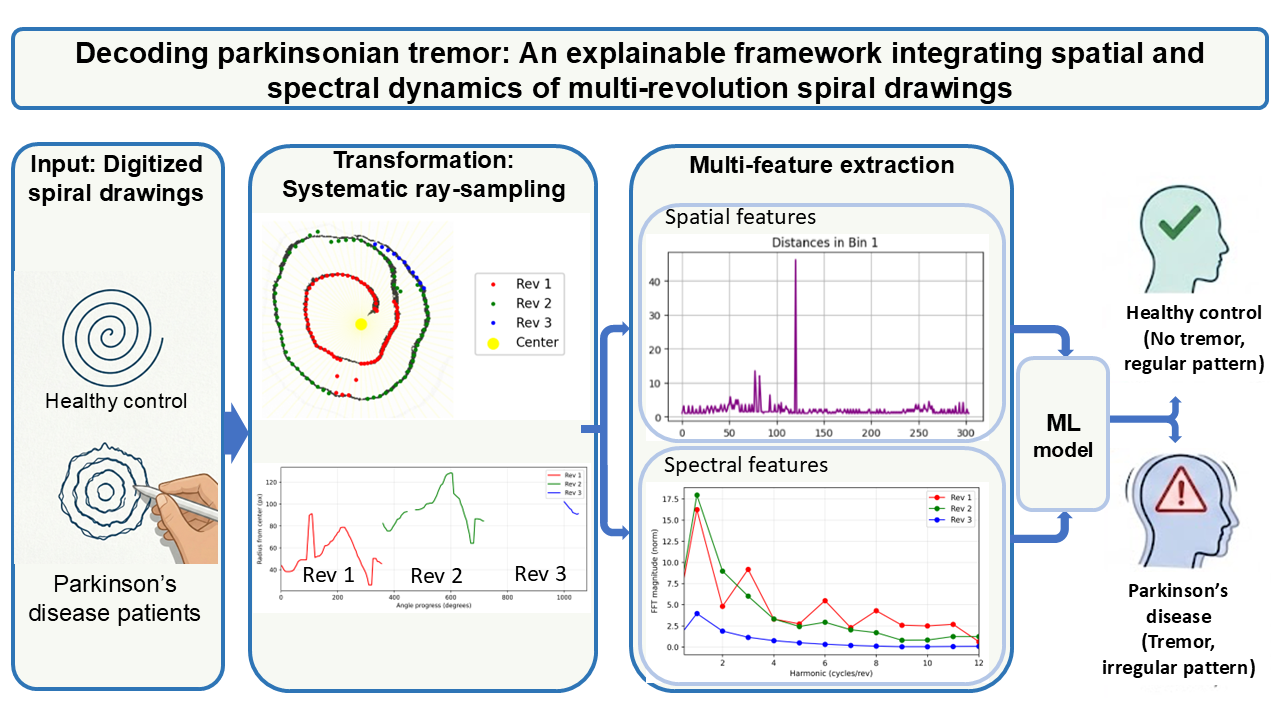
Parkinson’s disease manifests with motor impairments that are detectable through digitized spiral drawings. This study introduces an explainable framework for Parkinson’s disease screening using a novel radial-sampling feature fusion approach. We transform two-dimensional spiral images into one-dimensional revolution signals via a systematic ray-sampling technique to extract three distinct revolutions. We integrate spatial metrics, such as inter-revolution spacing variability and root mean square radial derivatives, with spectral descriptors derived from fast Fourier transform analysis across low-, mid-, and high-harmonic bands. A total of 20 features were utilized to train state-of-the-art machine learning models, including support vector machines, random forests, and light gradient boosting machines. Among these, the random-forest classifier demonstrated superior performance. Subsequent five-fold cross-validation stability analysis, along with feature importance analysis, identified the root mean square radial derivative of the outer revolution (r3_derive_rms) as the most critical biomarker. Stratified cross-validation demonstrates that combining spatial and frequency features significantly enhances detection accuracy compared to single-domain methods, facilitating effective clinical deployment even in data-scarce environments. This interpretable pipeline provides a robust, low-cost “white-box” screening tool, offering a practical alternative to opaque deep-learning models for early clinical intervention.
- Mercaldo F, Brunese L, Cesarelli M, Martinelli F, Santone A. Spiral Drawing Test and Explainable Convolutional Neural Networks for Parkinson’s Disease Detection. In: Proceedings of the 16th International Conference on Agents and Artificial Intelligence (ICAART 2024). 2024:443-452. doi: 10.5220/0012407100003636
- Smits EJ, Tolonen AJ, Cluitmans L, et al. Standardized handwriting to assess bradykinesia, micrographia and tremor in Parkinson’s disease. PLoS ONE. 2014;9(5):e97614. doi: 10.1371/journal.pone.0097614
- Wang H, Wang L, Pullman SL, Louis ED. Spiral analysis— Improved clinical utility with center detection. J Neurosci Methods. 2008;171(2):264-270. doi: 10.1016/j.jneumeth.2008.03.009
- Liu X, Carroll CB, Wang SY, Zajicek J, Bain PG. Quantifying drug-induced dyskinesias in the arms using digitised spiral-drawing tasks. J Neurosci Methods. 2005;144(1):47-52. doi: 10.1016/j.jneumeth.2004.10.005
- Letanneux A, Danna J, Velay JL, Viallet F, Pinto S. From micrographia to Parkinson’s disease dysgraphia. Mov Disord. 2014;29(12):1467-1475. doi: 10.1002/mds.25990
- Thomas M, Lenka A, Pal PK. Handwriting analysis in Parkinson’s disease: Current status and future directions. Mov Disord Clin Pract. 2017;4(6):806-818. doi: 10.1002/mdc3.12552
- Ma HI, Hwang WJ, Chang SH, Wang TY. Progressive micrographia shown in horizontal, but not vertical, writing in Parkinson’s disease. Behav Neurol. 2013;27(2):169-174. doi: 10.1155/2013/212675
- Zham P, Arjunan SP, Raghav S, Kumar DK. A kinematic study of progressive micrographia in Parkinson’s disease. Front Neurol. 2019;10:403. doi: 10.3389/fneur.2019.00403
- San Luciano M, Wang C, Ortega RA, et al. Digitized spiral drawing: A possible biomarker for early Parkinson’s disease. PLoS ONE. 2016; 11(10): e0162799. doi: 10.1371/journal.pone.0162799
- Pullman SL. Spiral analysis: A new technique for measuring tremor with a digitizing tablet. Mov Disord. 1998;13(s3):85- 89. doi: 10.1002/mds.870131315
- Rizzo G, Copetti M, Arcuti S, Martino D, Fontana A, Logroscino G. Accuracy of clinical diagnosis of Parkinson disease: A systematic review and meta-analysis. Neurology. 2016;86(6):566-576. doi: 10.1212/WNL.0000000000002350
- Westin J, Ghiamati S, Memedi M, et al. A new computer method for assessing drawing impairment in Parkinson’s disease. J Neurosci Methods. 2010;190(1):143-148. doi: 10.1016/j.jneumeth.2010.04.027
- Elble RJ, Pullman S, Matsumoto JY, Raethjen J, Deuschl G, Tintner R. Digitizing tablet and Fahn-Tolosa-Marín ratings of Archimedes spirals have comparable minimum detectable change in essential tremor. Tremor Other Hyperkinet Mov. 2017. doi: 10.5334/tohm.344
- Kamble M, Shrivastava P, Jain M. Digitized spiral drawing classification for Parkinson’s disease diagnosis. Meas : Sens. 2021;16:100047. doi: 10.1016/j.measen.2021.100047
- Rosenblum S, Samuel M, Zlotnik S, Erikh I, Schlesinger I. Handwriting as an objective tool for Parkinson’s disease diagnosis. J Neurol. 2013;260(9):2357-2361. doi: 10.1007/s00415-013-6996-x
- Huang P, He P, Tian S, et al. A ViT-AMC Network With Adaptive Model Fusion and Multiobjective Optimization for Interpretable Laryngeal Tumor Grading From Histopathological Images. IEEE Trans Med Imaging. 2023;42(1):15-28. doi: 10.1109/TMI.2022.3202248
- Li W, Rao Q, Dong S, et al. PIDGN: An explainable multimodal deep learning framework for early prediction of Parkinson’s disease. J Neurosci Methods. 2025;415:110363. doi: 10.1016/j.jneumeth.2025.110363
- Tonekaboni S, Joshi S, McCradden MD, Goldenberg A. What Clinicians Want: Contextualizing Explainable Machine Learning for Clinical End Use. In: Proceedings of Machine Learning Research. Vol 106. 2019:359-380. Available from: https://proceedings.mlr.press/v106/tonekaboni19a.html [Last accessed on April 25, 2026].
- Wang S, Schwirtlich L, Pullman SL, et al. Clinical applications and measurement properties of the digitized Archimedes spiral drawing test: A scoping review. Mov Disord Clin Pract. 2025;12(11):1742-1755. doi: 10.1002/mdc3.70278
- Peng Y, Han S, Wu D, et al. A deep learning approach to remotely assessing essential tremor with handwritten images. Sci Rep. 2025;15(1):10783. doi: 10.1038/s41598-025-94729-0
- Yoon H, Ahn M. Quantification of Movement Error from Spiral Drawing Test. Sensors. 2023;23(6):3043. doi: 10.3390/s23063043
- Ishii N, Mochizuki Y, Shiomi K, Nakazato M, Mochizuki H. Spiral drawing: Quantitative analysis and artificial-intelligence-based diagnosis using a smartphone. J Neurol Sci. 2020;411:116723. doi: 10.1016/j.jns.2020.116723
- Louis ED. The roles of age and aging in essential tremor: An epidemiological perspective. Neuroepidemiology. 2019;52(1- 2):111-118. doi: 10.1159/000492831
- Danna J, Velay JL, de Gabory I, et al. Digitalized spiral drawing in Parkinson’s disease: A tool for evaluating beyond the written trace. Hum Mov Sci. 2019;65:80-88. doi: 10.1016/j.humov.2018.08.003
- Aghanavesi S, Memedi M, Westin J. Verification of a method for measuring Parkinson’s disease related temporal irregularity in spiral drawings. Sensors. 2017;17(10):2341. doi: 10.3390/s17102341
- Smits EJ, Tolonen AJ, de Vos CC, et al. Graphical tasks to measure upper limb function in patients with Parkinson’s disease: Validity and response to dopaminergic medication. IEEE J Biomed Health Inform. 2017;21(1):283-289. doi: 10.1109/JBHI.2015.2503802
- Drotár P, Mekyska J, Rektorová I, Masarová L, Smékal Z, Faundez-Zanuy M. Evaluation of handwriting kinematics and pressure for differential diagnosis of Parkinson’s disease. Artif Intell Med. 2016;67:39-46. doi: 10.1016/j.artmed.2016.01.004
- Drotár P, Mekyska J, Rektorová I, Masarová L, Smékal Z, Faundez-Zanuy M. Decision support framework for Parkinson’s disease based on novel handwriting markers. IEEE Trans Neural Syst Rehabil Eng. 2015;23(3):508-516. doi: 10.1109/TNSRE.2014.2359997
- Rios-Urrego CD, Vásquez-Correa JC, Vargas-Bonilla JF, Nöth E, Lopera F, Orozco-Arroyave JR. Analysis and evaluation of handwriting in patients with Parkinson’s disease using kinematic, geometrical, and non-linear features. Comput Methods Programs Biomed. 2019;173:43- 52. doi: 10.1016/j.cmpb.2019.03.005
- Saunders-Pullman R, Derby C, Stanley K, et al. Validity of spiral analysis in early Parkinson’s disease. Mov Disord. 2008;23(4):531-537. doi: 10.1002/mds.21874
- Toffoli S, Gazzola G, Bonvento B, et al. Spiral drawing analysis with a smart ink pen to identify Parkinson’s disease fine motor deficits. Front Neurol. 2023;14. doi: 10.3389/fneur.2023.1093690
- Sisti JA, Christophe B, Seville AR, et al. Computerized spiral analysis using the iPad. J Neurosci Methods. 2017;275:50-54. doi: 10.1016/j.jneumeth.2016.11.004
- Zham P, Arjunan SP, Raghav S, Kumar DK. Efficacy of guided spiral drawing in the classification of Parkinson’s disease. IEEE J Biomed Health Inform. 2018;22(5):1648- 1652. doi: 10.1109/JBHI.2017.2762008
- Gil-Martín M, Montero JM, San-Segundo R. Parkinson’s disease detection from drawing movements using convolutional neural networks. Electronics. 2019;8(8):907. doi: 10.3390/electronics8080907
- Senatore R, Marcelli A, De Micco R, Tessitore A, Teulings HL. Distinctive handwriting signs in early Parkinson’s disease. Appl Sci. 2022;12(23):12338. doi: 10.3390/app122312338
- Purk M, et al. Utilizing a tablet-based artificial intelligence system to assess movement disorders in a prospective study. Sci Rep. 2023;13. doi: 10.1038/s41598-023-37388-3
- Cascarano GD, Loconsole C, Brunetti A, et al. Biometric handwriting analysis to support Parkinson’s disease assessment and grading. BMC Med Inform Decis Mak. 2019;19(s9):252. doi: 10.1186/s12911-019-0989-3
- Ullah Z, Kim J. Hierarchical Deep Feature Fusion and Ensemble Learning for Enhanced Brain Tumor MRI Classification. Mathematics. 2025;13(17):2787. doi: 10.3390/math13172787
- Ullah Z, Hong M, Mahmood T, Kim J. Systematic Integration of Attention Modules into CNNs for Accurate and Generalizable Medical Image Classification. Mathematics. 2025;13(22):3728. doi: 10.3390/math13223728
- Kumar BA, Bansal M. A transfer learning approach with MobileNetV2 for Parkinson’s Disease Detection using hand-drawings. In: Proceedings of the 2023 14th International Conference on Computing Communication and Networking Technologies (ICCCNT). IEEE; 2023:1-7. doi: 10.1109/ICCCNT56998.2023.10307641
- Zham P, Kumar DK, Dabnichki P, Poosapadi Arjunan S, Raghav S. Distinguishing Different Stages of Parkinson’s Disease Using Composite Index of Speed and Pen-Pressure of Sketching a Spiral. Front Neurol. 2017;8. doi: 10.3389/fneur.2017.00435
- Haubenberger D, Kalowitz D, Nahab FB, et al. Validation of digital spiral analysis as outcome parameter for clinical trials in essential tremor. Mov Disord. 2011;26(11):2073-2080. doi: 10.1002/mds.23808