
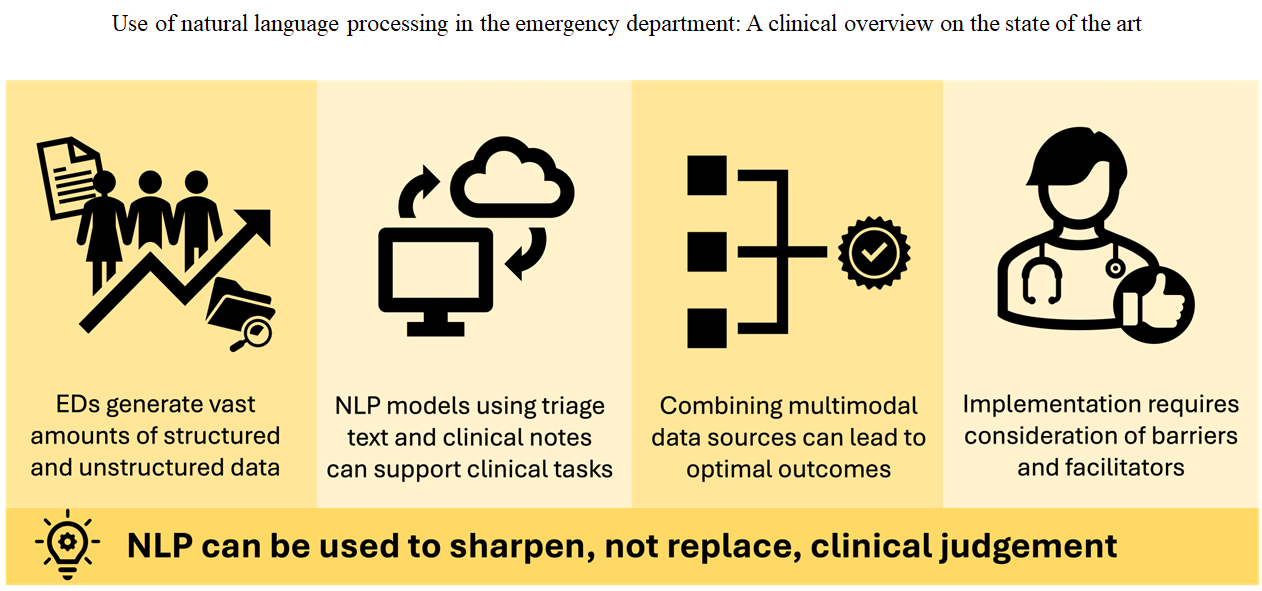
Use of natural language processing in the emergency department: A clinical overview on the state of the art

Machine learning (ML) and artificial intelligence are increasingly ubiquitous in healthcare data analytics. To date, however, ML has been largely restricted to the analysis of structured data. While natural language processing (NLP) is gaining prominence in healthcare, substantial challenges remain in the generation and analysis of unstructured data. Emergency departments, which are increasingly under-resourced and overburdened, may benefit from the implementation of ML techniques that incorporate NLP to support clinical decision-making and improve patient care. Historically, regional and cultural variations have posed significant challenges to the widespread application of ML algorithms beyond their original training datasets. The rapidly increasing use of NLP within clinical note-taking applications provides avenues to assist in standardizing unstructured data and extracting meaningful insights to improve generalization and clinical translation.
- Payne K, Risi D, O’Hare A, Binks S, Curtis K. Factors that contribute to patient length of stay in the emergency department: A time in motion observational study. Australas Emerg Care. 2023;26(4):321-325. doi: 10.1016/j.auec.2023.04.002
- National Center for Health Statistics. Emergency Department Visits. Available from: https://www.cdc.gov/nchs/fastats/ emergency-department.htm [Last accessed on 2025 Dec 04].
- Mostafa R, El-Atawi K. Strategies to measure and improve emergency department performance: A review. Cureus. 2024;16(1):e52879. doi: 10.7759/cureus.52879
- Australian Institute of Health and Welfare. Emergency Department Care. Available from: https://www.aihw.gov.au/ hospitals/topics/emergency-departments [Last accessed on 2026 Jan 02].
- Hirschberg J, Manning CD. Advances in natural language processing. Science. 2015;349(6245):261-266. doi: 10.1126/science.aaa8685
- Zhou B, Yang G, Shi Z, Ma S. Natural Language Processing for Smart Healthcare. IEEE Rev Biomed Eng. 2024;17:4-18. doi: 10.1109/rbme.2022.3210270
- Chen MC, Huang TY, Chen TY, Boonyarat P, Chang YC. Clinical narrative-aware deep neural network for emergency department critical outcome prediction. J Biomed Inform. 2023;138:104284. doi: 10.1016/j.jbi.2023.104284
- Choi SW, Ko T, Hong KJ, Kim KH. Machine learning-based prediction of Korean triage and acuity scale level in emergency department patients. Healthc Inform Res. 2019;25(4):305-312. doi: 10.4258/hir.2019.25.4.305
- Walker K, Ben-Meir M, Dunlop W, et al. Impact of scribes on emergency medicine doctors’ productivity and patient throughput: Multicentre randomised trial. BMJ. 2019;364:l121. doi: 10.1136/bmj.l121
- Pun JK, Matthiessen CM, Murray KA, Slade D. Factors affecting communication in emergency departments: Doctors and nurses’ perceptions of communication in a trilingual ED in Hong Kong. Int J Emerg Med. 2015;8(1):48. doi: 10.1186/s12245-015-0095-y.
- Manias E, Geddes F, Watson B, Jones D, Della P. Communication failures during clinical handovers lead to a poor patient outcome: Lessons from a case report. SAGE Open Med Case Rep. 2015;3:2050313X15584859. doi: 10.1177/2050313X15584859
- Microsoft. Microsoft Dragon Copilot. Available from: https:// www.microsoft.com/en-us/health-solutions/clinical-workflow/dragon-copilot [Last accessed on 2025 Jun 13].
- Abridge AI. Abridge. Available from: https://www.abridge. com [Last accessed on 2025 Jun 27].
- Suki AI. Suki Assistant. Available from: https://www.suki.ai/ suki-assistant [Last accessed on 2025 Jun 29].
- Gligorijevic D, Stojanovic J, Satz W, et al. Deep Attention Model for Triage of Emergency Department Patients. In: Proceedings of the 2018 SIAM International Conference on Data Mining. Society for Industrial and Applied Mathematics; 2018:297-305. doi: 10.1137/1.9781611975321.34
- Ivanov O, Wolf L, Brecher D, et al. Improving ED emergency severity index acuity assignment using machine learning and clinical natural language processing. J Emerg Nurs. 2021;47(2):265-278.e7. doi: 10.1016/j.jen.2020.11.001
- Kim D, Oh J, Im H, Yoon M, Park J, Lee J. Automatic classification of the Korean triage acuity scale in simulated emergency rooms using speech recognition and natural language processing: A proof of concept study. J Korean Med Sci. 2021;36(27):e175. doi: 10.3346/jkms.2021.36.e175
- Sterling NW, Brann F, Patzer RE, et al. Prediction of emergency department resource requirements during triage: An application of current natural language processing techniques. J Am Coll Emerg Phys Open. 2020;1(6):1676-1683. doi: 10.1002/emp2.12253
- Stewart J, Lu J, Goudie A, et al. Applications of natural language processing at emergency department triage: A narrative review. PLoS One. 2023;18(12):e0279953. doi: 10.1371/journal.pone.0279953
- Wang G, Liu X, Xie K, Chen N, Chen T. DeepTriager: A Neural Attention Model for Emergency Triage with Electronic Health Records. In: 2019 IEEE International Conference on Bioinformatics and Biomedicine (BIBM). IEEE; 2019:978-982. doi: 10.1109/bibm47256.2019.8983093
- Arnaud E, Elbattah M, Gignon M, Dequen G. Deep Learning to Predict Hospitalization at Triage: Integration of Structured Data and Unstructured Text. In: 2020 IEEE International Conference on Big Data (Big Data). IEEE; 2020:4836-4841. doi: 10.1109/bigdata50022.2020.9378073
- Fernandes M, Mendes R, Vieira SM, et al. Risk of mortality and cardiopulmonary arrest in critical patients presenting to the emergency department using machine learning and natural language processing. PLoS One. 2020;15(4):e0230876. doi: 10.1371/journal.pone.0230876
- Fernandes M, Mendes R, Vieira SM, et al. Predicting Intensive Care Unit admission among patients presenting to the emergency department using machine learning and natural language processing. PLoS One. 2020;15(3):e0229331. doi: 10.1371/journal.pone.0229331
- Horng S, Sontag DA, Halpern Y, Jernite Y, Shapiro NI, Nathanson LA. Creating an automated trigger for sepsis clinical decision support at emergency department triage using machine learning. PLoS One. 2017;12(4):e0174708. doi: 10.1371/journal.pone.0174708
- Joseph JW, Leventhal EL, Grossestreuer AV, et al. Deep‐learning approaches to identify critically Ill patients at emergency department triage using limited information. JACEP Open. 2020;1(5):773-781. doi: 10.1002/emp2.12218
- Roquette BP, Nagano H, Marujo EC, Maiorano AC. Prediction of admission in pediatric emergency department with deep neural networks and triage textual data. Neural Netw. 2020;126:170-177. doi: 10.1016/j.neunet.2020.03.012
- Tahayori B, Chini‐Foroush N, Akhlaghi H. Advanced natural language processing technique to predict patient disposition based on emergency triage notes. Emerg Med Australas. 2021;33(3):480-484. doi: 10.1111/1742-6723.13656
- Zhang X, Bellolio MF, Medrano-Gracia P, Werys K, Yang S, Mahajan P. Use of natural language processing to improve predictive models for imaging utilization in children presenting to the emergency department. BMC Med Inform Decis Mak. 2019;19:287. doi: 10.1186/s12911-019-1006-6
- Zhang X, Kim J, Patzer RE, Pitts SR, Chokshi FH, Schrager JD. Advanced diagnostic imaging utilization during emergency department visits in the United States: A predictive modeling study for emergency department triage. PLoS One. 2019;14(4):e0214905. doi: 10.1371/journal.pone.0214905
- Zhang X, Kim J, Patzer RE, Pitts SR, Patzer A, Schrager JD. Prediction of emergency department hospital admission based on natural language processing and neural networks. Methods Inform Med. 2017;56(05):377-389. doi: 10.3414/ME17-01-0024
- Chang D, Hong WS, Taylor RA. Generating contextual embeddings for emergency department chief complaints. JAMIA Open. 2020;3(2):160-166. doi: 10.1093/jamiaopen/ooaa022
- Greenbaum NR, Jernite Y, Halpern Y, et al. Improving documentation of presenting problems in the emergency department using a domain-specific ontology and machine learning-driven user interfaces. Int J Med Inform. 2019;132:103981. doi: 10.1016/j.ijmedinf.2019.103981
- Gupta N, Mujumdar S, Patel H, et al. Data Quality for Machine Learning Tasks. In: Proceedings of the 27th ACM SIGKDD Conference on Knowledge Discovery & Data Mining. ACM; 2021:4040-4041. doi: 10.1145/3447548.3470817
- Gao Y, Dligach D, Christensen L, et al. A scoping review of publicly available language tasks in clinical natural language processing. J Am Med Inform Assoc. 2022;29(10):1797-1806. doi: 10.1093/jamia/ocac127
- Clapp MA, Kim E, James KE, Perlis RH, Kaimal AJ, McCoy TH Jr. Natural language processing of admission notes to predict severe maternal morbidity during the delivery encounter. Am J Obstet Gynecol. 2022;227(3):511.e1-e8. doi: 10.1016/j.ajog.2022.04.008
- Durango MC, Torres-Silva EA, Orozco-Duque A. Named entity recognition in electronic health records: A methodological review. Healthc Inform Res. 2023;29(4):286-300. doi: 10.4258/hir.2023.29.4.286
- Sim JA, Huang X, Horan MR, et al. Natural language processing with machine learning methods to analyze unstructured patient-reported outcomes derived from electronic health records: A systematic review. Artif Intell Med. 2023;146:102701. doi: 10.1016/j.artmed.2023.102701
- Huang K, Altosaar J, Ranganath R. ClinicalBERT: Modeling Clinical Notes and Predicting Hospital Readmission. arXiv. Preprint posted online 2019. doi: 10.48550/arXiv.1904.05342
- Wang Y, Wang Y, Peng Z, Zhang F, Zhou L, Yang F. Medical text classification based on the discriminative pre-training model and prompt-tuning. Digit Health. 2023;9:20552076231193213. doi: 10.1177/20552076231193213
- Lyu W, Dong X, Wong R, et al. A multimodal transformer: Fusing clinical notes with structured ehr data for interpretable in-hospital mortality prediction. AMIA Annu Symp Proc. 2023;2022:719-728.
- Hayat N, Geras KJ, Shamout FE. MedFuse: Multi-Modal Fusion with Clinical Time-Series Data and Chest X-Ray Images. In: Proceedings of Machine Learning Research; 2022:479-503.
- Wang Y, Yin C, Zhang P. Multimodal risk prediction with physiological signals, medical images and clinical notes. Heliyon. 2024;10(5):e26772. doi: 10.1016/j.heliyon.2024.e26772
- AlSaad R, Abd-Alrazaq A, Boughorbel S, et al. Multimodal large language models in health care: Applications, challenges, and future outlook. J Med Internet Res. 2024;26:e59505. doi: 10.2196/59505
- Judge CS, Krewer F, O’Donnell MJ, et al. Multimodal artificial intelligence in medicine. Kidney360. 2024;5:1771-1779. doi: 10.34067/KID.0000000000000556
- Chiu CC, Wu CM, Chien TN, Kao LJ, Li C, Chu CM. Integrating structured and unstructured EHR data for predicting mortality by machine learning and latent Dirichlet allocation method. Int J Environ Res Public Health. 2023;20(5):4340. doi: 10.3390/ijerph20054340
- Atkins L, Francis J, Islam R, et al. A guide to using the Theoretical Domains Framework of behaviour change to investigate implementation problems. Implement Sci. 2017;12:77. doi: 10.1186/s13012-017-0605-9
- Ahn C. Exploring ChatGPT for information of cardiopulmonary resuscitation. Resuscitation. 2023;185:109729. doi: 10.1016/j.resuscitation.2023.109729
- Michie S, Van Stralen MM, West R. The behaviour change wheel: A new method for characterising and designing behaviour change interventions. Implement Sci. 2011;6:42. doi: 10.1186/1748-5908-6-42.
- Salwei ME, Carayon P, Hoonakker PL, et al. Workflow integration analysis of a human factors-based clinical decision support in the emergency department. Appl Ergon. 2021;97:103498. doi: 10.1016/j.apergo.2021.103498