

Predicting breast cancer prognosis using γδ T cell gene signatures

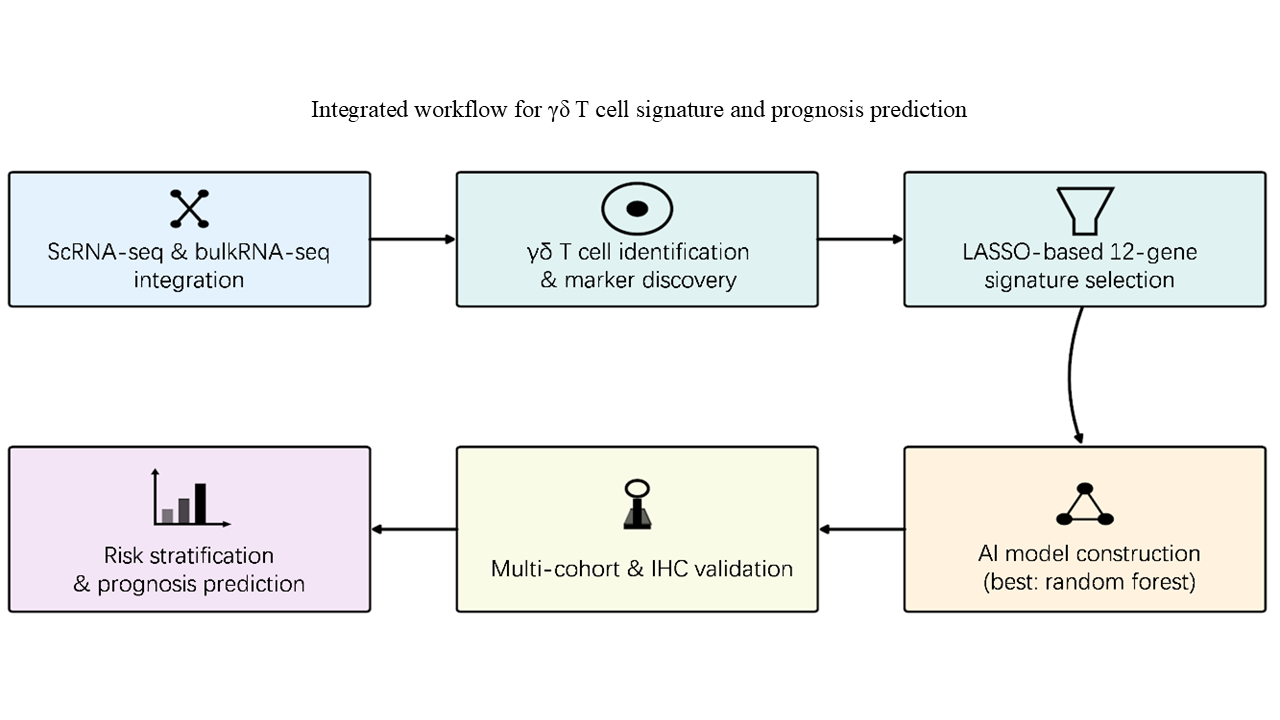
Gamma delta (γδ) T cells exert a pivotal anti-tumor role in the breast cancer (BC) tumor microenvironment, highlighting the importance of investigating their prognostic value for improved patient stratification. We analyzed single-cell ribonucleic acid sequencing data to cluster immune cells and identify marker genes. Prognostic features were selected using Least Absolute Shrinkage and Selection Operator regression in the Cancer Genome Atlas–Breast Invasive Carcinoma cohort and validated across five external Gene Expression Omnibus cohorts. The expression of these prognostic genes was further validated by immunohistochemistry (IHC) in an in-house cohort of BC patients. These selected features were used to construct machine learning models, with the best-performing model undergoing hyperparameter tuning to optimize its performance. γδ T cells were identified as one of the major immune cell populations in BC. Twelve γδ T cell-associated genes were selected based on their prognostic significance in external validation cohorts. The random forest (RF) model achieved the highest accuracy (0.835) after hyperparameter tuning. In external validation, the final model showed the highest performance with area under the curve/accuracy values of 0.81/0.849. IHC analysis confirmed dysregulated expression of key signature proteins in BC tissues. In conclusion, we developed an efficient prognostic RF model based on a 12-gene signature from γδ T cells, which may serve as a clinically valuable tool for risk stratification in BC patients.
- Britt KL, Cuzick J, Phillips KA. Key steps for effective breast cancer prevention. Nat Rev Cancer. 2020;20:417-436. doi: 10.1038/s41568-020-0266-x
- Cameron D, Piccart-Gebhart MJ, Gelber RD, et al. 11 years’ follow-up of trastuzumab after adjuvant chemotherapy in HER2-positive early breast cancer: Final analysis of the HERceptin adjuvant (HERA) trial. Lancet. 2017;389(10075):1195-1205. doi: 10.1016/S0140-6736(16)32616-2
- Emens LA. Breast cancer immunotherapy: Facts and hopes. Clin Cancer Res. 2018;24(3):511-520. doi: 10.1158/1078-0432.ccr-16-3001
- Li CW, Lim SO, Chung EM, et al. Eradication of triple-negative breast cancer cells by targeting glycosylated PD-L1. Cancer Cell. 2018;33(2):187-201.e10. doi: 10.1016/j.ccell.2018.01.009
- Roychowdhury A, Jondhale M, Saldanha E, et al. Landscape of toll-like receptors expression in tumor microenvironment of triple negative breast cancer (TNBC): Distinct roles of TLR4 and TLR8. Gene. 2021;792:145728. doi: 10.1016/j.gene.2021.145728
- Sebestyen Z, Prinz I, Déchanet-Merville J, Silva-Santos B, Kuball J. Translating gammadelta (γδ) T cells and their receptors into cancer cell therapies. Nat Rev Drug Discov. 2020;19(3):169-184. doi: 10.1038/s41573-019-0038-z
- Spiegel JY, Patel S, Muffly L, et al. CAR T cells with dual targeting of CD19 and CD22 in adult patients with recurrent or refractory B cell malignancies: a phase 1 trial. Nat Med. 2021;27(8):1419-1431. doi: 10.1038/s41591-021-01436-0
- Kabelitz D, Serrano R, Kouakanou L, Peters C, Kalyan S. Cancer immunotherapy with γδ T cells: Many paths ahead of us. Cell Mol Immunol. 2020;17(9):925-939. doi: 10.1038/s41423-020-0504-x
- Qian J, Olbrecht S, Boeckx B, et al. A pan-cancer blueprint of the heterogeneous tumor microenvironment revealed by single-cell profiling. Cell Res. 2020;30:745-762. doi: 10.1038/s41422-020-0355-0
- Van der Leun AM, Thommen DS, Schumacher TN. CD8(+) T cell states in human cancer: Insights from single-cell analysis. Nat Rev Cancer. 2020;20:218-232. doi: 10.1038/s41568-019-0235-4
- Tran KA, Kondrashova O, Bradley A, Williams ED, Pearson JV, Waddell NAO. Deep learning in cancer diagnosis, prognosis and treatment selection. Genome Med. 2021;13(1):152. doi: 10.1186/s13073-021-00968-x
- Cheng X, Li S, Deng L, et al. Predicting elevated TSH levels in the physical examination population with a machine learning model. Front Endocrinol (Lausanne). 2022;13:839829. doi: 10.3389/fendo.2022.839829
- Lu Y, Zhou Y, Qu W, Deng M, Zhang C. A lasso regression model for the construction of microRNA-target regulatory networks. Bioinformatics. 2011;27:2406-2413. doi: 10.1093/bioinformatics/btr410
- Shannon P, Markiel A, Ozier O, et al. Cytoscape: A software environment for integrated models of biomolecular interaction networks. Genome Res. 2003;13:2498-2504. doi: 10.1101/gr.1239303
- Wu T, Hu E, Xu S, et al. Clusterprofiler 4.0: A universal enrichment tool for interpreting omics data. Innovation (Camb). 2021;2(3):100141. doi: 10.1016/j.xinn.2021.100141
- Fukumura D, Kloepper J, Amoozgar Z, Duda DG, Jain RK. Enhancing cancer immunotherapy using antiangiogenics: Opportunities and challenges. Nat Rev Clin Oncol. 2018;15(5):325-340. doi: 10.1038/nrclinonc.2018.29
- Risom T, Wang X, Liang J, et al. Deregulating MYC in a model of HER2+ breast cancer mimics human intertumoral heterogeneity. J Clin Invest. 2020;130:231-246. doi: 10.1172/jci126390
- Costa-Pinheiro P, Montezuma D, Henrique R, Jerónimo C. Diagnostic and prognostic epigenetic biomarkers in cancer. Epigenomics. 2015;7(6):1003-1015. doi: 10.2217/epi.15.56
- Sammut SJ, Crispin-Ortuzar M, Chin SF, et al. Multi-omic machine learning predictor of breast cancer therapy response. Nature. 2022;601(7894):623-629. doi: 10.1038/s41586-021-04278-5
- Matsuo K, Purushotham S, Jiang B, et al. Survival outcome prediction in cervical cancer: Cox models vs deep-learning model. Am J Obstet Gynecol. 2019;220(4):381. e1-381.e14. doi: 10.1016/j.ajog.2018.12.030
- Liang X, Guan R, Zhu J, et al. A clinical decision support system to predict the efficacy for EGFR-TKIs based on artificial neural network. J Cancer Res Clin Oncol. 2023;149(13):12265-12274. doi: 10.1007/s00432-023-05104-3
- Ansari S, Navin AH, Sangar AB, Gharamaleki JV, Danishvar S. A customized efficient deep learning model for the diagnosis of acute leukemia cells based on lymphocyte and monocyte images. Electronics. 2023;12:322. doi: 10.3390/electronics12020322
- Lee J, Cho Y, Kyung Y, Kim E. Precision forecasting in colorectal oncology: Predicting Six-month survival to optimize clinical decisions. Electronics. 2025;14:880. doi: 10.3390/electronics14050880
- Verzellesi L, Botti A, Bertolini M, et al. Machine and deep learning algorithms for COVID-19 mortality prediction using clinical and radiomic features. Electronics. 2023;12:3878. doi: 10.3390/electronics12183878
- Alshamrani SS. Machine learning techniques improving the box-cox transformation in breast cancer prediction. Electronics. 2025;14:3173. doi: 10.3390/electronics14163173
- Zhang Y, Zhong F, Liu L. Single-cell transcriptional atlas of tumor-associated macrophages in breast cancer. Breast Cancer Res. 2024;26(1):129. doi: 10.1186/s13058-024-01887-6
- Lv J, Liu Z, Ren X, et al. γδ T cells a key subset of T cell for cancer immunotherapy. Front Immunol. 2025;16:1562188. doi: 10.3389/fimmu.2025.1562188
- Jin C, Lagoudas GK, Zhao C, et al. Commensal microbiota promote lung cancer development via γδ gammadelta T cells. Cell. 2019;176:998-1013.e16. doi: 10.1016/j.cell.2018.12.040
- Yan M, Wu S, Wang Y, et al. Recent progress of supramolecular chemotherapy based on host-guest interactions. Adv Mater. 2024;36(21):e2304249. doi: 10.1002/adma.202304249
- Geng H, Lin W, Liu J, Pei Q, Xie Z. Choline phosphate lipid-hitchhiked near-infrared BODIPY nanoparticles for enhanced phototheranostics. J Mater Chem B. 2023;11(24):5586-5593. doi: 10.1039/d3tb00175j
- Dai Y, Sun J, Zhang X, et al. Supramolecular assembly boosting the phototherapy performances of BODIPYs. Coord Chem Rev. 2024;517:216054. doi: 10.1016/j.ccr.2024.216054
- Hu X, Zhu H, Chen B, et al. Tubulin Alpha 1b Is associated with the immune cell infiltration and the response of HCC patients to immunotherapy. Diagnostics. 2022;12:858. doi: 10.3390/diagnostics12040858
- Fu DA, Li J, Wei J, et al. HMGB2 is associated with malignancy and regulates Warburg effect by targeting LDHB and FBP1 in breast cancer. Cell Commun Signal. 2018;16(1):8. doi: 10.1186/s12964-018-0219-0