
Artificial intelligence in health sciences education: A mini-review of clinical reasoning development and educator perceptions

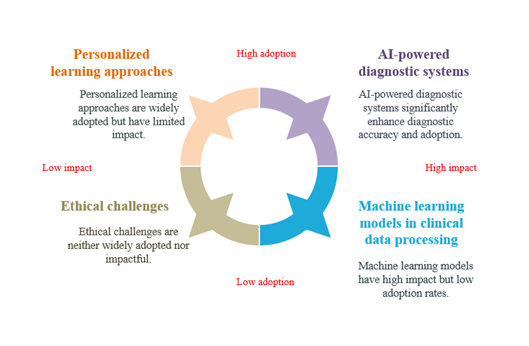
Clinical reasoning forms the basis of practice in the health sciences, enabling professionals to collect and interpret patient data to support sound clinical decisions. Artificial intelligence (AI) and machine learning (ML) have emerged as strong tools, revolutionizing diagnosis, personalizing treatment, and enhancing therapeutic outcomes. However, very little research has been conducted concerning health sciences educators’ perceptions regarding AI and its role in clinical reasoning skill development. This mini-review examines AI’s growing prevalence in health sciences education, as well as the challenges and opportunities it presents. A systematic search of the scholarly literature identified studies related to AI applications in the teaching and learning of clinical reasoning. A number of recurring themes emerged from these analyses, including the potential for AI to transform the training of clinical skills, the ethical implications associated with AI implementation, contributions from the field of ML to clinical data analysis, and innovations in educational assessment. Thus, these findings highlight the need for ethical frameworks, interdisciplinary collaborations, and sustained research to enhance the benefits of AI. Proper integration of AI in health sciences education would significantly assist students in improving their clinical reasoning skills, enabling them to become competent practitioners so that, ultimately, patients may benefit in an increasingly digital health environment.
- García-Castro G, Ruiz-Ortega FJ. Clinical reasoning and medical education: Scoping review. Educ Méd. 2021;22(2):106-110. doi: 10.1016/j.edumed.2020.11.015
- Bohr A, Memarzadeh K. The rise of artificial intelligence in healthcare applications. Artif Intell Health. 2020:25-60. doi: 10.1016/B978-0-12-818438-7.00002-2
- Bhutoria A. Personalized education and artificial intelligence in the United States, China, and India: A systematic review using a human-in-the-loop model. Comput Educ Artif Intell. 2022;3:100068. doi: 10.1016/j.caeai.2022.100068
- Mansourzadeh A, Rasouli S. The Future of Medical Education: A Review of the Opportunities and Challenges of Artificial Intelligence Integration. Med Edu Bull. Paris: Paris Nanterre University; 2024;5(2)973-982. doi: 10.22034/meb.2024.491888.1102
- Meskó B, Görög M. A short guide for medical professionals in the era of artificial intelligence. Npj Digit Med. 2020;3(1):126. doi: 10.1038/s41746-020-00333-z
- Huang CJ, Wu T, Lu JT, et al. Developing a medical artificial intelligence course for high school students. In: International Forum on Medical Imaging in Asia 2021. Vol 11792. United States: SPIE; 2021:103-108. doi: 10.1117/12.2590769
- Alcantara MF, Cao Y, Liu B, et al. eRx - a technological advance to speed-up TB diagnostics. Smart Health. 2020;16:100117. doi: 10.1016/j.smhl.2020.100117
- Sadhasivam J, Rathore A, Bose I, Bhattacharjee S, Jayavel S. A survey on machine learning algorithms. Int J Eng Trends Technol. 2020;68(4):64-71.
- Abdullah R, Fakieh B. Health care employees’ perceptions of the use of artificial intelligence applications: Survey study. J Med Internet Res. 2020;22(5):e17620. doi: 10.2196/17620
- Sapci AH, Sapci HA. Artificial intelligence education and tools for medical and health informatics students: Systematic review. JMIR Med Educ. 2020;6(1):e19285. doi: 10.2196/19285
- Rowe JP, Lester JC. Artificial intelligence for personalized preventive adolescent healthcare. J Adolesc Health. 2020;67(2 Suppl):S52-S58. doi: 10.1016/j.jadohealth.2020.02.021
- Thompson CL, Morgan HM. Ethical barriers to artificial intelligence in the national health service, United Kingdom of Great Britain and Northern Ireland. Bull World Health Organ. 2020;98(4):293-295. doi: 10.2471/BLT.19.237230
- Brown P, Jones A, Davies J. Shall I tell my mentor? Exploring the mentor-student relationship and its impact on students’ raising concerns on clinical placement. J Clin Nurs. 2020;29(17-18):3298-3310. doi: 10.1111/jocn.15356
- Chen L, Kong D, Zhang S, Yang L. A quasi-experimental study of specialized training on the clinical decision-making skills and social problem-solving abilities of nursing students. Contemp Nurse. 2021;57:4-12. doi: 10.1080/10376178.2021.1912616
- Zidaru T, Morrow EM, Stockley R. Ensuring patient and public involvement in the transition to AI-assisted mental health care: A systematic scoping review and Agenda for design justice. Health Expect. 2021;24(4):1072-1124. doi: 10.1111/hex.13299
- Nagasaki K, Nishizaki Y, Nojima M, et al. Validation of the general medicine in-training examination using the professional and linguistic assessments board examination among postgraduate residents in Japan. Int J Gen Med. 2021;14:6487-6495. doi: 10.2147/IJGM.S331173
- Teng M, Singla R, Yau O, et al. Health care students’ perspectives on artificial intelligence: Countrywide survey in Canada. JMIR Med Educ. 2022;8(1):e33390. doi: 10.2196/33390
- Kaswan KS, Dhatterwal JS, Balyan A. Intelligent Agents Based Integration of Machine Learning and Case Base Reasoning System. In: 2022 2nd International Conference on Advance Computing and Innovative Technologies in Engineering (ICACITE). 2022:1477-1481. doi: 10.1109/ICACITE53722.2022.9823890
- Evans T, Retzlaff CO, Geißler C, et al. The explainability paradox: Challenges for xAI in digital pathology. Future Gener Comput Syst. 2022;133:281-296. doi: 10.1016/j.future.2022.03.009
- Guerrero DT, Asaad M, Rajesh A, Hassan A, Butler CE. Advancing surgical education: The use of artificial intelligence in surgical training. Am Surg. 2023;89(1):49-54. doi: 10.1177/00031348221101503
- King H, Wright J, Treanor D, Williams B, Randell R. What works where and how for uptake and impact of artificial intelligence in pathology: Review of theories for a realist evaluation. J Med Internet Res. 2023;25(1):e38039. doi: 10.2196/38039
- Weidener L, Fischer M. Artificial intelligence teaching as part of medical education: Qualitative analysis of expert interviews. JMIR Med Educ. 2023;9:e46428. doi: 10.2196/46428
- Wysocki O, Davies JK, Vigo M, et al. Assessing the communication gap between AI models and healthcare professionals: Explainability, utility and trust in AI-driven clinical decision-making. Artif Intell. 2023;316:103839. doi: 10.1016/j.artint.2022.103839
- O’Connor S, Yan Y, Thilo FJS, Felzmann H, Dowding D, Lee JJ. Artificial intelligence in nursing and midwifery: A systematic review. J Clin Nurs. 2023;32(13-14):2951-2968. doi: 10.1111/jocn.16478
- Hui ML, Sacoransky E, Chung A, Kwan BY. Exploring the integration of artificial intelligence in radiology education: A scoping review. Curr Probl Diagn Radiol. 2024;54: 332-338. doi: 10.1067/j.cpradiol.2024.10.012
- Li Q, Qin Y. AI in medical education: Medical student perception, curriculum recommendations and design suggestions. BMC Med Educ. 2023;23(1):852. doi: 10.1186/s12909-023-04700-8
- Risana V, Shirin A, Purayil R, et al. Artificial intelligence and pharmacy education: A survey to assess the knowledge, application, and perspective of B. Pharm. Students from India. Discov Educ. 2024;3:213. doi: 10.1007/s44217-024-00297-2
- Ghimire A, Prather J, Edwards J. Generative AI in Education: A Study of Educators’ Awareness, Sentiments, and Influencing Factors. arXiv. Preprint posted online 2024. doi: 10.48550/arXiv.2403.15586
- Božić V. The role of artificial intelligence in increasing the health literacy of patients. Int J Digi Health Patient Care. 2024;1(1):1-21. doi: 10.5281/zenodo.12593108
- Salih SM. Perceptions of faculty and students about use of artificial intelligence in medical education: A qualitative study. Cureus. 2024;16(4):e57605. doi: 10.7759/cureus.57605
- Chen Y, Qi H, Qiu Y, et al. Artificial intelligence in medical problem-based learning: Opportunities and challenges. Glob Med Educ. 2024:1-9. doi: 10.1515/gme-2024-0015
- Bowers P, Graydon K, Ryan T, Lau J, Tomlin D. Artificial intelligence-driven virtual patients for communication skill development in healthcare students: A scoping review. Australas J Educ Technol. 2024;40:39-57. doi: 10.14742/ajet.9307
- Alkhaaldi SMI, Kassab CH, Dimassi Z, et al. Medical student experiences and perceptions of chatGPT and artificial intelligence: Cross-sectional study. JMIR Med Educ. 2023;9(1):e51302. doi: 10.2196/51302
- Kim S, Kim SH, Kim H, Lee YM. Integrating artificial intelligence into medical curricula: Perspectives of faculty and students in South Korea. Korean J Med Educ. 2025;37(1):65-70. doi: 10.3946/kjme.2025.324
- Ahmed H, Akber N, Saleem M, Ahmed F, Yasmeen R, Ali L. The application of AI in clinical nursing, yields several advantageous outcomes. Indus J Biosci Res. 2025;3(2): 591-599. doi: 10.70749/ijbr.v3i2.731
- Nakamura Y. Japanese cross-ministerial strategic innovation promotion program “innovative AI hospital system”; How will the 4th industrial revolution affect our health and medical care system? JMA J. 2022;5(1):1-8. doi: 10.31662/jmaj.2021-0133
- Tangsrivimol JA, Schonfeld E, Zhang M, et al. Artificial intelligence in neurosurgery: A state-of-the-art review from past to future. Diagnostics (Basel). 2023;13(14):2429. doi: 10.3390/diagnostics13142429
- Khizar A. Artificial intelligence and neurosurgery: A revolution in the field. Pak J Neurol Sci. 2024;18(04):244. doi: 10.56310/pjns.v18i04.244
- Malik AR, Pratiwi Y, Andajani K, et al. Exploring artificial intelligence in academic essay: Higher education student’s perspective. Int J Educ Res Open. 2024;5:100296. doi: 10.1016/j.ijedro.2023.100296
- Božić V. The Role of Artificial Intelligence in Increasing the Digital Literacy of Healthcare Workers and Standardization of Healthcare. Research Gate. Preprint posted online 2023. doi: 10.13140/RG.2.2.30715.80165/1