
Organoid-derived extracellular vesicles: From organoid, to organoid

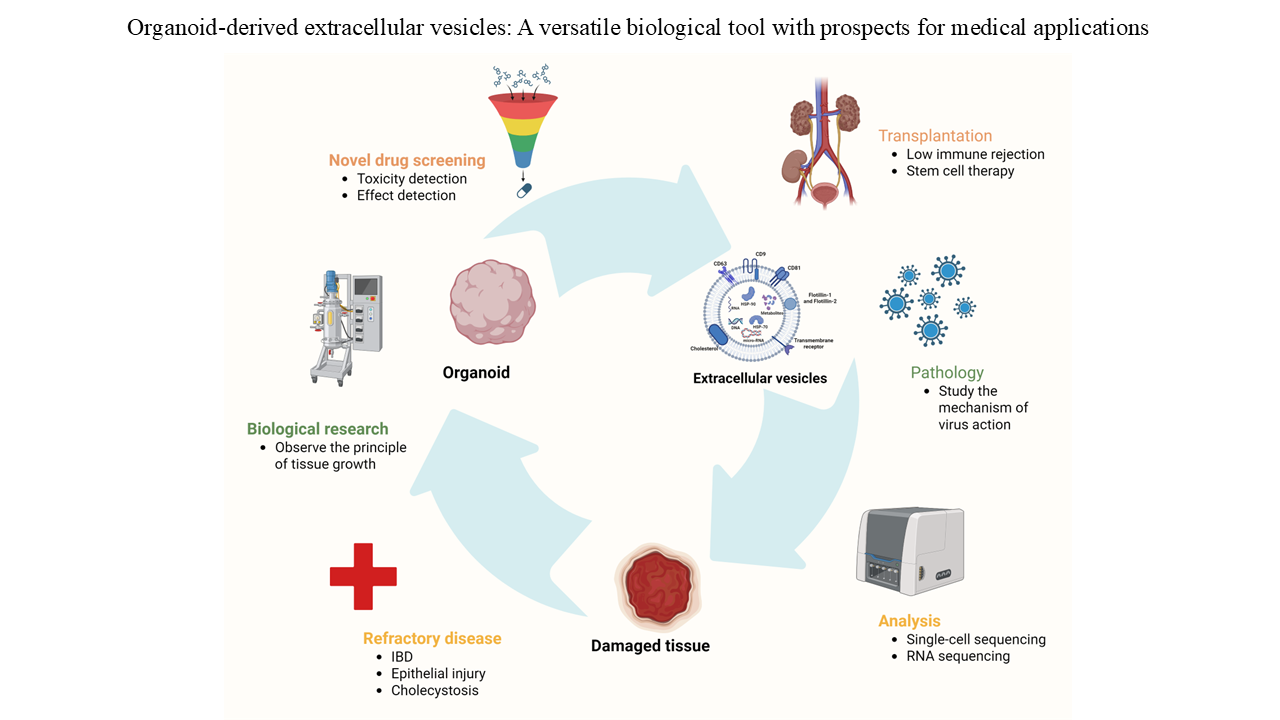
Organoids are miniature, three-dimensional tissue constructs generated from stem cells or primary cells that recapitulate key structural and functional features similar to those of in situ organs. Extracellular vesicles (EVs) are non-replicating nanocarriers enclosed by a phospholipid bilayer (20–400 nm) that mediate the delivery of bioactive substances. Organoid-derived EVs (OEVs) are easier to produce than conventional EVs and exhibit enhanced biological functions. Given that organoids retain stem cell-like characteristics, the transportation of bioactive substances by OEVs shows broad prospects in medical applications. This article examines the development, concepts, construction methods, and applications of organoids, providing an overview of their types, research progress, and advantages. The review also outlines the basic biological features of EVs and their potential applications in disease treatment and intervention. Furthermore, we examine the key distinctions between OEVs and conventional EVs. Finally, this review summarizes the advantages and challenges of OEVs and outlines their future prospects in disease treatment.
- Cano A, Ettcheto M, Bernuz M, et al. Extracellular vesicles, the emerging mirrors of brain physiopathology. Int J Biol Sci. 2023;19(3):721-743. doi: 10.7150/ijbs.79063
- Doyle LM, Wang MZ. Overview of extracellular vesicles, their origin, composition, purpose, and methods for exosome isolation and analysis. Cells. 2019;8(7):727. doi: 10.3390/cells8070727
- Liu H, Geng Z, Su J. Engineered mammalian and bacterial extracellular vesicles as promising nanocarriers for targeted therapy. Extracell Vesicles Circ Nucleic Acids. 2022;3(2):63-86. doi: 10.20517/evcna.2022.04
- Maas SLN, Breakefield XO, Weaver AM. Extracellular vesicles: Unique intercellular delivery vehicles. Trends Cell Biol. 2017;27(3):172-188. doi: 10.1016/j.tcb.2016.11.003
- Kumar MA, Baba SK, Sadida HQ, et al. Extracellular vesicles as tools and targets in therapy for diseases. Signal Transduct Target Ther. 2024;9(1):27. doi: 10.1038/s41392-024-01735-1
- Chutkan H, MacDonald I, Manning A, Kuehn MJ. Quantitative and Qualitative Preparations of Bacterial Outer Membrane Vesicles. In: Methods in Molecular Biology. Humana Press; 2012:259-272. doi: 10.1007/978-1-62703-245-2-16
- Ji N, Wang F, Wang M, Zhang W, Liu H, Su J. Engineered bacterial extracellular vesicles for central nervous system diseases. J Control Release. 2023;364:46-60. doi: 10.1016/j.jconrel.2023.10.027
- Su Y, Sun X, Liu X, et al. hUC-EVs-ATO reduce the severity of acute GVHD by resetting inflammatory macrophages toward the M2 phenotype. J Hematol Oncol. 2022;15(1):99. doi: 10.1186/s13045-022-01315-2
- Zaborowski MŁP, Balaj L, Breakefield XO, Lai CP. Extracellular vesicles: Composition, biological relevance, and methods of study. Bioscience. 2015;65(8):783-797. doi: 10.1093/biosci/biv084
- Zhou G, Li R, Sheng S, et al. Organoids and organoid extracellular vesicles-based disease treatment strategies. J Nanobiotechnol. 2024;22(1):679. doi: 10.1186/s12951-024-02917-3
- Yi SA, Zhang Y, Rathnam C, Pongkulapa T, Lee KB. Bioengineering approaches for the advanced organoid research. Adv Mater. 2021;33(45):2007949. doi: 10.1002/adma.202007949
- Rossi G, Manfrin A, Lutolf MP. Progress and potential in organoid research. Nat Rev Genet. 2018;19(11):671-687. doi: 10.1038/s41576-018-0051-9
- Garreta E, Kamm RD, Chuva De Sousa Lopes SM, et al. Rethinking organoid technology through bioengineering. Nat Mater. 2021;20(2):145-155. doi: 10.1038/s41563-020-00804-4
- Mei J, Liu X, Tian HX, et al. Tumour organoids and assembloids: Patient-derived cancer avatars for immunotherapy. Clin Transl Med. 2024;14(4):e1656. doi: 10.1002/ctm2.1656
- Jiang X, Oyang L, Peng Q, et al. Organoids: Opportunities and challenges of cancer therapy. Front Cell Dev Biol. 2023;11:1232528. doi: 10.3389/fcell.2023.1232528
- Anania C. Human intestinal immuno-organoids. Nat Genet. 2024;56(9):1765. doi: 10.1038/s41588-024-01927-z
- Yang Q, Li M, Yang X, et al. Flourishing tumor organoids: History, emerging technology, and application. Bioeng Transl Med. 2023;8(5):e10559. doi: 10.1002/btm2.10559
- Sakaguchi H. Self-organization and applications of neural organoids. Eur J Cell Biol. 2025;104(2):151496. doi: 10.1016/j.ejcb.2025.151496
- Bai L, Wu Y, Li G, Zhang W, Zhang H, Su J. AI-enabled organoids: Construction, analysis, and application. Bioact Mater. 2023;31:525-548. doi: 10.1016/j.bioactmat.2023.09.005
- Srivastava V, Huycke TR, Phong KT, Gartner ZJ. Organoid models for mammary gland dynamics and breast cancer. Curr Opin Cell Biol. 2020;66:51-58. doi: 10.1016/j.ceb.2020.05.003
- Liang X, Li C, Song J, et al. HucMSC-exo promote mucosal healing in experimental colitis by accelerating intestinal stem cells and epithelium regeneration via wnt signaling pathway. Int J Nanomedicine. 2023;18:2799-2818. doi: 10.2147/IJN.S402179
- Liu H, Song P, Zhang H, et al. Synthetic biology-based bacterial extracellular vesicles displaying BMP-2 and CXCR4 to ameliorate osteoporosis. J Extracell Vesicles. 2024;13(4):e12429. doi: 10.1002/jev2.70095
- Yang Y, Kong Y, Cui J, Hou Y, Gu Z, Ma C. Advances and applications of cancer organoids in drug screening and personalized medicine. Stem Cell Rev Rep. 2024;20(5): 1213-1226. doi: 10.1007/s12015-024-10714-6
- Corrò C, Novellasdemunt L, Li VSW. A brief history of organoids. Am J Physiol Cell Physiol. 2020;319(3):C575-C582. doi: 10.1152/ajpcell.00120.2020
- Verstegen MMA, Coppes RP, Beghin A, et al. Clinical applications of human organoids. Nat Med. 2025;31(2): 409-421. doi: 10.1038/s41591-024-03489-3
- Tang XY, Wu S, Wang D, et al. Human organoids in basic research and clinical applications. Signal Transduct Target Ther. 2022;7(1):168. doi: 10.1038/s41392-022-01024-9
- Gopallawa I, Gupta C, Jawa R, et al. Applications of organoids in advancing drug discovery and development. J Pharm Sci. 2024;113(9):2659-2667. doi: 10.1016/j.xphs.2024.06.016
- Hong ZX, Zhu ST, Li H, et al. Bioengineered skin organoids: From development to applications. Mil Med Res. 2023;10(1):40. doi: 10.1186/s40779-023-00475-7
- Clevers H. Modeling development and disease with organoids. Cell. 2016;165(7):1586-1597. doi: 10.1016/j.cell.2016.05.082
- Liu H, Zhang Q, Wang S, et al. Bacterial extracellular vesicles as bioactive nanocarriers for drug delivery: Advances and perspectives. Bioact Mater. 2022;14:169-181. doi: 10.1016/j.bioactmat.2021.12.006
- Record M, Carayon K, Poirot M, Silvente-Poirot S. Exosomes as new vesicular lipid transporters involved in cell-cell communication and various pathophysiologies. Biochim Biophys Acta. 2014;1841(1):108-120. doi: 10.1016/j.bbalip.2013.10.004
- Schwechheimer C, Kuehn MJ. Outer-membrane vesicles from Gram-negative bacteria: Biogenesis and functions. Nat Rev Microbiol. 2015;13(10):605-619. doi: 10.1038/nrmicro3525
- Pérez-Cruz C, Delgado L, López-Iglesias C, Mercade E. Outer-inner membrane vesicles naturally secreted by gram-negative pathogenic bacteria. PLoS One. 2015;10(1):e0116896. doi: 10.1371/journal.pone.0116896
- Almousa S, Kim S, Kumar A, et al. Bacterial nanovesicles as interkingdom signaling moieties mediating pain hypersensitivity. ACS Nano. 2025;19(3):3210-3225. doi: 10.1021/acsnano.4c10529
- Xu H, Li W, Yue H, et al. S100B induces angiogenesis via the clathrin/FOXO1/β-catenin signaling pathway and contributes to Bevacizumab resistance in epithelial ovarian cancer. J Adv Res. 2025. doi: 10.1016/j.jare.2025.05.060
- Moghaddam ZS, Dehghan A, Halimi S, et al. Bacterial extracellular vesicles: Bridging pathogen biology and therapeutic innovation. Acta Biomater. 2025;200:1-20. doi: 10.1016/j.actbio.2025.05.028
- Toyofuku M, Schild S, Kaparakis-Liaskos M, Eberl L. Composition and functions of bacterial membrane vesicles. Nat Rev Microbiol. 2023;21(7):415-430. doi: 10.1038/s41579-023-00875-5
- Melo-Marques I, Cardoso SM, Empadinhas N. Bacterial extracellular vesicles at the interface of gut microbiota and immunity. Gut Microbes. 2024;16(1):2396494. doi: 10.1080/19490976.2024.2396494
- Skotland T, Llorente A, Sandvig K. Lipids in extracellular vesicles: What can be learned about membrane structure and function? Cold Spring Harb Perspect Biol. 2023;15(8):a041415. doi: 10.1101/cshperspect.a041415
- Liu JH, Chen CY, Liu ZZ, et al. Extracellular vesicles from child gut microbiota enter into bone to preserve bone mass and strength. Adv Sci (Weinh). 2021;8(9):2004831. doi: 10.1002/advs.202004831
- Prados-Rosales R, Brown L, Casadevall A, Montalvo- Quirós S, Luque-Garcia JL. Isolation and identification of membrane vesicle-associated proteins in Gram-positive bacteria and mycobacteria. MethodsX. 2014;1:124-129. doi: 10.1016/j.mex.2014.08.001
- Vanaja SK, Russo AJ, Behl B, et al. Bacterial outer membrane vesicles mediate cytosolic localization of LPS and caspase-11 activation. Cell. 2016;165(5):1106-1119. doi: 10.1016/j.cell.2016.04.015
- Lee EY, Bang JY, Park GW, et al. Global proteomic profiling of native outer membrane vesicles derived from Escherichia coli. Proteomics. 2007;7(17):3143-3153. doi: 10.1002/pmic.200700196
- Manabe T, Kato M, Ueno T, Kawasaki K. Flagella proteins contribute to the production of outer membrane vesicles from Escherichia coli W3110. Biochem Biophys Res Commun. 2013;441(1):151-156. doi: 10.1016/j.bbrc.2013.10.022
- Jang KS, Sweredoski MJ, Graham RL, Hess S, Clemons WM Jr. Comprehensive proteomic profiling of outer membranevesiclesfrom Campylobacterjejuni. J Proteomics. 2014;98: 90-98. doi: 10.1016/j.jprot.2013.12.014
- Xie J, Li Q, Haesebrouck F, Van Hoecke L, Vandenbroucke RE. The tremendous biomedical potential of bacterial extracellular vesicles. Trends Biotechnol. 2022;40(10): 1173-1194. doi: 10.1016/j.tibtech.2022.03.005
- Díaz-Garrido N, Badia J, Baldomà L. Microbiota-derived extracellular vesicles in interkingdom communication in the gut. J Extracell Vesicles. 2021;10(13):e12161. doi: 10.1002/jev2.12161
- Van Niel G, D’Angelo G, Raposo G. Shedding light on the cell biology of extracellular vesicles. Nat Rev Mol Cell Biol. 2018;19(4):213-228. doi: 10.1038/nrm.2017.125
- Zhao X, Wei Y, Bu Y, Ren X, Dong Z. Review on bacterial outer membrane vesicles: Structure, vesicle formation, separation and biotechnological applications. Microb Cell Fact. 2025;24(1):27. doi: 10.1186/s12934-025-02653-9
- Clua-Ferré L, Suau R, Vañó-Segarra I, Ginés I, Serena C, Manyé J. Therapeutic potential of mesenchymal stem cell-derived extracellular vesicles: A focus on inflammatory bowel disease. Clin Transl Med. 2024;14(11):e70075. doi: 10.1002/ctm2.70075
- Joshi BS, De Beer MA, Giepmans BNG, Zuhorn IS. Endocytosis of extracellular vesicles and release of their cargo from endosomes. ACS Nano. 2020;14(4):4444-4455. doi: 10.1021/acsnano.9b10033
- Zhu G, Yang F, Wei H, et al. 90 K increased delivery efficiency of extracellular vesicles through mediating internalization. J Control Release. 2023;353:930-942. doi: 10.1016/j.jconrel.2022.12.034
- Geng Z, Sun T, Yuan L, Zhao Y. The existing evidence for the use of extracellular vesicles in the treatment of osteoporosis: A review. Int J Surg. 2025;111(5):3414-3429. doi: 10.1097/JS9.0000000000002339
- Haertinger M, Weiss T, Mann A, Tabi A, Brandel V, Radtke C. Adipose stem cell-derived extracellular vesicles induce proliferation of Schwann cells via internalization. Cells. 2020;9(1):163. doi: 10.3390/cells9010163
- Yuan X, Sun L, Jeske R, et al. Engineering extracellular vesicles by three-dimensional dynamic culture of human mesenchymal stem cells. J Extracell Vesicles. 2022;11(6):e12235. doi: 10.1002/jev2.12235
- Carter K, Lee HJ, Na KS, et al. Characterizing the impact of 2D and 3D culture conditions on the therapeutic effects of human mesenchymal stem cell secretome on corneal wound healing in vitro and ex vivo. Acta Biomater. 2019;99:247-257. doi: 10.1016/j.actbio.2019.09.022
- Sun L, Ji Y, Chi B, et al. A 3D culture system improves the yield of MSCs-derived extracellular vesicles and enhances their therapeutic efficacy for heart repair. Biomed Pharmacother. 2023;161:114557. doi: 10.1016/j.biopha.2023.114557
- Sugimoto A, Okuno T, Miki Y, et al. EMMPRIN in extracellular vesicles from peritoneal mesothelial cells stimulates the invasion activity of diffuse-type gastric cancer cells. Cancer Lett. 2021;521:169-177. doi: 10.1016/j.canlet.2021.08.031
- Prieto-Vila M, Yoshioka Y, Kuriyama N, et al. Adult cardiomyocytes-derived EVs for the treatment of cardiac fibrosis. J Extracell Vesicles. 2024;13(7):e12461. doi: 10.1002/jev2.12461
- Yang L, Zhai Y, Hao Y, Zhu Z, Cheng G. The regulatory functionality of exosomes derived from hUMSCs in 3D culture for Alzheimer’s disease therapy. Small. 2020;16(3):e1906273. doi: 10.1002/smll.201906273
- Zinger A, Cvetkovic C, Sushnitha M, et al. Humanized biomimetic nanovesicles for neuron targeting. Adv Sci (Weinh). 2021;8(19):2101437. doi: 10.1002/advs.202101437
- Zhou J, Flores-Bellver M, Pan J, et al. Human retinal organoids release extracellular vesicles that regulate gene expression in target human retinal progenitor cells. Sci Rep. 2021;11(1):21128. doi: 10.1038/s41598-021-00542-w
- Arthur P, Kan doi S, Sun L, et al. Biophysical, molecular and proteomic profiling of human retinal organoid-derived exosomes. Pharm Res. 2023;40(4):801-816. doi: 10.1007/s11095-022-03350-7
- Alhasan L, Qi A, Al-Abboodi A, et al. Rapid enhancement of cellular spheroid assembly by acoustically driven microcentrifugation. ACS Biomater Sci Eng. 2016;2(6): 1013-1022. doi: 10.1021/acsbiomaterials.6b00144
- Villard A, Boursier J, Andriantsitohaina R. Microbiota-derived extracellular vesicles and metabolic syndrome. Acta Physiol (Oxf). 2021;231(4):e13600. doi: 10.1111/apha.13600
- Xing X, Han S, Cheng G, Ni Y, Li Z, Li Z. Proteomic analysis of exosomes from adipose-derived mesenchymal stem cells: A novel therapeutic strategy for tissue injury. Biomed Res Int. 2020;2020:6094562. doi: 10.1155/2020/6094562
- Schuster M, Braun FK, Chiang DM, et al. Extracellular vesicles secreted by 3D tumor organoids are enriched for immune regulatory signaling biomolecules compared to conventional 2D glioblastoma cell systems. Front Immunol. 2024;15:1388769. doi: 10.3389/fimmu.2024.1388769
- Proaño-Pérez E, Serrano-Candelas E, Guerrero M, et al. MITF regulates autophagy and extracellular vesicle cargo in gastrointestinal stromal tumors. Mol Biomed. 2025;6:92. doi: 10.1186/s43556-025-00329-9
- Upadhya R, Zingg W, Shetty S, Shetty AK. Astrocyte-derived extracellular vesicles: Neuroreparative properties and role in the pathogenesis of neurodegenerative disorders. J Control Release. 2020;323:225-239. doi: 10.1016/j.jconrel.2020.04.017
- Chansaenroj A, Adine C, Charoenlappanit S, et al. Magnetic bioassembly platforms towards the generation of extracellular vesicles from human salivary gland functional organoids for epithelial repair. Bioact Mater. 2022;18:151-163. doi: 10.1016/j.bioactmat.2022.02.007
- Roush S, Slack FJ. The let-7 family of microRNAs. Trends Cell Biol. 2008;18(10):505-516. doi: 10.1016/j.tcb.2008.07.007
- Kwak S, Song CL, Lee J, et al. Development of pluripotent stem cell-derived epidermal organoids that generate effective extracellular vesicles in skin regeneration. Biomaterials. 2024;307:122522. doi: 10.1016/j.biomaterials.2024.122522
- Herrmann IK, Wood MJA, Fuhrmann G. Extracellular vesicles as a next-generation drug delivery platform. Nat Nanotechnol. 2021;16(7):748-759. doi: 10.1038/s41565-021-00931-2
- Zhang Y, Dou Y, Liu Y, et al. Advances in therapeutic applications of extracellular vesicles. Int J Nanomedicine. 2023;18:3285-3307. doi: 10.2147/ijn.s409588
- Elsharkasy OM, Nordin JZ, Hagey DW, et al. Extracellular vesicles as drug delivery systems: Why and how? Adv Drug Deliv Rev. 2020;159:332-343. doi: 10.1016/j.addr.2020.04.004
- Liu H, Zhang H, Han Y, Hu Y, Geng Z, Su J. Bacterial extracellular vesicles-based therapeutic strategies for bone and soft tissue tumors therapy. Theranostics. 2022;12(15):6576-6594. doi: 10.7150/thno.78034
- Wu Y, Song P, Wang M, Liu H, Jing Y, Su J. Extracellular derivatives for bone metabolism. J Adv Res. 2024;66: 329-347. doi: 10.1016/j.jare.2024.01.011
- Liu H, Su J. Organoid extracellular vesicle-based therapeutic strategies for bone therapy. Biomater Transl. 2023;4(4): 199-212. doi: 10.12336/biomatertransl.2023.04.002
- Nemati M, Singh B, Mir RA, et al. Plant-derived extracellular vesicles: A novel nanomedicine approach with advantages and challenges. Cell Commun Signal. 2022;20(1):69. doi: 10.1186/s12964-022-00889-1
- Rutter BD, Innes RW. Extracellular vesicles isolated from the leaf apoplast carry stress-response proteins. Plant Physiol. 2017;173(1):728-741. doi: 10.1104/pp.16.01253