
Multi-objective collaborative optimization of preparation process parameters for continuous carbon fiber–reinforced polyamide prepreg based on neural network

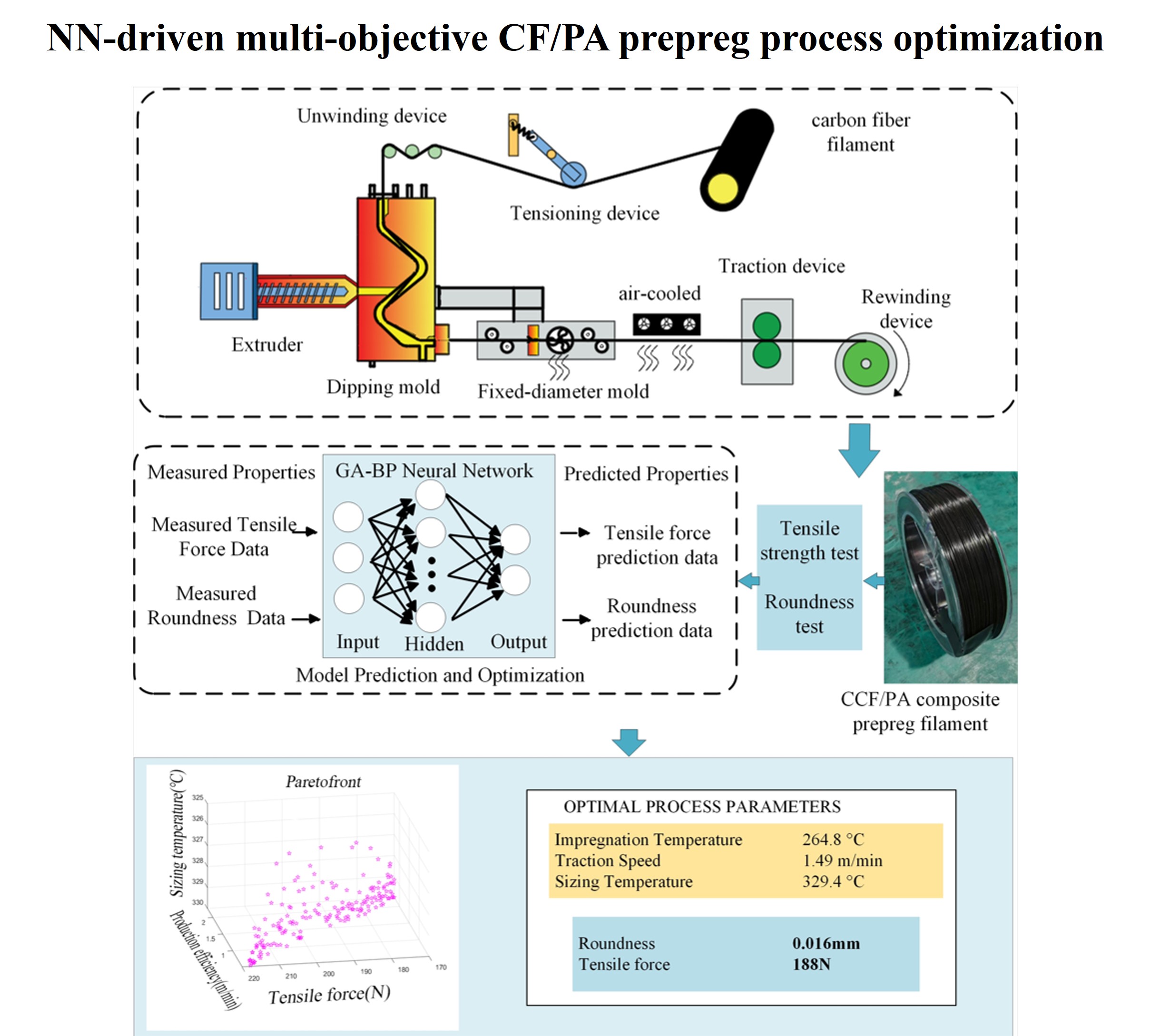
Continuous prepreg filament fabrication involves complex interactions between process parameters and forming performance, limiting the effectiveness of conventional optimization methods. This work investigates continuous carbon fiber–reinforced polyamide (CCF/PA) prepreg filaments using a self‑developed platform to evaluate these interactions and address these limitations. Thirty‑group process‑performance data were obtained via customized orthogonal‑like experiments with three process inputs and two performance outputs. A backpropagation (BP) neural network was built, and a genetic algorithm (GA) was employed to optimize its initial weights and thresholds for constructing a GA–BP prediction model. On this basis, nondominated sorting genetic algorithm II (NSGA‑II) was adopted for process multi‑objective optimization to balance production efficiency, mechanical properties, and dimensional quality. The results indicate that the proposed GA–BP model achieved high prediction accuracy, with determination coefficients (R2) of 0.964 and 0.945 for tensile force and roundness, respectively. The multi-objective optimization yielded an impregnation temperature of 264.8 °C, a traction speed of 1.49 m/min, and a sizing temperature of 329.4 °C. Experimental validation shows that the optimized prepreg filament achieved a tensile strength of 1,381 MPa and a roundness of 0.016 mm, consistent with the model predictions. The proposed coupled optimization system provides an innovative and efficient technical route for the high-precision fabrication of thermoplastic composite prepreg filaments. It can effectively reduce repetitive trial-production costs, stabilize the tensile mechanical properties and dimensional roundness of prepreg filaments, and offer a universal data-driven optimization strategy for the large-scale industrial production of thermoplastic prepreg filaments.
- Karataş M, Gökkaya H. A review on machinability of carbon fiber reinforced polymer (CFRP) and glass fiber reinforced polymer (GFRP) composite materials. Def Technol. 2018;14(4):318-326. doi: 10.1016/j.dt.2018.02.001
- Zhang J, Lin G, Vaidya U, Wang H. Past, present and future prospective of global carbon fibre composite developments and applications. Compos Part B Eng. 2023;250:110463. doi: 10.1016/j.compositesb.2022.110463
- Li S, Cheng P, Ahzi S, et al. Advances in hybrid fibers reinforced polymer-based composites prepared by FDM: A review on mechanical properties and prospects. Compos Commun. 2023;40:101592. doi: 10.1016/j.coco.2023.101592
- Smith WC, Dean RW. Structural characteristics of fused deposition modeling polycarbonate material. Polym Test. 2013;32(8):1306-1312. doi: 10.1016/j.polymertesting.2013.07.014
- Melocchi A, Parietti F, Maroni A, Foppoli A, Gazzaniga A, Zema L. Hot-melt extruded filaments based on pharmaceutical grade polymers for 3D printing by fused deposition modeling. Int J Pharm 2016;509(1-2):255-263. doi: 10.1016/j.ijpharm.2016.05.036
- Tian X, Todoroki A, Liu T, et al. 3D printing of continuous fiber reinforced polymer composites: development, application, and prospective. Chin J Mech Eng.: Addit Manuf Front. 2022;1(1):100016. doi: 10.1016/j.cjmeam.2022.100016
- Xu Z, He S, Luo K, Chen S, Duan M. Additive manufacturing with continuous fiber: a comparison between prepreg and in-situ impregnated fiber on printing accuracy, bonding, and mechanical performance. In: Proceedings of the ASME 2025 International Manufacturing Science and Engineering Conference. June 23-27, 2025; Greenville, CA. ASME; 2025:V001T05A007. doi: 10.1115/MSEC2025-155691
- Yu X, Zheng J, Chen Y, Fan C, Song W, Shan Z. Melt-impregnation and sizing optimization for the fabrication of high-performance 3D printed continuous carbon fiber-reinforced polyetheretherketone filaments. Polym Compos. 2025;46(9):7993-8014. doi: 10.1002/pc.29472
- Chen X, Wang Y, Liu M, Qu S, Zhang Q, Chen S. Preparation and process parameter optimization of continuous carbon fiber-reinforced polycarbonate prepreg filament. Polymers. 2023;15(3):607. doi: 10.3390/polym15030607
- Ma Q, Ilyas RA, Saharudin MS, et al. The next-generation polymer composite revolution: AI-driven multi-functional polymer composite for intelligent additive manufacturing. Rev Mater Res. 2026;2(6):100229. doi: 10.1016/j.revmat.2026.100229
- Liu P, Chang B, Xu C, Zhang W, Yang T, Wu T. Optimizing 3D printed continuous CF/PEEK composites: a machine learning approach to strength prediction. J Reinf Plast Compos. 2026;45(13-14):3200-3215. doi: 10.1177/07316844251356346
- Ma Q, Lei X. Machine learning prediction of multiple recycling degradation behaviours on additively manufactured short fibre- reinforced thermoplastic composites. Transactions of Materials Research. 2026;2(12):100360. doi: 10.1016/j.tramat.2026.100360
- Zhu W, Zhi Q, Li D, Fu L, Zhang Z, Jiang C. Process-induced property loss of prepreg filaments with continuous fiber content of 65 vol% suitable for direct 3D printing. J Manuf Process. 2024;131:1928-1941. doi: 10.1016/j.jmapro.2024.10.008
- Uşun A, Gümrük R. The mechanical performance of the 3D printed composites produced with continuous carbon fiber reinforced filaments obtained via melt impregnation. Addit Manuf. 2021;46:102112. doi: 10.1016/j.addma.2021.102112
- Gupta V, Bankapalli NK, Saxena P, Bajpai A, Ruan D. Additive manufacturing of fiber-reinforced polymer matrix composites through material extrusion: a comprehensive review on filament fabrication, printing, testing methods, applications, and challenges. Adv Eng Mater. 2026;2500676. doi: 10.1002/adem.202500676
- Wang H, Song Z, Zhu D, et al. Preparation of continuous carbon-fiber/polycarbonate prepreg filaments with low damage based on a synergistic suspension pre-impregnation and melt-impregnation process. Polym Compos. 2026;47(11):10451-10459. doi: 10.1002/pc.70904
- Chukov DI, Tcherdyntsev VV, Stepashkin AA, Zadorozhnyy MY. Structure, thermal, and mechanical behavior of the polysulfone solution impregnated unidirectional carbon fiber yarns. Polymers. 2023;15(23):4601. doi: 10.3390/polym15234601
- Chen W, Hu Z, Li X, et al. Additive manufacturing of high-strength polyamide 6 composites reinforced with continuous carbon fiber prepreg. Polym Compos. 2024;45(1):668-679. doi: 10.1002/pc.27805
- Zhang M, Sun Z, Liang Y, et al. Preparation of continuous carbon fiber reinforced PA6 prepreg filaments with high fiber volume fraction. Addit Manuf Lett. 2024;11:100245. doi: 10.1016/j.addlet.2024.100245
- Zhang H, Chen Y, Song W, et al. Preparation of continuous glass fiber reinforced PEEK filaments and high-temperature performance for additive manufacturing. Compos Part B Eng. 2025;292:112078. doi: 10.1016/j.compositesb.2024.112078
- Wang Q, Zhang Q, Kang Y, Wang Y, Liu J. An investigation of preparation of continuous carbon fiber reinforced PLA prepreg filament. Compos Commun. 2023;39:101530. doi: 10.1016/j.coco.2023.101530
- Sidim G, Doğu M, Özbek B. Manufacturing and characterization of continuous carbon fiber reinforced polyphenylene sulfide filaments via melt impregnation method. Polym Compos. 2025;46(1):749-760. doi: 10.1002/pc.29021
- Maqsood N, Mordas G, Rimašauskas M, Skotnicová K, Ullah J, Gonzalez-Gutierrez J. Investigation and assessment of mechanical properties of co-extrusion with towpreg continuous carbon fiber reinforced thermoplastic composites manufactured using material extrusion. Polym Compos. 2025;46(S3):e30004. doi: 10.1002/pc.30004
- Ding S, Zou B, Liu Q, Wang X, Liu J, Li L. Non-planar additive manufacturing of pre-impregnated continuous fiber reinforced composites using a three-axis printer. J Mater Res Technol. 2024;32:4410-4419. doi: 10.1016/j.jmrt.2024.09.032
- Pandelidi C, Bateman S, Piegert S, Hoehner R, Kelbassa I, Brandt M. The technology of continuous fibre-reinforced polymers: a review on extrusion additive manufacturing methods. Int J Adv Manuf Technol. 2021;113(11-12):3057-3077. doi: 10.1007/s00170-021-06837-6
- Sun H, Lv X, Wen X, et al. High-content continuous carbon fiber reinforced polyamide prepreg filaments via solution impregnation: Microstructure optimization and enhanced mechanical properties for 3D printing. Mater Today Commun. 2025;47:113024. doi: 10.1016/j.mtcomm.2025.113024
- Chen Y, Zhu D, Hui Y, Wang H, Sheng J, Guo J. Preparation and multi-scale characterization of continuous carbon fiber/polyether ether ketone prepreg filaments for fused deposition modeling 3D printing: influence of processing parameters on performance and microstructure. Eng Sci 2026;39:2042. doi: 10.30919/es2042
- Hu Q, Duan Y, Zhang H, Liu D, Yan B, Peng F. Manufacturing and 3D printing of continuous carbon fiber prepreg filament. J Mater Sci 2018;53(3):1887-1898. doi: 10.1007/s10853-017-1624-2
- Touchard F, Marchand D, Chocinski-Arnault L, Fournier T, Magro C. 3D printing of continuous cellulose fibre composites: microstructural and mechanical characterisation. Rapid Prototyp J. 2023;29(9):1879-1887. doi: 10.1108/RPJ-04-2023-0121
- Wang H, Wang F, Wang G, et al. Bidirectional roller-compression impregnation and mechanism modeling for high-viscosity PEEK-based continuous fiber prepreg filaments. Compos Part B Eng. 2026;325:113948. doi: 10.1016/j.compositesb.2026.113948
- Hamouti L, El Farissi O, Laouardi M. Experimental study of the effect of different 3D printing parameters on tensile strength, using artificial neural network. Mater Res Express. 2024;11(3):035505. doi: 10.1088/2053-1591/ad3465
- Rojek I, Mikołajewski D, Kotlarz P, Tyburek K, Kopowski J, Dostatni E. Traditional artificial neural networks versus deep learning in optimization of material aspects of 3D printing.Materials. 2021;14(24):7625. doi: 10.3390/ma14247625
- Seyedzavvar M. A hybrid ANN/PSO optimization of material composition and process parameters for enhancement of mechanical characteristics of 3D-printed sample. Rapid Prototyp J. 2023;29(6):1270-1288. doi: 10.1108/RPJ-10-2022-0338
- Yadav D, Chhabra D, Garg RK, Ahlawat A, Phogat A. Optimization of FDM 3D printing process parameters for multi-material using artificial neural network. Mater Today: Proc. 2020;21:1583-1591. doi: 10.1016/j.matpr.2019.11.225
- Alhaddad W, He M, Halabi Y, Khalil YMA. Optimizing the material and printing parameters of the additively manufactured fiber-reinforced polymer composites using an artificial neural network model and artificial bee colony algorithm. Structures. 2022;46:1781-1795. doi: 10.1016/j.istruc.2022.10.134
- Giri J, Shahane P, Jachak S, Chadge R, Giri P. Optimization of FDM process parameters for dual extruder 3D printer using artificial neural network. Mater Today: Proc. 2021;43:3242-3249. doi: 10.1016/j.matpr.2021.01.899
- Ulkir O, Kuncan F, Alay FD. Experimental study and ANN development for modeling tensile and surface quality of fiber-reinforced nylon composites. Polymers. 2025;17(11):1528. doi: 10.3390/polym17111528