
Gas versus plasma atomized powder in laser powder bed fusion of Grade 5 Ti6Al4V: Processing characteristics and mechanical properties

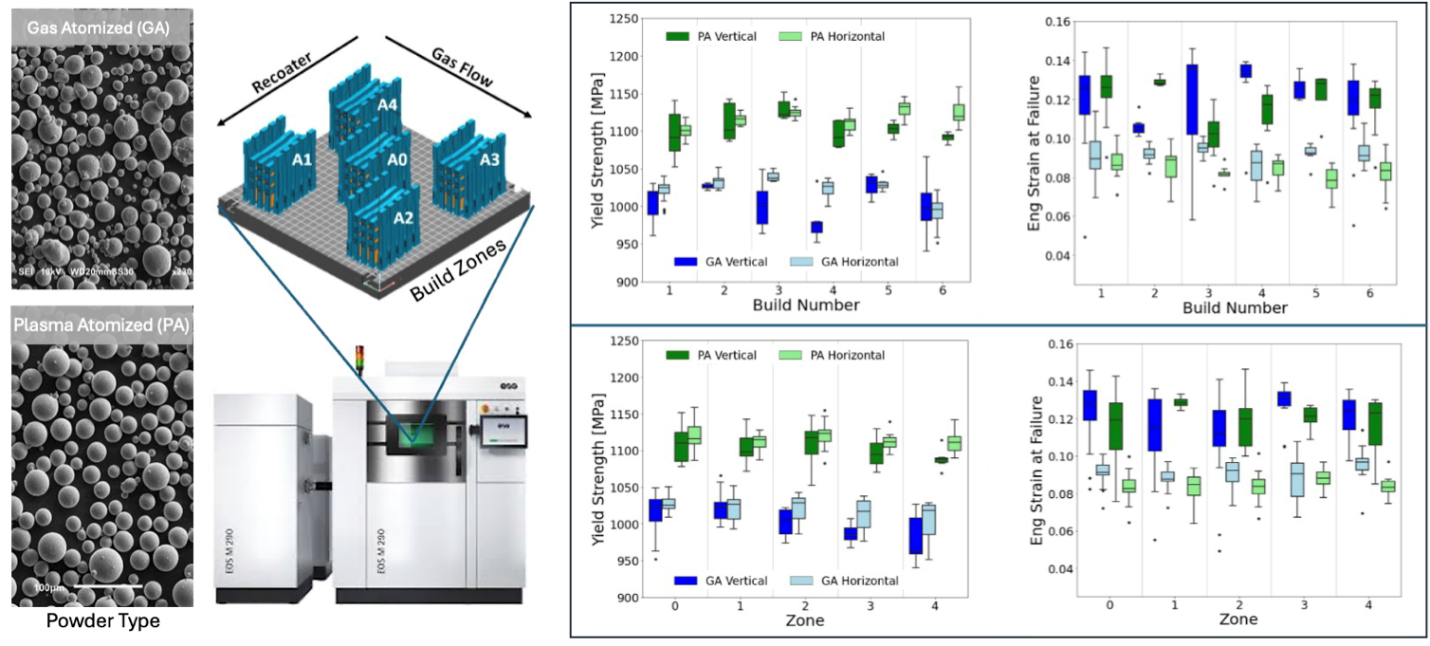
Additive manufacturing (AM) of metal components by laser powder bed fusion (L-PBF) has become a viable method of manufacturing in various industries. However, new challenges are emerging, including the high cost of powder feedstock and concerns associated with its reuse. Here, L-PBF was performed with two commercial sources of Grade 5 Ti6Al4V, including commercial plasma-atomized (PA) and gas-atomized (GA) powders. The overall objective was to evaluate differences in the quality, spatial variations in mechanical properties of metal produced with the PA and GA powders over a series of six builds, and to assess if GA powder could be used to replace PA powder for cost savings. The mechanical properties were characterized in uniaxial tension considering powder type, reuse and location within the build envelope. Results showed that the yield and ultimate tensile strength of metal produced with GA powder were significantly lower than that produced with PA powder (p ≤ 0.05). In addition, spatial variation in the mechanical properties was greatest for the GA powder. The lower strength and greater spatial variation in printing with GA powder appears related to the larger quantity of fines and powder particle satellites, which promote porosity. Overall, the findings indicate that components built with GA powder would: (i) require separate optimization of the printing parameters relative to those used for PA powder, and/or (ii) require additional post-processing to achieve the same performance as those built with PA powder.
- Natarajan J. Advances in Additive Manufacturing Processes. Bentham Science Publishers; 2021.
- Hajare DM, Gajbhiye TS. Additive manufacturing (3D printing): Recent progress on advancement of materials and challenges. Mater Today Proc. 2022;58(2):736. doi: 10.1016/j.matpr.2022.02.391
- Wimpenny DI, Pandey PM, Kumar LJ, editors. Advances in 3D printing & additive manufacturing technologies. Singapore: Springer; 2017.
- Vafadar A, Guzzomi F, Rassau A, Hayward K. Advances in Metal Additive Manufacturing: A Review of Common Processes, Industrial Applications, and Current Challenges. Appl Sci. 2021;11(3):1213. doi: 10.3390/app11031213
- Goh GD, Yap YL, Agarwala S, Yeong WY. Recent Progress in Additive Manufacturing of Fiber Reinforced Polymer Composite. Adv Mater Technol. 2018;4(1):1800271. doi: 10.1002/admt.201800271
- Cao S, Zou Y, Lim CVS, Wu X. Review of laser powder bed fusion (LPBF) fabricated Ti-6Al-4V: process, post-process treatment, microstructure, and property. LAM. 2021;2(2):1. doi: 10.37188/lam.2021.020
- Cabrini M, Carrozza A, Lorenzi S, et al. Influence of surface finishing and heat treatments on the corrosion resistance of LPBF-produced Ti-6Al-4V alloy for biomedical applications. J Mater Process Technol. 2022;308:117730-117730. doi: 10.1016/j.jmatprotec.2022.117730
- Gupta A, Bennett CJ, Sun W. High Cycle Fatigue Performance Evaluation of a Laser Powder Bed Fusion Manufactured Ti-6Al-4V Bracket for Aero-Engine Applications. Eng Fail Anal. 2022;140:106494. doi: 10.1016/j.engfailanal.2022.106494
- Su JL, Jiang FL, Teng J, et al. Laser additive manufacturing of titanium alloys: process, materials and post-processing. Rare Metals. 2024:43(12): 6288-6328. doi: 10.1007/s12598-024-02685-x
- Blakey-Milner B, Gradl P, Snedden G, et al. Metal additive manufacturing in aerospace: A review. Mater Des. 2021;209(1):110008. doi: 10.1016/j.matdes.2021.110008
- Yusuf SM, Cutler S, Gao N. Review: The Impact of Metal Additive Manufacturing on the Aerospace Industry. Metals. 2019;9(12):1286. doi: 10.3390/met9121286
- Taminger KM, Domack CS. Challenges in Metal Additive Manufacturing for Large-Scale Aerospace Applications. Women Aerosp Mater. 2020;105-124. doi: 10.1007/978-3-030-40779-7_8
- Montelione A, Ghods S, Schur R, Wisdom C, Arola D, Ramulu M. Powder Reuse in Electron Beam Melting Additive Manufacturing of Ti6Al4V: Particle Microstructure, Oxygen Content and Mechanical Properties. Addit Manuf. 2020;35:101216. doi: 10.1016/j.addma.2020.101216
- Ghods S, Schultz E, Wisdom C, et al. Electron beam additive manufacturing of Ti6Al4V: Evolution of powder morphology and part microstructure with powder reuse. Materialia. 2020;9:100631. doi: 10.1016/j.mtla.2020.100631
- Soundarapandiyan G, Johnston C, Khan RHU, et al. The effects of powder reuse on the mechanical response of electron beam additively manufactured Ti6Al4V parts. Addit Manuf. 2021;46:102101. doi: 10.1016/j.addma.2021.102101
- Tang HP, Qian M, Liu N, Zhang XZ, Yang GY, Wang J. Effect of Powder Reuse Times on Additive Manufacturing of Ti-6Al-4V by Selective Electron Beam Melting. JOM. 2015;67(3):555-563. doi: 10.1007/s11837-015-1300-4
- Derimow N, Gorham JM, Martin ML, Benzing JT, White RM, Hrabe N. Surface chemistry in Ti-6Al-4V feedstock as influenced by powder reuse in electron beam additive manufacturing. Appl Surf Sci. 2022;602:154280. doi: 10.1016/j.apsusc.2022.154280
- Gruber H, Henriksson M, Eduard Hryha, Nyborg L. Effect of Powder Recycling in Electron Beam Melting on the Surface Chemistry of Alloy 718 Powder. Metall Mater Trans A Phys Metall Mater Sci. 2019;50(9):4410-4422. doi: 10.1007/s11661-019-05333-7
- Quintana OA, Alvarez J, Mcmillan R, Tong W, Tomonto C. Effects of Reusing Ti-6Al-4V Powder in a Selective Laser Melting Additive System Operated in an Industrial Setting. JOM. 2018;70(9):1863-1869. doi: 10.1007/s11837-018-3011-0
- Soltani-Tehrani A, Isaac JP, Tippur HV, Silva DF, Shao S, Shamsaei N. Ti-6Al-4V powder reuse in laser powder bed fusion (L-PBF): The effect on porosity, microstructure, and mechanical behavior. Int J Fatigue. 2023;167:107343. doi: 10.1016/j.ijfatigue.2022.107343.
- Zhuo Z, Ji R, Wang L, Mao J. Reusability of Ti-6Al-4V powder in laser powder bed fusion: Influence on powder morphology, oxygen uptake, and mechanical properties. J Mater Processing Technol. 2025;335:118672. doi: 10.1016/j.jmatprotec.2024.118672
- Harkin R, Wu H, Nikam S, et al. Powder reuse in laser-based powder bed fusion of Ti6Al4V—changes in mechanical properties during a powder top-up regime. Materials. 2022;15(6):2238. doi: 10.3390/ma15062238
- Meier B, Warchomicka F, Ehgartner D, et al. Toward a sustainable laser powder bed fusion of Ti 6Al 4 V: Powder reuse and its effects on material properties during a single batch regime. Sustain Mater Technol. 2023;36:e00626. doi: 10.1016/j.susmat.2023.e00626.
- Carrion PE, Soltani-Tehrani A, Phan N, Shamsaei N. Powder Recycling Effects on the Tensile and Fatigue Behavior of Additively Manufactured Ti-6Al-4V Parts. JOM. 2019;71(3):963-73. doi: 10.1007/s11837-018-3248-7
- Chen G, Zhao SY, Tan P, Wang J, Xiang CS, Tang HP. A comparative study of Ti-6Al-4V powders for additive manufacturing by gas atomization, plasma rotating electrode process and plasma atomization. Powder Technol. 2018;333:38-46. doi: 10.1016/j.powtec.2018.04.013
- Xie B, Fan Y, Zhao S. Characterization of Ti6Al4V powders produced by different methods for selective laser melting. Mater Res Express. 2021;8(7):076510-076510. doi: 10.1088/2053-1591/ac10d1
- Kassym K, Perveen A. Atomization processes of metal powders for 3D printing. Mater. Today Pro. 2020;26:1727- 1733. doi: 10.1016/j.matpr.2020.02.364
- Ruan G, Liu C, Qu H, et al. A comparative study on laser powder bed fusion of IN718 powders produced by gas atomization and plasma rotating electrode process. Mater Sci Eng A. 2022;850:143589-143589. doi: 10.1016/j.msea.2022.143589
- Moghimian P, Poirié T, Habibnejad-Korayem M, et al. Metal powders in additive manufacturing: A review on reusability and recyclability of common titanium, nickel and aluminum alloys. Addit Manuf. 2021;43:102017. doi: 10.1016/j.addma.2021.102017
- Lagutkin S, Achelis L, Sheikhaliev SM, Volker Uhlenwinkel, Srivastava VC. Atomization process for metal powder. Mater Sci Eng A. 2004;383(1):1-6. doi: 10.1016/j.msea.2004.02.059
- Strondl A, Lyckfeldt O, Brodin H, Ackelid U. Characterization and Control of Powder Properties for Additive Manufacturing. JOM. 2015;67(3):549-554. doi: 10.1007/s11837-015-1304-0
- Sutton AT, Kriewall CS, Leu MC, Newkirk JW. Powders for additive manufacturing processes: Characterization techniques and effects on prt properties. Reviewed paper presented at: Solid Freeform Fabrication 2016: Proceedings of the 26th Annual International Solid Freeform Fabrication Symposium – An Additive Manufacturing Conference; 2016; Austin, TX.
- Slotwinski JA, Garboczi EJ, Stutzman PE, Ferraris CF, Watson SS, Peltz MA. Characterization of Metal Powders Used for Additive Manufacturing. J Res Natl Inst Stand Technol. 2014;119:460. doi: 10.6028/jres.119.018
- Baesso I, Karl D, Spitzer A, Gurlo A, Günster J, Zocca A. Characterization of powder flow behavior for additive manufacturing. Addit Manuf. 2021;47:102250. doi: 10.1016/j.addma.2021.102250
- Nguyen QB, Nai MLS, Zhu Z, Sun CN, Wei J, Zhou W. Characteristics of Inconel Powders for Powder-Bed Additive Manufacturing. Engineering. 2017;3(5):695-700. doi: 10.1016/j.eng.2017.05.012
- Yang Y, Gu D, Dai D, Ma C. Laser energy absorption behavior of powder particles using ray tracing method during selective laser melting additive manufacturing of aluminum alloy. Mater Des. 2018;143:12-19. doi: 10.1016/j.matdes.2018.01.043
- Nandwana P, Kirka MM, Paquit VC, Yoder S, Dehoff RR. Correlations Between Powder Feedstock Quality, In Situ Porosity Detection, and Fatigue Behavior of Ti-6Al-4V Fabricated by Powder Bed Electron Beam Melting: A Step Towards Qualification. JOM. 2018;70(9):1686-1691. doi: 10.1007/s11837-018-3034-6
- Boyer RR. An overview on the use of titanium in the aerospace industry. Mater Sci Eng A. 1996;213(1-2):103-114. doi: 10.1016/0921-5093(96)10233-1
- Elias CN, Lima JHC, Valiev R, Meyers MA. Biomedical applications of titanium and its alloys. JOM. 2008;60(3):46- 49. doi: 10.1007/s11837-008-0031-1
- Trevisan F, Calignano F, Aversa A, et al. Additive manufacturing of titanium alloys in the biomedical field: processes, properties and applications. J App Biomat Func Mater 2018;16(2):57-67. doi: 10.5301/jabfm.5000371
- Naqvi SMR, Gu J, Liu S, et al. Laser powder bed fusion additive manufacturing of Ti-6Al-4V dental implants with gradient porosity: Design, simulation, and biomechanical performance. J Mater Sci. 2025; 61(1):594–616. doi: 10.1007/s10853-025-11880-9
- Aufa AN, Hassan MZ, Ismail Z. Recent advances in Ti-6Al-4V additively manufactured by selective laser melting for biomedical implants: Prospect development. J Alloys Compd. 2022;896:163072. doi: 10.1016/j.jallcom.2021.163072
- Pasang T, Budiman AS, Wang JC, et al. Additive manufacturing of titanium alloys – Enabling re-manufacturing of aerospace and biomedical components. Microelectron Eng. 2023;270:111935. doi: 10.1016/j.mee.2022.111935
- García-Hernández C, García-Cabezón C, González-Diez F, et al. Effect of processing on microstructure, mechanical properties, corrosion and biocompatibility of additive manufacturing Ti-6Al-4V orthopaedic implants. Sci Rep. 2025;15(1). doi: 10.1038/s41598-025-98349-6
- Young Z, Qu M, Coday MM, et al. Effects of Particle Size Distribution with Efficient Packing on Powder Flowability and Selective Laser Melting Process. Materials. 2022;15(3):705. doi: 10.3390/ma15030705
- Haferkamp L, Haudenschild L, Spierings A, et al. The Influence of Particle Shape, Powder Flowability, and Powder Layer Density on Part Density in Laser Powder Bed Fusion. Metals. 2021;11(3):418. doi: 10.3390/met11030418
- Spurek MA, Haferkamp L, Weiss C, Spierings AB, Schleifenbaum JH, Wegener K. Influence of the particle size distribution of monomodal 316L powder on its flowability and processability in powder bed fusion. Prog Addit Manuf. 2022;7(4):533–542. doi: 10.1007/s40964-021-00240-z
- Chu F, Li E, Shen H, et al. Influence of powder size on defect generation in laser powder bed fusion of AlSi10Mg alloy. J Manuf Process. 2023;94:183-195. doi: 10.1016/j.jmapro.2023.03.046
- Dietrich K, Diller J, Dubiez-Le Goff S, Bauer D, Forêt P, Witt G. The influence of oxygen on the chemical composition and mechanical properties of Ti-6Al-4V during laser powder bed fusion (L-PBF). Addit Manuf. 2020;32:100980. doi: 10.1016/j.addma.2019.100980
- Dong YP, Li YL, Zhou SY, et al. Cost-affordable Ti-6Al-4V for additive manufacturing: Powder modification, compositional modulation and laser in-situ alloying. Addit Manuf. 2021;37:101699. doi: 10.1016/j.addma.2020.101699
- Wu Z, Asherloo M, Jiang R, et al. Study of printability and porosity formation in laser powder bed fusion built hydride-dehydride (HDH) Ti-6Al-4V. Addit Manuf. 2021;47:102323. doi: 10.1016/j.addma.2021.102323
- Soltani-Tehrani A, Habibnejad-Korayem M, Shao S, Haghshenas M, Shamsaei N. Ti-6Al-4V powder characteristics in laser powder bed fusion: The effect on tensile and fatigue behavior. Addit Manuf. 2022;51:102584. doi: 10.1016/j.addma.2021.102584
- Asherloo M, Wu Z, Delpazir MH, et al. Laser-beam powder bed fusion of cost-effective non-spherical hydride-dehydride Ti-6Al-4V alloy. Addit Manuf. 2022;56:102875-102875. doi: 10.1016/j.addma.2022.102875
- Meier B, Warchomicka F, Petrusa J, et al. Influence of powder production process and properties on material properties of Ti6Al4V manufactured by L-PBF. Int. J. Adv. Manuf. Technol. 2022;123(5-6):1577-1588. doi: 10.1007/s00170-022-10250-y
- Lu F, Ma Q, Liu E, et al. Advancements in understanding the microstructure and properties of additive manufacturing Ti-6Al-4V alloy: A comprehensive review. J Alloys Comp. 2025;1027:180543. doi: 10.1016/j.jallcom.2025.180543
- Asherloo M, Hwang J, Leroux R, et al. Understanding process-microstructure-property relationships in laser powder bed fusion of non-spherical Ti-6Al-4V powder. Mater Charact. 2023;198:112757-112757. doi: 10.1016/j.matchar.2023.112757
- Habibnejad-Korayem M, Lalh M, Schunk C, Zou Y. Offsize particle size utilization for laser powder bed fusion processing of plasma atomized Ti-6Al-4V powders: Impacts on part properties and powder safety. J Manuf Process. 2023;107:559-573. doi: 10.1016/j.jmapro.2023.10.036
- Asherloo M, Ramadurai MS, Heim M, et al. Advancing laser powder bed fusion with non-spherical powder: Powder-process-structure-property relationships through experimental and analytical studies of fatigue performance. Addit Manuf. 2024;95:104534. doi: 10.1016/j.addma.2024.104534
- Kim M, Kim O, Song Y, et al. Cost-Effective Laser Powder Bed Fusion of Ti-6Al-4V Grade 5: The Effect of Expanding Powder Size Distribution on Mechanical Performance. Materials. 2024;18(1):6. doi: 10.3390/ma18010006
- Ludwig I, Kluge M. Investigation of an Increased Particle Size Distribution of Ti-6Al-4V Powders Used for Laser-Based Powder Bed Fusion of Metals. Materials. 2024;17(12):2942- 2942. doi: 10.3390/ma17122942
- Gordon JV, Narra SP, Cunningham RW, et al. Defect structure process maps for laser powder bed fusion additive manufacturing. Addit Manuf. 2020;36:101552. doi: 10.1016/j.addma.2020.101552
- ASTM C1444-00. Standard Test Method for Measuring the Angle of Repose of Free-Flowing Mold Powders. West Conshohocken, PA, ASTM International, 2000.
- ASTM B212-17. Standard Test Method for Apparent Density of Free-Flowing Metal Powders Using the Hall Flowmeter Funnel. West Conshohocken, PA, ASTM International, 2017. doi: 10.1520/B0212-17
- ASTM E8/E8M-16a, Standard Test Methods for Tension Testing of Metallic Materials, ASTM International, West Conshohocken, PA, 2016. doi: 10.1520/E0008_E0008M-16A
- Sun P, Fang ZZ, Zhang Y, Xia Y. Review of the Methods for Production of Spherical Ti and Ti Alloy Powder. JOM. 2017;69(10):1853-1860. doi: 10.1007/s11837-017-2513-5
- Boley CD, Khairallah SA, Rubenchik AM. Calculation of laser absorption by metal powders in additive manufacturing. Appl Opt. 2015;54(9):2477. doi: 10.1364/ao.54.002477
- Yin J, Wang D, Yang L, et al. Correlation between forming quality and spatter dynamics in laser powder bed fusion. Addit Manuf. 2020;31:100958. doi: 10.1016/j.addma.2019.100958
- Wang D, Wu S, Fu F, et al. Mechanisms and characteristics of spatter generation in SLM processing and its effect on the properties. Mater Des. 2017;117:121-130. doi: 10.1016/j.matdes.2016.12.060
- Lee Y, Simunovic S, A. Gurnon. Quantification of Powder Spreading Process for Metal Additive Manufacturing. OSTI OAI US Dep Energy Off Sci Tech Inf. Published online October 10, 2019. doi: 10.2172/1615799
- Anderson IE, White EMH, Dehoff R. Feedstock powder processing research needs for additive manufacturing development. Curr Opin. Solid State Mater Sci. 2018;22(1):8- 15. doi: 10.1016/j.cossms.2018.01.002
- Seyda V, Kaufmann N, Emmelmann C. Investigation of Aging Processes of Ti-6Al-4 V Powder Material in Laser Melting. Phys Procedia. 2012;39:425-431. doi: 10.1016/j.phpro.2012.10.057
- Habibnejad-korayem M, Zhang J, Zou Y. Effect of particle size distribution on the flowability of plasma atomized Ti-6Al-4V powders. Powder Technol. 2021;392:536-543. doi: 10.1016/j.powtec.2021.07.026
- Abeyta A, Nouwens C, Jones AM, et al. Characterizing gas flow in the build chamber of laser powder bed fusion systems utilizing particle image velocimetry: A path to improvements. Addit Manuf. 2025;106:104810. doi: 10.1016/j.addma.2025.104810
- du Plessis A, Yadroitsev I, Yadroitsava I, Le Roux SG. X-Ray Microcomputed Tomography in Additive Manufacturing: A Review of the Current Technology and Applications. 3D Print Addit Manuf. 2018;5(3):227-247. doi: 10.1089/3dp.2018.0060
- Poulin JR, Kreitcberg A, Brailovski V. Effect of hot isostatic pressing of laser powder bed fused Inconel 625 with purposely induced defects on the residual porosity and fatigue crack propagation behavior. Addit Manuf. 2021;47:102324. doi: 10.1016/j.addma.2021.102324
- Gao H, Zhang Z, Li J, et al. Hot isostatic pressing elimination of process-induced defects in laser powder bed fusion fabricated DZ125 superalloy: Microstructure evolution and mechanical property enhancement. J Mater Res Technol. 2025;37:3907-3923. doi: 10.1016/j.jmrt.2025.07.069
- Mahtabi M, Yadollahi A, Ataollahi S, Mahtabi MJ. Effect of build height on structural integrity of Ti-6Al-4V fabricated via laser powder bed fusion. Eng Fail Anal. 2023;154:107691. doi: 10.1016/j.engfailanal.2023.107691
- Xue M, Chen X, Ji X, Xie X, Chao Q, Fan G. Effect of Particle Size Distribution on the Printing Quality and Tensile Properties of Ti-6Al-4V Alloy Produced by LPBF Process. Metals. 2023;13(3):604-604. doi: 10.3390/met13030604
- Brika SE, Letenneur M, Dion CA, Brailovski V. Influence of particle morphology and size distribution on the powder flowability and laser powder bed fusion manufacturability of Ti-6Al-4V alloy. Addit Manuf. 2020;31:100929. doi: 10.1016/j.addma.2019.100929