

Topology optimization for negative Poisson’s ratio metamaterials with geometric curvature control

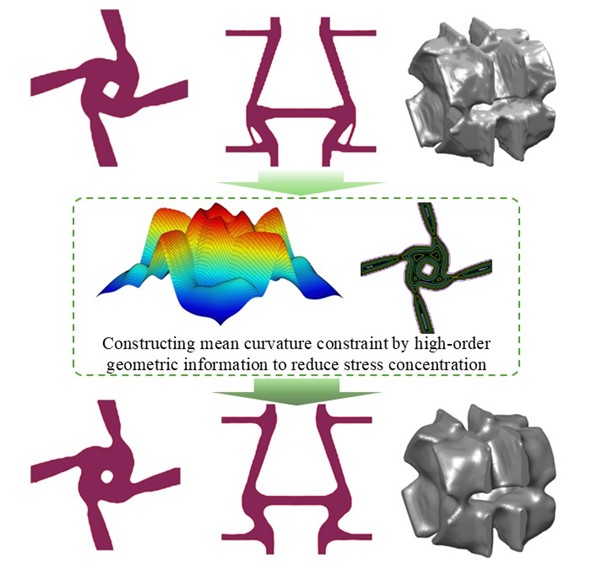
Metamaterials with a negative Poisson’s ratio (NPR) exhibit unique auxetic deformation mechanism that enables superior energy absorption and mechanical resilience. Topology optimization (TO) can effectively generate microstructures with NPR characteristics, but conventional optimized designs often suffer from sharp corners and stress concentrations, which compromise durability and limit multicycle energy absorption. To address this issue, we introduced a boundary-fitting derivable geodesics-coupled TO (B-DGTO) framework to construct explicit curvature constraints into the optimization process, ensuring smooth boundaries and more uniform stress distribution with optimal NPR properties. In numerical example and experiment, we provided different types of 2D/3D NPR microstructures under curvature control to demonstrate the versatility of the proposed approach. These results confirm that the curvature constraint significantly improves the stress distribution of NPR microstructures and enhances their robustness and reliability under repeated loading. This study highlights curvature-constrained TO as a general and practical strategy for developing durable NPR metamaterials with superior energy dissipation performance.
- Lakes R. Foam structures with a negative Poisson’s ratio. Science. 1987;235(4792):1038-1040. doi: 10.1126/science.235.4792.1038
- Kolken HM, Zadpoor A. Auxetic mechanical metamaterials. RSC Adv. 2017;7(9):5111-5129. doi: 10.1039/c6ra27333e
- Saxena KK, Das R, Calius EP. Three decades of auxetics research- materials with negative Poisson’s ratio: A review. Adv Eng Mater. 2016;18(11):1847-1870. doi: 10.1002/adem.201600053
- Li F, Zhang Q, Wang Z, Zhu D. A new three-dimensional re-entrant negative Poisson’s ratio metamaterial with tunable stiffness. Eng Struct. 2024;306:117793. doi: 10.1016/j.engstruct.2024.117793
- Choi J, Lakes R. Fracture toughness of re-entrant foam materials with a negative Poisson’s ratio: Experiment and analysis. Int J Fract. 1996;80(1):73-83. doi: 10.1007/bf00036481
- Li F, Chen Y, Zhu D. Revealing the sound transmission loss capacities of sandwich metamaterials with re-entrant negative Poisson’s ratio configuration. Materials. 2023;16(17):5928. doi: 10.3390/ma16175928
- Wen G, Zhang S, Wang H, et al. Origami-based acoustic metamaterial for tunable and broadband sound attenuation. Int J Mech Sci. 2023;239:107872. doi: 10.1016/j.ijmecsci.2022.107872
- Liu W, Wang N, Luo T, Lin Z. In-plane dynamic crushing of re-entrant auxetic cellular structure. Mater Design. 2016;100:84-91. doi: 10.1016/j.matdes.2016.03.086
- Tian J, Yang J, Zhao Y. Metamaterial with synergistically controllable Poisson’s ratio and thermal expansion coefficient. Int J Mech Sci. 2023;256:108488. doi: 10.1016/j.ijmecsci.2023.108488
- He H, Niu X, Xu Z, et al. Interdigitated structure-derived scalable all-solid-state electrocaloric cooling device using lead-free BaSrTiO3-based multilayer ceramics. Joule. 2025;9(10):102128. doi: 10.1016/j.joule.2025.102128
- Wei K, Peng Y, Qu Z, Pei Y, Fang D. A cellular metastructure incorporating coupled negative thermal expansion and negative Poisson’s ratio. Int J Solids Struct. 2018;150:255-267. doi: 10.1016/j.ijsolstr.2018.06.018
- Zhang Q, Li F, Zhu D, Zhang T, Chen L. Quasi-static and impact performance study of a three-dimensional negative Poisson’s ratio structure with adjustable mechanical properties. Int J Impact Eng. 2024;193:105057. doi: 10.1016/j.ijimpeng.2024.105057
- Kun Y, Fei T, Bo WY, He HY. Study on impact energy absorption performance and optimization of negative Poisson’s ratio structure. J Braz Soc Mech Sci Eng. 2023;45(6):328. doi: 10.1007/s40430-023-04253-3
- Qin S, Deng X, Yang F, Lu Q. Energy absorption characteristics and negative Poisson’s ratio effect of axisymmetric tetrachiral honeycombs under in-plane impact. Compos Struct. 2023;323:117493. doi: 10.1016/j.compstruct.2023.117493
- Bertoldi K, Vitelli V, Christensen J, Van Hecke M. Flexible mechanical metamaterials. Nat Rev Mater. 2017;2(11):17066. doi: 10.1038/natrevmats.2017.66
- Surjadi JU, Gao L, Du H, et al. Mechanical metamaterials and their engineering applications. Adv Eng Mater. 2019;21(3):1800864. doi: 10.1002/adem.201800864
- Zhai Z, Wu L, Jiang H. Mechanical metamaterials based on origami and kirigami. Appl Phys Rev. 2021;8(4):041319. doi: 10.1063/5.0051088
- Bendsøe MP, Sigmund O. Topology Optimization: Theory, Methods, and Applications. Germany: Springer Science and Business Media; 2003.
- Allaire G, Jouve F, Toader AM. A level-set method for shape optimization. C R Mathématique. 2002;334(12):1125-1130. doi: 10.1016/s1631-073x(02)02412-3
- Wang MY, Wang X, Guo D. A level set method for structural topology optimization. Comput Methods Appl Mech Eng. 2003;(192):227-246. doi: 10.1016/s0045-7825(02)00559-5
- Huang X, Xie M. Evolutionary Topology Optimization of Continuum Structures: Methods and Applications. New Jersey, U.S: John Wiley and Sons; 2010.
- Guo X, Zhang W, Zhong W. Doing Topology Optimization Explicitly and Geometrically-A New Moving Morphable Components Based Framework. J Appl Mech. 2014;81(8):081009. doi: 10.1115/1.4027609
- Sigmund O. Materials with prescribed constitutive parameters: An inverse homogenization problem. Int J Solids Struct. 1994;31(17):2313-2329. doi: 10.1016/0020-7683(94)90154-6
- Schwerdtfeger J, Wein F, Leugering G, et al. Design of auxetic structures via mathematical optimization. Adv Mater. 2011;23(22):2650. doi: 10.1002/adma.201004090
- Han Z, Wei K. Multi-material topology optimization and additive manufacturing for metamaterials incorporating double negative indexes of Poisson’s ratio and thermal expansion. Addit Manuf. 2022;54:102742. doi: 10.1016/j.addma.2022.102742
- Bao Y, Wei Z, Jia Z, et al. Mechanical metamaterial design with the customized low-frequency bandgap and negative Poisson’s ratio via topology optimization. Extreme Mech Lett. 2024;67:102124. doi: 10.1016/j.eml.2024.102124
- Andreassen E, Lazarov BS, Sigmund O. Design of manufacturable 3D extremal elastic microstructure. Mech Mater. 2014;69(1):1-10. doi: 10.1016/j.mechmat.2013.09.018
- Li H, Luo Z, Gao L, Walker P. Topology optimization for functionally graded cellular composites with metamaterials by level sets. Comput Methods Appl Mech Eng. 2018;328:340-364. doi: 10.1016/j.cma.2017.09.008
- Zhang H, Luo Y, Kang Z. Bi-material microstructural design of chiral auxetic metamaterials using topology optimization. Compos Struct. 2018;195:232-248. doi: 10.1016/j.compstruct.2018.04.058
- Wang C, Zhao H, Wang Y, et al. Topology optimization of chiral metamaterials with application to underwater sound insulation. Appl Math Mech. 2024;45(7):1119-1138. doi: 10.1007/s10483-024-3162-8
- Chen W, Huang X. Topological design of 3D chiral metamaterials based on couple-stress homogenization. J Mech Phys Solids. 2019;131:372-386. doi: 10.1016/j.jmps.2019.07.014
- Zhou Y, Gao L, Li H. Topology optimization design of graded infills for 3D curved volume by a conformal sweeping method. Comput Methods Appl Mech Eng. 2023;412:116009. doi: 10.1016/j.cma.2023.116009
- Zhou Y, Gao L, Li H. A ready-to-manufacture optimization design of 3D chiral auxetics for additive manufacturing. Eng Comput Germany. 2024;40(3):1517-1538. doi: 10.1007/s00366-023-01880-1
- Bernard AR, Yalcin MM, Elsayed MSA. Shape transformers for crashworthiness of additively manufactured engineering resin lattice structures: Experimental and numerical investigations. Mech Mater. 2024;190:104925. doi: 10.1016/j.mechmat.2024.104925
- Ni Z, Cheng W, Wang Y, et al. Topology optimization of two-scale hierarchical structures with high-cycle fatigue resistance. Comput Methods Appl Mech Eng. 2024;430:117213. doi: 10.1016/j.cma.2024.117213
- Xu S, Liu J, He D, Tang K, Yaji K. Self-support structure topology optimization for multi-axis additive manufacturing incorporated with curved layer slicing. Comput Methods Appl Mech Eng. 2025;438:117841. doi: 10.1016/j.cma.2025.117841
- Guo Y, Xu S, Wang Y, et al. DGTO: Derivable geodesics-coupled topology optimization for multi-axis hybrid additive and subtractive manufacturing with curved layer generation. Addit Manuf. 2025;105:104786. doi: 10.1016/j.addma.2025.104786
- Liang K, Liu J, Xu S, Guo Y. DGTO: Derivable geodesics-coupled topology optimization for multi-axis 3D printing of continuous fiber-reinforced spatial structures. Comput Methods Appl Mech Eng. 2026;448:118419. doi: 10.1016/j.cma.2025.118419
- Osher S, Fedkiw RP. Level Set Methods and Dynamic Implicit Surfaces. Vol 1. New York: Springer; 2005.
- Crane K, Weischedel C, Wardetzky M. Geodesics in heat: A new approach to computing distance based on heat flow. ACM Trans Graph (TOG). 2013;32(5):1-11. doi: 10.1145/2516971.2516977
- Huang J, Liu J. Derivable skeletons in topology optimization for length scale control. Comput Methods Appl Mech Eng. 2024;421:116778. doi: 10.1016/j.cma.2024.116778
- Wang FW, Lazarov BS, Sigmund O. On projection methods, convergence and robust formulations in topology optimization. Struct Multidiscip O. 2011;43(6):767-784. doi: 10.1007/s00158-010-0602-y
- Bartz R, Franke T, Fiebig S, Vietor T. Density-based shape optimization of 3D structures with mean curvature constraints. Struct Multidiscip O. 2022;65:5. doi: 10.1007/s00158-021-03089-6
- Xia L, Breitkopf P. Design of materials using topology optimization and energy-based homogenization approach in Matlab. Struct Multidiscip O. 2015;52(6):1229-1241. doi: 10.1007/s00158-015-1294-0
- Svanberg K. The method of moving asymptotes-a new method for structural optimization. Int J Numer Meth Eng. 1987;24(2):359-373.
- Lazarov BS, Sigmund O. Filters in topology optimization based on Helmholtz‐type differential equations. Int J Numer Meth Eng. 2011;86(6):765-781. doi: 10.1002/nme.3072
- Zhu B, Zhang X, Zhang H, et al. Design of compliant mechanisms using continuum topology optimization: A review. Mech Mach Theory. 2020;143:103622. doi: 10.1016/j.mechmachtheory.2019.103622
- Jin M, Zhang X, Zhu B, Wang N. Spring-joint method for topology optimization of planar passive compliant mechanisms. Chin J Mech Eng. 2013;26(6):1063-1072. doi: 10.3901/cjme.2013.06.1063
- Jin M, Zhang X, Zhu B. A numerical method for static analysis of pseudo-rigid-body model of compliant mechanisms. Proc Inst Mech Eng Part C J Mech Eng Sci. 2014;228(17):3170-3177. doi: 10.1177/0954406214525951
- Zhu B, Zhang X, Fatikow S. Level set-based topology optimization of hinge-free compliant mechanisms using a two-step elastic modeling method. J Mech Design. 2014;136(3):031007. doi: 10.1115/1.4026097
- Liang K, Zhu D, Liu J. Topology optimization of a spatial compliant parallel mechanism based on constant motion transmission characteristic matrix. Mech Mach Theory. 2023;180:180105125. doi: 10.1016/j.mechmachtheory.2022.105125
- Jin M, Zhang X. A new topology optimization method for planar compliant parallel mechanisms. Mech Mach Theory. 2016;95:42-58. doi: 10.1016/j.mechmachtheory.2015.08.016