
Enhancing biomedical text interpretation through neuro-symbolic knowledge integration

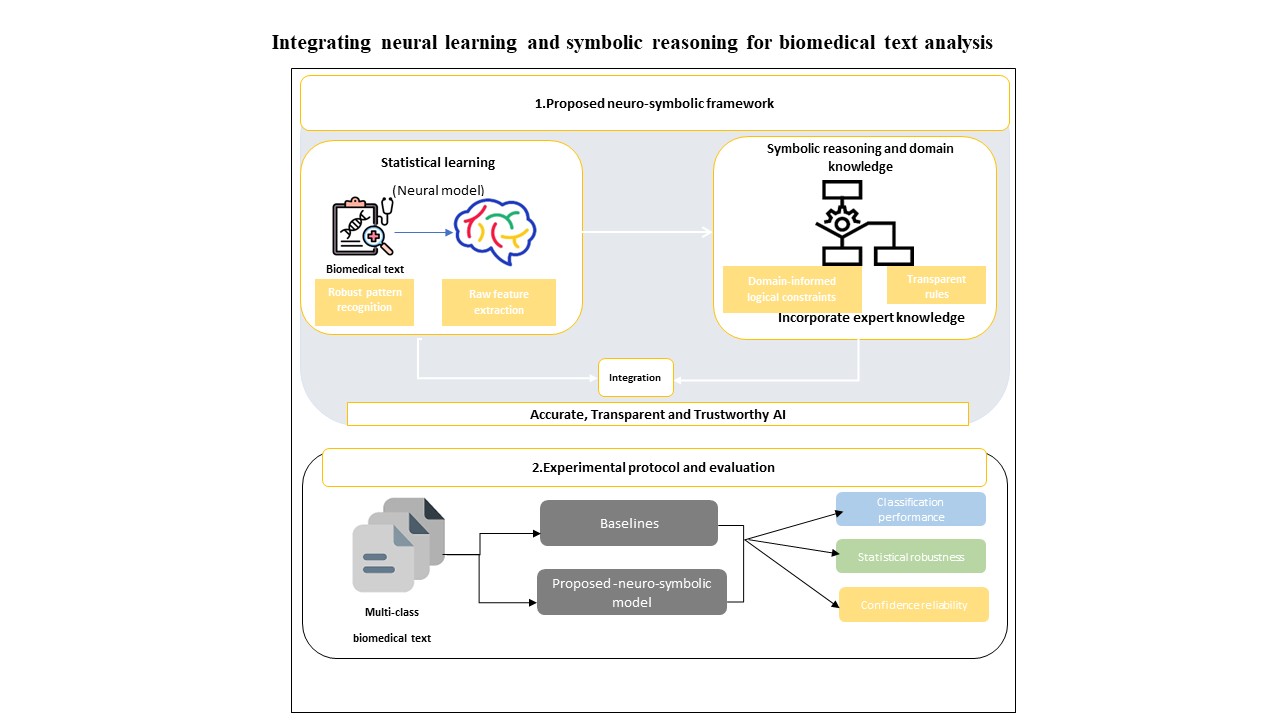
The integration of statistical learning with symbolic reasoning provides a promising pathway toward artificial intelligence systems that are not only highly accurate but also transparent and trustworthy. In this study, we propose a neuro-symbolic framework that integrates neural models for robust pattern recognition with symbolic reasoning mechanisms designed to enforce domain-informed logical constraints, thereby improving the interpretation of biomedical text. The proposed framework is evaluated through a comprehensive experimental protocol that assesses classification performance, statistical robustness, and prediction reliability. Experimental results on a multi-class biomedical text classification task demonstrate that the proposed approach consistently outperformed conventional machine learning baselines, including term frequency--inverse document frequency-based logistic regression. Specifically, the neuro-symbolic model achieved a macro-averaged F1-score of 0.863, compared to 0.724 for the baseline model, representing a 19.2\% relative improvement. Furthermore, the framework exhibited strong predictive stability across multiple biomedical categories, with classification accuracies ranging from 0.938 to 0.950 across topics. The highest performance was observed for sclerenchyma-related texts (accuracy = 0.950), while all other categories maintained accuracies above 0.94, indicating consistent and reliable classification performance. In addition, the proposed framework substantially improved model calibration, achieving a 63\% reduction in expected calibration error and yielding more reliable probability estimates for decision-support applications.
- Bhuyan BP. Neuro-symbolic knowledge hypergraphs: knowledge representation and learning in neuro-symbolic artificial intelligence. Doctoral dissertation. UniversitÅLe Paris-Saclay; University
of Petroleum and Energy Studies; 2025. Accessed April 11, 2026. https://theses.hal.science/tel-05051386/
- Isakov A, Zaglubotskii A, Tomilov I, et al. Bridging heterogeneous agents: a neurosymbolic knowledge transfer approach. Technologies.,2025;13(12):568. https://www.doi.org/10.3390/technologies13120568
- Alqutaibi AY, AL-Zaghruri AS. The rise of AI in healthcare: are chatbots ready to lead? Clin eHealth. 2025;8:175-176. https://www.doi.org/10.1016/j.ceh.2025.09.001
- GarcÅLıa-BarragÅLan ÅLA, Sakor A, Vidal ME, et al. NSSC: a neuro-symbolic AI system for enhancing accuracy of named entity recognition and linking from oncologic clinical notes. Med Biol Eng Comput. 2025;63(3):749-772. https://www.doi.org/10.1007/s11517-024-03227-4
- Shalaby AM, Hassan SMA, Abdelnour HM, et al. Ameliorative potential of bone marrow-derived mesenchymal stem cells versus prednisolone in a rat model of lung fibrosis: a histological, immunohistochemical, and biochemical study. Microsc Microanal. 2024;30(3):539-551. https://www.doi.org/10.1093/mam/ozae043
- Azmat H, Maheen A. Neuro-symbolic approaches in NLP: integrating logic and learning for transparent language understanding. J Integr Res. 2025;6(3):1-9. Accessed April 11, 2026. https://interresearcher.com/index.php/JIR/article/view/3
- Alghauli MA, Aljohani W, Almutairi S, Aljohani R, Alqutaibi AY. Advancements in digital data acquisition and CAD technology in dentistry: innovation, clinical impact, and promising integration of artificial intelligence. Clin eHealth. 2025;8:32-52. https://www.doi.org/10.1016/j.ceh.2025.03.001
- Jammal F, Dahab M, Bayahya AY. Neuro-Bridge-X: a neuro-symbolic vision transformer with Meta-XAI for interpretable leukemia diagnosis from peripheral blood smears. Diagnostics.2025;15(16):2040. https://www.doi.org/10.3390/diagnostics15162040
- Singh S. Neuro-fuzzy architectures for interpretable AI: a comprehensive survey and research outlook. J Mach Learn Res. 2025;1:11. Accessed April 11, 2026. https://www.preprints.org/frontend/manuscript/6176c0df3fe6e770725b0318288a0e8a/download_pub
- Anand S, Miglani S, Anand R. Neuro-symbolic signal processing: a modular framework for adaptive and transparent real-time cognitive signal interpretation. Int J Comput Appl. 2025;186(66):24-30. https://www.doi.org/10.5120/ijca2025924351
- Confalonieri R, Guizzardi G. On the multiple roles of ontologies in explanations for neuro-symbolic AI. Neurosymbolic Artif Intell. 2025;1:NAI-240754. https://www.doi.org/10.3233/NAI-240754
- Alikhani MH. Synthetic reasoning—designing AI architectures beyond neural networks with hybrid neuro-symbolic systems. SSRN. 2025. https://www.doi.org/10.2139/ssrn.5226493
- Anani M, Amer SA, Kishk RM, et al. Evaluation of blood and biochemical parameters of COVID-19 patients in Suez Canal University Hospital: a retrospective study. J Infect Dev Ctries. 2022;16(4):592-599. https://www.doi.org/10.3855/jidc.14591
- Cheng K, Ahmed NK, Rossi RA, Willke T, Sun Y. Neural-symbolic methods for knowledge graph reasoning: a survey. ACM Trans Knowl Discov Data. 2025;18(9):1-44. https://www.doi.org/10.1145/3686806
- Gao L, Sun L, Sheng VS. Enhancing transcription factor prediction via domain knowledge integration with logic tensor networks. IEEE Trans Comput Biol Bioinform. 2025;22(6):3564-3570. https://www.doi.org/10.1109/TCBBIO.2025.3617864
- De Boer M, Smit Q, van Bekkum M, Meyer-Vitali A, Schmid T. Design patterns for large language model-based neuro-symbolic systems. Neurosymbolic Artif Intell. 2025;1. https://www.doi.org/10.1177/29498732251377499
- Sabou M, Llugiqi M, Ekaputra FJ, Waltersdorfer L, Tsaneva S. Knowledge engineering in the age of neurosymbolic systems. Neurosymbolic Artif Intell. 2025;1. https://www.doi.org/10.1177/29498732251320078
- Bhatnagar R, Hassan E, Saber A, Shams MY, Elbedwehy S. Enhanced vision transformer with Lion optimizer for accurate classification of monkeypox skin images. In: Proc 4th Int Conf Technol Advancements Comput Sci (ICTACS). IEEE; 2024:1897-1902. https://www.doi.org/10.1109/ICTACS62700.2024.10840567
- Bougzime O, Cruz C, AndrÅLe JC, Zhou K, Qi HJ, Demoly F. Neuro-symbolic artificial intelligence in accelerated design for 4D printing: status, challenges, and perspectives. Mater Des. 2025;252:113737. https://www.doi.org/10.1016/j.matdes.2025.113737
- Zhang J, Chen B, Zhang L, Ke X, Ding H. Neural, symbolic and neural-symbolic reasoning on knowledge graphs. AI Open. 2021;2:14-35. https://www.doi.org/10.1016/j.aiopen.2021.03.001
- Hassan E, Ghazalah SA, El-Rashidy N, et al. DenseNet model with attention mechanisms for robust date fruit image classification. Int J Comput Intell Syst. 2025;18(1):228. https://www.doi.org/10.1007/s44196-025-00809-4
- Wu M, Li M, Qian C, et al. Enhance deep learning in few-shot datasets: the role of implicit symbolic rules. Signal Image Video Process. 2025;19(12):1013. https://www.doi.org/10.1007/s11760-025-04603-9
- Mundlamuri R, Gunnam GR, Mysari NK, Pujuri J. The evolution of AI: from classical machine learning to modern large language models. IEEE Access. 2025;13:178302-178341. https://www.doi.org/10.1109/ACCESS.2025. 3621344
- Fathy MA, Anbaig A, Aljafil R, et al. Effect of liraglutide on osteoporosis in a rat model of type 2 diabetes mellitus: a histological, immunohistochemical, and biochemical study. Microsc Microanal. 2023;29(6):2053-2067. https://www.doi.org/10.1093/micmic/ozad102
- Hassan E, El-Rashidy N, Elbedwehy S, et al. Exploring the frontiers of image super-resolution: a review of modern techniques and emerging applications. Neural Comput Appl. 2025;37(22):17913-17961. https://www.doi.org/10.1007/s00521-025-11331-1
- Shams MY, Hassan E, Gamil S, et al. Skin disease classification: a comparison of ResNet50, MobileNet, and Efficient-B0. J Curr Multidiscip Res. 2025;1(1):1-7. ₹https://www.doi.org/10.21608/jcmr.2025.327880.1002
- Shalaby AM, Shalaby RH, Alabiad MA, et al. Evening primrose oil attenuates oxidative stress, inflammation, fibrosis, apoptosis, and ultrastructural alterations induced by metanil yellow in rat liver. Ultrastruct Pathol. 2023;47(3):188-204. https://www.doi.org/10.1080/01913123.2023.
2189987
- Alam F, Malik K, Krishnamurthy M. Neuro-Clustr: empowering biomedical text clustering with neuro-symbolic intelligence. In: Proc IJCAI Workshop Knowledge-Based Compositional Generalization. 2023. Accessed April 11, 2026. https://openreview.net/pdf?id=eu12MV19ho
- Rajalakshmi R, Unhelkar B, Shankar S. Neurosymbolic integration using knowledge attention graphs with advanced deep learning techniques for detecting brain disorders. Int Insurance Law Rev. 2025;33(S5):420-436. https://www.doi.org/10.65677/iilr.33.S5.27
- Hassan E, Bhatnagar R, Shams MY. Advancing scientific research in computer science by Chat-GPT and LLaMA—a review. In: Int Conf Intelligent Manufacturing and Energy Sustainability. Springer; 2023:23-37. https://www.doi.org/10.1007/978-981-99-6774-2_3
- Lu Q, Li R, Sagheb E, et al. Explainable diagnosis prediction through neuro-symbolic integration. AMIA Jt Summits Transl Sci Proc. 2025:332-341. https://www.doi.org/10.48550/arXiv.2410.01855
- Keber M, GrubiˇsiÅLc I, BareˇsiÅLc A, JoviÅLc A. A review on neuro-symbolic AI improvements to natural language processing. In: 2024 47th MIPRO ICT and Electronics Convention (MIPRO). IEEE; 2024:66-72. https://www.doi.org/10.1109/MIPRO60963.2024.10569741
- Jain M, Singh K, Mutharaju R. ReOnto: a neurosymbolic approach for biomedical relation extraction. In: Joint European Conference on Machine Learning and Knowledge Discovery in Databases. Springer; 2023;14172:230-247. https://www.doi.org/10.1007/978-3-031-43421-1_14
- Alshahrani M, Khan MA, Maddouri O, et al. Neuro-symbolic representation learning on biological knowledge graphs. Bioinformatics. 2017;33(17):2723-2730. https://www.doi.org/10.1093/bioinformatics/btx275
- Lucos R, LP S, PR V, et al. Neuro-symbolic artificial intelligence: foundations, advances, and future directions. 2025. https://www.doi.org/10.2139/ssrn.5915242
- Jung YJ, Subramani P, Ashokkumar S. Neurosymbolic cognition for intelligent autonomy and adaptive interpretability in wearable healthcare systems. IEEE Trans Consum Electron. 2025. https://www.doi.org/10.1109/TCE.2025.3647696
- Prenosil GA, Weitzel TK, Bello SC, et al. Neurosymbolic AI for auditable cognitive information extraction from medical reports. Commun Med. 2025;5(1):491. https://www.doi.org/10.1038/s43856-025-01194-x
- Gueddes A, Fathallah W, Mahjoub MA. OntoMed-KGTransformer: a neuro-symbolic framework for clinical knowledge fusion. Procedia Comput Sci. 2025;270:426-435. https://www.doi.org/10.1016/j.procs.2025.09.161
- Mileo A. Towards a neuro-symbolic cycle for human-centered explainability. Neurosymbolic Artif Intell. 2025;1:NAI-240740. https://www.doi.org/10.3233/NAI-240740
- Bhuyan BP, Ramdane-Cherif A, Singh TP, Tomar R. Neuro-symbolic AI in various domains. In: Neuro-Symbolic Artificial Intelligence: Bridging Logic and Learning. Springer; 2024:311-324. https://www.doi.org/10.1007/978-981-97-8171-3_17