
Extrusion-based three-dimensional bioprinting of osteochondral scaffolds: Strategies using hydrogel/thermoplastic combinations

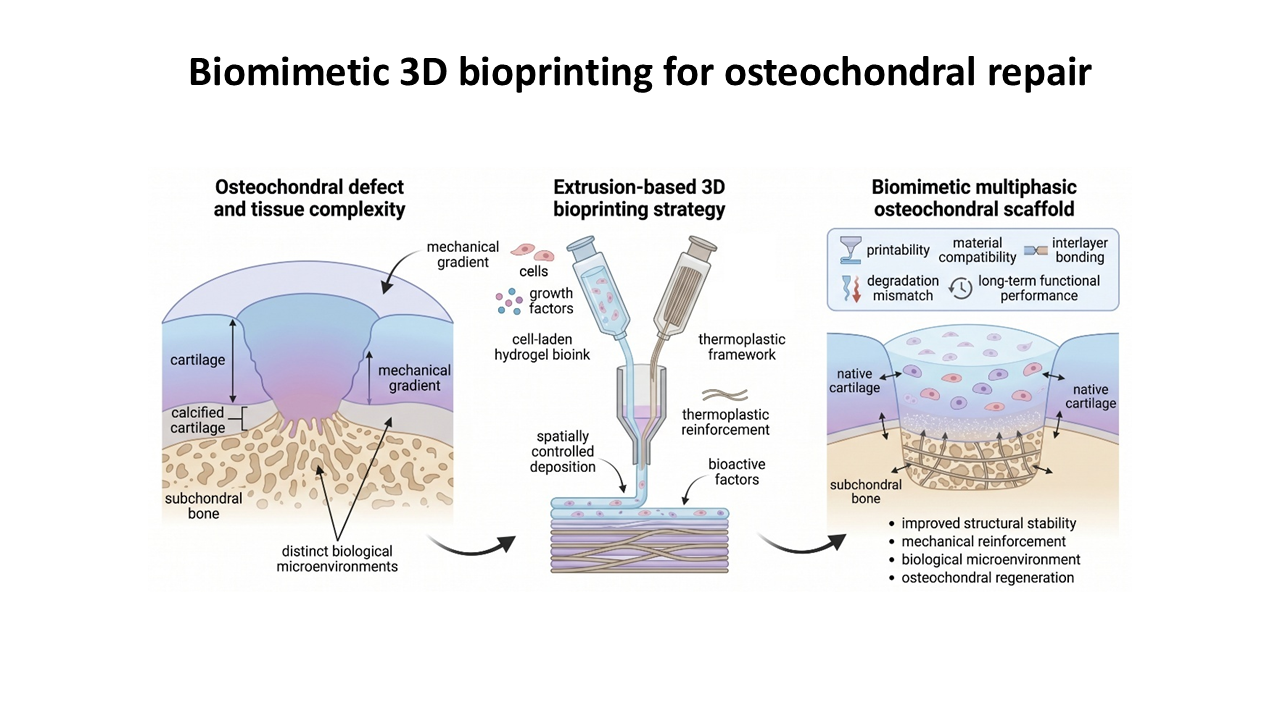
Osteochondral defects remain a major clinical challenge due to the complex hierarchical structure, marked mechanical gradients, and distinct biological requirements of cartilage, calcified cartilage, and subchondral bone. Extrusion-based three-dimensional bioprinting has emerged as a promising strategy for osteochondral repair, enabling the spatially controlled deposition of cells, biomaterials, and bioactive factors to fabricate constructs with region-specific compositions and architectures. Among the available material systems, combinations of hydrogels and thermoplastics have attracted increasing attention, as they integrate the favourable biological microenvironment of hydrogels with the mechanical strength, structural stability, and printability of thermoplastics. This synergy makes them particularly suitable for the fabrication of biomimetic osteochondral scaffolds with multiphasic and gradient features. This review systematically summarises the application of hydrogel/thermoplastic combinations in extrusion-based bioprinting for osteochondral repair, with particular emphasis on their role in addressing the structural, mechanical, and biological requirements of osteochondral regeneration. It discusses the design requirements for osteochondral scaffolds, the properties and crosslinking strategies of hydrogel bioinks, the function of thermoplastic frameworks in mechanical reinforcement, and current approaches for constructing multilayered and gradient scaffolds. The review also analyses current limitations, including challenges related to printability, material compatibility, interlayer bonding, degradation mismatch, and long-term functional performance. Overall, this work provides a comprehensive overview of hydrogel/thermoplastic composite systems and highlights their potential to advance the development of clinically relevant bioprinted scaffolds for osteochondral repair.
- Wei W, Dai H. Articular cartilage and osteochondral tissue engineering techniques: Recent advances and challenges. Bioact Mater. 2021;6(12):4830-4855. doi: 10.1016/j.bioactmat.2021.05.011
- Komarraju A, Goldberg-Stein S, Pederson R, McCrum C, Chhabra A. Spectrum of common and uncommon causes of knee joint hyaline cartilage degeneration and their key imaging features. Eur J Radiol. 2020;129:109097. doi: 10.1016/j.ejrad.2020.109097
- Ai C, Lee YHD, Tan XH, Tan SHS, Hui JHP, Goh JC-H. Osteochondral tissue engineering: perspectives for clinical application and preclinical development. J Orthop Transl. 2021;30:93-102. doi: 10.1016/j.jot.2021.07.008
- Ji S, Guvendiren M. Recent advances in bioink design for 3D bioprinting of tissues and organs. Front Bioeng Biotechnol. 2017;5:23. doi: 10.3389/fbioe.2017.00023
- Chen W, Xu Y, Li Y, et al. 3D printing electrospinning fiber-reinforced decellularized extracellular matrix for cartilage regeneration. Chem Eng J. 2020;382:122986. doi: 10.1016/j.cej.2019.122986
- Badar W, Inamdar SR, Fratzl P, et al. Nonlinear Stress‐ Induced Transformations in Collagen Fibrillar Organization, Disorder and Strain Mechanisms in the Bone‐Cartilage Unit. Adv Sci. 2025;12(1):2407649. doi: 10.1002/advs.202407649
- Lee JM, Suen SKQ, Ng WL, Ma WC, Yeong WY. Bioprinting of collagen: considerations, potentials, and applications. Macromol Biosci. 2021;21(1):2000280. doi: 10.1002/mabi.202000280
- Chartrain NA, Gilchrist KH, Ho VB, Klarmann GJ. 3D bioprinting for the repair of articular cartilage and osteochondral tissue. Bioprinting. 2022;28:e00239. doi: 10.1016/j.bprint.2022.e00239
- Dhawan A, Kennedy PM, Rizk EB, Ozbolat IT. Three-dimensional bioprinting for bone and cartilage restoration in orthopaedic surgery. J Am Acad Orthop Surg. 2019;27(5):e215-e226. doi: 10.5435/JAAOS-D-17-00632
- Ozbolat IT, Hospodiuk M. Current advances and future perspectives in extrusion-based bioprinting. Biomaterials. 2016;76:321-343. doi: 10.1016/j.biomaterials.2015.10.076
- Kesti M, Müller M, Becher J, et al. A versatile bioink for three-dimensional printing of cellular scaffolds based on thermally and photo-triggered tandem gelation. Acta Biomater. 2015;11:162-172. doi: 10.1016/j.actbio.2014.09.033
- Chiulan I, Frone AN, Brandabur C, Panaitescu DM. Recent advances in 3D printing of aliphatic polyesters. Bioengineering. 2017;5(1):2. doi: 10.3390/bioengineering5010002
- Hölzl K, Lin S, Tytgat L, Van Vlierberghe S, Gu L, Ovsianikov A. Bioink properties before, during and after 3D bioprinting. Biofabrication. 2016;8(3):032002. doi: 10.1088/1758-5090/8/3/032002
- Lee JM, Ng WL, Yeong WY. Resolution and shape in bioprinting: Strategizing towards complex tissue and organ printing. Appl Phys Rev. 2019;6(1):011306. doi: 10.1063/1.5053909
- Fu Z, Naghieh S, Xu C, Wang C, Sun W, Chen X. Printability in extrusion bioprinting. Biofabrication. 2021;13(3):033001. doi: 10.1088/1758-5090/abe7ab
- Wu D, Zheng K, Yin W, et al. Enhanced osteochondral regeneration with a 3D-Printed biomimetic scaffold featuring a calcified interfacial layer. Bioact Mater. 2024;36:317-329. doi: 10.1016/j.bioactmat.2024.03.004
- Liu Y, Peng L, Li L, et al. 3D-bioprinted BMSC-laden biomimetic multiphasic scaffolds for efficient repair of osteochondral defects in an osteoarthritic rat model. Biomaterials. 2021;279:121216. doi: 10.1016/j.biomaterials.2021.121216
- Lesage C, Lafont M, Guihard P, Weiss P, Guicheux J, Delplace V. Material‐Assisted Strategies for Osteochondral Defect Repair. Adv Sci. 2022;9(16):2200050. doi: 10.1002/advs.202200050
- Baumann CA, Hinckel BB, Bozynski CC, Farr J. Articular Cartilage: Structure and Restoration. In: Joint Preservation of the Knee: A Clinical Casebook. Cham, Switzerland: Springer International Publishing; 2019:3-24. doi: 10.1007/978-3-030-01491-9_1
- Norrdin R, Kawcak C, Capwell B, McIlwraith C. Calcified cartilage morphometry and its relation to subchondral bone remodeling in equine arthrosis. Bone. 1999;24(2):109-114. doi: 10.1016/S8756-3282(98)00157-4
- Zhou L, Gjvm VO, Malda J, et al. Innovative Tissue‐ Engineered Strategies for Osteochondral Defect Repair and Regeneration: Current Progress and Challenges. Adv Healthc Mater. 2020;9(23):2001008. doi: 10.1002/adhm.202001008
- Goyal D, Goyal A, Adachi N. Subchondral bone: healthy soil for the healthy cartilage. In: Bio-orthopaedics. Berlin, Germany: Springer; 2017:479-486. doi: 10.1007/978-3-662-54181-4_38
- Zhang B, Huang J, Narayan RJ. Gradient scaffolds for osteochondral tissue engineering and regeneration. J Mater Chem B. 2020;8(36):8149-8170. doi: 10.1039/D0TB00688B
- Cole BJ, Malek MM. Articular Cartilage Lesions: A Practical Guide to Assessment and Treatment. New York, NY: Springer Science & Business Media; 2004.
- Cheuk YC, Wong MWN, Lee KM, Fu SC. Use of allogeneic scaffold‐free chondrocyte pellet in repair of osteochondral defect in a rabbit model. J Orthop Res. 2011;29(9):1343- 1350. doi: 10.1002/jor.21339
- Li H, Qian J, Chen J, Zhong K, Chen S. Osteochondral repair with synovial membranederived mesenchymal stem cells. Mol Med Rep. 2016;13(3):2071-2077. doi: 10.3892/mmr.2016.4795
- Wang X, Song X, Li T, et al. Aptamer-functionalized bioscaffold enhances cartilage repair by improving stem cell recruitment in osteochondral defects of rabbit knees. Am J Sports Med. 2019;47(10):2316-2326. doi: 10.1177/0363546519856355
- Jeong CG, Zhang H, Hollister SJ. Three‐dimensional polycaprolactone scaffold‐conjugated bone morphogenetic protein‐2 promotes cartilage regeneration from primary chondrocytes in vitro and in vivo without accelerated endochondral ossification. J Biomed Mater Res A. 2012;100(8):2088-2096. doi: 10.1002/jbm.a.33249
- Pati F, Jang J, Lee JW, Cho D-W. Extrusion bioprinting. In: Atala A, Yoo JJ, eds. Essentials of 3D Biofabrication and Translation. Amsterdam, Netherlands: Elsevier; 2015:123- 152. doi: 10.1016/B978-0-12-800972-7.00007-4
- Mandrycky C, Wang Z, Kim K, Kim D-H. 3D bioprinting for engineering complex tissues. Biotechnol Adv. 2016;34(4):422-434. doi: 10.1016/j.biotechadv.2015.12.011
- Boularaoui S, Al Hussein G, Khan KA, Christoforou N, Stefanini C. An overview of extrusion-based bioprinting with a focus on induced shear stress and its effect on cell viability. Bioprinting. 2020;20:e00093. doi: 10.1016/j.bprint.2020.e00093
- Costantini M, Colosi C, Święszkowski W, Barbetta A. Co-axial wet-spinning in 3D bioprinting: state of the art and future perspective of microfluidic integration. Biofabrication. 2018;11(1):012001. doi: 10.1088/1758-5090/aae605
- Wu Z, Yao H, Sun H, et al. Enhanced hyaline cartilage formation and continuous osteochondral regeneration via 3D-Printed heterogeneous hydrogel with multi-crosslinking inks. Mater Today Bio. 2024;26:101080. doi: 10.1016/j.mtbio.2024.101080
- Khalil S, Sun W. Bioprinting endothelial cells with alginate for 3D tissue constructs. J Biomech Eng. 2009;131(11):111002. doi: 10.1115/1.3128729
- Cornock R, Beirne S, Thompson B, Wallace G. Coaxial additive manufacture of biomaterial composite scaffolds for tissue engineering. Biofabrication. 2014;6(2):025002. doi: 10.1088/1758-5082/6/2/025002
- Jin Y, Compaan A, Bhattacharjee T, Huang Y. Granular gel support-enabled extrusion of three-dimensional alginate and cellular structures. Biofabrication. 2016;8(2):025016. doi: 10.1088/1758-5090/8/2/025016
- Gao G, Kim BS, Jang J, Cho D-W. Recent strategies in extrusion-based three-dimensional cell printing toward organ biofabrication. ACS Biomater Sci Eng. 2019;5(3):1150- 1169. doi: 10.1021/acsbiomaterials.8b00691
- Moroni L, Boland T, Burdick JA, et al. Biofabrication: a guide to technology and terminology. Trends Biotechnol. 2018;36(4):384-402. doi: 10.1016/j.tibtech.2017.10.015
- Habib A, Sathish V, Mallik S, Khoda B. 3D Printability of Alginate-Carboxymethyl Cellulose Hydrogel. Materials. 2018;11(3):454. doi: 10.3390/ma11030454
- Ramirez Caballero SS, Saiz E, Montembault A, et al. 3-D printing of chitosan-calcium phosphate inks: rheology, interactions and characterization. J Mater Sci Mater Med. 2019;30(1):1-15. doi: 10.1007/s10856-018-6201-y
- Mezger T. The Rheology Handbook: For Users of Rotational and Oscillatory Rheometers. 5th ed. Hannover, Germany: European Coatings; 2020.
- Mouser VH, Melchels FP, Visser J, Dhert WJ, Gawlitta D, Malda J. Yield stress determines bioprintability of hydrogels based on gelatin-methacryloyl and gellan gum for cartilage bioprinting. Biofabrication. 2016;8(3):035003. doi: 10.1088/1758-5090/8/3/035003
- Highley CB, Song KH, Daly AC, Burdick JA. Jammed microgel inks for 3D printing applications. Adv Sci. 2019;6(1):1801076. doi: 10.1002/advs.201801076
- Schwartz R, Malpica M, Thompson GL, Miri AK. Cell encapsulation in gelatin bioink impairs 3D bioprinting resolution. J Mech Behav Biomed Mater. 2020;103:103524. doi: 10.1016/j.jmbbm.2019.103524
- Lee A, Hudson A, Shiwarski D, et al. 3D bioprinting of collagen to rebuild components of the human heart. Science. 2019;365(6452):482-487. doi: 10.1126/science.aav9051
- Gillispie G, Prim P, Copus J, et al. Assessment methodologies for extrusion-based bioink printability. Biofabrication. 2020;12(2):022003. doi: 10.1088/1758-5090/ab6f0d
- Ribeiro A, Blokzijl MM, Levato R, et al. Assessing bioink shape fidelity to aid material development in 3D bioprinting. Biofabrication. 2017;10(1):014102. doi: 10.1088/1758-5090/aa90e2
- Bercea M. Rheology as a tool for fine-tuning the properties of printable bioinspired gels. Molecules. 2023;28(6):2766. doi: 10.3390/molecules28062766
- Paxton N, Smolan W, Böck T, Melchels F, Groll J, Jungst T. Proposal to assess printability of bioinks for extrusion-based bioprinting and evaluation of rheological properties governing bioprintability. Biofabrication. 2017;9(4):044107. doi: 10.1088/1758-5090/aa8dd8
- Peak CW, Stein J, Gold KA, Gaharwar AK. Nanoengineered colloidal inks for 3D bioprinting. Langmuir. 2018;34(3):917- 925. doi: 10.1021/acs.langmuir.7b02540
- Sarker M, Naghieh S, McInnes AD, Ning L, Schreyer DJ, Chen X. Bio-fabrication of peptide-modified alginate scaffolds: Printability, mechanical stability and neurite outgrowth assessments. Bioprinting. 2019;14:e00045. doi: 10.1016/j.bprint.2019.e00045
- Müller M, Fisch P, Molnar M, et al. Development and thorough characterization of the processing steps of an ink for 3D printing for bone tissue engineering. Mater Sci Eng C. 2020;108:110510. doi: 10.1016/j.msec.2019.110510
- Ouyang L, Yao R, Zhao Y, Sun W. Effect of bioink properties on printability and cell viability for 3D bioplotting of embryonic stem cells. Biofabrication. 2016;8(3):035020. doi: 10.1088/1758-5090/8/3/035020
- Therriault D, White SR, Lewis JA. Rheological behavior of fugitive organic inks for direct-write assembly. Appl Rheol. 2007;17(1):10112-1-10112-8. doi: 10.1515/arh-2007-0001
- Wang L, Xu M, Zhang L, Zhou Q, Luo L. Automated quantitative assessment of three-dimensional bioprinted hydrogel scaffolds using optical coherence tomography. Biomed Opt Express. 2016;7(3):894-910. doi: 10.1364/BOE.7.000894
- Chen C-W, Betz MW, Fisher JP, Paek A, Chen Y. Macroporous hydrogel scaffolds and their characterization by optical coherence tomography. Tissue Eng Part C Methods. 2011;17(1):101-112. doi: 10.1089/ten.TEC.2010.0072
- Menon A, Póczos B, Feinberg AW, Washburn NR. Optimization of silicone 3D printing with hierarchical machine learning. 3D Print Addit Manuf. 2019;6(4):181- 189. doi: 10.1089/3dp.2018.0088
- Tomasina C, Bodet T, Mota C, Moroni L, Camarero- Espinosa S. Bioprinting vasculature: materials, cells and emergent techniques. Materials. 2019;12(17):2701. doi: 10.3390/ma12172701
- Ouyang L. Pushing the rheological and mechanical boundaries of extrusion-based 3D bioprinting. Trends Biotechnol. 2022;40(7):891-902. doi: 10.1016/j.tibtech.2022.01.001
- Seiffert S, Sprakel J. Physical chemistry of supramolecular polymer networks. Chem Soc Rev. 2012;41(2):909-930. doi: 10.1039/C1CS15191F
- Cui X, Li J, Hartanto Y, et al. Advances in extrusion 3D bioprinting: a focus on multicomponent hydrogel‐based bioinks. Adv Healthc Mater. 2020;9(15):1901648. doi: 10.1002/adhm.201901648
- Drury JL, Mooney DJ. Hydrogels for tissue engineering: scaffold design variables and applications. Biomaterials. 2003;24(24):4337-4351. doi: 10.1016/S0142-9612(03)00340-5
- Lan X, Ma Z, Dimitrov A, et al. Double crosslinked hyaluronic acid and collagen as a potential bioink for cartilage tissue engineering. Int J Biol Macromol. 2024;273:132819. doi: 10.1016/j.ijbiomac.2024.132819
- Hashemi-Afzal F, Bagheri F, Vasheghani-Farahani E, Azami M, Tayebi L, Eslaminejad MB. 3D-bioprinted dual-crosslinked oxidized gellan gum-decellularized human amniotic membrane hydrogels reinforced with aminolyzed electrospun nanofibers for cartilage regeneration. Biomater Adv. 2026;182:214654. doi: 10.1016/j.bioadv.2025.214654
- Çelik E, Bayram C, Denkbaş EB. Zone-inspired hydrogel constructs promote spatially controlled chondrogenesis for osteochondral regeneration. Sci Rep. 2025;16(1):3370. doi: 10.1038/s41598-025-33222-0
- Lombardi L, Scalzone A, Ausilio C, Gentile P, Tammaro D. Optimizing nozzle design in extrusion-based 3D bioprinting to minimize mechanical stress and enhance cell viability. Int J Bioprint. 2025;0(0):025190182. doi: 10.36922/IJB025190182
- Wei Q, An Y, Zhao X, Li M, Zhang J, Cui N. Optimal design of multi-biomaterials mixed extrusion nozzle for 3D bioprinting considering cell activity. Virtual Phys Prototyping. 2025;20(1):e2438897. doi: 10.1080/17452759.2024.2438897
- Afghah F, Kheiri S, Ladd A, et al. Advancing bioink homogeneity in extrusion 3D bioprinting with active in situ magnetic mixing. Device. 2026;4(3):101044. doi: 10.1016/j.device.2025.101044
- Li X, Chen S, Li J, et al. 3D culture of chondrocytes in gelatin hydrogels with different stiffness. Polymers. 2016;8(8):269. doi: 10.3390/polym8080269
- Nicodemus G, Skaalure S, Bryant S. Gel structure has an impact on pericellular and extracellular matrix deposition, which subsequently alters metabolic activities in chondrocyte-laden PEG hydrogels. Acta Biomater. 2011;7(2):492-504. doi: 10.1016/j.actbio.2010.08.021
- Hosseini M, Dimaraki A, van Osch GJ, Fratila-Apachitei LE, Díaz-Payno PJ, Zadpoor AA. Three-Dimensional Bioprinting of Regenerative Cartilage Constructs with Directional Ionically Derived Stiffness Gradients. J Funct Biomater. 2025;16(12):451. doi: 10.3390/jfb16120451
- Ai C, Liu L, Wong K, Tan XH, Goh JC. The effect of chondroitin sulfate concentration and matrix stiffness on chondrogenic differentiation of mesenchymal stem cells. Biomater Sci. 2023;11(13):4557-4573. doi: 10.1039/D2BM01980A
- Tavakoli S, Krishnan N, Mokhtari H, Oommen OP, Varghese OP. Fine‐tuning dynamic cross–linking for enhanced 3D bioprinting of hyaluronic acid hydrogels. Adv Funct Mater. 2024;34(4):2307040. doi: 10.1002/adfm.202307040
- Tavakoli S, Kocatürkmen A, Oommen OP, Varghese OP. Ultra‐fine 3D bioprinting of dynamic hyaluronic acid hydrogel for in vitro modeling. Adv Mater. 2025;37(30):2500315. doi: 10.1002/adma.202500315
- Distler T, Solisito AA, Schneidereit D, Friedrich O, Detsch R, Boccaccini AR. 3D printed oxidized alginate-gelatin bioink provides guidance for C2C12 muscle precursor cell orientation and differentiation via shear stress during bioprinting. Biofabrication. 2020;12(4):045005. doi: 10.1088/1758-5090/ab98e4
- Wang B, Diaz-Payno PJ, Browe DC, et al. Affinity-bound growth factor within sulfated interpenetrating network bioinks for bioprinting cartilaginous tissues. Acta Biomater. 2021;128:130-142. doi: 10.1016/j.actbio.2021.04.016
- Schipani R, Scheurer S, Florentin R, Critchley SE, Kelly DJ. Reinforcing interpenetrating network hydrogels with 3D printed polymer networks to engineer cartilage mimetic composites. Biofabrication. 2020;12(3):035011. doi: 10.1088/1758-5090/ab8708
- Wang D, Zeng J, Zhu H, et al. Extrusion bioprinting of elastin‐containing bioactive double‐network tough hydrogels for complex elastic tissue regeneration. Aggregate. 2024;5(3):e477. doi: 10.1002/agt2.477
- Zhang Y, Li D, Liu Y, et al. 3D-bioprinted anisotropic bicellular living hydrogels boost osteochondral regeneration via reconstruction of cartilage–bone interface. Innovation. 2024;5(1):100542. doi: 10.1016/j.xinn.2023.100542
- Sasikumar SC, Goswami U, Raichur AM. Mucin-based dual cross-linkable IPN hydrogel bioink for 3D bioprinting and cartilage tissue engineering. ACS Appl Bio Mater. 2025;8(2):1186-1200. doi: 10.1021/acsabm.4c01505
- Chandra DK, Reis RL, Kundu SC, Kumar A, Mahapatra C. Nanomaterials-based hybrid bioink platforms in advancing 3D bioprinting technologies for regenerative medicine. ACS Biomater Sci Eng. 2024;10(7):4145-4174. doi: 10.1021/acsbiomaterials.4c00166
- Amhare AF, Qiao L, Deng H, et al. The current status of nano-hydrogel preparations for osteochondral repair: Systematic Review. Front Bioeng Biotechnol. 2025;13:1611522. doi: 10.3389/fbioe.2025.1611522
- Lu J, Gao Y, Cao C, et al. 3D bioprinted scaffolds for osteochondral regeneration: advancements and applications. Mater Today Bio. 2025;32:101834. doi: 10.1016/j.mtbio.2025.101834
- Corzo IJM, da Fonseca JHL, Ferman V, Sánchez DNR, de Oliveira ALR, d’Ávila MA. Optimizing biomaterial inks: A study on the printability of Carboxymethyl cellulose- Laponite nanocomposite hydrogels and dental pulp stem cells bioprinting. Bioprinting. 2024;43:e00358. doi: 10.1016/j.bprint.2024.e00358
- Chimene D, Kaunas R, Gaharwar AK. Hydrogel bioink reinforcement for additive manufacturing: a focused review of emerging strategies. Adv Mater. 2020;32(1):1902026. doi: 10.1002/adma.201902026
- Kosowska K, Korycka P, Jankowska-Snopkiewicz K, et al. Graphene oxide (GO)-based bioink with enhanced 3D printability and mechanical properties for tissue engineering applications. Nanomaterials. 2024;14(9):760. doi: 10.3390/nano14090760
- Chakraborty J, Fernandez-Perez J, Ghahfarokhi MT, et al. Development of 4D-bioprinted shape-morphing magnetic constructs for cartilage regeneration using a silk fibroin-gelatin bioink. Cell Rep Phys Sci. 2024;5(3):101819. doi: 10.1016/j.xcrp.2024.101819
- Zengin A, Teixeira FC, Feliciano T, et al. Matrix metalloproteinase degradable, in situ photocrosslinked nanocomposite bioinks for bioprinting applications. Biomater Adv. 2023;154:213647. doi: 10.1016/j.bioadv.2023.213647
- Zengin A, Hafeez S, Habibovic P, Baker M, van Rijt S. Extracellular matrix mimetic supramolecular hydrogels reinforced with covalent crosslinked mesoporous silica nanoparticles. J Mater Chem B. 2024;12(48):12577-12588. doi: 10.1039/D4TB00499J
- Landau S, Kieda J, Khosravi R, et al. Cell driven elastomeric particle packing in composite bioinks for engineering and implantation of stable 3D printed structures. Bioact Mater. 2025;44:411-427. doi: 10.1016/j.bioactmat.2024.10.008
- Xu R, Ooi HS, Bian L, Ouyang L, Sun W. Dynamic hydrogels for biofabrication: A review. Biomaterials. 2025;320:123266. doi: 10.1016/j.biomaterials.2025.123266
- Dai W, Gong X, Wang C, et al. Injectable decellularized extracellular matrix hydrogel with cell-adaptable supramolecular network enhances cartilage regeneration by regulating inflammation and facilitating chondrogenesis. Chem Eng J. 2024;498:155138. doi: 10.1016/j.cej.2024.155138
- Xu J, Feng Q, Lin S, et al. Injectable stem cell-laden supramolecular hydrogels enhance in situ osteochondral regeneration via the sustained co-delivery of hydrophilic and hydrophobic chondrogenic molecules. Biomaterials. 2019;210:51-61. doi: 10.1016/j.biomaterials.2019.04.031
- Ma X, Yang R, Wang P, et al. Bioinspired dual dynamic network hydrogels promote cartilage regeneration through regulating BMSC chondrogenic differentiation. Mater Today Chem. 2022;23:100648. doi: 10.1016/j.mtchem.2021.100648
- Ravi S, Chokkakula LP, Dey SR, Rath SN. Fabrication of hypoxia-mimicking supramolecular hydrogels for cartilage repair. ACS Appl Bio Mater. 2025;8(2):1261-1277. doi: 10.1021/acsabm.4c01576
- Falandt M, Nunez Bernal P, Longoni A, et al. Hybrid supramolecular-covalent bioresin promotes cell migration and self-assembly in light-based volumetric bioprinted constructs. bioRxiv. Preprint posted online 2025. doi: 10.1101/2025.01.06.631505
- Stampoultzis T, Rana VK, Guo Y, Pioletti DP. Impact of molecular dynamics of polyrotaxanes on chondrocytes in double-network supramolecular hydrogels under physiological thermomechanical stimulation. Biomacromolecules. 2024;25(2):1144-1152. doi: 10.1021/acs.biomac.3c01132
- Lewis JA, Nemke B, Lu Y, et al. A bioactive supramolecular and covalent polymer scaffold for cartilage repair in a sheep model. Proc Natl Acad Sci USA. 2024;121(33):e2405454121. doi: 10.1073/pnas.2405454121
- Grivet‐Brancot A, Boffito M, Ciardelli G. Use of polyesters in fused deposition modeling for biomedical applications. Macromol Biosci. 2022;22(10):2200039. doi: 10.1002/mabi.202200039
- Wang F-Z, Liu S, Gao M, et al. 3D-printed polycaprolactone/hydroxyapatite bionic scaffold for bone regeneration. Polymers. 2025;17(7):858. doi: 10.3390/polym17070858
- Ke Re Mu ALM, Liang ZL, Chen L, Tu Xun AKBE, A Bu Li Ke Mu MMTAL, Wu YQ. 3D printed PLGA scaffold with nano-hydroxyapatite carrying linezolid for treatment of infected bone defects. Biomed Pharmacother. 2024;172:116228. doi: 10.1016/j.biopha.2024.116228
- Du M, Tronci G, Yang XB, Wood DJ. Parameter Optimisation in 3D Extrusion Printing of Polyhydroxybutyrate Using Design of Experiment Methodology. J Funct Biomater. 2026;17(2):90. doi: 10.3390/jfb17020090
- Kim D, Lee SJ, Lee D, et al. Biomimetic mineralization of 3D-printed polyhydroxyalkanoate-based microbial scaffolds for bone tissue engineering. Int J Bioprint. 2024;10(1):1806. doi: 10.36922/ijb.1806
- Cheng R, Xie T, Ma W, et al. Application of polydopamine-modified triphasic PLA/PCL-PLGA/Mg (OH) 2-velvet antler polypeptides scaffold loaded with fibrocartilage stem cells for the repair of osteochondral defects. Front Bioeng Biotechnol. 2024;12:1460623. doi: 10.3389/fbioe.2024.1460623
- Cantella S, Badini S, Bollati C, et al. Development of a 3D-printable bioactive polycaprolactone–collagen peptides filament for biomedical applications. Sci Rep. 2025;15(1):44513. doi: 10.1038/s41598-025-28030-5
- Xu Z, Zhang Y, Dai H, et al. 3D printed MXene (Ti2AlN)/ polycaprolactone composite scaffolds for in situ maxillofacial bone defect repair. J Ind Eng Chem. 2022;114:536-548. doi: 10.1016/j.jiec.2022.07.042
- Wang Y, Ling C, Chen J, et al. 3D-printed composite scaffold with gradient structure and programmed biomolecule delivery to guide stem cell behavior for osteochondral regeneration. Biomater Adv. 2022;140:213067. doi: 10.1016/j.bioadv.2022.213067
- Mackay ME. The importance of rheological behavior in the additive manufacturing technique material extrusion. J Rheol. 2018;62(6):1549-1561. doi: 10.1122/1.5037687
- Balani SB, Ghaffar SH, Chougan M, Pei E, Şahin E. Processes and materials used for direct writing technologies: A review. Results Eng. 2021;11:100257. doi: 10.1016/j.rineng.2021.100257
- Gu P, Xu Y, Liu Q, et al. Tailorable 3DP flexible scaffolds with porosification of filaments facilitate cell ingrowth and biomineralized deposition. ACS Appl Mater Interfaces. 2022;14(29):32914-32926. doi: 10.1021/acsami.2c07649
- Zhang B, Chung SH, Barker S, Craig D, Narayan RJ, Huang J. Direct ink writing of polycaprolactone/polyethylene oxide based 3D constructs. Prog Nat Sci Mater Int. 2021;31(2):180- 191. doi: 10.1016/j.pnsc.2020.10.001
- Tolbert JW, French T, Kitson A, et al. Solvent‐cast 3D printing with molecular weight polymer blends to decouple effects of scaffold architecture and mechanical properties on mesenchymal stromal cell fate. J Biomed Mater Res A. 2024;112(9):1364-1375. doi: 10.1002/jbm.a.37674
- Russias J, Saiz E, Deville S, et al. Fabrication and in vitro characterization of three‐dimensional organic/ inorganic scaffolds by robocasting. J Biomed Mater Res A. 2007;83(2):434-445. doi: 10.1002/jbm.a.31237
- International Council for Harmonisation. ICH Q3C(R9): Impurities: Guideline for Residual Solvents. 2024. Accessed May 14, 2026. https://database.ich.org/ sites/default/files/ICH_Q3C%28R9%29_Guideline_ MinorRevision_2024_2024_Approved.pdf
- Villanueva Navarrete D, Sandoval-Castellanos AM, Gunen M, et al. Wetstable PLGA–PCL electrospun membranes as synthetic scaffolds for corneal applications. Biomed Mater. 2026;21(2):025033. doi: 10.1088/1748-605X/ae57f1
- Nam J, Huang Y, Agarwal S, Lannutti J. Materials selection and residual solvent retention in biodegradable electrospun fibers. J Appl Polym Sci. 2008;107(3):1547-1554. doi: 10.1002/app.27063
- Liu H, Dou Y, Wei J, et al. Fiber-reinforced hydrogel combined with 3D printed scaffolds for regeneration of osteochondral defects. Mater Chem Phys. 2025;335:130532. doi: 10.1016/j.matchemphys.2025.130532
- Wang H, Zhang J, Bai H, et al. 3D printed cell-free bilayer porous scaffold based on alginate with biomimetic microenvironment for osteochondral defect repair. Biomater Adv. 2025;167:214092. doi: 10.1016/j.bioadv.2024.214092
- Gu E, Chen K, Zheng J, et al. 3D-printed GelMA/BC@ PLLAms-Cur@ TCP-PCL-PEG bilayer scaffold for osteochondral repair. RSC Adv. 2026;16(15):13949-13959. doi: 10.1039/D5RA07655B
- Ghorbani F, Oliveira JM, Qian Z, et al. Biomimetically hierarchical scaffolds drive critical-sized osteochondral tissue regeneration. Int J Bioprint. 2025;11(1):573-597. doi: 10.36922/ijb.5104
- Mahajan A, Zaidi ZS, Shukla A, Saxena R, Katti DS. Functionally graded hydrogels with opposing biochemical cues for osteochondral tissue engineering. Biofabrication. 2024;16(3):035020. doi: 10.1088/1758-5090/ad467e
- Zhao X, Wang W, Yu X, Kalyon DM, Erisken C. Bioextrusion of hydrogels with controlled mineral gradients for regenerative engineering of osteochondral interfaces. Bio- Des Manuf. 2026;9(1):122-136. doi: 10.1631/bdm.2500291
- Huang Y, Fan H, Gong X, Yang L, Wang F. Scaffold With Natural Calcified Cartilage Zone for Osteochondral Defect Repair in Minipigs. Am J Sports Med. 2021;49(7):1883-1891. doi: 10.1177/03635465211007139
- Wang Y, Hou Y, Vyas C, Huang B, Bartolo P. An integrated hybrid 3D bioprinting of heterogeneous and zone-specific construct resembling structural and biofunctional properties of osteochondral tissue. Mater Futures. 2025;4(2):025401. doi: 10.1088/2752-5724/adb7f6
- U.S. Food and Drug Administration. Technical Considerations for Additive Manufactured Medical Devices: Guidance for Industry and Food and Drug Administration Staff. 2017. Accessed May 14, 2026. https://www.fda.gov/ regulatory-information/search-fda-guidance-documents/ technical-considerations-additive-manufactured-medical-devices