

CGA–Eu nanozyme-functionalized 3D-printed scaffolds accelerate osteoporotic bone regeneration via ROS scavenging and angio-osteogenic modulation

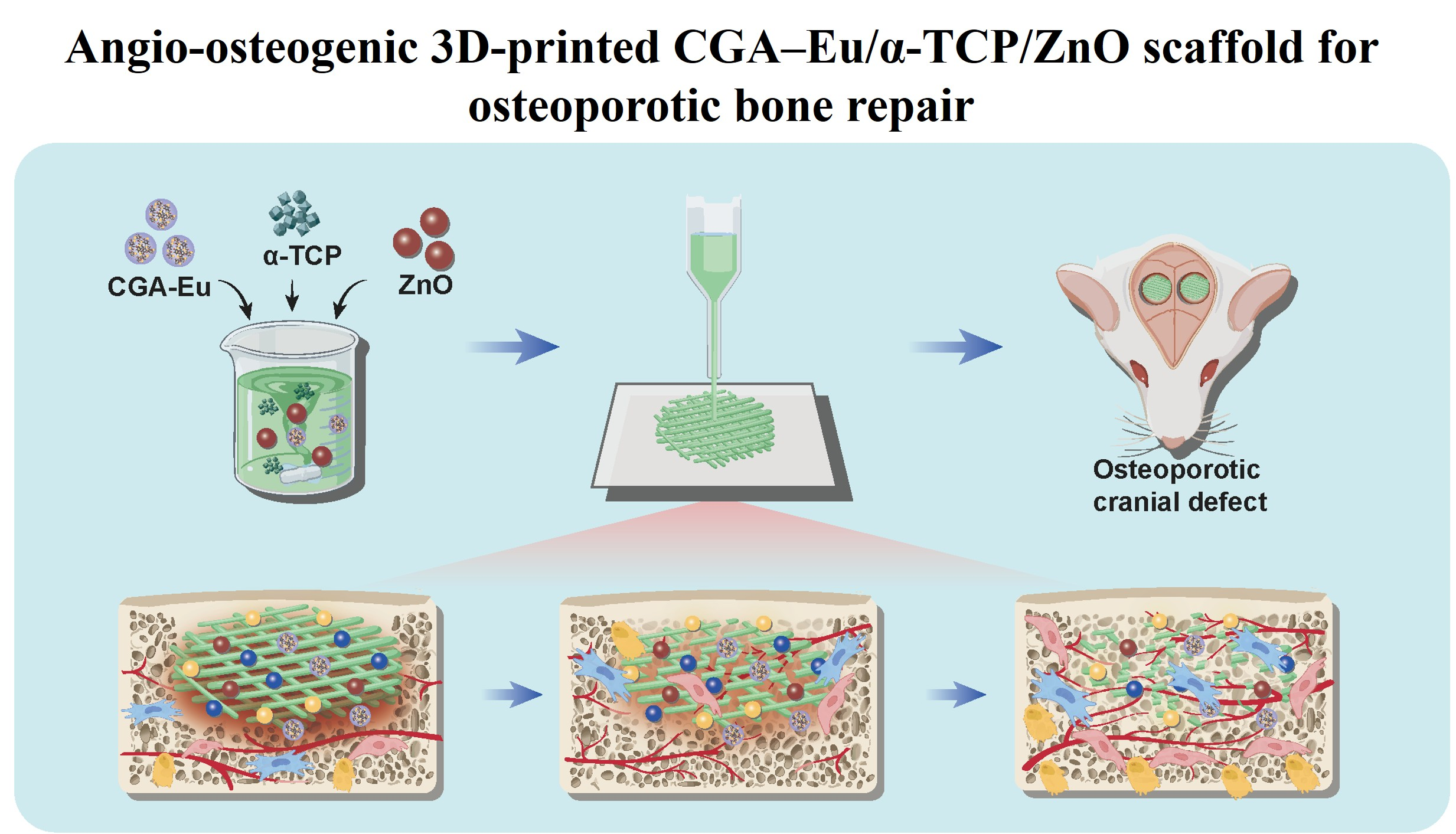
Impaired bone regeneration in osteoporosis primarily stems from a local pathological microenvironment characterized by high levels of reactive oxygen species (ROS), which severely inhibits osteogenic differentiation and angiogenesis. To address this challenge, this study engineered a 3D-printed multifunctional composite scaffold consisting of an α-tricalcium phosphate/zinc oxide (α-TCP/ZnO) matrix loaded with chlorogenic acid–europium (CGA–Eu) metal-phenolic network nanoparticles. The incorporation of ZnO effectively buffered the acidity generated by α-TCP degradation, thereby maintaining a physiological pH environment favorable for regeneration. Furthermore, CGA–Eu endowed the scaffold with potent antioxidant capacity, enabling it to efficiently scavenge excessive ROS and significantly alleviate oxidative damage in vitro. Biological evaluations confirmed that the sustained release of Eu3+, Zn2+, and CGA cooperatively promoted osteogenic differentiation of bone marrow mesenchymal stem cells and angiogenic activity in human umbilical vein endothelial cells. In an ovariectomized rat cranial defect model, the composite scaffold effectively accelerated bone mass accumulation and enhanced angiogenesis. In conclusion, this dual microenvironment-regulating strategy, which integrates pH buffering, ROS scavenging, and sustained osteo-angiogenic ion delivery, offers a promising scaffold design for osteoporotic bone defect repair.
- Wang W, Zhang X, Zhang L, et al. An immunomodulating regenerating hydrogel that rescues the oxidative microenvironment and reverses cell senescence for osteoporotic bone defects. ACS Nano. 2025;19(31):28353- 28371. doi: 10.1021/acsnano.5c06549
- Sheppard A, Barfield A, Barton S, Dong Y. Understanding reactive oxygen species in bone regeneration: A glance at potential therapeutics and bioengineering applications. Front Bioeng Biotechnol. 2022;10:836764. doi: 10.3389/fbioe.2022.836764
- Wu H, Zhang Q, Zhu J, Wu L, Xiao Y, Yang X. Biomaterials targeting senescent cells for bone regeneration: State-of-the-art and future perspectives. Bioact Mater. 2025;54:686-714. doi: 10.1016/j.bioactmat.2025.09.002
- Li H, Zhang Z, Liu J, Wang H. Antioxidant scaffolds for enhanced bone regeneration: Recent advances and challenges. Biomed Eng Online. 2025;24(1):41. doi: 10.1186/s12938-025-01370-z
- Luo J, Li L, Shi W, Xu K, Shen Y, Dai B. Oxidative stress and inflammation: Roles in osteoporosis. Front Immunol. 2025;16:1611932. doi: 10.3389/fimmu.2025.1611932
- Saberi A, Kouhjani M, Mohammadi M, Hosta-Rigau L. Novel scaffold platforms for simultaneous induction osteogenesis and angiogenesis in bone tissue engineering: A cutting-edge approach. J Nanobiotechnol. 2023;21(1):351. doi: 10.1186/s12951-023-02115-7
- Müller W, Ackermann M, Al-Nawas B, et al. Amplified morphogenetic and bone forming activity of amorphous versus crystalline calcium phosphate/polyphosphate. Acta Biomater. 2020;118:233-247. doi: 10.1016/j.actbio.2020.10.023
- Tao S, Li X, Wei W, et al. Polymeric coating on β-TCP scaffolds provides immobilization of small extracellular vesicles with surface-functionalization and ZEB1-loading for bone defect repair in diabetes mellitus. Biomaterials. 2022;283:121465. doi: 10.1016/j.biomaterials.2022.121465
- Carrodeguas R, De Aza S. α-tricalcium phosphate: Synthesis, properties and biomedical applications. Acta Biomater. 2011;7(10):3536-3546. doi: 10.1016/j.actbio.2011.06.019
- Tronco M, Cassel J, dos Santos L. α-TCP-based calcium phosphate cements: A critical review. Acta Biomater. 2022;151:70-87. doi: 10.1016/j.actbio.2022.08.040
- Liu S, Chen W, Xiao L, et al. Robust osteoconductive β-tricalcium phosphate/L-poly(lactic acid) membrane via orientation-strengthening technology. ACS Biomater Sci Eng. 2023;9(9):5293-5303. doi: 10.1021/acsbiomaterials.3c00617
- Bohner M, Santoni B, Döbelin N. β-tricalcium phosphate for bone substitution: Synthesis and properties. Acta Biomater. 2020;113:23-41. doi: 10.1016/j.actbio.2020.06.022
- Ni X, Feng J, Liang M, et al. Enhancing bone repair with β-TCP-based composite scaffolds: A review of design strategies and biological mechanisms. Orthop Res Rev. 2025;17:313-340. doi: 10.2147/ORR.S525959
- Wang J, Xia Y, Hao Z, et al. A triple-integrated 3D-printed composite scaffold of high-activity peptide-metal ion-bone cement facilitates osteo-vascular regenerative repair of diabetic bone defects. Adv Funct Mater. 2025;35(24):2422950. doi: 10.1002/adfm.202422950
- Xia Y, Jing X, Wu X, Zhuang P, Guo X, Dai H. 3D-printed dual-ion chronological release functional platform reconstructs neuro-vascularization network for critical-sized bone defect regeneration. Chem Eng J. 2023;465:143015. doi: 10.1016/j.cej.2023.143015
- Safronova T, Selezneva II, Tikhonova S, et al. Biocompatibility of biphasic α,β-tricalcium phosphate ceramics in vitro. Bioact Mater. 2020;5(2):423-427. doi: 10.1016/j.bioactmat.2020.03.007
- Li P, Dai J, Li Y, et al. Zinc based biodegradable metals for bone repair and regeneration: Bioactivity and molecular mechanisms. Mater Today Bio. 2024;25:100932. doi: 10.1016/j.mtbio.2023.100932
- Molenda M, Kolmas J. The Role of Zinc in Bone Tissue Health and Regeneration—a Review. Biol Trace Elem Res. 2023;201(12):5640-5651. doi: 10.1007/s12011-023-03631-1
- Wen X, Wang J, Pei X, Zhang X. Zinc-based biomaterials for bone repair and regeneration: mechanism and applications. J Mater Chem B. 2023;11(48):11405-11425. doi: 10.1039/D3TB01874A
- Chen L, Zhou C, Xie Q, et al. Zinc Doped Synthetic Polymer Composites for Bone Regeneration: A Promising Strategy to Repair Bone Defects. Int J Nanomedicine. 2025;20:8567- 8586. doi: 10.2147/IJN.S512994
- Wang Z, Xiang P, Xu Z, et al. The role of magnesium, zinc, and strontium in osteoporotic fracture repair. Bioengineering (Basel). 2025;12(2):201. doi: 10.3390/bioengineering12020201
- Shen J, Zhang S, Zhang J, Wei X, Wang Z, Han B. Osteogenic mechanism of chlorogenic acid and its application in clinical practice. Front Pharmacol. 2024;15:1396354. doi: 10.3389/fphar.2024.1396354
- Huang J, Xie M, He L, Song X, Cao T. Chlorogenic acid: A review on its mechanisms of anti-inflammation, disease treatment, and related delivery systems. Front Pharmacol. 2023;14:1218015. doi: 10.3389/fphar.2023.1218015
- Nguyen V, Taine E, Meng D, Cui T, Tan W. Chlorogenic acid: A systematic review on the biological functions, mechanistic actions, and therapeutic potentials. Nutrients. 2024;16(7):924. doi: 10.3390/nu16070924
- Wang Y, Li Z, Yu R, et al. Metal-phenolic network biointerface-mediated cell regulation for bone tissue regeneration. Mater Today Bio. 2024;30:101400. doi: 10.1016/j.mtbio.2024.101400
- Lin Z, Liu H, Richardson J, et al. Metal–phenolic network composites: From fundamentals to applications. Chem Soc Rev. 2024;53(22):10800-10826. doi: 10.1039/D3CS00273J
- Tang Z, Huang Z, Huang Y, et al. Nanomedicine’s shining armor: Understanding and leveraging the metal-phenolic networks. J Nanobiotechnol. 2025;23(1):158. doi: 10.1186/s12951-025-03210-7
- Wu K, Wu X, Guo J, Jiao Y, Zhou C. Facile polyphenol– europium assembly enabled functional poly(l-lactic acid) nanofiber mats with enhanced antioxidation and angiogenesis for accelerated wound healing. Adv Healthc Mater. 2021;10(19):2100793. doi: 10.1002/adhm.202100793
- Shi M, Xia L, Chen Z, et al. Europium-doped mesoporous silica nanosphere as an immune-modulating osteogenesis/ angiogenesis agent. Biomaterials. 2017;144:176-187. doi: 10.1016/j.biomaterials.2017.08.027
- Wu L, Yang F, Xue Y, et al. The biological functions of europium-containing biomaterials: A systematic review. Mater Today Bio. 2023;19:100595. doi: 10.1016/j.mtbio.2023.100595
- Feng S, Peng X, Wu Y, et al. Europium-doped 3D dimensional porous calcium phosphate scaffolds as a strategy for facilitating the comprehensive regeneration of bone tissue: In vitro and in vivo. ACS Biomater Sci Eng. 2024;10(11):7086-7099. doi: 10.1021/acsbiomaterials.4c01067
- He Z, Sun C, Ma Y, et al. Rejuvenating aged bone repair through multihierarchy reactive oxygen species-regulated hydrogel. Adv Mater. 2024;36(9):2306552. doi: 10.1002/adma.202306552
- Yao K, Zhang Q, Weng L, et al. Cerium-doped, alendronate-loaded, metal–organic framework nanodrug for delayed osteoporosis progress. ACS Appl Nano Mater. 2024;7(24):28504-28518. doi: 10.1021/acsanm.4c05640
- Cerqueni G, Scalzone A, Licini C, Gentile P, Mattioli- Belmonte M. Insights into oxidative stress in bone tissue and novel challenges for biomaterials. Mater Sci Eng C. 2021;130:112433. doi: 10.1016/j.msec.2021.112433
- Zhang C, Li H, Li J, Hu J, Yang K, Tao L. Oxidative stress: A common pathological state in a high-risk population for osteoporosis. Biomed Pharmacother. 2023;163:114834. doi: 10.1016/j.biopha.2023.114834
- Huang D, Li Z, Li G, et al. Biomimetic structural design in 3D-printed scaffolds for bone tissue engineering. Mater Today Bio. 2025;32:101664. doi: 10.1016/j.mtbio.2025.101664
- Tajvar S, Hadjizadeh A, Samandari SS. Scaffold degradation in bone tissue engineering: An overview. Int Biodeterior Biodegrad. 2023;180:105599. doi: 10.1016/j.ibiod.2023.105599
- Zhang J, Jiang Y, Shang Z, et al. Biodegradable metals for bone defect repair: A systematic review and meta-analysis based on animal studies. Bioact Mater. 2021;6(11):4027- 4052. doi: 10.1016/j.bioactmat.2021.03.035
- Cao X, Sun K, Luo J, et al. Enhancing osteogenesis and mechanical properties through scaffold design in 3D printed bone substitutes. ACS Biomater Sci Eng. 2025;11(2):710-729. doi: 10.1021/acsbiomaterials.4c01661
- Bădilă A, Rădulescu D, Ilie A, Niculescu A, Grumezescu A, Rădulescu A. Bone regeneration and oxidative stress: An updated overview. Antioxidants (Basel). 2022;11(2):318. doi: 10.3390/antiox11020318
- Wei Y, Wei Z, Luo P, Wei W, Liu S. pH-sensitive metal-phenolic network capsules for targeted photodynamic therapy against cancer cells. Artif Cells Nanomed Biotechnol. 2018;46(8):1552-1561. doi: 10.1080/21691401.2017.1377724
- Ali A, Javed R, Farhangi S, et al. Metal phenolic networks (MPNs)-based pH-sensitive stimulus responsive nanosystems for drug delivery in tumor microenvironment. J Drug Deliv Sci Technol. 2023;84:104536. doi: 10.1016/j.jddst.2023.104536
- Wieszczycka K, Staszak K, Woźniak-Budych MJ, Jurga S. Lanthanides and tissue engineering strategies for bone regeneration. Coord Chem Rev. 2019;388:248-267. doi: 10.1016/j.ccr.2019.03.003
- Wu C, Xia L, Han P, et al. Europium-containing mesoporous bioactive glass scaffolds for stimulating in vitro and in vivo osteogenesis. ACS Appl Mater Interfaces. 2016;8(18):11342- 11354. doi: 10.1021/acsami.6b03100
- Zhu D, Su Y, Zheng Y, Fu B, Tang L, Qin YX. Zinc regulates vascular endothelial cell activity through zinc-sensing receptor ZnR/GPR39. Am J Physiol Cell Physiol. 2018;314(4):C404-C414. doi: 10.1152/ajpcell.00279.2017
- Qiang L, Huang H, Shan J, et al. 3D-printed zinc/ magnesium-doped hydroxyapatite-polycaprolactone composite scaffolds for angiogenesis and osteogenesis. Int J Bioprint. 2024;10(6):4243. doi: 10.36922/ijb.4243
- Chen G, Chen C, Dong Z, et al. Enhancing degradation behaviour, osteogenic capacity and angiogenic performance of additively manufactured porous Zn-Mg scaffold via a neobavaisoflavone-doped GelMA composite hydrogel coating. Virtual Phys Prototyping. 2025;20(1):e2500673. doi: 10.1080/17452759.2025.2500673