
Comprehensive review on additive manufacturing of porous biomedical titanium alloys: Structural design, surface modification and applications

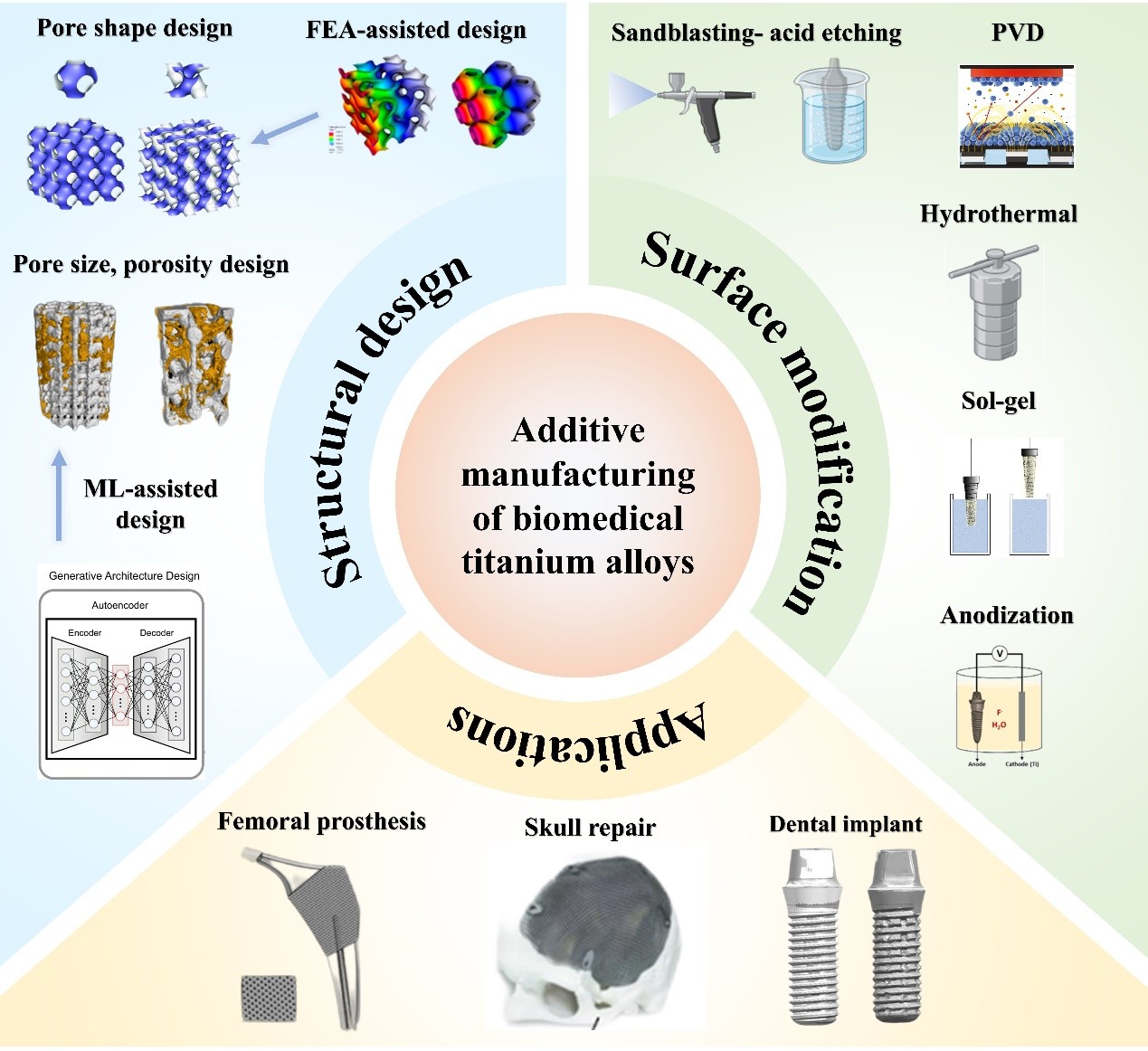
Titanium and its alloys have become the primary materials for orthopedic implants due to their excellent biocompatibility, mechanical properties, and corrosion resistance. However, traditional manufacturing techniques struggle to achieve complex porous structures, and their insufficient surface bioactivity limits their clinical performance. Additive manufacturing (AM) technology enables the precise fabrication of titanium implants with personalized shape, biomimetic porous structures, and gradient mechanical properties. The controllable porosity, pore size, and pore shape not only achieve mechanical compatibility with human bone tissue, but also provide an optimal microenvironment for cell adhesion, proliferation, and vascularization. During the process of designing porous structures, the auxiliary roles of finite element analysis (FEA) and machine learning (ML) play a crucial role in performance prediction and process optimization. To further enhance the bioactivity of AM titanium alloys, surface modification techniques such as mechanical, physical, chemical, and electrochemical methods have been widely employed. These modified coatings significantly improve the osseointegration efficiency, antibacterial properties, and corrosion resistance of implants without compromising the mechanical integrity of the substrate. Currently, AM titanium alloy implants have been successfully applied in joint replacements, dental prosthetics, and other fields. Through the synergistic effect of personalized design and surface functionalization, they demonstrate superior clinical application potential compared to traditional implants. This article systematically reviews the porous structure design, surface modification techniques, and application progress of AM titanium alloy implants, aiming to provide valuable insights for clinical applications.
- Briggs AM, Cross MJ, Hoy DG, et al. Musculoskeletal Health Conditions Represent a Global Threat to Healthy Aging: A Report for the 2015 World Health Organization World Report on Ageing and Health. Gerontologist. 2016;56(Suppl 2):S243-S255. doi: 10.1093/geront/gnw002
- Westrick ER, Bernstein M, Little MT, Marecek GS, Scolaro JA. Orthopaedic Advances: Use of Three-Dimensional Metallic Implants for Reconstruction of Critical Bone Defects After Trauma. J Am Acad Orthop Surg. 2023;31(18):e685-e693. doi: 10.5435/JAAOS-D-22-00676
- Meng M, Wang J, Huang H, Liu X, Zhang J, Li Z. 3D printing metal implants in orthopedic surgery: Methods, applications and future prospects. J Orthop Transl. 2023;42:94-112. doi: 10.1016/j.jot.2023.08.004
- Zhao L, Pei X, Jiang L, et al. Bionic design and 3D printing of porous titanium alloy scaffolds for bone tissue repair. Compos Part B Eng. 2019;162:154-161. doi: 10.1016/j.compositesb.2018.10.094
- Cordeiro JM, Beline T, Ribeiro ALR, et al. Development of binary and ternary titanium alloys for dental implants. Dent Mater. 2017;33(11):1244-1257. doi: 10.1016/j.dental.2017.07.013
- Li Y, Jiang D, Zhu R, Yang C, Wang L, Zhang LC. Revolutionizing medical implant fabrication: advances in additive manufacturing of biomedical metals. Int J Extrem Manuf. 2025;7(2):022002. doi: 10.1088/2631-7990/ad92cc
- Abd-Elaziem W, Darwish MA, Hamada A, Daoush WM. Titanium-Based alloys and composites for orthopedic implants Applications: A comprehensive review. Mater Des. 2024;241:112850. doi: 10.1016/j.matdes.2024.112850
- Guo AXY, Cheng L, Zhan S, et al. Biomedical applications of the powder‐based 3D printed titanium alloys: A review. J Mater Sci Technol. 2022;125:252-264. doi: 10.1016/j.jmst.2021.11.084
- Cui YW, Wang L, Zhang LC. Towards load-bearing biomedical titanium-based alloys: From essential requirements to future developments. Prog Mater Sci. 2024;144:101277. doi: 10.1016/j.pmatsci.2024.101277
- Sun XD, Liu TT, Wang QQ, Zhang J, Cao MS. Surface Modification and Functionalities for Titanium Dental Implants. ACS Biomater Sci Eng. 2023;9(8):4442-4461. doi: 10.1021/acsbiomaterials.3c00183
- Mao C, Yu W, Jin M, et al. Mechanobiologically optimized Ti–35Nb–2Ta–3Zr improves load transduction and enhances bone remodeling in tilted dental implant therapy. Bioact Mater. 2022;16:15-26. doi: 10.1016/j.bioactmat.2022.03.005
- Shao L, Du Y, Dai K, et al. β-Ti Alloys for Orthopedic and Dental Applications: A Review of Progress on Improvement of Properties through Surface Modification. Coatings. 2021;11(12):1446. doi: 10.3390/coatings11121446
- Zhang E, Zhao X, Hu J, Wang R, Fu S, Qin G. Antibacterial metals and alloys for potential biomedical implants. Bioact Mater. 2021;6(8):2569-2612. doi: 10.1016/j.bioactmat.2021.01.030
- Sidhu SS, Singh H, Gepreel MAH. A review on alloy design, biological response, and strengthening of β-titanium alloys as biomaterials. Mater Sci Eng C. 2021;121:111661. doi: 10.1016/j.msec.2020.111661
- Xu Z, Zhang Y, Wu Y, et al. In Vitro and In Vivo Analysis of the Effects of 3D‐Printed Porous Titanium Alloy Scaffold Structure on Osteogenic Activity. Biomed Res Int. 2022;2022(1):8494431. doi: 10.1155/2022/8494431
- Wang Z, Zhang M, Liu Z, et al. Biomimetic design strategy of complex porous structure based on 3D printing Ti-6Al-4V scaffolds for enhanced osseointegration. Mater Des. 2022;218:110721. doi: 10.1016/j.matdes.2022.110721
- Song C, Liu L, Deng Z, et al. Research progress on the design and performance of porous titanium alloy bone implants. J Mater Res Technol. 2023;23:2626-2641. doi: 10.1016/j.jmrt.2023.01.155
- Qu Z, Zhang Z, Liu R, et al. High fatigue resistance in a titanium alloy via near-void-free 3D printing. Nature. 2024;626(8001):999-1004. doi: 10.1038/s41586-024-07048-1
- Zhang J, Bermingham MJ, Otte J, et al. Ultrauniform, strong, and ductile 3D-printed titanium alloy through bifunctional alloy design. Science. 2024;383(6683):639-645. doi: 10.1126/science.adj0141
- Tang Z, Yu D, Bao S, et al. Porous Titanium Scaffolds with Mechanoelectrical Conversion and Photothermal Function: A Win‐Win Strategy for Bone Reconstruction of Tumor‐ Resected Defects. Adv Healthc Mater. 2024;13(7):2302901. doi: 10.1002/adhm.202302901
- Kaseem M, Fatimah S, Nashrah N, Ko YG. Recent progress in surface modification of metals coated by plasma electrolytic oxidation: Principle, structure, and performance. Prog Mater Sci. 2021;117:100735. doi: 10.1016/j.pmatsci.2020.100735
- Li G, Ma F, Liu P, et al. Review of micro-arc oxidation of titanium alloys: Mechanism, properties and applications. J Alloys Compd. 2023;948:169773. doi: 10.1016/j.jallcom.2023.169773
- Han X, Ma J, Tian A, et al. Surface modification techniques of titanium and titanium alloys for biomedical orthopaedics applications: A review. Colloids Surf B Biointerfaces. 2023;227:113339. doi: 10.1016/j.colsurfb.2023.113339
- Yao Y, Yi Z, Chong WJ, et al. Micro-arc oxidation surface-modification of titanium alloys for biomedical applications: Mechanisms, advances, challenges, and prospects. Prog Mater Sci. 2026;159:101654. doi: 10.1016/j.pmatsci.2026.101654
- Luo X, Yang C, Li D, Zhang LC. Laser Powder Bed Fusion of Beta-Type Titanium Alloys for Biomedical Application: A Review. Acta Metall Sin (Engl Lett). 2024;37(1):17-28. doi: 10.1007/s40195-023-01654-0
- Armstrong M, Mehrabi H, Naveed N. An overview of modern metal additive manufacturing technology. J Manuf Process. 2022;84:1001-1029. doi: 10.1016/j.jmapro.2022.10.060
- Chattopadhyay S, Mahapatra SD, Mandal NK. Advancements and challenges in additive manufacturing: a comprehensive review. Eng Res Express. 2024;6(1):012505. doi: 10.1088/2631-8695/ad30b1
- Sing SL, Huang S, Goh GD, et al. Emerging metallic systems for additive manufacturing: In-situ alloying and multi-metal processing in laser powder bed fusion. Prog Mater Sci. 2021;119:100795. doi: 10.1016/j.pmatsci.2021.100795
- Haase F, Siemers C, Rösler J. Laser powder bed fusion (LPBF) of commercially pure titanium and alloy development for the LPBF process. Front Bioeng Biotechnol. 2023;11:1260925. doi: 10.3389/fbioe.2023.1260925
- Behjat A, Sanaei S, Mosallanejad MH, et al. A novel titanium alloy for load-bearing biomedical implants: Evaluating the antibacterial and biocompatibility of Ti536 produced via electron beam powder bed fusion additive manufacturing process. Biomater Adv. 2024;163:213928. doi: 10.1016/j.bioadv.2024.213928
- Ibrahim P, Garrard R, Attallah MM. Laser powder bed fusion of a β titanium alloy: Microstructural development, post-processing, and mechanical behaviour. Mater Sci Eng A. 2024;905:146617. doi: 10.1016/j.msea.2024.146617
- Thijs L, Verhaeghe F, Craeghs T, Humbeeck JV, Kruth JP. A study of the microstructural evolution during selective laser melting of Ti–6Al–4V. Acta Mater. 2010;58(9):3303-3312. doi: 10.1016/j.actamat.2010.02.004
- Li G, Zhou X, Zhang J, Yuan M, Chen Z. Effects of electron beam current on local microstructure characteristics and tensile behaviors of Ti–6Al–4V alloys fabricated by electron beam melting. Mater Sci Eng A. 2024;912:146966. doi: 10.1016/j.msea.2024.146966
- He S, Xiao F, Li L, et al. Design biomedical β-Ti alloys with exceptional strength-ductility balance via domain knowledge-based machine learning. Acta Mater. 2025;301:121550. doi: 10.1016/j.actamat.2025.121550
- Xiao F, Ye J hui, Huang C xiao, et al. Gradient gyroid Ti6Al4V scaffolds with TiO2 surface modification: Promising approach for large bone defect repair. Biomater Adv. 2024;161:213899. doi: 10.1016/j.bioadv.2024.213899
- Taghian M, Pilehvar Meibody A, Saboori A, Iuliano L. Toward closed-loop quality assurance in powder bed fusion additive manufacturing: Defect detection, machine learning, and computational modeling. J Manuf Process. 2026;160:50- 81. doi: 10.1016/j.jmapro.2026.01.026
- Aufa AN, Hassan MZ, Ismail Z. Recent advances in Ti-6Al-4V additively manufactured by selective laser melting for biomedical implants: Prospect development. J Alloys Compd. 2022;896:163072. doi: 10.1016/j.jallcom.2021.163072
- Liu J, Zhang K, Bermingham MJ, et al. Fatigue and damage tolerance performance of additively-manufactured titanium alloys for structural application: A comprehensive review. Mater Sci Eng R Rep. 2026;167:101135. doi: 10.1016/j.mser.2025.101135
- Li G, Liu W, Liang L, Liu T, Tian Y, Wu H. Preparing Sr-containing nano-structures on micro-structured titanium alloy surface fabricated by additively manufacturing to enhance the anti-inflammation and osteogenesis. Colloids Surf B Biointerfaces. 2022;218:112762. doi: 10.1016/j.colsurfb.2022.112762
- Civantos A, Martínez-Campos E, Ramos V, Elvira C, Gallardo A, Abarrategi A. Titanium Coatings and Surface Modifications: Toward Clinically Useful Bioactive Implants. ACS Biomater Sci Eng. 2017;3(7):1245-1261. doi: 10.1021/acsbiomaterials.6b00604
- Xie X, Chang L, Chen B, Li J, Huang H, Guo Z. Promote the catalytic performance and service life of Ti-based oxide coatings through sandblasting. Ionics. 2022;28(5):2501- 2511. doi: 10.1007/s11581-021-04408-z
- Chen R, Xu J, Zhao F, Wu Y, Zhang J. Preparation of Microstructure Laser Ablation and Multiple Acid-Etching Composites on the Surfaces of Medical Titanium Alloy TC4 by Laser Ablation and Multiple Acid-Etching, and Study of Frictional Properties of the Processed Surfaces. Metals. 2022;12(7):1148. doi: 10.3390/met12071148
- Liu X, Niu Y, Xie W, Wei D, Du Q. Comparative investigations of in vitro and in vivo bioactivity of titanium vs. Ti–24Nb–4Zr–8Sn alloy before and after sandblasting and acid etching. RSC Adv. 2020;10(40):23582-23591. doi: 10.1039/D0RA00280A
- Rautray TR, Narayanan R, Kim KH. Ion implantation of titanium based biomaterials. Prog Mater Sci. 2011;56(8):1137-1177. doi: 10.1016/j.pmatsci.2011.03.002
- Lenis JA, Bejarano G, Rico P, Ribelles JLG, Bolívar FJ. Development of multilayer Hydroxyapatite - Ag/TiN-Ti coatings deposited by radio frequency magnetron sputtering with potential application in the biomedical field. Surf Coat Technol. 2019;377:124856. doi: 10.1016/j.surfcoat.2019.06.097
- Su Y, Komasa S, Sekino T, Nishizaki H, Okazaki J. Nanostructured Ti6Al4V alloy fabricated using modified alkali-heat treatment: Characterization and cell adhesion. Mater Sci Eng C. 2016;59:617-623. doi: 10.1016/j.msec.2015.10.077
- Tsukimura N, Ueno T, Iwasa F, et al. Bone integration capability of alkali- and heat-treated nanobimorphic Ti–15Mo–5Zr–3Al. Acta Biomater. 2011;7(12):4267-4277. doi: 10.1016/j.actbio.2011.08.016
- Dai X, Zhao J, Qi S, et al. Enhanced biological performance of Sr2+-doped nanorods on titanium implants by surface thermal-chemical treatment. J Mater Sci Mater Med. 2025;36(1):54. doi: 10.1007/s10856-025-06898-z
- Advincula MC, Rahemtulla FG, Advincula RC, Ada ET, Lemons JE, Bellis SL. Osteoblast adhesion and matrix mineralization on sol–gel-derived titanium oxide. Biomaterials. 2006;27(10):2201-2212. doi: 10.1016/j.biomaterials.2005.11.014
- Bai W, Ma F, Zhao J, et al. Preparation of a composite coating of bimodal TiO2 nanotubes with deposited Ag nanoparticles and its biological performance. Mater Chem Phys. 2025;339:130710. doi: 10.1016/j.matchemphys.2025.130710
- Gulati K, Zhang Y, Di P, Liu Y, Ivanovski S. Research to Clinics : Clinical Translation Considerations for Anodized Nano-Engineered Titanium Implants. ACS Biomater Sci Eng. 2022;8(10):4077-4091. doi: 10.1021/acsbiomaterials.1c00529
- Liu L, Ma F, Liu P, et al. Preparation and antibacterial properties of ZnSr-doped micro-arc oxidation coatings on titanium. Surf Coat Technol. 2023;462:129469. doi: 10.1016/j.surfcoat.2023.129469
- Qi S, Kang B, Yao C, et al. Cerium doped TiO2 coating with superior antibacterial property and biocompatibility prepared by micro-arc oxidation. Mater Des. 2023;234:112312. doi: 10.1016/j.matdes.2023.112312
- Shojaei AR, Soleimany Zefreh A, Malekli M, Ramezanzadeh B, Eivaz Mohammadloo H. Sustainable metal-organic framework (MOF) bio-films for biomedical applications. Sustain Mater Technol. 2025;46:e01633. doi: 10.1016/j.susmat.2025.e01633
- Sun M, Wang J, Huang X, et al. Ultrasound-driven radical chain reaction and immunoregulation of piezoelectric-based hybrid coating for treating implant infection. Biomaterials. 2024;307:122532. doi: 10.1016/j.biomaterials.2024.122532
- Blakey-Milner B, Gradl P, Snedden G, et al. Metal additive manufacturing in aerospace: A review. Mater Des. 2021;209:110008. doi: 10.1016/j.matdes.2021.110008
- Depboylu FN, Yasa E, Poyraz Ö, Minguella-Canela J, Korkusuz F, De Los Santos López MA. Titanium based bone implants production using laser powder bed fusion technology. J Mater Res Technol. 2022;17:1408-1426. doi: 10.1016/j.jmrt.2022.01.087
- Chen H, Han Q, Wang C, Liu Y, Chen B, Wang J. Porous Scaffold Design for Additive Manufacturing in Orthopedics: A Review. Front Bioeng Biotechnol. 2020;8:609. doi: 10.3389/fbioe.2020.00609
- Vaiani L, Boccaccio A, Uva AE, et al. Ceramic Materials for Biomedical Applications: An Overview on Properties and Fabrication Processes. J Funct Biomater. 2023;14(3):146. doi: 10.3390/jfb14030146
- Al-Ketan O, Abu Al-Rub RK. Multifunctional Mechanical Metamaterials Based on Triply Periodic Minimal Surface Lattices. Adv Eng Mater. 2019;21(10):1900524. doi: 10.1002/adem.201900524
- Gawronska E, Dyja R. A Numerical Study of Geometry’s Impact on the Thermal and Mechanical Properties of Periodic Surface Structures. Materials. 2021;14(2):427. doi: 10.3390/ma14020427
- Liu W, Zhang Y, Lyu Y, Bosiakov S, Liu Y. Inverse design of anisotropic bone scaffold based on machine learning and regenerative genetic algorithm. Front Bioeng Biotechnol. 2023;11:1241151. doi: 10.3389/fbioe.2023.1241151
- Sun C, Shang G. Application and Development of 3D Printing in Medical Field. Mod Mech Eng. 2020;10(3):25-33. doi: 10.4236/mme.2020.103003
- Qin Z, He Y, Gao J, et al. Surface modification improving the biological activity and osteogenic ability of 3D printing porous dental implants. Front Mater. 2023;10:1183902. doi: 10.3389/fmats.2023.1183902
- Ahmadi S, Yavari S, Wauthle R, et al. Additively Manufactured Open-Cell Porous Biomaterials Made from Six Different Space-Filling Unit Cells: The Mechanical and Morphological Properties. Materials. 2015;8(4):1871-1896. doi: 10.3390/ma8041871
- Li Y, Jiang D, Zhao R, Wang X, Wang L, Zhang LC. High Mechanical Performance of Lattice Structures Fabricated by Additive Manufacturing. Metals. 2024;14(10):1165. doi: 10.3390/met14101165
- Al-Ketan O, Rowshan R, Abu Al-Rub RK. Topology-mechanical property relationship of 3D printed strut, skeletal, and sheet based periodic metallic cellular materials. Addit Manuf. 2018;19:167-183. doi: 10.1016/j.addma.2017.12.006
- Zhang Y, Wei D, Chen Y, et al. Non-negligible role of gradient porous structure in superelasticity deterioration and improvement of NiTi shape memory alloys. J Mater Sci Technol. 2024;186:48-63. doi: 10.1016/j.jmst.2023.10.053
- Lv Y, Wang B, Liu G, et al. Design of bone-like continuous gradient porous scaffold based on triply periodic minimal surfaces. J Mater Res Technol. 2022;21:3650-3665. doi: 10.1016/j.jmrt.2022.10.160
- Arabnejad S, Burnett Johnston R, Pura JA, Singh B, Tanzer M, Pasini D. High-strength porous biomaterials for bone replacement: A strategy to assess the interplay between cell morphology, mechanical properties, bone ingrowth and manufacturing constraints. Acta Biomater. 2016;30:345-356. doi: 10.1016/j.actbio.2015.10.048
- Lei H, Zhou Z, Liu J, et al. Structural Optimization of 3D-Printed Porous Titanium Implants Promotes Bone Regeneration for Enhanced Biological Fixation. ACS Appl Mater Interfaces. 2025;17(12):18059-18073. doi: 10.1021/acsami.4c22401
- Parisien A, ElSayed MSA, Frei H. Mechanoregulation modelling of stretching versus bending dominated periodic cellular solids. Mater Today Commun. 2022;33:104315. doi: 10.1016/j.mtcomm.2022.104315
- Ali D, Ozalp M, Blanquer SBG, Onel S. Permeability and fluid flow-induced wall shear stress in bone scaffolds with TPMS and lattice architectures: A CFD analysis. Eur J Mech B Fluids. 2020;79:376-385. doi: 10.1016/j.euromechflu.2019.09.015
- Wang B, Zhou C, Zhou J, et al. Niti minimal surface porous scaffolds matching human bone characteristics: mechanical, permeability and osteogenic properties. Virtual Phys Prototyp. 2026;21(1):e2633475. doi: 10.1080/17452759.2026.2633475
- Werner M, Blanquer SBG, Haimi SP, et al. Surface Curvature Differentially Regulates Stem Cell Migration and Differentiation via Altered Attachment Morphology and Nuclear Deformation. Adv Sci. 2017;4(2):1600347. doi: 10.1002/advs.201600347
- Ataee A, Li Y, Fraser D, Song G, Wen C. Anisotropic Ti-6Al-4V gyroid scaffolds manufactured by electron beam melting (EBM) for bone implant applications. Mater Des. 2018;137:345-354. doi: 10.1016/j.matdes.2017.10.040
- Santos J, Pires T, Gouveia BP, Castro APG, Fernandes PR. On the permeability of TPMS scaffolds. J Mech Behav Biomed Mater. 2020;110:103932. doi: 10.1016/j.jmbbm.2020.103932
- Bobbert FSL, Lietaert K, Eftekhari AA, et al. Additively manufactured metallic porous biomaterials based on minimal surfaces: A unique combination of topological, mechanical, and mass transport properties. Acta Biomater. 2017;53:572-584. doi: 10.1016/j.actbio.2017.02.024
- Deng F, Liu L, Li Z, Liu J. 3D printed Ti6Al4V bone scaffolds with different pore structure effects on bone ingrowth. J Biol Eng. 2021;15(1):4. doi: 10.1186/s13036-021-00255-8
- Gandhi R, Salmi M, Roy B, Pagliari L, Concli F. Mechanical performance, fatigue behaviour, and biointegration of additively manufactured architected lattices. Virtual Phys Prototyp. 2025;20(1):e2530733. doi: 10.1080/17452759.2025.2530733
- Lv Y, Wang B, Liu G, et al. Metal Material, Properties and Design Methods of Porous Biomedical Scaffolds for Additive Manufacturing: A Review. Front Bioeng Biotechnol. 2021;9:641130. doi: 10.3389/fbioe.2021.641130
- Kapat K, Srivas PK, Rameshbabu AP, et al. Influence of Porosity and Pore-Size Distribution in Ti6 Al4 V Foam on Physicomechanical Properties, Osteogenesis, and Quantitative Validation of Bone Ingrowth by Micro- Computed Tomography. ACS Appl Mater Interfaces. 2017;9(45):39235-39248. doi: 10.1021/acsami.7b13960
- Taniguchi N, Fujibayashi S, Takemoto M, et al. Effect of pore size on bone ingrowth into porous titanium implants fabricated by additive manufacturing: An in vivo experiment. Mater Sci Eng C. 2016;59:690-701. doi: 10.1016/j.msec.2015.10.069
- Liang H, Yang Y, Xie D, et al. Trabecular-like Ti-6Al-4V scaffolds for orthopedic: fabrication by selective laser melting and in vitro biocompatibility. J Mater Sci Technol. 2019;35(7):1284-1297. doi: 10.1016/j.jmst.2019.01.012
- Chen Z, Yan X, Yin S, et al. Influence of the pore size and porosity of selective laser melted Ti6Al4V ELI porous scaffold on cell proliferation, osteogenesis and bone ingrowth. Mater Sci Eng C. 2020;106:110289. doi: 10.1016/j.msec.2019.110289
- Yan X, Li Q, Yin S, et al. Mechanical and in vitro study of an isotropic Ti6Al4V lattice structure fabricated using selective laser melting. J Alloys Compd. 2019;782:209-223. doi: 10.1016/j.jallcom.2018.12.220
- Zhang Y, Sun N, Zhu M, et al. The contribution of pore size and porosity of 3D printed porous titanium scaffolds to osteogenesis. Biomater Adv. 2022;133:112651. doi: 10.1016/j.msec.2022.112651
- Ouyang P, Dong H, He X, et al. Hydromechanical mechanism behind the effect of pore size of porous titanium scaffolds on osteoblast response and bone ingrowth. Mater Des. 2019;183:108151. doi: 10.1016/j.matdes.2019.108151
- Kelly CN, Evans NT, Irvin CW, Chapman SC, Gall K, Safranski DL. The effect of surface topography and porosity on the tensile fatigue of 3D printed Ti-6Al-4V fabricated by selective laser melting. Mater Sci Eng C. 2019;98:726-736. doi: 10.1016/j.msec.2019.01.024
- Pobloth AM, Checa S, Razi H, et al. Mechanobiologically optimized 3D titanium-mesh scaffolds enhance bone regeneration in critical segmental defects in sheep. Sci Transl Med. 2018;10(423):eaam8828. doi: 10.1126/scitranslmed.aam8828
- Li G, Wang L, Pan W, et al. In vitro and in vivo study of additive manufactured porous Ti6Al4V scaffolds for repairing bone defects. Sci Rep. 2016;6(1):34072. doi: 10.1038/srep34072
- Goto M, Matsumine A, Yamaguchi S, et al. Osteoconductivity of bioactive Ti-6Al-4V implants with lattice-shaped interconnected large pores fabricated by electron beam melting. J Biomater Appl. 2021;35(9):1153-1167. doi: 10.1177/0885328220968218
- Zhang C, Zhang L, Liu L, et al. Mechanical behavior of a titanium alloy scaffold mimicking trabecular structure. J Orthop Surg Res. 2020;15(1):40. doi: 10.1186/s13018-019-1489-y
- Hara D, Nakashima Y, Sato T, et al. Bone bonding strength of diamond-structured porous titanium-alloy implants manufactured using the electron beam-melting technique. Mater Sci Eng C. 2016;59:1047-1052. doi: 10.1016/j.msec.2015.11.025
- Wang C, Xu D, Li S, et al. Effect of Pore Size on the Physicochemical Properties and Osteogenesis of Ti6Al4V Porous Scaffolds with Bionic Structure. ACS Omega. 2020;5(44):28684-28692. doi: 10.1021/acsomega.0c03824
- Arabnejad S, Johnston B, Tanzer M, Pasini D. Fully porous 3D printed titanium femoral stem to reduce stress-shielding following total hip arthroplasty. J Orthop Res. 2017;35(8):1774-1783. doi: 10.1002/jor.23445
- Yao B, Zhang Z, Li Z, et al. Compressive properties and energy absorption of selective laser melting formed Ti-6Al-4V porous radial gradient scaffold. Powder Technol. 2024;442:119856. doi: 10.1016/j.powtec.2024.119856
- Jia Y, Liu K, Zhang XS. Modulate stress distribution with bio-inspired irregular architected materials towards optimal tissue support. Nat Commun. 2024;15(1):4072. doi: 10.1038/s41467-024-47831-2
- Zhang L, Wang B, Song B, et al. 3D Printed Biomimetic Metamaterials with Graded Porosity and Tapering Topology for Improved Cell Seeding and Bone Regeneration. Bioact Mater. 2023;25:677-688. doi: 10.1016/j.bioactmat.2022.07.009
- Ye X, Shi X, Miao X, Lu P, Wu M. The influence mechanism of fractal design method on mechanical properties and corrosion behavior of sheet Gyroid porous structures formed by LPBF. Mater Today Commun. 2024;41:110373. doi: 10.1016/j.mtcomm.2024.110373
- Zhang J, Chen X, Sun Y, et al. Design of a biomimetic graded TPMS scaffold with quantitatively adjustable pore size. Mater Des. 2022;218:110665. doi: 10.1016/j.matdes.2022.110665
- Naqvi SMR, Gu J, Liu S, et al. Laser powder bed fusion additive manufacturing of Ti-6Al-4V dental implants with gradient porosity: Design, simulation, and biomechanical performance. J Mater Sci. 2026;61(1):594-616. doi: 10.1007/s10853-025-11880-9
- Zhang L, Li F, Yang Y, et al. Structure design of porous TC4 alloy with excellent mechanical properties prepared by laser-powder bed fusion. Vacuum. 2024;220:112818. doi: 10.1016/j.vacuum.2023.112818
- He X, Li Y, Bi Y, et al. Finite element analysis of temperature and residual stress profiles of porous cubic Ti-6Al-4V titanium alloy by electron beam melting. J Mater Sci Technol. 2020;44:191-200. doi: 10.1016/j.jmst.2020.01.033
- Sarkar D, Kapil A, Sharma A. Advances in computational modeling for laser powder bed fusion additive manufacturing: A comprehensive review of finite element techniques and strategies. Addit Manuf. 2024;85:104157. doi: 10.1016/j.addma.2024.104157
- Wang L, Huang H, Yuan H, et al. In vitro fatigue behavior and in vivo osseointegration of the auxetic porous bone screw. Acta Biomater. 2023;170:185-201. doi: 10.1016/j.actbio.2023.08.040
- Yu G, Li Z, Li S, et al. The select of internal architecture for porous Ti alloy scaffold: A compromise between mechanical properties and permeability. Mater Des. 2020;192:108754. doi: 10.1016/j.matdes.2020.108754
- Shum JM, Gadomski BC, Tredinnick SJ, et al. Enhanced bone formation in locally-optimised, low-stiffness additive manufactured titanium implants: An in silico and in vivo tibial advancement study. Acta Biomater. 2023;156:202-213. doi: 10.1016/j.actbio.2022.04.006
- Moussa A, Rahman S, Xu M, Tanzer M, Pasini D. Topology optimization of 3D-printed structurally porous cage for acetabular reinforcement in total hip arthroplasty. J Mech Behav Biomed Mater. 2020;105:103705. doi: 10.1016/j.jmbbm.2020.103705
- Srivastava P, Singh VP. FEM-based designing and modelling of a porous customised hip implant stem using n-Topology software. Aust J Mech Eng. 2026;24(1):118-126. doi: 10.1080/14484846.2025.2506264
- Peng W ming, Cheng K jie, Liu Y feng, et al. Biomechanical and Mechanostat analysis of a titanium layered porous implant for mandibular reconstruction: The effect of the topology optimization design. Mater Sci Eng C. 2021;124:112056. doi: 10.1016/j.msec.2021.112056
- Wu C, Xu Y, Fang J, Li Q. Machine Learning in Biomaterials, Biomechanics/Mechanobiology, and Biofabrication: State of the Art and Perspective. Arch Comput Methods Eng. 2024. doi: 10.1007/s11831-024-10100-y
- Mao Y, Jiang D, Vladimir U, Jing Z, Wang L. Machine learning-driven additive manufacturing of biomedical metals: A review of forward prediction, inverse optimization, and quality control. Eng Sci Addit Manuf. 2025;1(4):025440031. doi: 10.36922/ESAM025440031
- Jiang D, Luo M, Liu C, et al. 3D Printing parameter optimisation combined with heat treatment for achieving high density and enhanced performance in refractory high-entropy alloys. Virtual Phys Prototyp. 2025;20(1):e2524524. doi: 10.1080/17452759.2025.2524524
- Jha R, Dulikravich GS. Discovery of New Ti-Based Alloys Aimed at Avoiding/Minimizing Formation of α” and ω-Phase Using CALPHAD and Artificial Intelligence. Metals. 2020;11(1):15. doi: 10.3390/met11010015
- Suwardi A, Wang F, Xue K, et al. Machine Learning‐Driven Biomaterials Evolution. Adv Mater. 2022;34(1):2102703. doi: 10.1002/adma.202102703
- Peng B, Wei Y, Qin Y, et al. Machine learning-enabled constrained multi-objective design of architected materials. Nat Commun. 2023;14(1):6630. doi: 10.1038/s41467-023-42415-y
- Hu B, Wang Z, Du C, et al. Multi-objective Bayesian optimization accelerated design of TPMS structures. Int J Mech Sci. 2023;244:108085. doi: 10.1016/j.ijmecsci.2022.108085
- Zhang J, Zhao J, Rong Q, Yu W, Li X, Misra RDK. Machine learning guided prediction of mechanical properties of TPMS structures based on finite element simulation for biomedical titanium. Mater Technol. 2021. doi: 10.1080/10667857.2021.1999558
- Sing SL, An J, Yeong WY, Wiria FE. Laser and electron‐beam powder‐bed additive manufacturing of metallic implants: A review on processes, materials and designs. J Orthop Res. 2016;34(3):369-385. doi: 10.1002/jor.23075
- Benedetti M, Torresani E, Leoni M, et al. The effect of post-sintering treatments on the fatigue and biological behavior of Ti-6Al-4V ELI parts made by selective laser melting. J Mech Behav Biomed Mater. 2017;71:295-306. doi: 10.1016/j.jmbbm.2017.03.024
- Zhang LC, Chen LY, Wang L. Surface Modification of Titanium and Titanium Alloys: Technologies, Developments, and Future Interests. Adv Eng Mater. 2020;22(5):1901258. doi: 10.1002/adem.201901258
- Bagehorn S, Wehr J, Maier HJ. Application of mechanical surface finishing processes for roughness reduction and fatigue improvement of additively manufactured Ti-6Al-4V parts. Int J Fatigue. 2017;102:135-142. doi: 10.1016/j.ijfatigue.2017.05.008
- Zhang X, Guan S, Qiu J, et al. Atomic Layer Deposition of Tantalum Oxide Films on 3D-Printed Ti6Al4V Scaffolds with Enhanced Osteogenic Property for Orthopedic Implants. ACS Biomater Sci Eng. 2023;9(7):4197-4207. doi: 10.1021/acsbiomaterials.3c00217
- Heimann RB. Plasma-Sprayed Hydroxylapatite Coatings as Biocompatible Intermediaries Between Inorganic Implant Surfaces and Living Tissue. J Therm Spray Technol. 2018;27(8):1212-1237. doi: 10.1007/s11666-018-0737-8
- Zhou L, You J, Wang Z, et al. 3D printing monetite-coated Ti-6Al-4V surface with osteoimmunomodulatory function to enhance osteogenesis. Biomater Adv. 2022;134:112562. doi: 10.1016/j.msec.2021.112562
- Huang H, Wu Z, Yang Z, et al. In vitro application of drug-loaded hydrogel combined with 3D-printed porous scaffolds. Biomed Mater. 2022;17(6):065019. doi: 10.1088/1748-605X/ac9943
- Chudinova EA, Surmeneva MA, Timin AS, et al. Adhesion, proliferation, and osteogenic differentiation of human mesenchymal stem cells on additively manufactured Ti6Al4V alloy scaffolds modified with calcium phosphate nanoparticles. Colloids Surf B Biointerfaces. 2019;176:130- 139. doi: 10.1016/j.colsurfb.2018.12.047
- Yang G, Liu H, Li A, Liu T, Lu Q, He F. Antibacterial Structure Design of Porous Ti6Al4V by 3D Printing and Anodic Oxidation. Materials. 2023;16(15):5206. doi: 10.3390/ma16155206
- Guilherme AS, Henriques GEP, Zavanelli RA, Mesquita MF. Surface roughness and fatigue performance of commercially pure titanium and Ti-6Al-4V alloy after different polishing protocols. J Prosthet Dent. 2005;93(4):378-385. doi: 10.1016/j.prosdent.2005.01.010
- Kim J, Lee H, Jang TS, et al. Characterization of Titanium Surface Modification Strategies for Osseointegration Enhancement. Metals. 2021;11(4):618. doi: 10.3390/met11040618
- Wennerberg A, Albrektsson T. Effects of titanium surface topography on bone integration: a systematic review. Clin Oral Implants Res. 2009;20(s4):172-184. doi: 10.1111/j.1600-0501.2009.01775.x
- Pyka G, Burakowski A, Kerckhofs G, et al. Surface Modification of Ti6Al4V Open Porous Structures Produced by Additive Manufacturing. Adv Eng Mater. 2012;14(6):363- 370. doi: 10.1002/adem.201100344
- Rupp F, Liang L, Geis-Gerstorfer J, Scheideler L, Hüttig F. Surface characteristics of dental implants: A review. Dent Mater. 2018;34(1):40-57. doi: 10.1016/j.dental.2017.09.007
- Gittens RA, Olivares-Navarrete R, Schwartz Z, Boyan BD. Implant osseointegration and the role of microroughness and nanostructures: Lessons for spine implants. Acta Biomater. 2014;10(8):3363-3371. doi: 10.1016/j.actbio.2014.03.037
- Buser D, Janner SFM, Wittneben J, Brägger U, Ramseier CA, Salvi GE. 10‐Year Survival and Success Rates of 511 Titanium Implants with a Sandblasted and Acid‐Etched Surface: A Retrospective Study in 303 Partially Edentulous Patients. Clin Implant Dent Relat Res. 2012;14(6):839-851. doi: 10.1111/j.1708-8208.2012.00456.x
- Zhang L, Chen L. A Review on Biomedical Titanium Alloys: Recent Progress and Prospect. Adv Eng Mater. 2019;21(4):1801215. doi: 10.1002/adem.201801215
- Huang HL, Tsai MT, Chang YY, Lin YJ, Hsu JT. Fabrication of a Novel Ta(Zn)O Thin Film on Titanium by Magnetron Sputtering and Plasma Electrolytic Oxidation for Cell Biocompatibilities and Antibacterial Applications. Metals. 2020;10(5):649. doi: 10.3390/met10050649
- Jörg F, Betül KA, Heiner M, Gerhard K, Erwin BR. Effects of Ti6Al4V Surfaces Manufactured through Precision Centrifugal Casting and Modified by Calcium and Phosphorus Ion Implantation on Human Osteoblasts. Metals. 2020;10(12):1681. doi: 10.3390/met10121681
- Wei G, Tan M, Attarilar S, et al. An overview of surface modification, A way toward fabrication of nascent biomedical Ti–6Al–4V alloys. J Mater Res Technol. 2023;24:5896-5921. doi: 10.1016/j.jmrt.2023.04.046
- Bose S, Robertson SF, Bandyopadhyay A. Surface modification of biomaterials and biomedical devices using additive manufacturing. Acta Biomater. 2018;66:6-22. doi: 10.1016/j.actbio.2017.11.003
- Ebrahimi M, Kermanpur A, Kharaziha M, Bagherifard S. Engineering of multilayered coating on additively manufactured Ti-6Al-4V porous implants to promote tribological and fatigue performances. Surf Coat Technol. 2024;494:131400. doi: 10.1016/j.surfcoat.2024.131400
- Diez-Escudero A, Carlsson E, Andersson B, Järhult JD, Hailer NP. Trabecular Titanium for Orthopedic Applications: Balancing Antimicrobial with Osteoconductive Properties by Varying Silver Contents. ACS Appl Mater Interfaces. 2022;14(37):41751-41763. doi: 10.1021/acsami.2c11139
- Li L, Bai W, Wang X, Gu C, Jin G, Tu J. Mechanical Properties and in Vitro and in Vivo Biocompatibility of a-C/ a-C:Ti Nanomultilayer Films on Ti6Al4V Alloy as Medical Implants. ACS Appl Mater Interfaces. 2017;9(19):15933- 15942. doi: 10.1021/acsami.7b02552
- Li Y, Lu Y, Liu C. Engineered manganese phosphate coatings on titanium implants: synergistic photothermal antibiosis and ion-stimulated osteogenesis via zinc/calcium co-doping. Rare Met. 2025;44:10491-10513. doi: 10.1007/s12598-025-03639-7
- Yu D, Tang Z, Bao S, et al. Immunoregulatory Neuro‐ Vascularized Osseointegration Driven by Different Nano‐Morphological CaTiO3 Bioactive Coatings on Porous Titanium Alloy Scaffolds. Adv Healthc Mater. 2025;14(9):2404647. doi: 10.1002/adhm.202404647
- Bao S, Yu D, Tang Z, et al. Conformationally regulated “nanozyme-like” cerium oxide with multiple free radical scavenging activities for osteoimmunology modulation and vascularized osseointegration. Bioact Mater. 2024;34:64-79. doi: 10.1016/j.bioactmat.2023.12.006
- Wu SC, Hsu HC, Wu WH, Ho WF. Enhancing Bioactivity and Mechanical Properties of Nano-Hydroxyapatite Derived from Oyster Shells through Hydrothermal Synthesis. Nanomaterials. 2024;14(15):1281. doi: 10.3390/nano14151281
- Yu X, Xu R, Zhang Z, et al. Different Cell and Tissue Behavior of Micro-/Nano-Tubes and Micro-/Nano- Nets Topographies on Selective Laser Melting Titanium to Enhance Osseointegration. Int J Nanomedicine. 2021;16:3329-3342. doi: 10.2147/IJN.S303770
- Rajendran A, Kapoor U, Jothinarayanan N, Lenka N, Pattanayak DK. Effect of Silver-Containing Titania Layers for Bioactivity, Antibacterial Activity, and Osteogenic Differentiation of Human Mesenchymal Stem Cells on Ti Metal. ACS Appl Bio Mater. 2019;2(9):3808-3819. doi: 10.1021/acsabm.9b00420
- Luo Y, Jiang Y, Zhu J, Tu J, Jiao S. Surface treatment functionalization of sodium hydroxide onto 3D printed porous Ti6Al4V for improved biological activities and osteogenic potencies. J Mater Res Technol. 2020;9(6):13661- 13670. doi: 10.1016/j.jmrt.2020.09.076
- Wu C, Ramaswamy Y, Gale D, et al. Novel sphene coatings on Ti–6Al–4V for orthopedic implants using sol–gel method. Acta Biomater. 2008;4(3):569-576. doi: 10.1016/j.actbio.2007.11.005
- Yetim T, Tekdir H, Taftalı M, Turalıoğlu K, Yetim AF. Synthesis and characterisation of single and duplex ZnO/ TiO2 ceramic films on additively manufactured bimetallic material of 316L stainless steel and Ti6Al4V. Surf Topogr Metrol Prop. 2023;11(2):024005. doi: 10.1088/2051-672X/accf6c
- Dong H, Li T, Tang Z, et al. Dual‐Functional 3D‐Printed Porous Titanium–Hydrogel Composite Scaffold With Mg2+ and ZIF-8 Release for Enhanced Bone Regeneration and Bacterial Inhibition. Small Struct. 2026;7(3):e202500861. doi: 10.1002/sstr.202500861
- Ma Z, Zhao Y, Xu Z, et al. 3D-printed porous titanium rods equipped with vancomycin-loaded hydrogels and polycaprolactone membranes for intelligent antibacterial drug release. Sci Rep. 2024;14(1):21749. doi: 10.1038/s41598-024-72457-1
- He S, Zhu J, Jing Y, et al. Effect of 3D-Printed Porous Titanium Alloy Pore Structure on Bone Regeneration: A Review. Coatings. 2024;14(3):253. doi: 10.3390/coatings14030253
- Wang B, Luo M, Shi Z, et al. Porous titanium alloys for medical application: Progress in preparation process and surface modification research. Mater Sci Addit Manuf. 2024;3(1):2753. doi: 10.36922/msam.2753
- Oh JS, Jang JH, Lee EJ. Electrophoretic Deposition of a Hybrid Graphene Oxide/Biomolecule Coating Facilitating Controllable Drug Loading and Release. Metals. 2021;11(6):899. doi: 10.3390/met11060899
- Fan D, Ding K, Lu J, Zhao Z, Mao Y, Yang G. Application of electrochemical deposition of CeO2 nanoparticles modified 3D printed porous Ti6Al4V scaffold in bone defect repair. Biomed Mater. 2025;20(1):015031. doi: 10.1088/1748-605X/ada23e
- Wei X, Chen Q, Bu L, et al. Improved Muscle Regeneration into a Joint Prosthesis with Mechano-Growth Factor Loaded within Mesoporous Silica Combined with Carbon Nanotubes on a Porous Titanium Alloy. ACS Nano. 2022;16(9):14344-14361. doi: 10.1021/acsnano.2c04591
- Campoccia D, Montanaro L, Arciola CR. A review of the biomaterials technologies for infection-resistant surfaces. Biomaterials. 2013;34(34):8533-8554. doi: 10.1016/j.biomaterials.2013.07.089
- Gunputh UF, Le H, Lawton K, Besinis A, Tredwin C, Handy RD. Antibacterial properties of silver nanoparticles grown in situ and anchored to titanium dioxide nanotubes on titanium implant against Staphylococcus aureus. Nanotoxicology. 2020;14(1):97-110. doi: 10.1080/17435390.2019.1665727
- Yang Y, Liu L, Luo H, Zhang D, Lei S, Zhou K. Dual- Purpose Magnesium-Incorporated Titanium Nanotubes for Combating Bacterial Infection and Ameliorating Osteolysis to Realize Better Osseointegration. ACS Biomater Sci Eng. 2019;5(10):5368-5383. doi: 10.1021/acsbiomaterials.9b00938
- He P, Zhang H, Li Y, et al. 1α,25-Dihydroxyvitamin D3-loaded hierarchical titanium scaffold enhanced early osseointegration. Mater Sci Eng C. 2020;109:110551. doi: 10.1016/j.msec.2019.110551
- Yang X, Wang FH, Wang WL, Liu SF, Chen YQ, Tang HP. Comparison of two-step surface treatment on surface roughness and corrosion resistance of TC4 alloy parts prepared by SLM and SEBM. J Alloys Compd. 2022;921:165929. doi: 10.1016/j.jallcom.2022.165929
- Liu L, Ma F, Kang B, et al. Preparation and mechanical and biological performance of the Sr-containing microarc oxidation layer on titanium implants. Surf Coat Technol. 2023;463:129530. doi: 10.1016/j.surfcoat.2023.129530
- Kołodziejska B, Stępień N, Kolmas J. The Influence of Strontium on Bone Tissue Metabolism and Its Application in Osteoporosis Treatment. Int J Mol Sci. 2021;22(12):6564. doi: 10.3390/ijms22126564
- Li Q, Yang W, Liu C, Wang D, Liang J. Correlations between the growth mechanism and properties of micro-arc oxidation coatings on titanium alloy: Effects of electrolytes. Surf Coat Technol. 2017;316:162-170. doi: 10.1016/j.surfcoat.2017.03.021
- Zhang Y, Xiu P, Jia Z, et al. Effect of vanadium released from micro-arc oxidized porous Ti6Al4V on biocompatibility in orthopedic applications. Colloids Surf B Biointerfaces. 2018;169:366-374. doi: 10.1016/j.colsurfb.2018.05.044
- Liu W, Li W, Wang H, Bian H, Zhang K. Surface Modification of Porous Titanium and Titanium Alloy Implants Manufactured by Selective Laser Melting: A Review. Adv Eng Mater. 2023;25(21):2300765. doi: 10.1002/adem.202300765
- Chen Z, Wang B, Yang C, et al. 3D Printed Pedicle Screws with Microarc Oxidation Ceramic Interfaces Enhance Osteointegration and Orthopedic Fixation Feasibility. ACS Appl Mater Interfaces. 2024;16(25):31983-31996. doi: 10.1021/acsami.4c03628
- Yang X, Wu L, Li C, et al. Synergistic Amelioration of Osseointegration and Osteoimmunomodulation with a Microarc Oxidation-Treated Three-Dimensionally Printed Ti-24Nb-4Zr-8Sn Scaffold via Surface Activity and Low Elastic Modulus. ACS Appl Mater Interfaces. 2024;16(3):3171-3186. doi: 10.1021/acsami.3c16459
- Zhao P, Liu H, Deng H, et al. A study of chitosan hydrogel with embedded mesoporous silica nanoparticles loaded by ibuprofen as a dual stimuli-responsive drug release system for surface coating of titanium implants. Colloids Surf B Biointerfaces. 2014;123:657-663. doi: 10.1016/j.colsurfb.2014.10.013
- Fischer NG, Chen X, Astleford-Hopper K, et al. Antimicrobial and enzyme-responsive multi-peptide surfaces for bone-anchored devices. Mater Sci Eng C. 2021;125:112108. doi: 10.1016/j.msec.2021.112108
- Nie R, Sun Y, Lv H, et al. 3D printing of MXene composite hydrogel scaffolds for photothermal antibacterial activity and bone regeneration in infected bone defect models. Nanoscale. 2022;14(22):8112-8129. doi: 10.1039/D2NR02176E
- Ji Z, Wan Y, Zou Y, Wang H, Liang X, Liu P. Dual-release 3D-printed porous Ti–6Al–4V implant with drug-eluting photothermal micro-nanotopographies: combating osteosarcoma recurrence, infections, and enhancing osteogenesis. Biomaterials. 2026;327:123749. doi: 10.1016/j.biomaterials.2025.123749
- Chen Z, Cao Z, Li Z, Liu G, Zhou F, Liu W. Photothermal Lubricating Composite Hydrogel Coating with Hydrated Polymer Brushes and Load‐Bearing Micropores on Ti6Al4V Implants. Small. 2026;22(4):e12945. doi: 10.1002/smll.202512945
- Wang C, Wang Y, Li X, et al. 3D-printed titanium scaffolds coated with a multifunctional photothermal-responsive hydrogel promote osteoporotic bone defect repair. Mater Today Bio. 2026;37:102879. doi: 10.1016/j.mtbio.2026.102879
- Chen C, Wang M, Yue X, et al. Ultrasound-responsive drug-carrying microbubbles combined with piezoelectric porous titanium scaffolds for the treatment of infected bone defects. Mater Today Bio. 2025;35:102389. doi: 10.1016/j.mtbio.2025.102389
- Luo L, Zheng W, Li J, et al. 3D‐Printed Titanium Trabecular Scaffolds with Sustained Release of Hypoxia‐Induced Exosomes for Dual‐Mimetic Bone Regeneration. Adv Sci. 2025;12(23):2500599. doi: 10.1002/advs.202500599
- Che Z, Sheng X, Wu Y, et al. Sequential release of bioactive factors from functionalized metal-organic framework hydrogel enhances interfacial osseointegration of 3D-printed titanium alloy porous scaffolds. Theranostics. 2026;16(2):852-875. doi: 10.7150/thno.120711
- Palmquist A, Jolic M, Hryha E, Shah FA. Complex geometry and integrated macro-porosity: Clinical applications of electron beam melting to fabricate bespoke bone-anchored implants. Acta Biomater. 2023;156:125-145. doi: 10.1016/j.actbio.2022.06.002
- Beltrán V, Weber B, Lillo R, et al. Histomorphometric Analysis of Osseointegrated Grade V Titanium Mini Transitional Implants in Edentulous Mandible by Backscattered Scanning Electron Microscopy (BS-SEM). Metals. 2020;11(1):2. doi: 10.3390/met11010002
- Gupta K, Meena K. Artificial bone scaffolds and bone joints by additive manufacturing: A review. Bioprinting. 2023;31:e00268. doi: 10.1016/j.bprint.2023.e00268
- Guo L, Ataollah Naghavi S, Wang Z, et al. On the design evolution of hip implants: A review. Mater Des. 2022;216:110552. doi: 10.1016/j.matdes.2022.110552
- Xu L, Qin H, Tan J, et al. Clinical study of 3D printed personalized prosthesis in the treatment of bone defect after pelvic tumor resection. J Orthop Transl. 2021;29:163-169. doi: 10.1016/j.jot.2021.05.007
- Siu TL, Rogers JM, Lin K, Thompson R, Owbridge M. Custom-Made Titanium 3-Dimensional Printed Interbody Cages for Treatment of Osteoporotic Fracture–Related Spinal Deformity. World Neurosurg. 2018;111:1-5. doi: 10.1016/j.wneu.2017.11.160
- Cheng J, Gao Y, Long Z, Pei G, Li Z, Meng G. Repair of distal fibular and lateral malleolus defects with individualized 3D-printed titanium alloy prosthesis: The first case report from China. Int J Surg Case Rep. 2022;94:107057. doi: 10.1016/j.ijscr.2022.107057
- Sharma M, Soni M. Direct metal laser sintering of TI6Al4V alloy for patient-specific temporo mandibular joint prosthesis and implant. Mater Today Proc. 2021;38:333-339. doi: 10.1016/j.matpr.2020.07.417
- Bregoli C, Stacchiotti F, Fiocchi J, et al. A biomechanical study of osseointegrated patient-matched additively manufactured implant for treatment of thumb amputees. Med Eng Phys. 2023;118:104019. doi: 10.1016/j.medengphy.2023.104019
- Zhang LC, Klemm D, Eckert J, Hao YL, Sercombe TB. Manufacture by selective laser melting and mechanical behavior of a biomedical Ti–24Nb–4Zr–8Sn alloy. Scr Mater. 2011;65(1):21-24. doi: 10.1016/j.scriptamat.2011.03.024
- Li L, Shi J, Zhang K, et al. Early osteointegration evaluation of porous Ti6Al4V scaffolds designed based on triply periodic minimal surface models. J Orthop Transl. 2019;19:94-105. doi: 10.1016/j.jot.2019.03.003
- Rana M, Karmakar S, Bandyopadhyay A, Roychowdhury A. Design and manufacturing of patient-specific Ti6Al4V implants with inhomogeneous porosity. J Mech Behav Biomed Mater. 2023;143:105925. doi: 10.1016/j.jmbbm.2023.105925
- Chowdhury S, Arunachalam N. Surface functionalization of additively manufactured titanium alloy for orthopaedic implant applications. J Manuf Process. 2023;102:387-405. doi: 10.1016/j.jmapro.2023.07.015
- Li Y, Wang F. Review of 3D‐Printed Titanium‐Based Implants: Materials and Post‐Processing. ChemBioEng Rev. 2024;11(6):e202400032. doi: 10.1002/cben.202400032
- Chen A, Li K, Li Y, et al. Occlusion-activated autonomous piezoelectric implants for adaptive prevention of peri-implantitis. Nat Commun. 2026. doi: 10.1038/s41467-026-71556-z
- Xiong Y, Wang W, Gao R, et al. Fatigue behavior and osseointegration of porous Ti-6Al-4V scaffolds with dense core for dental application. Mater Des. 2020;195:108994. doi: 10.1016/j.matdes.2020.108994
- Iezzi G, Zavan B, Petrini M, et al. 3D printed dental implants with a porous structure: The in vitro response of osteoblasts, fibroblasts, mesenchymal stem cells, and monocytes. J Dent. 2024;140:104778. doi: 10.1016/j.jdent.2023.104778
- Tunchel S, Blay A, Kolerman R, Mijiritsky E, Shibli JA. 3D Printing/Additive Manufacturing Single Titanium Dental Implants: A Prospective Multicenter Study with 3 Years of Follow-Up. Int J Dent. 2016;2016:1-9. doi: 10.1155/2016/8590971