
Stimuli-responsive biomaterials for 3D bioprinting: Bioprinting biomaterials classification (BBC)

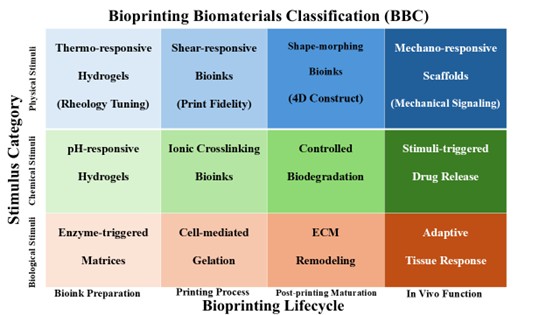
Stimuli-responsive biomaterials have progressively developed over the last decade in three-dimensional (3D) bioprinting, enabling dynamic regulation of bioink rheological and processing properties, printing fidelity, and the functional maturation of printed constructs. However, the rapid expansion of responsive materials and bioprinting technologies has led to fragmented and non-standardized definitions of biomaterials and bioinks, resulting in inconsistent classification approaches and complicating the analysis, comparison, and design of emerging systems. This highlights the lack of a unified framework for biomaterial selection for bioprinting. This perspective introduces the bioprinting biomaterials classification (BBC) as a conceptual framework that provides a structured and design-oriented basis for biomaterial selection for bioprinting by linking stimuli-responsive behavior with stage-specific functional requirements across the bioprinting process. The BBC framework classifies biomaterials according to two complementary dimensions: stimulus category (physical, chemical, and biological stimuli) and functional roles across the bioprinting lifecycle (bioink preparation, printing process, post-printing maturation, and in vivo function). This two-level biofunctional classification connects material responsiveness with biofabrication processes and enables a systematic approach to selecting and applying responsive biomaterials based on their stage-specific functional roles. It provides a systematic framework for positioning responsive biomaterials within the biofabrication context and supports a more structured and application-driven approach to biomaterial selection and design in bioprinting systems. By addressing the current lack of structured strategies for biomaterial selection for bioprinting, the BBC framework offers a foundational step toward a more rational and consistent design of responsive biomaterials in advanced biofabrication systems.
- Santoni S, Gugliandolo SG, Sponchioni M, Moscatelli D, Colosimo BM. 3D bioprinting: current status and trends―a guide to the literature and industrial practice. Bio-Des Manuf. 2022;5:14-43. doi: 10.1007/s42242-021-00165-0
- Fu Z, Ouyang L, Xu R, Yang Y, Sun W. Responsive biomaterials for 3D bioprinting: A review. Mater Today. 2022;52:112-132. doi: 10.1016/j.mattod.2022.01.001
- Hospodiuk M, Dey M, Sosnoski D, Ozbolat IT. The bioink: A comprehensive review on bioprintable materials. Biotechnol Adv. 2017;35(2):217-239. doi: 10.1016/j.biotechadv.2016.12.006
- Teixeira do Nascimento A, Stoddart PR, Goris T, et al. Stimuli-responsive materials for biomedical applications. Adv Mater. 2025;37(36):e07559. doi: 10.1002/adma.202507559
- Qiao T, He C, Xia P, et al. Bioink design for organ-scale projection-based 3D bioprinting. Nat Protoc. 2026;21(3):894- 923. doi: 10.1038/s41596-025-01221-0
- Ning L, Chen X, Schreyer DJ, et al. Embedded 3D bioprinting of gelatin methacryloyl-based constructs with highly tunable structural fidelity. ACS Appl Mater Interfaces. 2020;12(40):44563-44572. doi: 10.1021/acsami.0c15078
- Machour M, Hen N, Goldfracht I, Safina D, Davidovich- Pinhas M, Bianco-Peled H, Levenberg S. Print-and-grow within a novel support material for 3D bioprinting and post-printing tissue growth. Adv Sci. 2022;9(34):2200882. doi: 10.1002/advs.202200882
- Datta P, Barui A, Wu Y, Ozbolat V, Moncal KK, Ozbolat IT. Essential steps in bioprinting: From pre- to post-bioprinting. Biotechnol Adv. 2018;36(5):1481-1504. doi: 10.1016/j.biotechadv.2018.06.003
- Li X, Wang Z, Huang C, et al. A comprehensive review on the printing efficiency, precision, and cell viability in 3D bioprinting. Med Eng Phys. 2025;145:104880. doi: 10.1016/j.medengphy.2025.104448
- Wu C, Wang B, Zhang C, Wysk RA, Chen Y-W. Bioprinting: an assessment based on manufacturing readiness levels. Crit Rev Biotechnol. 2017;37(3):333-354. doi: 10.3109/07388551.2016.1163321
- Li X, Zheng F, Wang X, et al. Biomaterial inks for extrusion-based 3D bioprinting: Property, classification, modification, and selection. Int J Bioprint. 2023;9(2):649. doi: 10.18063/ijb.v9i2.649
- Mota C, Camarero-Espinosa S, Baker MB, Wieringa P, Moroni L. Bioprinting: From tissue and organ development to in vitro models. Chem Rev. 2020;120(19):10547-10607. doi: 10.1021/acs.chemrev.9b00789
- Levato R, Jungst T, Scheuring RG, Blunk T, Groll J, Malda J. From shape to function: The next step in bioprinting. Adv Mater. 2020;32(12):1906423. doi: 10.1002/adma.201906423
- Ng WL, Lee JM, Zhou M, et al. Vat polymerization-based bioprinting—process, materials, applications and regulatory challenges. Biofabrication. 2020;12(2):022001. doi: 10.1088/1758-5090/ab6034
- Liu J, Du C, Huang W, Lei Y. Injectable smart stimuli-responsive hydrogels: pioneering advancements in biomedical applications. Biomater Sci. 2024;12(1):8-56. doi: 10.1039/D3BM01352A
- Lee JM, Sing SL, Zhou M, et al. 3D bioprinting processes: A perspective on classification and terminology. Int J Bioprint. 2018;4(2):151. doi: 10.18063/ijb.v4i2.151
- Chandarana C, Sane D, Mishra S, Chaubey A, Gohil U, Prajapati B. Recent advances in bioink research for biomedical applications. Biomed Mater Devices. 2025. doi: 10.1007/s44174-025-00478-z
- Li J, Chen M, Fan X, Zhou H. Recent advances in bioprinting techniques: approaches, applications and future prospects. J Transl Med. 2016;14:271. doi: 10.1186/s12967-016-1028-0
- Ng WL, Vyas C, Huang B, Yeong WY, Bartolo P. Advanced bioprinting strategies for fabrication of biomimetic tissues and organs. Int J Extreme Manuf. 2022;4:042003. doi: 10.1088/2631-7990/adeee0
- Zhang X, Williams DF, eds. Definitions of Biomaterials for the Twenty-First Century. Elsevier; 2019.
- Kang HW, Lee SJ, Ko IK, Kengla C, Yoo JJ, Atala A. A 3D bioprinting system to produce human-scale tissue constructs with structural integrity. Nat Biotechnol. 2016;34(3):312- 319. doi: 10.1038/nbt.3413
- Saeb MR. Biofunctional materials: fundamentals and classification. Biofunctional Materials. 2026;4(1):0004. doi: 10.55092/bm20260004
- Kirillova A, Maxson R, Stoychev G, Gomillion CT, Ionov L. 4D biofabrication using shape-morphing hydrogels. Adv Mater. 2017;29(46):1703443. doi: 10.1002/adma.201703443
- Chimene D, Lennox KK, Kaunas RR, Gaharwar AK. Advanced bioinks for 3D printing: A materials science perspective. Biofabrication. 2016;44:2090-2102. doi: 10.1007/s10439-016-1638-y
- Wei Z, Yang JH, Zhou J, et al. Self-healing gels based on constitutional dynamic chemistry and their biomedical applications. Chem Soc Rev. 2014;43:8114-8131. doi: 10.1039/C4CS00219A
- Langer R, Tirrell DA. Designing materials for biology and medicine. Nature. 2004;428:487-492. doi: 10.1038/nature02388
- Moon SH, Park TY, Cha HJ, Yang YJ. Photo-/thermo-responsive bioink for improved printability in extrusion-based bioprinting. Mater Today Bio. 2024;25:100973. doi: 10.1016/j.mtbio.2024.100973
- Hu C, Hahn L, Yang M, et al. Improving printability of a thermoresponsive hydrogel biomaterial ink by nanoclay addition. J Mater Sci. 2021;56(1):691-705. doi: 10.1007/s10853-020-05190-5
- Khalil AKA, Teow YH, Takriff MS, Ahmad AL, Atieh MA. Recent developments of stimuli-responsive polymers for emerging applications: A review. Results Eng. 2025;25:103900. doi: 10.1016/j.rineng.2024.103900
- Daly AC, Prendergast ME, Hughes AJ, Burdick JA. Bioprinting for the biologist. Cell. 2021;184(1):18-32. doi: 10.1016/j.cell.2020.12.002
- Yarali E, Mirzaali MJ, Ghalayaniesfahani A, Accardo A, Diaz-Payno PJ, Zadpoor AA. 4D printing for biomedical applications. Adv Mater. 2024;36(31):e2402301. doi: 10.1002/adma.202402301
- Lee JE, Heo SW, Kim CH, Park SJ, Park S-H, Kim TH. In-situ ionic crosslinking of 3D bioprinted cell-hydrogel constructs for mechanical reinforcement and improved cell growth. Biomater Adv. 2023;147:213322. doi: 10.1016/j.bioadv.2023.213322
- Liu Y, Potthuri H, Sosnik A, Khoury LR. Autonomous hydrogel actuators programmed by endogenous biochemical logic for dual-stage morphing and drug release. Adv Mater. 2026;38(12):e16809. doi: 10.1002/adma.202516809
- Bhandari A, Ghosh RN, Namboothiri PK, Peter M. A review of stimuli-responsive materials in 4D bioprinting for biomedical applications. Mater Adv. 2026;7:17-39. doi: 10.1039/D5MA00679A
- Rahimnejad M, Jahangiri S, Zirak Hassan Kiadeh S, et al. Stimuli-responsive biomaterials: smart avenue toward 4D bioprinting. Crit Rev Biotechnol. 2024;44(5):860-891. doi: 10.1080/07388551.2023.2213398
- Khoeini R, Nosrati H, Akbarzadeh A, et al. Natural and synthetic bioinks for 3D bioprinting. Adv NanoBiomed Res. 2021;1(8):2000097. doi: 10.1002/anbr.202000097
- Agarwalla A, Ahmed W, Al-Marzouqi AH, Zaneldin S, Rizvi TA, Khan M. Advancements in synthetic polymers for 3D bioprinting materials, applications, and future prospects. Int J Polym Mater Polym Biomater. 2025;75(4):404-442. doi: 10.1080/00914037.2025.2562081
- Chandra DK, Reis RL, Kundu SC, Kumar A, Mahaparta C. Nanomaterials-based hybrid bioink platforms in advancing 3D bioprinting technologies for regenerative medicine. ACS Biomater Sci Eng. 2024;10(7):4145-4174. doi: 10.1021/acsbiomaterials.4c00166
- De Santis MM, Alsafadi HN, Tas S, et al. Extracellular-matrix-reinforced bioinks for 3D bioprinting human tissue. Adv Mater. 2021;33(3):2005476. doi: 10.1002/adma.202005476
- Dikmen M, Zikşahna K, Dinçer ZY, Adiyil R, Ihlamur M. Advances in 3D bioprinting: Comparative insights into natural and synthetic polymers for tissue engineering. Biomed Mater Devices. 2026. doi: 10.1007/s44174-026-00668-3
- Zhang YS, Haghiashtiani G, Hübscher T, et al. 3D extrusion bioprinting. Nat Rev Methods Primers. 2021;1(1):75. doi: 10.1038/s43586-021-00073-8
- Li X, Liu B, Pei B, et al. Inkjet bioprinting of biomaterials. Chem Rev. 2020;120(19):10793-10833. doi: 10.1021/acs.chemrev.0c00008
- Dou C, Perez V, Qu J, Tsin A, Xu B, Li J. A state-of-the-art review of laser-assisted bioprinting and its future research trends. ChemBioEng Rev. 2021;8(5):517-534. doi: 10.1002/cben.202000037
- Zhang F, Zhu L, Li Z, et al. The recent development of vat photopolymerization: A review. Addit Manuf. 2021;48(B):102423. doi: 10.1016/j.addma.2021.102423
- Patra S, Young V. A Review of 3D Printing Techniques and the Future in Biofabrication of Bioprinted Tissue. Cell Biochem Biophys. 2016;74:93-98. doi: 10.1007/s12013-016-0730-0
- Suntornnond R, An J, Chua CK. Roles of support materials in 3D bioprinting - Present and future. Int J Bioprint. 2017;3(1):006. doi: 10.18063/IJB.2017.01.006
- Urciuolo A, Giobbe GG, Dong Y, et al. Hydrogel-in-hydrogel live bioprinting for guidance and control of organoids and organotypic cultures. Nat Commun. 2023;14:3128. doi: 10.1038/s41467-023-37953-4
- Abasalizadeh F, Moghaddam SV, Alizadeh E, et al. Alginate-based hydrogels as drug delivery vehicles in cancer treatment and their applications in wound dressing and 3D bioprinting. J Biol Eng. 2020;14:8. doi: 10.1186/s13036-020-0227-7
- Ng WL, Chan A, Ong YS, Chua CK. Deep learning for fabrication and maturation of 3D bioprinted tissues and organs. Virtual Phys Prototyp. 2020;15(3):340-358. doi: 10.1080/17452759.2020.1771741
- Shi J, Song J, Song B, Lu WF. Multi-Objective Optimization Design through Machine Learning for Drop-on-Demand Bioprinting. Engineering. 2019;5(3):586-593. doi: 10.1016/j.eng.2018.12.009
- Qin Y, Fan L, Zhan L, et al. Biofabrication: Bioprinting process, printing materials, and the frontier applications in biomedicine. Addit Manuf Front. 2024;3(4):200175. doi: 10.1016/j.amf.2024.200175
- Ruiz-Alonso S, Ordoyo-Pascual J, Lafuente-Merchan M, et al. Hydrogel bioink formulation for 3D bioprinting: Sustained delivery of PDGF-BB and VEGF in biomimetic scaffolds for tendon partial rupture repair. Int J Bioprint. 2024;10(3):2632. doi: 10.36922/ijb.2632
- Perera KDC, Boiani SM, Vasta AK, et al. Development and characterization of a novel poly(N-isopropylacrylamide)- based thermoresponsive photoink and its applications in DLP bioprinting. J Mater Chem B. 2024;12(38):9767-9779. doi: 10.1039/D4TB00682H
- Huang YC, Cheng QP, Jeng US, et al. A biomimetic bilayer hydrogel actuator based on thermoresponsive gelatin methacryloyl-poly(N-isopropylacrylamide) hydrogel with three-dimensional printability. ACS Appl Mater Interfaces. 2023;15(4):5798-5810. doi: 10.1021/acsami.2c18961
- Rahimnejad M, Adoungotchodo A, Demarquette NR, Lerouge S. FRESH bioprinting of biodegradable chitosan thermosensitive hydrogels. Bioprinting. 2022;27:e00209. doi: 10.1016/j.bprint.2022.e00209
- Chandrawati R. Enzyme-responsive polymer hydrogels for therapeutic delivery. Exp Biol Med. 2016;241(9):972-979. doi: 10.1177/1535370216647186
- Wu K, Hu Y, Feng H. Investigation of 3D-printed PNIPAM-based constructs for tissue engineering applications: A review. J Mater Sci. 2023;58(47):17727-17750. doi: 10.1007/s10853-023-09125-8
- Shamma RN, Sayed RH, Madry H, El Sayed NS, Cucchiarini M. Triblock copolymer bioinks in hydrogel three-dimensional printing for regenerative medicine: A focus on Pluronic F127. Tissue Eng Part B Rev. 2022;28(2):451-463. doi: 10.1089/ten.teb.2021.0026
- Jergitsch M, Alluè-Mengual Z, Perez RA, Mateos-Timoneda MA. A systematic approach to improve printability and cell viability of methylcellulose-based bioinks. Int J Biol Macromol. 2023;253(7):127461. doi: 10.1016/j.ijbiomac.2023.127461
- Ying G, Jiang N, Yu C, Zhang YS. Three-dimensional bioprinting of gelatin methacryloyl (GelMA). Bio-Des Manuf. 2018;1(4):215-224. doi: 10.1007/s42242-018-0028-8
- Jia J, Richards DJ, Pollard S, et al. Engineering alginate as bioink for bioprinting. Acta Biomater. 2014;10(10):4323- 4331. doi: 10.1016/j.actbio.2014.06.034
- Walters-Shumka JP, Cheng C, Jiang F, Willerth SM. Recent advances in modeling tissues using 3D bioprinted nanocellulose bioinks. ACS Biomater Sci Eng. 2025;11(4):1882-1896. doi: 10.1021/acsbiomaterials.4c01902
- Ying G, Jiang N, Parra-Cantu C, et al. Bioprinted injectable hierarchically porous gelatin methacryloyl hydrogel constructs with shape-memory properties. Adv Funct Mater. 2020;30(46):2003740. doi: 10.1002/adfm.202003740
- Kim J, Choi HS, Kim YM, Song S-C. Thermo-responsive nanocomposite bioink with growth-factor holding and its application to bone regeneration. Small. 2023;19(9):2203464. doi: 10.1002/smll.202203464
- Santoni S, Sponchioni M, Gugliandolo SG, Colosimo BM, Moscatelli D. Preliminary tests on PEG-based thermoresponsive polymers for the production of 3D bioprinted constructs. Procedia CIRP. 2022;110:348-353. doi: 10.1016/j.procir.2022.06.062
- Dai M, Belaïdi J-P, Fleury G, et al. Elastin-like polypeptide-based bioink: A promising alternative for 3D bioprinting. Biomacromolecules. 2021;22(12):4956-4966. doi: 10.1021/acs.biomac.1c00861
- Salinas-Fernández S, Santos M, Alonso M, Quintanilla L, Rodríguez-Cabello JC. Genetically engineered elastin-like recombinamers with sequence-based molecular stabilization as advanced bioinks for 3D bioprinting. Appl Mater Today. 2020;18:100500. doi: 10.1016/j.apmt.2019.100500
- Rastogi P, Kandasubramanian B. Review of alginate-based hydrogel bioprinting for application in tissue engineering. Biofabrication. 2019;11(4):042001. doi: 10.1088/1758-5090/ab331e
- Lameirinhas NS, Teixeira MC, Carvalho JPF, et al. Nanofibrillated cellulose/gellan gum hydrogel-based bioinks for 3D bioprinting of skin cells. Int J Biol Macromol. 2023;229:849-860. doi: 10.1016/j.ijbiomac.2022.12.227
- Kim MH, Lee YW, Jung W-K, Oh J, Nam SY. Enhanced rheological behaviors of alginate hydrogels with carrageenan for extrusion-based bioprinting. J Mech Behav Biomed Mater. 2019;98:187-194. doi: 10.1016/j.jmbbm.2019.06.014
- Taghizadeh M, Taghizadeh A, Yazdi MK, et al. Chitosan-based inks for 3D printing and bioprinting. Green Chem. 2022;24(1):62-101. doi: 10.1039/D1GC01799C
- O’Bryan CS, Bhattacharjee T, Marshall SL, Sawyer WG, Angelini TE. Commercially available microgels for 3D bioprinting. Bioprinting. 2018;11:e00037. doi: 10.1016/j.bprint.2018.e00037
- Guo Z, Han J, Li Z, et al. Borate bioactive glass enhances 3D bioprinting precision and biocompatibility on a sodium alginate platform via Ca²⁺-controlled self-solidification. Int J Biol Macromol. 2024;277(2):134338. doi: 10.1016/j.ijbiomac.2024.134338
- Bandyopadhyay A, Mandal BB, Bhardwaj N. 3D bioprinting of photo-crosslinkable silk methacrylate (SilMA)- polyethylene glycol diacrylate (PEGDA) bioink for cartilage tissue engineering. J Biomed Mater Res A. 2022;110(4):884- 898. doi: 10.1002/jbm.a.37336
- Xin S, Chimene D, Garza JE, Gaharwar AK, Alge DL. Clickable PEG hydrogel microspheres as building blocks for 3D bioprinting. Biomater Sci. 2019;7(3):1179-1187. doi: 10.1039/C8BM01286E
- Karvinen J, Kellomäki M. 3D-bioprinting of self-healing hydrogels. Eur Polym J. 2024;209:112864. doi: 10.1016/j.eurpolymj.2024.112864
- Daly AC, Davidson MD, Burdick JA. 3D bioprinting of high cell-density heterogeneous tissue models through spheroid fusion within self-healing hydrogels. Nat Commun. 2021;12(1):753. doi: 10.1038/s41467-021-21029-2
- Lee JM, Suen SKQ, Ng WL, Ma WC, Yeong WY. Bioprinting of collagen: Considerations, potentials, and applications. Macromol Biosci. 2021;21(1):2000280. doi: 10.1002/mabi.202000280
- Asim S, Rabish TA, Liaqat U, Ozbolat IT, Rizwan M. Advances in Gelatin Bioinks to Optimize Bioprinted Cell Functions. Adv Healthc Mater. 2023;12(17):2203148. doi: 10.1002/adhm.202203148
- Abaci A, Guvendiren M. Designing decellularized extracellular matrix-based bioinks for 3D bioprinting. Adv Healthc Mater. 2020;9(24):2000734. doi: 10.1002/adhm.202000734
- Yin J, Yan M, Wang Y, Fu J, Suo H. 3D bioprinting of low-concentration cell-laden gelatin methacrylate (GelMA) bioinks with a two-step cross-linking strategy. ACS Appl Mater Interfaces. 2018;10(8):6849-6857. doi: 10.1021/acsami.7b16059
- Jain T, Baker HB, Gipsov A, et al. Impact of cell density on the bioprinting of gelatin methacrylate (GelMA) bioinks. Bioprinting. 2021;22:e00131. doi: 10.1016/j.bprint.2021.e00131
- Yoon J, Han H, Jang J. Nanomaterials-incorporated hydrogels for 3D bioprinting technology. Nano Convergence. 2023;10(1):52. doi: 10.1186/s40580-023-00402-5
- Ribeiro JS, Bordini EAF, Ferreira JA, et al. Injectable MMP-responsive nanotube-modified gelatin hydrogel for dental infection ablation. ACS Appl Mater Interfaces. 2020;12(12):16006-16017. doi: 10.1021/acsami.9b22964
- Wang LL, Highley CB, Yeh Y-C, Galarraga JH, Uman S, Burdick JA. Three-dimensional extrusion bioprinting of single- and double-network hydrogels containing dynamic covalent crosslinks. J Biomed Mater Res A. 2018;106(4):865- 875. doi: 10.1002/jbm.a.36323
- Ribeiro LS, Rocha Maia J, Mano JF, et al. Nozzle Jamming Granularized Blood-Derived Proteins for Bioprinting Cell- Instructive Architectures. Aggregate. 2025;6(7):e70041. doi: 10.1002/agt2.70041
- Gungor-Ozkerim PS, Inci I, Zhang YS, Khademhosseini A, Dokmeci MR. Bioinks for 3D bioprinting: an overview. Biomater Sci. 2018;6:915-946. doi: 10.1039/C7BM00765E
- Gao Q, Lee JS, Kim BS, Gao G. Three-dimensional printing of smart constructs using stimuli-responsive biomaterials: A future direction of precision medicine. Int J Bioprint. 2023;9(1):638. doi: 10.18063/ijb.v9i1.638