

Applications of 3D bioprinting in neurogenic bladder following spinal cord injury: Research and clinical translation to artificial intelligence-empowered prospects

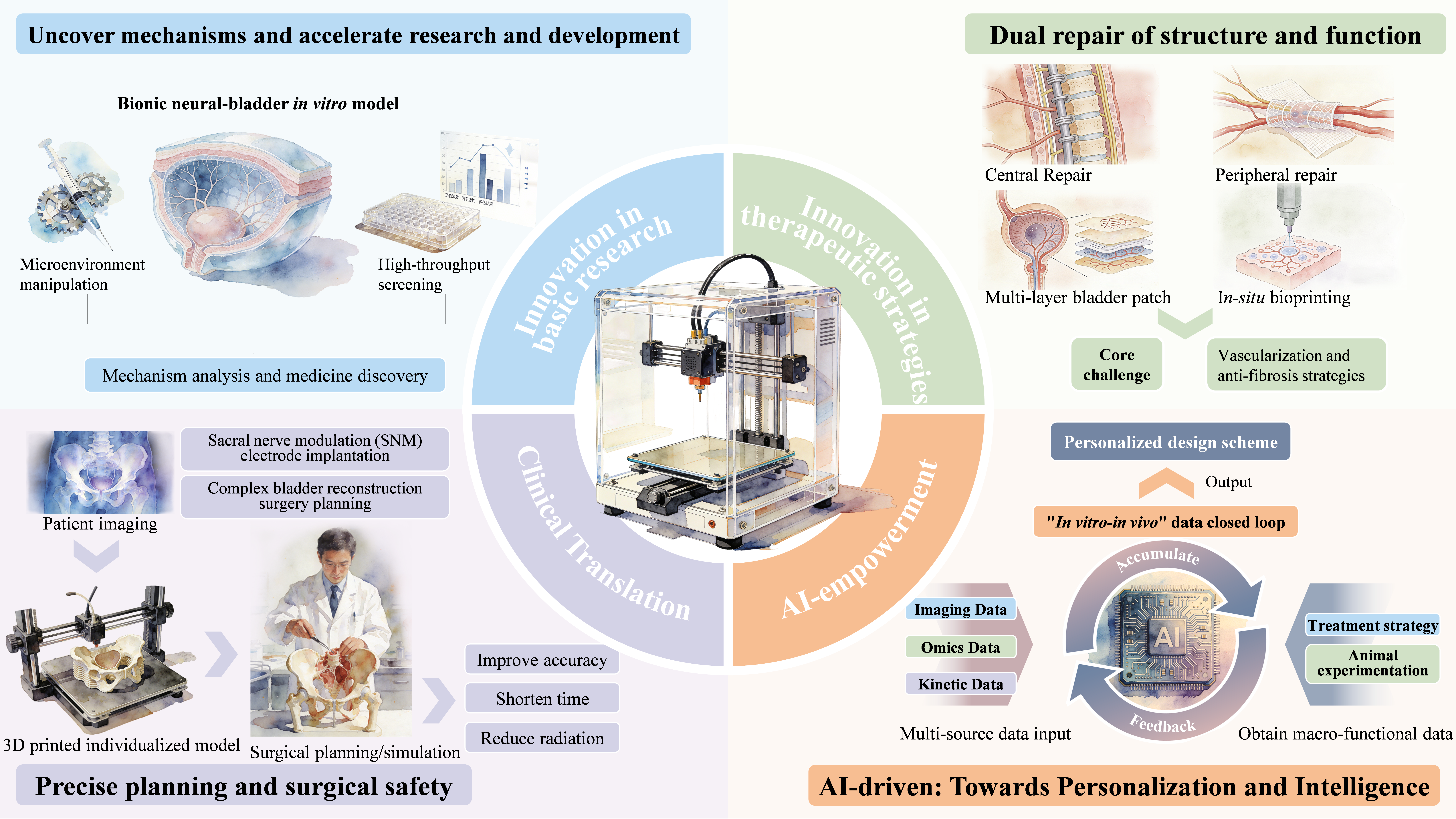
Neurogenic bladder (NB) after spinal cord injury (SCI) remains a major clinical challenge. Three-dimensional (3D) bioprinting technology offers a systematic solution in this field. This review summarizes its multidimensional applications in post-SCI NB. In basic research, the technology can be used to construct in vitro biomimetic “nerve-bladder” models for mechanism elucidation and high-throughput drug screening. In therapeutic strategies, it enables the fabrication of bioactive scaffolds that guide nerve regeneration and structurally biomimetic bladder tissues, synchronously promoting neural repair and tissue reconstruction. In clinical translation, image-based personalized 3D-printed models have been utilized for surgical planning and simulation. The integration of artificial intelligence further advances personalized design, printing process optimization, and multimodal collaborative research paradigms. Although major challenges remain in mechanistic understanding, manufacturing workflows, ethics, and regulation, 3D bioprinting may help shift NB management from “symptom management” to “functional reconstruction,” presenting tremendous and optimistic possibilities for transferring to the clinical end.
- Anjum A, Yazid MD, Fauzi Daud M, et al. Spinal Cord Injury: Pathophysiology, Multimolecular Interactions, and Underlying Recovery Mechanisms. Int J Mol Sci. 2020;21(20):7533. doi: 10.3390/ijms21207533
- Yang M, Du X, Tian T. Multivariate Logistic Regression Analysis of Risk Factors and Clinical Countermeasures of Neurogenic Bladder After Spinal Cord Injury. Br J Hosp Med. 2025;86(12):1-17. doi: 10.12968/hmed.2025.0227
- Doelman AW, Streijger F, Majerus SJA, Damaser MS, Kwon BK. Assessing Neurogenic Lower Urinary Tract Dysfunction after Spinal Cord Injury: Animal Models in Preclinical Neuro-Urology Research. Biomedicines. 2023;11(6):1539. doi: 10.3390/biomedicines11061539
- Tate DG, Wheeler T, Lane GI, et al. Recommendations for evaluation of neurogenic bladder and bowel dysfunction after spinal cord injury and/or disease. J Spinal Cord Med. 2020;43(2):141-164. doi: 10.1080/10790268.2019.1706033
- Sabetkish S, Gashti RN, Jobani BM, et al. Management of urinary and bowel dysfunction in rabbit model of spinal cord injury using Schwann cells and muscle progenitors: functional study and evidence for novel mechanism of action. Int Urol Nephrol. 2021;53(5):893-906. doi: 10.1007/s11255-020-02722-5
- Lefaucheur JP, Aleman A, Baeken C, et al. Evidence-based guidelines on the therapeutic use of repetitive transcranial magnetic stimulation (rTMS): An update (2014-2018). Clin Neurophysiol. 2020;131(2):474-528. doi: 10.1016/j.clinph.2019.11.002
- Song Y, Jo H, Jeong S, Kim I, Lee SS. Vascularised Brain Organoids: Engineering Strategies and Neurobiological Applications. Cell Prolif. 2026;59(3):e70161. doi: 10.1111/cpr.70161
- Wiewiórska-Krata N, Foroncewicz B, Zagożdżon R, Mucha K. 3D Bioprinting Strategies in Autoimmune Disease Models. Int J Mol Sci. 2025;27(1):343. doi: 10.3390/ijms27010343
- Ramesh S, Deep A, Tamayol A, Kamaraj A, Mahajan C, Madihally S. Advancing 3D bioprinting through machine learning and artificial intelligence. Bioprinting. 2024;38:e00331. doi: 10.1016/j.bprint.2024.e00331
- Kapałczyńska M, Kolenda T, Przybyła W, et al. 2D and 3D cell cultures – a comparison of different types of cancer cell cultures. Archives of Medical Science. 2018;14(4):910–919. doi: 10.5114/aoms.2016.63743
- Ahammed B, Kalangi SK. A Decade of Organoid Research: Progress and Challenges in the Field of Organoid Technology. ACS Omega. 2024;9(28):30087-30096. doi: 10.1021/acsomega.4c03683
- Wang S, Cai S, Zhu Z, Zeng W, Hu S, Shi B. Spinal cord injury modeling: from modeling to evaluation using rats as examples. Front Neurol. 2025;16:1573779. doi: 10.3389/fneur.2025.1573779
- Perez NE, Godbole NP, Amin K, Syan R, Gater DR Jr. Neurogenic Bladder Physiology, Pathogenesis, and Management after Spinal Cord Injury. J Pers Med. 2022;12(6):968. doi: 10.3390/jpm12060968
- Maharjan S, Ma C, Singh B, et al. Advanced 3D imaging and organoid bioprinting for biomedical research and therapeutic applications. Adv Drug Deliv Rev. 2024;208:115237. doi: 10.1016/j.addr.2024.115237
- Carvalho D, Pinto S, Sarmento B. Modeling the human bladder tissue using three dimensional in vitro approaches as a tool for drug screening platforms. Acta Biomater. 2026;210:296-313. doi: 10.1016/j.actbio.2025.12.018
- Wang H, Yu H, Zhou X, et al. An Overview of Extracellular Matrix-Based Bioinks for 3D Bioprinting. Front Bioeng Biotechnol. 2022;10:905438. doi: 10.3389/fbioe.2022.905438
- Ashammakhi N, Ahadian S, Xu C, et al. Bioinks and bioprinting technologies to make heterogeneous and biomimetic tissue constructs. Mater Today Bio. 2019;1:100008. doi: 10.1016/j.mtbio.2019.100008
- Cruz EM, Machado LS, Zamproni LN, et al. A Gelatin Methacrylate-Based Hydrogel as a Potential Bioink for 3D Bioprinting and Neuronal Differentiation. Pharmaceutics. 2023;15(2):627. doi: 10.3390/pharmaceutics15020627
- Bova L, Maggiotto F, Micheli S, et al. A Porous Gelatin Methacrylate-Based Material for 3D Cell-Laden Constructs. Macromol Biosci. 2023;23(2):e2200357. doi: 10.1002/mabi.202200357
- Ling Z, Zhao J, Song S, et al. Chitin nanocrystal-assisted 3D bioprinting of gelatin methacrylate scaffolds. Regen Biomater. 2023;10:rbad058. doi: 10.1093/rb/rbad058
- Wei Q, Zhou J, An Y, Li M, Zhang J, Yang S. Modification, 3D printing process and application of sodium alginate based hydrogels in soft tissue engineering: A review. Int J Biol Macromol. 2023;232:123450. doi: 10.1016/j.ijbiomac.2023.123450
- Gao Q, Kim BS, Gao G. Advanced Strategies for 3D Bioprinting of Tissue and Organ Analogs Using Alginate Hydrogel Bioinks. Mar Drugs. 2021;19(12):708. doi: 10.3390/md19120708
- Chae S, Kim J, Yi HG, Cho DW. 3D Bioprinting of an In Vitro Model of a Biomimetic Urinary Bladder with a Contract-Release System. Micromachines. 2022;13(2):277. doi: 10.3390/mi13020277
- Xuan Z, Peng Q, Larsen T, et al. Tailoring Hydrogel Composition and Stiffness to Control Smooth Muscle Cell Differentiation in Bioprinted Constructs. Tissue Eng Regen Med. 2023;20(2):199-212. doi: 10.1007/s13770-022-00500-1
- Li S, Meng X, Zhong Z, Li C. Advances in 3D bioprinting of functional biomaterials for neural tissue engineering. Tissue Cell. 2025;96:103024. doi: 10.1016/j.tice.2025.103024
- Lee S, Kim JH, Kang SJ, Chang IH, Park JY. Customized Multilayered Tissue-on-a-Chip (MToC) to Simulate Bacillus Calmette–Guérin (BCG) Immunotherapy for Bladder Cancer Treatment. BioChip J. 2022;16(1):67-81. doi: 10.1007/s13206-022-00047-2
- Zhao F, Yang T, Zhou L, et al. Construction of tissue-engineered bladders using an artificial acellular nanocomposite scaffold loaded with stromal vascular fraction secretome. Acta Biomater. 2023;167:260-277. doi: 10.1016/j.actbio.2023.05.041
- Adamowicz J, Pokrywczynska M, Van Breda SV, Kloskowski T, Drewa T. Concise Review: Tissue Engineering of Urinary Bladder; We Still Have a Long Way to Go?. Stem Cells Transl Med. 2017;6(11):2033-2043. doi: 10.1002/sctm.17-0101
- Yoshida T, Sopko NA, Kates M, et al. Impact of spheroid culture on molecular and functional characteristics of bladder cancer cell lines. Oncol Lett. 2019;18(5):4923-4929. doi: 10.3892/ol.2019.10786
- Wang Y, Shi J, Wang Y, et al. Advances in three-dimensional bioprinted tumor organoids: From model construction to clinical translation. Int J Bioprint. 2025;0(0):025390393. doi: 10.36922/ijb025390393
- Topoliova K, Harsanyi S, Danisovic L, Ziaran S. Tissue Engineering and Stem Cell Therapy in Neurogenic Bladder Dysfunction: Current and Future Perspectives. Medicina. 2023;59(8):1416. doi: 10.3390/medicina59081416
- Pokharel R, Leipzig ND. 3D Bioprinting for Spinal Cord Injury: Engineering Scaffolds for Functional Recovery. ACS Biomater Sci Eng. 2026;12(2):757-772. doi: 10.1021/acsbiomaterials.5c01474
- Huebner EA, Strittmatter SM. Axon regeneration in the peripheral and central nervous systems. Results Probl Cell Differ. 2009;48:339-351. doi: 10.1007/400_2009_19
- Jiu J, Liu H, Li D, et al. 3D bioprinting approaches for spinal cord injury repair. Biofabrication. 2024;16(3):10.1088/1758- 5090/ad3a13. doi: 10.1088/1758-5090/ad3a13
- Koffler J, Zhu W, Qu X, et al. Biomimetic 3D-printed scaffolds for spinal cord injury repair. Nat Med. 2019;25(2):263-269. doi: 10.1038/s41591-018-0296-z
- Liu X, Song S, Chen Z, et al. Release of O-GlcNAc transferase inhibitor promotes neuronal differentiation of neural stem cells in 3D bioprinted supramolecular hydrogel scaffold for spinal cord injury repair. Acta Biomater. 2022;151:148-162. doi: 10.1016/j.actbio.2022.08.031
- Cao X, Li X, Shi W, et al. 3D-Bioprinted Scaffolds with Precise Factor Delivery for Spinal Cord Injury Repair. ACS Appl Mater Interfaces. 2025;17(30):42586-42601. doi: 10.1021/acsami.5c03076
- Kanai AJ, Andersson KE, Fry CH, Yoshimura N. Targeting neurotrophin and nitric oxide signaling to promote recovery and ameliorate neurogenic bladder dysfunction following spinal cord injury - Mechanistic concepts and clinical implications. Continence. 2023;6:100703. doi: 10.1016/j.cont.2023.100703
- Liu S, Yang H, Chen D, et al. Three-dimensional bioprinting sodium alginate/gelatin scaffold combined with neural stem cells and oligodendrocytes markedly promoting nerve regeneration after spinal cord injury. Regen Biomater. 2022;9:rbac038. doi: 10.1093/rb/rbac038
- Yu M, Sun P, Sun C, Jin WL. Bioelectronic medicine potentiates endogenous NSCs for neurodegenerative diseases. Trends Mol Med. 2023;29(11):886-896. doi: 10.1016/j.molmed.2023.08.005
- Stassart RM, Gomez-Sanchez JA, Lloyd AC. Schwann Cells as Orchestrators of Nerve Repair: Implications for Tissue Regeneration and Pathologies. Cold Spring Harb Perspect Biol. 2024;16(6):a041363. doi: 10.1101/cshperspect.a041363
- Gao C, Li Y, Liu X, Huang J, Zhang Z. 3D bioprinted conductive spinal cord biomimetic scaffolds for promoting neuronal differentiation of neural stem cells and repairing of spinal cord injury. Chem Eng J. 2023;451:138788. doi: 10.1016/j.cej.2022.138788
- Szymoniuk M, Mazurek M, Dryla A, Kamieniak P. The application of 3D-bioprinted scaffolds for neuronal regeneration after traumatic spinal cord injury - A systematic review of preclinical in vivo studies. Exp Neurol. 2023;363:114366. doi: 10.1016/j.expneurol.2023.114366
- Chen J, Wang L, Liu M, et al. Implantation of adipose-derived mesenchymal stem cell sheets promotes axonal regeneration and restores bladder function after spinal cord injury. Stem Cell Res Ther. 2022;13(1):503. doi: 10.1186/s13287-022-03188-1
- Zhang J, Chen Y, Huang Y, et al. A 3D-Printed Self-Adhesive Bandage with Drug Release for Peripheral Nerve Repair. Adv Sci. 2020;7(23):2002601. doi: 10.1002/advs.202002601
- He J, Qian L, Li Z, et al. A tissue bandage for pelvic ganglia injury. Nat Commun. 2024;15(1):8972. doi: 10.1038/s41467-024-53302-5
- Elia E, Brownell D, Chabaud S, Bolduc S. Tissue Engineering for Gastrointestinal and Genitourinary Tracts. Int J Mol Sci. 2022;24(1):9. doi: 10.3390/ijms24010009
- Azari F, Robertson AM, Tobe Y, et al. Elucidating the high compliance mechanism by which the urinary bladder fills under low pressures. Sci Rep. 2025;15(1):25356. doi: 10.1038/s41598-025-07479-4
- Habteyes FG, Komari SO, Nagle AS, et al. Modeling the influence of acute changes in bladder elasticity on pressure and wall tension during filling. J Mech Behav Biomed Mater. 2017;71:192-200. doi: 10.1016/j.jmbbm.2017.02.020
- Hu JC, Osborn SL, Sanchez PC, Xu W, Christiansen BA, Kurzrock EA. Using uniaxial tensile testing to evaluate the biomechanical properties of bladder tissue after spinal cord injury in rat model. J Biomech. 2023;152:111571. doi: 10.1016/j.jbiomech.2023.111571
- Hanczar M, Moazen M, Day R. The Significance of Biomechanics and Scaffold Structure for Bladder Tissue Engineering. Int J Mol Sci. 2021;22(23):12657. doi: 10.3390/ijms222312657
- Zhao Y, Peng H, Sun L, et al. The application of small intestinal submucosa in tissue regeneration. Mater Today Bio. 2024;26:101032. doi: 10.1016/j.mtbio.2024.101032
- Brown M, Li J, Moraes C, Tabrizian M, Li-Jessen NYK. Decellularized extracellular matrix: New promising and challenging biomaterials for regenerative medicine. Biomaterials. 2022;289:121786. doi: 10.1016/j.biomaterials.2022.121786
- Zhang XZ, Jiang YL, Hu JG, et al. Procyanidins-crosslinked small intestine submucosa: A bladder patch promotes smooth muscle regeneration and bladder function restoration in a rabbit model. Bioact Mater. 2020;6(6):1827- 1838. doi: 10.1016/j.bioactmat.2020.11.023
- Zhao W, Yang Y, Liu Y, et al. Biomimetic multilayer scaffolds with prolonged retention of stem cells-recruiting and angiogenic peptides for promoting bladder regeneration. Compos Part B Eng. 2024;277:111409. doi: 10.1016/j.compositesb.2024.111409
- Forooghi M, Askari A, Haghdel M, et al. Engineering the Future of Bladder Repair: Can Biocompatible 3D-Printed Scaffolds Serve as a Novel Alternative to Intestinal Segments for the Treatment of Bladder Exstrophy? Adv Urol. 2025;2025:9437696. doi: 10.1155/aiu/9437696
- Ajalloueian F, Lemon G, Hilborn J, Chronakis IS, Fossum M. Bladder biomechanics and the use of scaffolds for regenerative medicine in the urinary bladder. Nat Rev Urol. 2018;15(3):155-174. doi: 10.1038/nrurol.2018.5
- Xuan Z, Gurevich L, Christiansen JC, Zachar V, Pennisi CP. Stable hydrogel adhesion to polydimethylsiloxane enables cyclic mechanical stimulation of 3D-bioprinted smooth muscle constructs. Biotechnol Bioeng. 2023;120(11):3396- 3408. doi: 10.1002/bit.28516
- Ding W, Ge Y, Zhang T, Zhang C, Yin X. Advanced construction strategies to obtain nanocomposite hydrogels for bone repair and regeneration. NPG Asia Mater. 2024;16(1):14. doi: 10.1038/s41427-024-00533-z
- Soufivand AA, Abolfathi N, Hashemi SA, Lee SJ. Prediction of mechanical behavior of 3D bioprinted tissue-engineered scaffolds using finite element method (FEM) analysis. Addit Manuf. 2020;33:101181. doi: 10.1016/j.addma.2020.101181
- Wang Y, Liao L. Histologic and functional outcomes of small intestine submucosa-regenerated bladder tissue. BMC Urol. 2014;14:69. doi: 10.1186/1471-2490-14-69
- Zhang YS, Dolatshahi-Pirouz A, Orive G. Regenerative cell therapy with 3D bioprinting. Science. 2024;385(6709):604- 606. doi: 10.1126/science.add8593
- Zhao W, Xu T. Preliminary engineering for in situ in vivo bioprinting: a novel micro bioprinting platform for in situ in vivo bioprinting at a gastric wound site. Biofabrication. 2020;12(4):045020. doi: 10.1088/1758-5090/aba4ff
- Masson-Meyers DS, Tayebi L. Vascularization strategies in tissue engineering approaches for soft tissue repair. J Tissue Eng Regen Med. 2021;15(9):747-762. doi: 10.1002/term.3225
- Wang N, Wang H, Weng D, et al. Nanomaterials for small diameter vascular grafts: overview and outlook. Nanoscale Adv. 2023;5(24):6751-6767. doi: 10.1039/d3na00666b
- Yeo M, Sarkar A, Singh YP, Derman ID, Datta P, Ozbolat IT. Synergistic coupling between 3D bioprinting and vascularization strategies. Biofabrication. 2023;16(1):012003. doi: 10.1088/1758-5090/ad0b3f
- Guo HL, Peng XF, Bao XQ, et al. Bladder reconstruction using autologous smooth muscle cell sheets grafted on a pre-vascularized capsule. Theranostics. 2020;10(23):10378- 10393. doi: 10.7150/thno.47006
- Keene JBD, Jackson R, Batra G, et al. Pre-vascularisation of the acellular bladder matrix using the omentum in a porcine model prior for bladder reconstruction-a step towards clinical application?. Pediatr Surg Int. 2024;40(1):308. doi: 10.1007/s00383-024-05855-1
- Ahmad A, Kim SJ, Jeong YJ, et al. Coaxial bioprinting of a stentable and endothelialized human coronary artery-sized in vitro model. J Mater Chem B. 2024;12(35):8633-8646. doi: 10.1039/d4tb00601a
- Zuo X, Han P, Yuan D, et al. Implantation of Adipose-Derived Mesenchymal Stromal Cells (ADSCs)-Lining Prosthetic Graft Promotes Vascular Regeneration in Monkeys and Pigs. Tissue Eng Regen Med. 2024;21(4):641-651. doi: 10.1007/s13770-023-00615-z
- Huang G, Zhao Y, Chen D, et al. Applications, advancements, and challenges of 3D bioprinting in organ transplantation. Biomater Sci. 2024;12(6):1425-1448. doi: 10.1039/d3bm01934a
- Christou CD, Vasileiadou S, Sotiroudis G, Tsoulfas G. Three-Dimensional Printing and Bioprinting in Renal Transplantation and Regenerative Medicine: Current Perspectives. J Clin Med. 2023;12(20):6520. doi: 10.3390/jcm12206520
- Booth D, Afshari R, Ghovvati M, Shariati K, Sturm R, Annabi N. Advances in 3D bioprinting for urethral tissue reconstruction. Trends Biotechnol. 2024;42(5):544-559. doi: 10.1016/j.tibtech.2023.10.009
- Zhu H, Kuang H, Huang X, et al. 3D printing of drug delivery systems enhanced with micro/nano-technology. Adv Drug Deliv Rev. 2025;216:115479. doi: 10.1016/j.addr.2024.115479
- Chowdhury SR, Mondal G, Ratnayake P, Basu B. Three- Dimensional Extrusion Printed Urinary Specific Grafts: Mechanistic Insights into Buildability and Biophysical Properties. ACS Biomater Sci Eng. 2024;10(2):1040-1061. doi: 10.1021/acsbiomaterials.3c01422
- Przedlacka A, Pellino G, Fletcher J, Bello F, Tekkis PP, Kontovounisios C. Current and future role of three-dimensional modelling technology in rectal cancer surgery: A systematic review. World J Gastrointest Surg. 2021;13(12):1754-1769. doi: 10.4240/wjgs.v13.i12.1754
- Pietrabissa A, Marconi S, Peri A, et al. From CT scanning to 3-D printing technology for the preoperative planning in laparoscopic splenectomy. Surg Endosc. 2016;30(1):366-371. doi: 10.1007/s00464-015-4185-y
- Segaran N, Saini G, Mayer JL, et al. Application of 3D Printing in Preoperative Planning. J Clin Med. 2021;10(5):917. doi: 10.3390/jcm10050917
- Kalidindi S. The role of three-dimensional (3D) printing in plastic and reconstructive surgery: innovations and applications. Eur J Plast Surg. 2024;47(1):96. doi: 10.1007/s00238-024-02242-w
- Vogel K, Nakib N. Off-Label but On-Target: Sacral Neuromodulation for Neurogenic Bladder Dysfunction. Curr Urol Rep. 2025;26(1):52. doi: 10.1007/s11934-025-01280-6
- Wei Z, Zhang Y, Hou J. Effectiveness and safety of sacral neuromodulation for neurogenic bladder. Neurol Res. 2023;45(6):520-529. doi: 10.1080/01616412.2022.2162223
- Yuan H, Xiao Y, Lin X, et al. Application of Augmented Reality for Accurate Punctures During Stage 1 Sacral Neuromodulation. Int Neurourol J. 2024;28(4):302-311. doi: 10.5213/inj.2448330.165
- Huri E, Tunç O, Küçük B. 240 - Evaluation of the Effectiveness of Patient-Specific 3D Modeling for Surgical Planning in Sacral Neuromodulation Surgery: Initial Case Results. Continence. 2025;15:102164. doi: 10.1016/j.cont.2025.102164
- Aydogan TB, Patel M, Digesu A, et al. Innovative training modality for sacral neuromodulation (SNM): Patient-specific computerized tomography (CT) reconstructed 3D-printed training system: ICS School of Modern Technology novel training modality. Neurourol Urodyn. 2023;42(1):297-302. doi: 10.1002/nau.25083
- Zhao J, Tang H, Xu R, Chen G. Intraoperative application of different imaging techniques in sacral neuromodulation: a systematic review and meta-analysis. BMC Urol. 2025;25(1):201. doi: 10.1186/s12894-025-01903-7
- Jacobson NM, Brusilovsky J, Ducey R, et al. The Inner Complexities of Multimodal Medical Data: Bitmap- Based 3D Printing for Surgical Planning Using Dynamic Physiology. 3D Print Addit Manuf. 2023;10(5):855-868. doi: 10.1089/3dp.2022.0265
- Wang X, Zhang F, Liao L. Current Applications and Future Directions of Bioengineering Approaches for Bladder Augmentation and Reconstruction. Front Surg. 2021;8:664404. doi: 10.3389/fsurg.2021.664404
- Chen H, Zhang B, Huang J. Recent advances and applications of artificial intelligence in 3D bioprinting. Biophys Rev. 2024;5(3):031301. doi: 10.1063/5.0190208
- Bhardwaj N, Sood M, Gill SS. 3D-Bioprinting and AI-empowered Anatomical Structure Designing: A Review. Curr Med Imaging. 2024;20:e15734056259274. doi: 10.2174/0115734056259274231019061329
- Kourounis G, Elmahmudi AA, Thomson B, Hunter J, Ugail H, Wilson C. Computer image analysis with artificial intelligence: a practical introduction to convolutional neural networks for medical professionals. Postgrad Med J. 2023;99(1178):1287-1294. doi: 10.1093/postmj/qgad095
- Fasse A, Newton T, Liang L, et al. A novel CNN-based image segmentation pipeline for individualized feline spinal cord stimulation modeling. J Neural Eng. 2024;21(3):ad4e6b. doi: 10.1088/1741-2552/ad4e6b
- Hazra D, Byun YC, Kim WJ, Kang CU. Synthesis of Microscopic Cell Images Obtained from Bone Marrow Aspirate Smears through Generative Adversarial Networks. Biology. 2022;11(2):276. doi: 10.3390/biology11020276
- Ahmad Z, Jaffri ZuA, Chen M, Bao S. Understanding GANs: fundamentals, variants, training challenges, applications, and open problems. Multimed Tools Appl. 2025;84(12):10347- 10423. doi: 10.1007/s11042-024-19361-y
- Wang T, Lan J, Han Z, et al. O-Net: A Novel Framework With Deep Fusion of CNN and Transformer for Simultaneous Segmentation and Classification. Front Neurosci. 2022;16:876065. doi: 10.3389/fnins.2022.876065
- Bediaga-Bañeres H, Moreno-Benítez I, Arrasate S, et al. Artificial Intelligence-Driven Modeling for Hydrogel Three- Dimensional Printing: Computational and Experimental Cases of Study. Polymers. 2025;17(1):121. doi: 10.3390/polym17010121
- Zhu Z, Ng DWH, Park HS, McAlpine MC. 3D-printed multifunctional materials enabled by artificial-intelligence-assisted fabrication technologies. Nat Rev Mater. 2020;6(1):27-47. doi: 10.1038/s41578-020-00235-2
- Chou A, Torres-Espin A, Kyritsis N, et al. Expert-augmented automated machine learning optimizes hemodynamic predictors of spinal cord injury outcome. PLoS ONE. 2022;17(4):e0265254. doi: 10.1371/journal.pone.0265254
- Ramchandani R, Guo E, Biglou SG, et al. Representation and Bias in Artificial Intelligence Models for Thyroid Cancer: A Systematic Review. Thyroid. 2025;35(12):1391-1402. doi: 10.1177/10507256251372175
- Jadhav S, Bharne S, Narawade V. Advancements in brain tumor classification: a survey of transfer learning techniques. Int J Inform Commun Technol (IJ-ICT). 2025;14(3):1002- 1014. doi: 10.11591/ijict.v14i3.pp1002-1014
- Liu D, Kababji SE, Mitsakakis N, et al. Augmenting small tabular health data for training prognostic ensemble machine learning models using generative models. BMC Med Inform Decis Mak. 2025;25(1):435. doi: 10.1186/s12911-025-03266-3
- Bian X, Lin H, Wang Y, et al. Federated cross-source learning for lung nodule segmentation with data characteristic-aware weight optimization. Pattern Recognit. 2026;172:112396. doi: 10.1016/j.patcog.2025.112396
- Shen JD, Chen SJ, Chen HY, Chiu KY, Chen YH, Chen WC. Review of Animal Models to Study Urinary Bladder Function. Biology. 2021;10(12):1316. doi: 10.3390/biology10121316
- Hockney S, Parker J, Turner JE, et al. Next generation organoid engineering to replace animals in cancer drug testing. Biochem Pharmacol. 2023;213:115586. doi: 10.1016/j.bcp.2023.115586
- Zhao J, Zhang H, Ling Z, et al. A bilayer bioengineered patch with sequential dual-growth factor release to promote vascularization in bladder reconstruction. Regen Biomater. 2024;11:rbae083. doi: 10.1093/rb/rbae083
- Wang H, Zhang P, Lu P, et al. Neural tissue-engineered prevascularization in vivo enhances peripheral neuroregeneration via rapid vascular inosculation. Mater Today Bio. 2023;21:100718. doi: 10.1016/j.mtbio.2023.100718
- Yu M, Chen J, Wang L, et al. Engineering pedicled vascularized bladder tissue for functional bladder defect repair. Bioeng Transl Med. 2022;8(5):e10440. doi: 10.1002/btm2.10440
- Xiao S, Wang P, Zhao J, et al. Bladder Acellular Matrix Prepared by a Self-Designed Perfusion System and Adipose- Derived Stem Cells to Promote Bladder Tissue Regeneration. Front Bioeng Biotechnol. 2022;10:794603. doi: 10.3389/fbioe.2022.794603
- Ren B, Jiang Z, Murfee WL, Katz AJ, Siemann D, Huang Y. Realizations of vascularized tissues: From in vitro platforms to in vivo grafts. Biophys Rev. 2023;4(1):011308. doi: 10.1063/5.0131972
- Wang J, Yang X, Xu M, Liu H, Liu L, Tan Z. Distinct cellular microenvironment with cytotypic effects regulates orderly regeneration of vascular tissues. Materials Today Bio. 2024;26:101033. doi: 10.1016/j.mtbio.2024.101033
- Shukla AK, Lee D, Yoon S, Ahn M, Kim BS. Vascularization strategies for human skin tissue engineering via 3D bioprinting. Int J Bioprint. 2024;10(3). doi: 10.36922/ijb.1727
- Guimarães CF, Gasperini L, Marques AP, Reis RL. The stiffness of living tissues and its implications for tissue engineering. Nat Rev Mater. 2020;5(5):351-370. doi: 10.1038/s41578-019-0169-1
- Garriboli M, Deguchi K, Totonelli G, et al. Development of a porcine acellular bladder matrix for tissue-engineered bladder reconstruction. Pediatr Surg Int. 2022;38(5):665- 677. doi: 10.1007/s00383-022-05094-2
- Eshraghi S, Das S. Mechanical and microstructural properties of polycaprolactone scaffolds with one-dimensional, two-dimensional, and three-dimensional orthogonally oriented porous architectures produced by selective laser sintering. Acta Biomater. 2010;6(7):2467-2476. doi: 10.1016/j.actbio.2010.02.002
- Ghosh Dastidar A, Clarke SA, Larrañeta E, Buchanan F, Manda K. In Vitro Degradation of 3D-Printed Poly(L-lactide-Co-Glycolic Acid) Scaffolds for Tissue Engineering Applications. Polymers. 2023;15(18):3714. doi: 10.3390/polym15183714
- Ma C, Zhu H, Liu C, Wang W. Advanced biomaterials for radiation-induced dermatitis: from pathophysiological mechanisms to translational interfaces. Mini Rev. 2025;12. doi: 10.3389/fmats.2025.1631141
- Afewerki S, Sheikhi A, Kannan S, Ahadian S, Khademhosseini A. Gelatin-polysaccharide composite scaffolds for 3D cell culture and tissue engineering: Towards natural therapeutics. Bioeng Transl Med. 2018;4(1):96-115. doi: 10.1002/btm2.10124