
3D-printed amino acid-restricted foods for special medical purposes to support cancer nutrition therapy

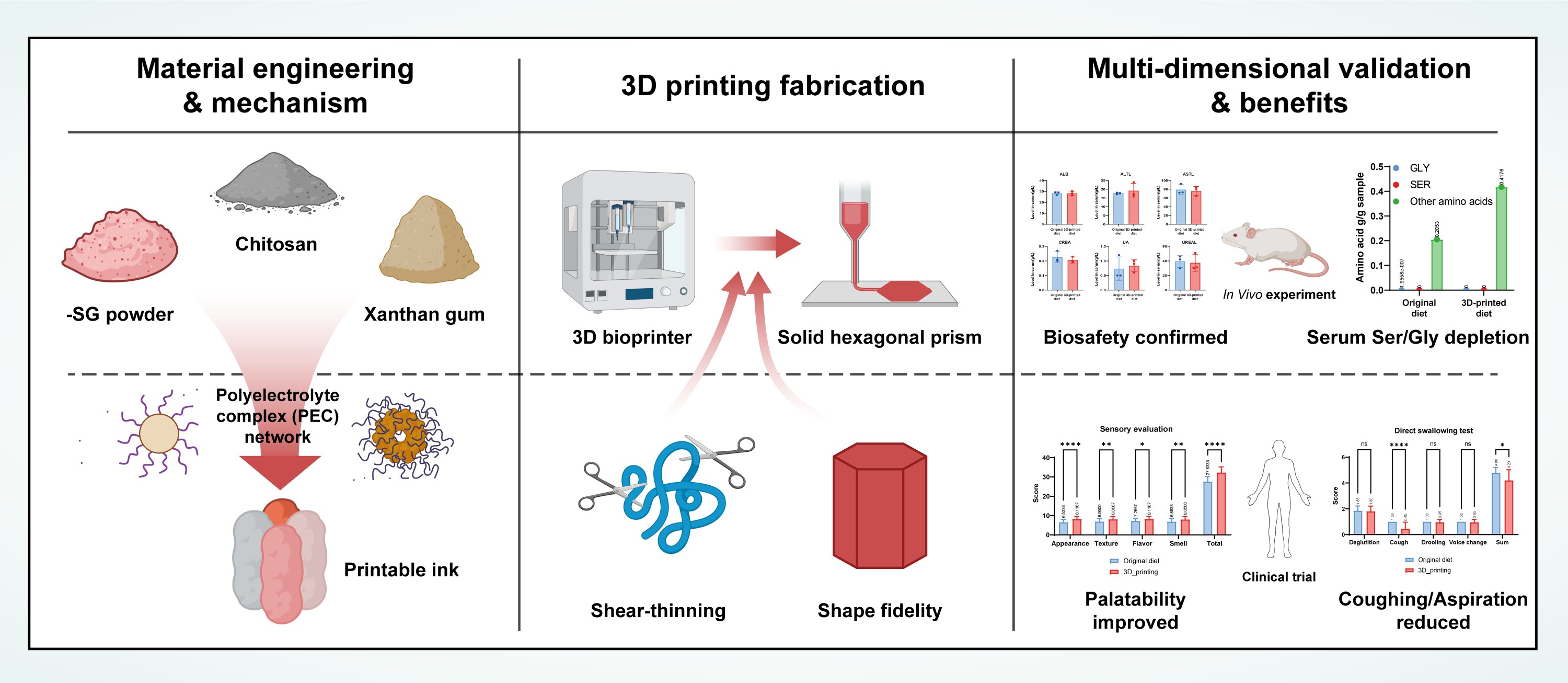
Serine/glycine-free (−SG) diets are recognized for boosting tumor immunotherapy efficacy by remodeling the tumor microenvironment, yet their clinical translation is hindered by aspiration risks and poor patient compliance associated with traditional liquid formulations. To address these challenges, this study leveraged 3D printing to transform −SG nutritional powder into a clinically viable semi-solid formulation. A functional food ink was developed by stabilizing −SG powder in a hydrocolloid matrix formed via electrostatic complexation between cationic chitosan and anionic xanthan gum. Formulation was optimized using response surface design of experiment methodology to maximize printability, with metabolic efficacy and biological safety validated in BALB/c mice, and clinical usability assessed in 20 cancer patients via sensory and direct swallowing tests. Rheological characterization confirmed that the polyelectrolyte network endowed the ink with ideal pseudoplasticity and yield stress—critical for extrusion-based 3D printing. The optimized formulation (1.25% chitosan, 1.25‰ xanthan gum) exhibited exceptional shape fidelity. In vivo studies showed the 3D-printed food for special medical purposes maintained serum serine/glycine depletion without systemic toxicity, supported by stable mouse body weight and normal liver/kidney function. Clinically, the 3D-printed semi-solid formulation significantly enhanced patient compliance, elevating sensory acceptability scores from “like slightly” to “like very much” (32.0 vs. 27.6, p < 0.0001). This study presents a novel application of 3D printing to fabricate texture-modified food for special medical purposes, effectively mitigating aspiration risks associated with traditional liquid amino acid-restricted diets.
- Horton HR, Moran LA, Scrimgeour KG, Perry MD, Rawn JD. Principles of Biochemistry. Pearson College Div; 2006.
- Latham MC. Human Nutrition in the Developing World. Food & Agriculture Organization; 1997.
- Vettore L, Westbrook RL, Tennant DA. New aspects of amino acid metabolism in cancer. Br J Cancer. 2020;122(2):150-156. doi: 10.1038/s41416-019-0620-5
- Lieu EL, Nguyen T, Rhyne S, Kim J. Amino acids in cancer. Exp Mol Med. 2020;52(1):15-30. doi: 10.1038/s12276-020-0375-3
- Tong H, Jiang Z, Song L, et al. Dual impacts of serine/glycine-free diet in enhancing antitumor immunity and promoting evasion via PD-L1 lactylation. Cell Metab. 2024;36(12):2493-2510.e9. doi: 10.1016/j.cmet.2024.10.019
- Choi BH, Coloff JL. The Diverse Functions of Non-Essential Amino Acids in Cancer. Cancers. 2019;11(5):675. doi: 10.3390/cancers11050675
- Pant A, Lee AY, Karyappa R, et al. 3D food printing of fresh vegetables using food hydrocolloids for dysphagic patients. Food Hydrocoll. 2021;114:106546. doi: 10.1016/j.foodhyd.2020.106546
- White PJ, McGarrah RW, Herman MA, Bain JR, Shah SH, Newgard CB. Insulin action, type 2 diabetes, and branched-chain amino acids: A two-way street. Mol Metab. 2021;52:101261. doi: 10.1016/j.molmet.2021.101261
- Wu B, Zhao TV, Jin K, et al. Mitochondrial aspartate regulates TNF biogenesis and autoimmune tissue inflammation. Nat Immunol. 2021;22(12):1551-1562. doi: 10.1038/s41590-021-01065-2
- Ruzzo EK, Capo-Chichi JM, Ben-Zeev B, et al. Deficiency of asparagine synthetase causes congenital microcephaly and a progressive form of encephalopathy. Neuron. 2013;80(2):429-441. doi: 10.1016/j.neuron.2013.08.013
- Ben-Salem S, Gleeson JG, Al-Shamsi AM, et al. Asparagine synthetase deficiency detected by whole exome sequencing causes congenital microcephaly, epileptic encephalopathy and psychomotor delay. Metab Brain Dis. 2015;30(3):687-694. doi: 10.1007/s11011-014-9618-0
- Palmer EE, Hayner J, Sachdev R, et al. Asparagine Synthetase Deficiency causes reduced proliferation of cells under conditions of limited asparagine. Mol Genet Metab. 2015;116(3):178-186. doi: 10.1016/j.ymgme.2015.08.007
- Seidahmed MZ, Salih MA, Abdulbasit OB, et al. Hyperekplexia, microcephaly and simplified gyral pattern caused by novel ASNS mutations, case report. BMC Neurol. 2016;16:105. doi: 10.1186/s12883-016-0633-0
- Gataullina S, Lauer-Zillhardt J, Kaminska A, et al. Epileptic Phenotype of Two Siblings with Asparagine Synthesis Deficiency Mimics Neonatal Pyridoxine-Dependent Epilepsy. Neuropediatrics. 2016;47(6):399-403. doi: 10.1055/s-0036-1586222
- Piao L, Fang YH, Parikh K, Ryan JJ, Toth PT, Archer SL. Cardiac glutaminolysis: a maladaptive cancer metabolism pathway in the right ventricle in pulmonary hypertension. J Mol Med. 2013;91(10):1185-1197. doi: 10.1007/s00109-013-1064-7
- Newgard CB. Metabolomics and Metabolic Diseases: Where Do We Stand? Cell Metab. 2017;25(1):43-56. doi: 10.1016/j.cmet.2016.09.018
- Alfadhel M, Alrifai MT, Trujillano D, et al. Asparagine Synthetase Deficiency: New Inborn Errors of Metabolism. JIMD Rep. 2015;22:11-16. doi: 10.1007/8904_2014_405
- Boger RH. The emerging role of asymmetric dimethylarginine as a novel cardiovascular risk factor. Cardiovasc Res. 2003;59(4):824-833. doi: 10.1016/S0008-6363(03)00500-5
- Wu H, Sang S, Weng P, et al. Structural, rheological, and gelling characteristics of starch-based materials in context to 3D food printing applications in precision nutrition. Compr Rev Food Sci Food Saf. 2023;22(6):4217-4241. doi: 10.1111/1541-4337.13217
- Li J, Ye G, Zhou Z, et al. Ultrasound-assisted extraction of polysaccharide from Allium chinense G. Don epidermal waste: Evaluation of extraction mechanism, physicochemical properties, and bioactivities. Ultrason Sonochem. 2025;112:107210. doi: 10.1016/j.ultsonch.2024.107210
- Zhang Y, Lee AY, Pojchanun K, et al. Systematic Engineering approach for optimization of multi-component alternative protein-fortified 3D printing food Ink. Food Hydrocoll. 2022;131:107803. doi: 10.1016/j.foodhyd.2022.107803
- National Research Council. Guide for the Care and Use of Laboratory Animals. 8th ed. National Academies Press; 2011. Available from: https://grants.nih.gov/grants/olaw/ guide-for-the-care-and-use-of-laboratory-animals.pdf
- Park KD, Kim TH, Lee SH. The Gugging Swallowing Screen in dysphagia screening for patients with stroke: A systematic review. Int J Nurs Stud. 2020;107:103588. doi: 10.1016/j.ijnurstu.2020.103588
- Estupinan Artiles C, Regan J, Donnellan C. Dysphagia screening in residential care settings: A scoping review. Int J Nurs Stud. 2021;114:103813. doi: 10.1016/j.ijnurstu.2020.103813
- Wang J, Li J, Zeng D, et al. Comprehensive evaluation of extraction process, physicochemical properties and bioactivities of hawk tea polysaccharides: comparison of ultrasonic and hot water extraction. Ultrason Sonochem. 2025;120:107477. doi: 10.1016/j.ultsonch.2025.107477
- Ye G, Li J, Wang J, et al. Advantages of ultrasonic-assisted extraction over hot water extraction for polysaccharides from waste stems of Rubia cordifolia L.: A comprehensive comparison of efficiency, structure, and bioactivity. Ultrason Sonochem. 2025;120:107502. doi: 10.1016/j.ultsonch.2025.107502
- Liu L, Yang X, Bhandari B, Meng Y, Prakash S. Optimization of the Formulation and Properties of 3D-Printed Complex Egg White Protein Objects. Foods. 2020;9(2):164. doi: 10.3390/foods9020164
- Nasser J, Mehravar S, Pimentel M, et al. Elemental Diet as a Therapeutic Modality: A Comprehensive Review. Dig Dis Sci. 2024;69(9):3344-3360. doi: 10.1007/s10620-024-08543-1
- Rodriguez-Hernandez AK, Perez-Martinez JD, Gallegos-Infante JA, Toro-Vazquez JF, Ornelas-Paz JJ. Rheological properties of ethyl cellulose-monoglyceride-candelilla wax oleogel vis-a-vis edible shortenings. Carbohydr Polym. 2021;252:117171. doi: 10.1016/j.carbpol.2020.117171
- Cichero JA, Lam P, Steele CM, et al. Development of International Terminology and Definitions for Texture- Modified Foods and Thickened Fluids Used in Dysphagia Management: The IDDSI Framework. Dysphagia. 2017;32(2):293-314. doi: 10.1007/s00455-016-9758-y
- Dick A, Bhandari B, Dong X, Prakash S. Feasibility study of hydrocolloid incorporated 3D printed pork as dysphagia food. Food Hydrocoll. 2020;107:105940. doi: 10.1016/j.foodhyd.2020.105940
- Tian Z, Zhong Q, Zhang H, et al. Optimising printing fidelity of the single-nozzle based multimaterial direct ink writing for 3D food printing. Virtual Phys Prototyp. 2024;19(1):e2352075. doi: 10.1080/17452759.2024.2352075
- Maldonado-Rosas R, Perez-Castillo JL, Cuan-Urquizo E, Tejada-Ortigoza V. The role of controlled voids shape on the flexural properties of 3D printed food: an approach for tailoring their mechanical properties. Virtual Phys Prototyp. 2024;19(1):e2284816. doi: 10.1080/17452759.2023.2284816
- World Medical Association. Declaration of Helsinki: ethical principles for medical research involving human subjects. JAMA. 2013;310(20):2191-2194. doi: 10.1001/jama.2013.281053