

Toward functional bone bioprinting: Addressing the overlooked challenges of mechanical compliance

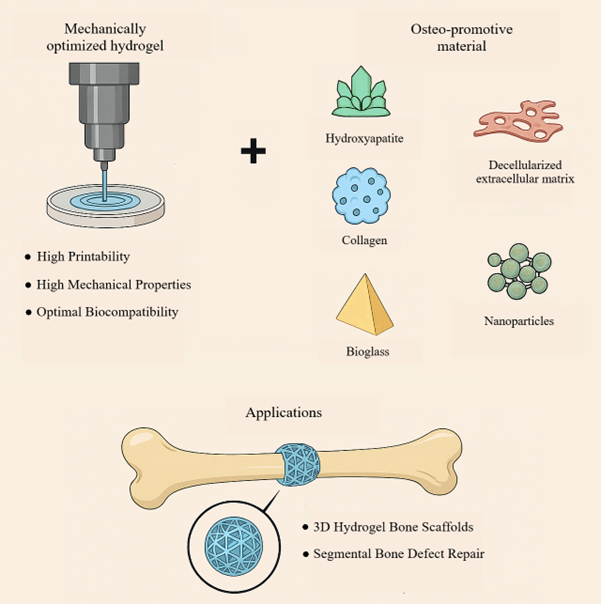
Three-dimensional bioprinting has emerged as a transformative biofabrication technology capable of engineering complex tissue constructs for regenerative medicine. While considerable progress has been made in replicating soft tissues using hydrogel-based bioprinting, the fabrication of mechanically robust bone-mimicking constructs remains a significant challenge. The mechanical heterogeneity of bone, including its anisotropic structure, varying mineral density, and intricate extracellular matrix composition, complicates the development of bioinks that can simultaneously achieve printability, structural integrity, and cellular viability. Recent advancements have focused on optimizing the mechanical properties of bioinks through composite hydrogels, osteoinductive nanomaterials, and bioactive moieties that enhance cell adhesion and differentiation. This review examines the role of mechanical cues in directing mesenchymal stem cell fate, the interplay between material stiffness and osteogenesis, and strategies to enhance bioink performance. We highlight limitations in mechanical compliance and propose novel biomaterial designs, crosslinking strategies, and scaffold functionalization to overcome these barriers. This review aims to bridge the gap between biomaterials science and clinical translation, with the ultimate goal of advancing functional bone graft substitutes.
- Chimene D, Lennox KK, Kaunas RR, Gaharwar AK. Advancedbioinks for 3d printing: a materials science perspective. Ann Biomed Eng. 2016;44(6):2090-2102. doi: 10.1007/s10439-016-1638-y
- Pedroza-Gonzalez SC, Rodriguez-Salvador M, Perez- Benitez BE, Alvarez MM, Santiago GT. Bioinks for 3D bioprinting: a scientometric analysis of two decades of progress. Int J Bioprint. 2021;7(2):333. doi: 10.18063/ijb.v7i2.337
- Engler AJ, Sen S, Sweeney HL, Discher DE. Matrix elasticity directs stem cell lineage specification. Cell. 2006;126(4):677-689. doi: 10.1016/j.cell.2006.06.044
- Chaudhuri O, Gu L, Klumpers D, et al. Hydrogels with tunable stress relaxation regulate stem cell fate and activity. Nat Mater. 2016;15(3):326-334. doi: 10.1038/nmat4489
- Bergonzi C, Bianchera A, Remaggi G, Ossiprandi MC, Bettini R, Elviri L. 3D printed chitosan/alginate hydrogels for the controlled release of silver sulfadiazine in wound healing applications: design, characterization and antimicrobial activity. Micromachines (Basel). 2023;14(1):137. doi: 10.3390/mi14010137
- Wang L, Zhou A, Chen C, Huang X, Zhang S, Chen J. Preparation and properties of composite hydrogels for 3D bioprinting. Polym Adv Technol. 2023;34(7):2369-2383. doi: 10.1002/pat.6057
- Zhang X, Yang X, Wu W, et al. Improving the mechanical properties of 3D printed GelMA composite hydrogels by tannic acid. MedComm–Biomater Appl. 2023;2(3):e51. doi: 10.1002/mba2.51
- Breisch M, Grasmik V, Loza K, et al. Bimetallic silver-platinum nanoparticles with combined osteo-promotive and antimicrobial activity. Nanotechnology. 2019;30(30):305101. doi: 10.1088/1361-6528/ab172b
- Lu N, Lu Y, Liu S, et al. Tailor-engineered POSS-based hybrid gels for bone regeneration. Biomacromolecules. 2019;20(9):3485-3493. doi: 10.1021/acs.biomac.9b00771
- Hoyle CE, Bowman CN. Thiol-ene click chemistry. Angew Chem Int Ed Engl. 2010;49(9):1540-1573. doi: 10.1002/anie.200903924
- Fairbanks BD, Schwartz MP, Halevi AE, Nuttelman CR, Bowman CN, Anseth KS. A versatile synthetic extracellular matrix mimic via thiol-norbornene photopolymerization. Adv Mater. 2009;21(48):5005-5010. doi: 10.1002/adma.200901808
- Mondal S, Lessard JJ, Meena CL, Sanjayan GJ, Sumerlin BS. Janus Cross-links in supramolecular networks. J Am Chem Soc. 2022;144(2):845-853. doi: 10.1021/jacs.1c10606
- Motloung MP, Mofokeng TG, Ray SS. Viscoelastic, thermal, and mechanical properties of melt-processed poly (epsilon-caprolactone) (PCL)/hydroxyapatite (HAP) composites. Materials (Basel). 2021;15(1):104.doi: 10.3390/ma15010104
- Chuysinuan P, Nooeaid P, Thanyacharoen T, Techasakul S, Pavasant P, Kanjanamekanant K. Injectable eggshell-derived hydroxyapatite-incorporated fibroin-alginate composite hydrogel for bone tissue engineering. Int J Biol Macromol. 2021;193(Pt A):799-808. doi: 10.1016/j.ijbiomac.2021.10.132
- Stocco TD, de Carvalho RP, Silva HCO, de Melo Sousa TS. The feasibility of 3D bioprinting for bone regeneration: key challenges and future directions. Regen Med. 2025;20(11):625-652. doi: 10.1080/17460751.2025.2572218
- Garcia-Aznar JM, Nasello G, Hervas-Raluy S, Perez MA, Gomez-Benito MJ. Multiscale modeling of bone tissue mechanobiology. Bone. 2021;151:116032. doi: 10.1016/j.bone.2021.116032
- Chmielewska A, Dean D. The role of stiffness-matching in avoiding stress shielding-induced bone loss and stress concentration-induced skeletal reconstruction device failure. Acta Biomater. 2024;173:51-65. doi: 10.1016/j.actbio.2023.11.011
- Florencio-Silva R, Sasso GRdS, Sasso-Cerri E, Simões MJ, Cerri PS. Biology of bone tissue: structure, function, and factors that influence bone cells. BioMed Res. Int.. 2015;2015(1):421746. doi: 10.1155/2015/421746
- Raubenheimer E, Miniggio H, Lemmer L, van Heerden W. The role of bone remodelling in maintaining and restoring bone health: an overview. Clin. Rev. Bone Miner Metab. 2017;15:90-97. doi: 10.1007/s12018-017-9230-z
- Hadjidakis DJ, Androulakis, II. Bone remodeling. Ann N Y Acad Sci. 2006;1092(1):385-396. doi: 10.1196/annals.1365.035
- Crockett JC, Rogers MJ, Coxon FP, Hocking LJ, Helfrich MH. Bone remodelling at a glance. J Cell Sci. 2011;124(7): 991-998. doi: 10.1242/jcs.063032
- Ott SM. Cortical or trabecular bone: what’s the difference? Am J Nephrol. 2018;47(6):373-375. doi: 10.1159/000489672
- Reyes KJC, Stanford FC, Singhal V, et al. Bone density, microarchitecture and strength estimates in white versus African American youth with obesity. Bone. 2020;138:115514. doi: 10.1016/j.bone.2020.115514
- Reichert JC, Wullschleger ME, Cipitria A, et al. Custom-made composite scaffolds for segmental defect repair in long bones. Int Orthop. 2011;35(8):1229-1236. doi: 10.1007/s00264-010-1146-x
- Cheung AM, Adachi JD, Hanley DA, et al. High-resolution peripheral quantitative computed tomography for the assessment of bone strength and structure: a review by the Canadian Bone Strength Working Group. Curr Osteoporos Rep. Jun 2013;11(2):136-146. doi: 10.1007/s11914-013-0140-9
- Das D, Zhang S, Noh I. Synthesis and characterizations of alginate-α-tricalcium phosphate microparticle hybrid film with flexibility and high mechanical property as a biomaterial. Biomed. Mater. 2018;13(2):025008. doi: 10.1088/1748-605X/aa8fa1
- Abelardo E. Synthetic material bioinks. In: 3D Bioprinting for Reconstructive Surgery. Amsterdam, Netherlands: Elsevier; 2018:137-144.
- Popp K, Xu C, Yuan A, et al. Trabecular microstructure is influenced by race and sex in Black and White young adults. Osteoporosis Int. 2019;30:201-209. doi: 10.1007/s00198-018-4729-9
- De Mori A, Pena Fernandez M, Blunn G, Tozzi G, Roldo M. 3D printing and electrospinning of composite hydrogels for cartilage and bone tissue engineering. Polymers (Basel). 2018;10(3):285. doi: 10.3390/polym10030285
- Morgan EF, Unnikrisnan GU, Hussein AI. Bone mechanical properties in healthy and diseased states. Annu Rev Biomed Eng. 2018;20(1):119-143. doi: 10.1146/annurev-bioeng-062117-121139
- Karpiński R, Jaworski Ł, Czubacka P. The structural and mechanical properties of the bone. J Technol Exploitat Mech Eng. 2017;3(1):43-51. doi: 10.35784/jteme.538
- Currey J. The structure and mechanical properties of bone. In: Bioceramics and Their Clinical Applications. Amsterdam, Netherlands: Elsevier; 2008:3-27.
- Vassiliou V, Chow E, Kardamakis D. Bone Metastases: A Translational and Clinical Approach. Vol 21. Dordrecht: Springer Science & Business Media; 2013.
- Shapiro F. Bone development and its relation to fracture repair. The role of mesenchymal osteoblasts and surface osteoblasts. Eur Cell Mater. 2008;15:53-76. doi: 10.22203/ecm.v015a05
- Kopperdahl DL, Keaveny TM. Yield strain behavior of trabecular bone. J Biomech. 1998;31(7):601-608. doi: 10.1016/s0021-9290(98)00057-8
- Currey JD. How well are bones designed to resist fracture? J Bone Miner Res. 2003;18(4):591-598. doi: 10.1359/jbmr.2003.18.4.591
- Osterhoff G, Morgan EF, Shefelbine SJ, Karim L, McNamara LM, Augat P. Bone mechanical properties and changes with osteoporosis. Injury. 2016;47 Suppl 2(Suppl 2): S11-S20. doi: 10.1016/S0020-1383(16)47003-8
- Boivin G, Bala Y, Doublier A, et al. The role of mineralization and organic matrix in the microhardness of bone tissue from controls and osteoporotic patients. Bone. 2008;43(3):532-538. doi: 10.1016/j.bone.2008.05.024
- Bala Y, Farlay D, Boivin G. Bone mineralization: from tissue to crystal in normal and pathological contexts. Osteoporos Int. 2013;24(8):2153-2166. doi: 10.1007/s00198-012-2228-y
- Zumstein V, Kraljević M, Wirz D, Hügli R, Müller- Gerbl M. Correlation between mineralization and mechanical strength of the subchondral bone plate of the humeral head. J Shoulder Elbow Surg. 2012;21(7): 887-893. doi: 10.1016/j.jse.2011.05.018
- Augat P, Schorlemmer S. The role of cortical bone and its microstructure in bone strength. Age Ageing. 2006;35 Suppl 2(suppl_2):ii27-ii31. doi: 10.1093/ageing/afl081
- Zebaze RM, Ghasem-Zadeh A, Bohte A, et al. Intracortical remodelling and porosity in the distal radius and post-mortem femurs of women: a cross-sectional study. Lancet. 2010;375(9727):1729-1736. doi: 10.1016/S0140-6736(10)60320-0
- Seeman E, Delmas PD, Hanley DA, et al. Microarchitectural deterioration of cortical and trabecular bone: differing effects of denosumab and alendronate. J Bone Miner Res. 2010;25(8):1886-1894. doi: 10.1002/jbmr.81
- Riggs BL, Melton III LJ, Robb RA, et al. A population‐based assessment of rates of bone loss at multiple skeletal sites: evidence for substantial trabecular bone loss in young adult women and men. J Bone Miner Res. 2008;23(2): 205-214. doi: 10.1359/JBMR.07102
- Luu YK, Pessin JE, Judex S, Rubin J, Rubin CT. Mechanical signals as a non-invasive means to influence mesenchymal stem cell fate, promoting bone and suppressing the fat phenotype. Bonekey Osteovision. 2009;6(4):132-149. doi: 10.1138/20090371
- Guilak F, Cohen DM, Estes BT, Gimble JM, Liedtke W, Chen CS. Control of stem cell fate by physical interactions with the extracellular matrix. Cell Stem Cell. 2009;5(1): 17-26. doi: 10.1016/j.stem.2009.06.016
- Kirby TJ, Lammerding J. Cell mechanotransduction: stretch to express. Nat Mater. 2016;15(12):1227-1229. doi: 10.1038/nmat4809
- Yang L, Gao Q, Ge L, et al. Topography induced stiffness alteration of stem cells influences osteogenic differentiation. Biomater Sci. 2020;8(9):2638-2652. doi: 10.1039/d0bm00264j
- Shen B, Delaney MK, Du X. Inside-out, outside-in, and inside-outside-in: G protein signaling in integrin-mediated cell adhesion, spreading, and retraction. Curr Opin Cell Biol. 2012;24(5):600-606. doi: 10.1016/j.ceb.2012.08.011
- Mousavi SJ, Doweidar MH. Role of mechanical cues in cell differentiation and proliferation: a 3D numerical model. PLoS One. 2015;10(5):e0124529. doi: 10.1371/journal.pone.0124529
- Chowdhury F, Li Y, Poh YC, Yokohama-Tamaki T, Wang N, Tanaka TS. Soft substrates promote homogeneous self-renewal of embryonic stem cells via downregulating cell-matrix tractions. PLoS One. 2010;5(12):e15655. doi: 10.1371/journal.pone.0015655
- Wang LS, Chung JE, Chan PP, Kurisawa M. Injectable biodegradable hydrogels with tunable mechanical properties for the stimulation of neurogenesic differentiation of human mesenchymal stem cells in 3D culture. Biomaterials. 2010;31(6):1148-1157. doi: 10.1016/j.biomaterials.2009.10.042
- Zhang M, Sun Q, Liu Y, et al. Controllable ligand spacing stimulates cellular mechanotransduction and promotes stem cell osteogenic differentiation on soft hydrogels. Biomaterials. 2021;268:120543. doi: 10.1016/j.biomaterials.2020.120543
- Cun X, Hosta-Rigau L. Topography: a biophysical approach to direct the fate of mesenchymal stem cells in tissue engineering applications. Nanomaterials (Basel). 2020;10(10):2070. doi: 10.3390/nano10102070
- Godoi FC, Prakash S, Bhandari BR. 3D printing technologies applied for food design: status and prospects. J Food Eng. 2016;179:44-54. doi: 10.1016/j.jfoodeng.2016.01.025
- Hölzl K, Lin S, Tytgat L, Van Vlierberghe S, Gu L, Ovsianikov A. Bioink properties before, during and after 3D bioprinting. Biofabrication. 2016;8(3):032002. doi: 10.1088/1758-5090/8/3/032002
- Hospodiuk M, Dey M, Sosnoski D, Ozbolat IT. The bioink: a comprehensive review on bioprintable materials. Biotechnol Adv. 2017;35(2):217-239. doi: 10.1016/j.biotechadv.2016.12.006
- Saunders RE, Derby B. Inkjet printing biomaterials for tissue engineering: bioprinting. Int Mater Rev. 2014;59(8):430-448. doi: 10.1179/1743280414Y.0000000040
- Xu T, Jin J, Gregory C, Hickman JJ, Boland T. Inkjet printing of viable mammalian cells. Biomaterials. 2005;26(1):93-99. doi: 10.1016/j.biomaterials.2004.04.011
- Mancha Sanchez E, Gomez-Blanco JC, Lopez Nieto E, et al. Hydrogels for bioprinting: a systematic review of hydrogels synthesis, bioprinting parameters, and bioprinted structures behavior. Front Bioeng Biotechnol. 2020;8:776. doi: 10.3389/fbioe.2020.00776
- Kyle S, Jessop ZM, Al‐Sabah A, Whitaker IS. ‘Printability’of candidate biomaterials for extrusion based 3D printing: state‐of‐the‐art. Adv Healthcare Mater. 2017;6(16):1700264. doi: 10.1002/adhm.201700264
- Li M, Tian X, Zhu N, Schreyer DJ, Chen X. Modeling process-induced cell damage in the biodispensing process. Tissue Eng Part C Methods. 2010;16(3):533-542. doi: 10.1089/ten.TEC.2009.0178
- Aljohani W, Ullah MW, Zhang X, Yang G. Bioprinting and its applications in tissue engineering and regenerative medicine. Int J Biol Macromol. 2018;107(Pt A):261-275. doi: 10.1016/j.ijbiomac.2017.08.171
- Shanjani Y, Pan CC, Elomaa L, Yang Y. A novel bioprinting method and system for forming hybrid tissue engineering constructs. Biofabrication. 2015;7(4):045008. doi: 10.1088/1758-5090/7/4/045008
- Billiet T, Gevaert E, De Schryver T, Cornelissen M, Dubruel P. The 3D printing of gelatin methacrylamide cell-laden tissue-engineered constructs with high cell viability. Biomaterials. 2014;35(1):49-62. doi: 10.1016/j.biomaterials.2013.09.078
- Diamantides N, Dugopolski C, Blahut E, Kennedy S, Bonassar LJ. High density cell seeding affects the rheology and printability of collagen bioinks. Biofabrication. 2019;11(4):045016. doi: 10.1088/1758-5090/ab3524
- Gregory T, Benhal P, Scutte A, et al. Rheological characterization of cell-laden alginate-gelatin hydrogels for 3D biofabrication. J Mech Behav Biomed Mater. 2022;136:105474. doi: 10.1016/j.jmbbm.2022.105474
- Guo Z, Ma C, Xie W, Tang A, Liu W. An effective DLP 3D printing strategy of high strength and toughness cellulose hydrogel towards strain sensing. Carbohydr Polym. 2023;315:121006. doi: 10.1016/j.carbpol.2023.121006
- Müller SJ, Fabry B, Gekle S. Predicting cell stress and strain during extrusion bioprinting. Phys Rev Appl. 2023;19(6):064061. doi: 10.48550/arXiv.2209.13666
- Boularaoui S, Shanti A, Khan KA, Iacoponi S, Christoforou N, Stefanini C. Harnessing shear stress preconditioning to improve cell viability in 3D post-printed biostructures using extrusion bioprinting. Bioprinting. 2022;25:e00184. doi: 10.1016/j.bprint.2021.e00184
- Lyu J, Johnson M, Creagh-Flynn J, et al. Instant gelation system as self-healable and printable 3D cell culture bioink based on dynamic covalent chemistry. ACS Appl Mater Interfaces. 2020;12(35):38918-38924. doi.org/10.1021/acsami.0c08567
- Ashammakhi N, Ahadian S, Xu C, et al. Bioinks and bioprinting technologies to make heterogeneous and biomimetic tissue constructs. Mater Today Bio. 2019;1:100008. doi: 10.1016/j.mtbio.2019.100008
- Schwab A, Levato R, D’Este M, Piluso S, Eglin D, Malda J. Printability and shape fidelity of bioinks in 3D bioprinting. Chem Rev. 2020;120(19):11028-11055. doi: 10.1021/acs.chemrev.0c00084
- Oh D, Shirzad M, Kim MC, Chung EJ, Nam SY. Rheology-informed hierarchical machine learning model for the prediction of printing resolution in extrusion-based bioprinting. Int J Bioprint. 2023;9(6):308-324. doi: 10.36922/ijb.1280
- Wu L, Zhao J, Huang J, Huang P, Zhao H. Advances and challenges in 3D bioprinting of bone organoids: materials, techniques, and functionalization strategies. Int J Bioprint. 2025;0(0) doi: 10.36922/ijb025190183
- Khalaf AT, Wei Y, Wan J, et al. Bone tissue engineering through 3D bioprinting of bioceramic scaffolds: a review and update. Life. 2022;12(6):903. doi: 10.3390/life12060903
- Lakatos E, Magyar L, Bojtar I. Material properties of the mandibular trabecular bone. J Med Eng. 2014;2014(1):470539. doi: 10.1155/2014/470539
- Luo Y. Toward fully automated personalized orthopedic treatments: innovations and interdisciplinary gaps. Bioengineering (Basel). 2024;11(8):817. doi: 10.3390/bioengineering11080817
- Zhou J, See CW, Sreenivasamurthy S, Zhu D. Customized additive manufacturing in bone scaffolds-the gateway to precise bone defect treatment. Research (Wash D C). 2023;6:0239. doi: 10.34133/research.0239
- Varshney S, Dwivedi A, Pandey V. Bioprinting techniques for regeneration of oral and craniofacial tissues: current advances and future prospects. J Oral Biol Craniofac Res. 2025;15(2):331-346. doi: 10.1016/j.jobcr.2025.01.019
- Lai Y, Fan J, Li P, et al. Recent advances in 3D bioprinting for cartilage and osteochondral regeneration. Int J Bioprint. 2025;0(0). doi: 10.36922/ijb025120098
- Eschweiler J, Horn N, Rath B, et al. The biomechanics of cartilage: an overview. Life (Basel). 2021;11(4). doi: 10.3390/life11040302
- Petitjean N, Canadas P, Royer P, Noel D, Le Floc’h S. Cartilage biomechanics: from the basic facts to the challenges of tissue engineering. J Biomed Mater Res A. 2023;111(7):1067-1089. doi: 10.1002/jbm.a.37478
- Dąbrowski M, Rogala P, Uklejewski R, Patalas A, Winiecki M, Gapiński B. Subchondralbone relative area and density in human osteoarthritic femoral heads assessed with micro- CT before and after mechanical embedding of the innovative multi-spiked connecting scaffold for resurfacing THA endoprostheses: a pilot study. J Clinic Med. 2021;10(13):2937. doi: 10.3390/jcm10132937
- Lu J, Gao Y, Cao C, et al. 3D bioprinted scaffolds for osteochondral regeneration: advancements and applications. Mater Today Bio. 2025;32:101834. doi: 10.1016/j.mtbio.2025.101834
- Gao D, Li R, Pan J, et al. 3D bioprinting bone/cartilage organoids: construction, applications, and challenges. J Orthop Translat. 2025;55:75-93. doi: 10.1016/j.jot.2025.08.008
- Wang J, Chen X, Li R, et al. Standardization and consensus in the development and application of bone organoids. Review. Theranostics. 2025;15(2):682-706. doi: 10.7150/thno.105840
- Ohman-Magi C, Holub O, Wu D, Hall RM, Persson C. Density and mechanical properties of vertebral trabecular bone: a review. JOR Spine. Dec 2021;4(4):e1176. doi: 10.1002/jsp2.1176
- Inzana JA, Olvera D, Fuller SM, et al. 3D printing of composite calcium phosphate and collagen scaffolds for bone regeneration. Biomaterials. 2014;35(13):4026-4034. doi: 10.1016/j.biomaterials.2014.01.064
- Bendtsen ST, Quinnell SP, Wei M. Development of a novel alginate-polyvinyl alcohol-hydroxyapatite hydrogel for 3D bioprinting bone tissue engineered scaffolds. J Biomed Mater Res A. 2017;105(5):1457-1468. doi: 10.1002/jbm.a.36036
- Monavari M, Medhekar R, Nawaz Q, et al. A 3D printed bone tissue engineering scaffold composed of alginate dialdehyde-gelatine reinforced by lysozyme loaded cerium doped mesoporous silica-calcia nanoparticles. Macromol Biosci. 2022;22(9):e2200113. doi: 10.1002/mabi.202200113
- Ojansivu M, Rashad A, Ahlinder A, et al. Wood-based nanocellulose and bioactive glass modified gelatin-alginate bioinks for 3D bioprinting of bone cells. Biofabrication. 2019;11(3):035010. doi: 10.1088/1758-5090/ab0692
- Wang LL, Highley CB, Yeh YC, Galarraga JH, Uman S, Burdick JA. Three-dimensional extrusion bioprinting of single- and double-network hydrogels containing dynamic covalent crosslinks. J Biomed Mater Res A. 2018;106(4):865-875. doi: 10.1002/jbm.a.36323
- Zhang X, Yan Z, Guan G, et al. Polyethylene glycol diacrylate scaffold filled with cell-laden methacrylamide gelatin/ alginate hydrogels used for cartilage repair. J Biomater Appl. 2022;36(6):1019-1032. doi: 10.1177/08853282211044853
- Hsieh CT, Hsu SH. Double- network polyurethane-gelatin hydrogel with tunable modulus for high-resolution 3D bioprinting. ACS Appl Mater Interfaces. 2019;11(36):32746-32757. doi: 10.1021/acsami.9b10784
- Lee J, Hong J, Kim W, Kim GH. Bone-derived dECM/ alginate bioink for fabricating a 3D cell-laden mesh structure for bone tissue engineering. Carbohydr Polym. 2020;250:116914. doi: 10.1016/j.carbpol.2020.116914
- Chen Z, Zhang H, Huang J, et al. DNA-encoded dynamic hydrogels for 3D bioprinted cartilage organoids. Mater Today Bio. 2025;31:101509. doi: 10.1016/j.mtbio.2025.101509
- Leite AJ, Sarker B, Zehnder T, Silva R, Mano JF, Boccaccini AR. Bioplotting of a bioactive alginate dialdehyde-gelatin composite hydrogel containing bioactive glass nanoparticles. Biofabrication. 2016;8(3):035005. doi: 10.1088/1758-5090/8/3/035005
- Korkeamaki JT, Rashad A, Ojansivu M, et al. Systematic development and bioprinting of novel nanostructured multi-material bioinks for bone tissue engineering. Biofabrication. 2025;17(2):025005. doi: 10.1088/1758-5090/ada63b
- Liu B, Li J, Lei X, et al. 3D-bioprinted functional and biomimetic hydrogel scaffolds incorporated with nanosilicates to promote bone healing in rat calvarial defect model. Mater Sci Eng C Mater Biol Appl. 2020;112:110905. doi: 10.1016/j.msec.2020.110905
- Mathur V, Agarwal P, Kasturi M, Srinivasan V, Seetharam RN, Vasanthan KS. Innovative bioinks for 3D bioprinting: exploring technological potential and regulatory challenges. J Tissue Eng. 2025;16:20417314241308022. doi: 10.1177/20417314241308022
- Bastos AR, da Silva LP, Maia FR, et al. Hydroxyapatite/ alginate/gellan gum inks with osteoconduction and osteogenic potential for bioprinting bone tissue analogues. Int J Biol Macromol. 2024;271(Pt 2):132611. doi: 10.1016/j.ijbiomac.2024.132611
- Yang J, Chen Z, Gao C, et al. A mechanical-assisted post-bioprinting strategy for challenging bone defects repair. Nat Commun. 2024;15(1):3565. doi: 10.1038/s41467-024-48023-8
- Ebrahimi Sadrabadi A, Baei P, Hosseini S, Baghaban Eslaminejad M. Decellularized extracellular matrix as a potent natural biomaterial for regenerative medicine. Adv Exp Med Biol. 2021;(1341):27-43. doi: 10.1007/5584_2020_504
- Baroncelli M, Van Der Eerden BC, Chatterji S, et al. Human osteoblast-derived extracellular matrix with high homology to bone proteome is osteopromotive. Tissue Eng Part A. 2018;24(17-18):1377-1389. doi: 10.1089/ten.TEA.2017.0448
- Jones L, Thomsen JS, Mosekilde L, Bosch C, Melsen B. Biomechanical evaluation of rat skull defects, 1, 3, and 6 months after implantation with osteopromotive substances. J Craniomaxillofac Surg. 2007;35(8):350-357. doi: 10.1016/j.jcms.2007.06.004
- Biehl A, Gracioso Martins AM, Davis ZG, et al. Towards a standardized multi-tissue decellularization protocol for the derivation of extracellular matrix materials. Biomater Sci. 2023;11(2):641-654. doi: 10.1039/d2bm01012g
- Ramos‐Rodriguez DH, Leach JK. Decellularized cell‐secreted extracellular matrices as biomaterials for tissue engineering. Small Sci. 2025;5(2):2400335. doi: 10.1002/smsc.202400335
- Cao B, Zhang K, Zuo R, et al. 3D-bioprinted functional scaffold based on synergistic induction of i-PRF and laponite exerts efficient and personalized bone regeneration via miRNA-mediated TGF-beta/Smads signaling. Int J Surg. 2025;111(5):3193-3211. doi: 10.1097/JS9.0000000000002312
- Deng Y, Yang W-Z, Shi D, et al. Bioinspired and osteopromotive polydopamine nanoparticle-incorporated fibrous membranes for robust bone regeneration. NPG Asia Mater. 2019;11(1):39. doi: 10.1038/s41427-019-0139-5
- Grasmik V, Breisch M, Loza K, et al. Synthesis and biological characterization of alloyed silver-platinum nanoparticles: from compact core-shell nanoparticles to hollow nanoalloys. RSC Adv. 2018;8(67):38582-38590. doi: 10.1039/c8ra06461j
- Wolff N, Bialas N, Loza K, et al. Increased cytotoxicity of bimetallic ultrasmall silver-platinum nanoparticles (2 nm) on cells and bacteria in comparison to silver nanoparticles of the same size. Materials (Basel). 2024;17(15):3702. doi: 10.3390/ma17153702
- Seo JJ, Mandakhbayar N, Kang MS, et al. Antibacterial, proangiogenic, and osteopromotive nanoglass paste coordinates regenerative process following bacterial infection in hard tissue. Biomaterials. 2021;268:120593. doi: 10.1016/j.biomaterials.2020.120593
- Sadeghianmaryan A, Naghieh S, Yazdanpanah Z, et al. Fabrication of chitosan/alginate/hydroxyapatite hybrid scaffolds using 3D printing and impregnating techniques for potential cartilage regeneration. Int J Biol Macromol. 2022;204:62-75. doi: 10.1016/j.ijbiomac.2022.01.201
- Seok JM, Kim MJ, Park JH, et al. A bioactive microparticle-loaded osteogenically enhanced bioprinted scaffold that permits sustained release of BMP-2. Mater Today Bio. 2023;21:100685. doi: 10.1016/j.mtbio.2023.100685
- Osidak EO, Kozhukhov VI, Osidak MS, Domogatsky SP. Collagen as bioink for bioprinting: a comprehensive review. Int J Bioprint. 2020;6(3):270. doi: 10.18063/ijb.v6i3.270
- Hogan KJ, Oztatli H, Perez MR, et al. Development of photoreactive demineralized bone matrix 3D printing colloidal inks for bone tissue engineering. Regen Biomater. 2023;10:rbad090. doi: 10.1093/rb/rbad090
- Im S, Choe G, Seok JM, et al. An osteogenic bioink composed of alginate, cellulose nanofibrils, and polydopamine nanoparticles for 3D bioprinting and bone tissue engineering. Int J Biol Macromol. 2022;205:520-529. doi: 10.1016/j.ijbiomac.2022.02.012
- Ghosh S, Webster TJ. Metallic nanoscaffolds as osteogenic promoters: advances, challenges and scope. Metals. 2021;11(9):1356. doi: 10.3390/met11091356
- Palivela BC, Bandari SD, Mamilla RS. Extrusion-based 3D printing of bioactive glass scaffolds-process parameters and mechanical properties: a review. Bioprinting. 2022;27:e00219.
- Badhe RV, Chatterjee A, Bijukumar D, Mathew MT. Current advancements in bio-ink technology for cartilage and bone tissue engineering. Bone. 2023;171:116746. doi: 10.1016/j.bone.2023.116746
- Genova T, Roato I, Carossa M, Motta C, Cavagnetto D, Mussano F. Advances on bone substitutes through 3D bioprinting. Int J Mol Sci. 2020;21(19):7012. doi: 10.3390/ijms21197012
- Bahraminasab M. Challenges on optimization of 3D-printed bone scaffolds. Biomed Eng Online. 2020;19(1):69. doi: 10.1186/s12938-020-00810-2
- Midha S, Dalela M, Sybil D, Patra P, Mohanty S. Advances in three-dimensional bioprinting of bone: progress and challenges. J Tissue Eng Regen Med. 2019;13(6):925-945. doi: 10.1002/term.2847