
3D-printed biodegradable hydrogel microrobots for controlled therapeutic delivery

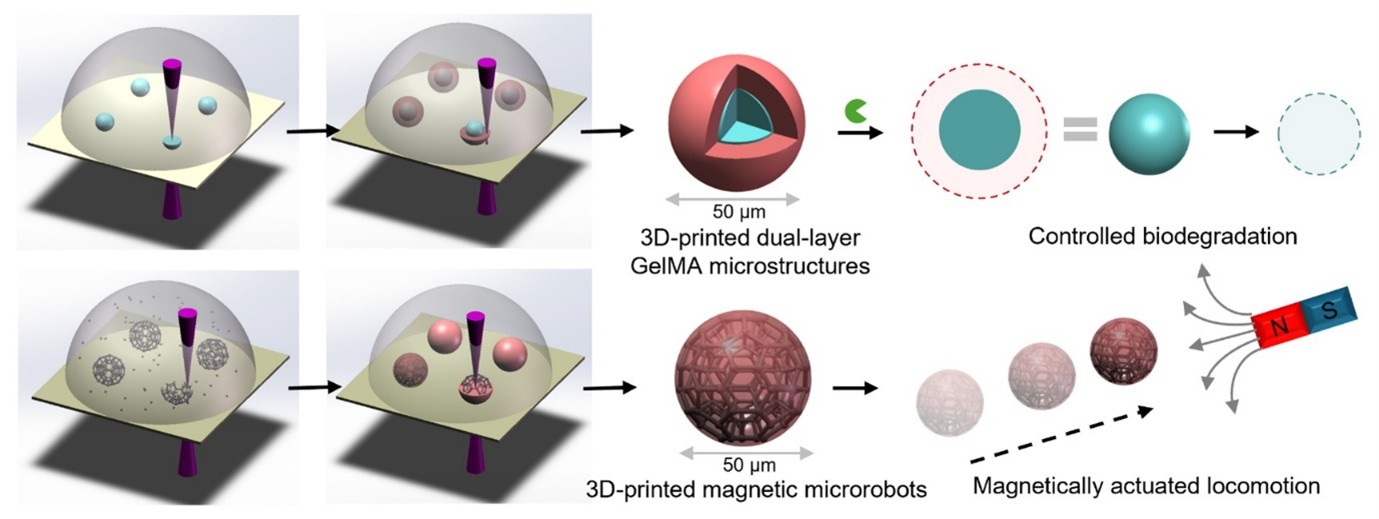
Precise delivery of therapeutic agents to targeted sites within the body is a significant challenge, especially in complex and confined physiological environments. Magnetically actuated microrobots offer a promising solution by enabling remote, controllable, and minimally invasive navigation; however, most existing microrobotic systems are fabricated from nondegradable materials and lack controlled drug release capability, which significantly limits their clinical translation. Here, we report 3D-printed biodegradable magnetic microrobots based on gelatin methacryloyl (GelMA) hydrogel capable of controlled therapeutic delivery. Using high-resolution direct laser writing, dual-layer GelMA microrobots with distinct crosslinking degrees were fabricated, enabling tunable degradation and controlled release of encapsulated drugs. The low-crosslinked outer shell functions as a protective barrier that prevents premature drug diffusion, while the highly crosslinked inner core enables sustained drug release during enzymatic degradation. The microrobots demonstrate excellent biocompatibility and controllable degradation in cellular environments. In addition, the integration of a biocompatible magnetic skeleton within the GelMA body enhances mechanical stability and enables precise magnetic actuation. This study presents a versatile strategy for developing biodegradable, magnetically actuated microrobots with controlled therapeutic release, offering strong potential for targeted drug delivery, tissue regeneration, and minimally invasive biomedical applications.
- Manzari MT, Shamay Y, Kiguchi H, et al. Targeted drug delivery strategies for precision medicines. Nat Rev Mater. 2021;6(4):351-370. doi: 10.1038/s41578-020-00269-6.
- Huang S, Zhu Y, Zhang L, et al. Recent advances in delivery systems for genetic and other novel vaccines. Adv Mater. 2022;34(46):2107946. doi: 10.1002/adma.202107946.
- Bian X, Zhou L, Luo Z, et al. Emerging delivery systems for enabling precision nucleic acid therapeutics. ACS Nano. 2025;19(4):4039-4083. doi: 10.1021/acsnano.4c11858.
- Yang Z, Xu C, Lee JX, et al. Magnetic miniature soft robot with reprogrammable drug-dispensing functionalities: toward advanced targeted combination therapy. Adv Mater. 2024;36(48):2408750. doi: 10.1002/adma.202408750.
- Wei T, Liu J, Li D, et al. Development of magnet-driven and image-guided degradable microrobots for the precise delivery of engineered stem cells for cancer therapy. Small. 2020;16(41):1906908. doi: 10.1002/smll.201906908.
- Gao J, Xia Z, Gunasekar S, et al. Precision drug delivery to the central nervous system using engineered nanoparticles. Nat Rev Mater. 2024;9(8):567-588. doi: 10.1038/s41578-024-00695-w.
- Tambuyzer E, Vandendriessche B, Austin CP, et al. Therapies for rare diseases: therapeutic modalities, progress and challenges ahead. Nat Rev Drug Discov. 2020;19(2):93-111. doi: 10.1038/s41573-019-0049-9.
- Akhtar A, Andleeb A, Waris TS, et al. Neurodegenerative diseases and effective drug delivery: A review of challenges and novel therapeutics. J Controlled Release. 2021;330:1152-1167. doi: 10.1016/j.jconrel.2020.11.021.
- Chen Z, Sánchez MM. Microrobots in gynaecological care and reproductive medicine. Nat Rev Electr Eng. 2024;1(12):759-761. doi: 10.1038/s44287-024-00102-0.
- Nelson BJ, Pané S. Delivering drugs with microrobots. Science. 2023;382(6675):1120-1122. doi: 10.1126/science.adh3073.
- Magdanz V, Khalil ISM, Simmchen J, et al. IRONSperm: Sperm-templated soft magnetic microrobots. Sci Adv. 2020;6(28):eaba5855. doi: 10.1126/sciadv.aba5855.
- Wang X, Chen X, Alcântara CCJ, et al. MOFBOTS: metal-organic‐framework‐based biomedical microrobots. Adv Mater. 2019;31(27):1901592. doi: 10.1002/adma.201901592.
- Ju X, Chen C, Oral CM, et al. Technology roadmap of micro/ nanorobots. ACS Nano. 2025;19(27):24174-24334. doi: 10.1021/acsnano.5c03911.
- Liu D, Wang T, Lu Y. Untethered microrobots for active drug delivery: from rational design to clinical settings. Adv Healthc Mater. 2022;11(3):2102253. doi: 10.1002/adhm.202102253.
- Wang B, Kostarelos K, Nelson BJ, et al. Trends in micro-/ nanorobotics: materials development, actuation, localization, and system integration for biomedical applications. Adv Mater. 2021;33(4):2002047. doi: 10.1002/adma.202002047.
- Sun M, Wu Y, Zhang J, et al. Versatile, modular, and customizable magnetic solid-droplet systems. Proc Natl Acad Sci. 2024;121(32):e2405095121. doi: 10.1073/pnas.2405095121.
- Sun M, Sun B, Park M, et al. Individual and collective manipulation of multifunctional bimodal droplets in three dimensions. Sci Adv. 2024; 10(29): eadp1439. doi: 10.1126/sciadv.adp1439.
- Sun M, Yang S, Jiang J, et al. Bioinspired self-assembled colloidal collectives drifting in three dimensions underwater. Sci Adv. 2023;9(45):eadj4201. doi: 10.1126/sciadv.adj4201.
- Sun M, Hao B, Yang S, et al. Exploiting ferrofluidic wetting for miniature soft machines. Nat Commun. 2022;13(1):7919. doi: 10.1038/s41467-022-35646-y.
- Xia N, Jin D, Yang Z, et al. Inverse programming of ferromagnetic domains for 3D curved surfaces of soft materials. Nat Synth. 2025;4(5):642-654. doi: 10.1038/s44160-025-00746-2.
- Yang C, Liu X, Song X, et al. Design and batch fabrication of anisotropic microparticles toward small-scale robots using microfluidics: recent advances. Lab Chip. 2024;24(19):4514-4535. doi: 10.1039/D4LC00566J.
- Dong Y, Wang L, Iacovacci V, et al. Magnetic helical micro-/ nanomachines: Recent progress and perspective. Matter. 2022;5(1):77-109. doi: 10.1016/j.matt.2021.10.010.
- Zhang L, Wang S, Hou Y. Magnetic micro/nanorobots in cancer theranostics: from designed fabrication to diverse applications. ACS Nano. 2025;19(8):7444-7481. doi: 10.1021/acsnano.4c10382.
- Li J, Li X, Luo T, et al. Development of a magnetic microrobot for carrying and delivering targeted cells. Sci Robot. 2018;3(19):eaat8829. doi: 10.1126/scirobotics.aat8829.
- Wang Q, Du X, Jin D, et al. Real-time ultrasound doppler tracking and autonomous navigation of a miniature helical robot for accelerating thrombolysis in dynamic blood flow. ACS Nano. 2022;16(1):604-616. doi: 10.1021/acsnano.1c07830.
- Dong Y, Wang L, Zhang Z, et al. Endoscope-assisted magnetic helical micromachine delivery for biofilm eradication in tympanostomy tube. Sci Adv. 2022;8(40):eabq8573. doi: 10.1126/sciadv.abq8573.
- Sun M, Chan KF, Zhang Z, et al. Magnetic microswarm and fluoroscopy‐guided platform for biofilm eradication in biliary stents. Adv Mater. 2022;34(34):2201888. doi: 10.1002/adma.202201888.
- Choi J, Hwang J, Kim J, et al. Recent progress in magnetically actuated microrobots for targeted delivery of therapeutic agents. Adv Healthc Mater. 2021;10(6):2001596. doi: 10.1002/adhm.202001596.
- Jin D, Yuan K, Du X, et al. Domino reaction encoded heterogeneous colloidal microswarm with on‐demand morphological adaptability. Adv Mater. 2021;33(37): 2100070. doi: 10.1002/adma.202100070.
- Dong M, Wang X, Chen X, et al. 3D‐printed soft magnetoelectric microswimmers for delivery and differentiation of neuron-like cells. Adv Funct Mater. 2020;30(17):1910323. doi: 10.1002/adfm.201910323.
- Sun B, Sun M, Zhang Z, et al. Magnetic hydrogel micromachines with active release of antibacterial agent for biofilm eradication. Adv Intell Syst. 2024;6(2):2300092. doi: 10.1002/aisy.202300092.
- Terzopoulou A, Wang X, Chen X, et al. Biodegradable metal-organic framework‐based microrobots (MOFBOTs). Adv Healthc Mater. 2020;9(20):2001031. doi: 10.1002/adhm.202001031.
- Wang B, Chan KF, Yuan K, et al. Endoscopy-assisted magnetic navigation of biohybrid soft microrobots with rapid endoluminal delivery and imaging. Sci Robot. 2021;6(52):eabd2813. doi: 10.1126/scirobotics.abd2813.
- Rajabasadi F, Moreno S, Fichna K, et al. Multifunctional 4D‐printed sperm‐hybrid microcarriers for assisted reproduction. Adv Mater. 2022;34(50):2204257. doi: 10.1002/adma.202204257.
- Alapan Y, Bozuyuk U, Erkoc P, et al. Multifunctional surface microrollers for targeted cargo delivery in physiological blood flow. Sci Robot. 2020;5(42): eaba5726. doi: 10.1126/scirobotics.aba5726.
- Su L, Jin D, Wang Y, et al. Modularized microrobot with lock-and-detachable modules for targeted cell delivery in bile duct. Sci Adv. 2023;9(50):eadj0883. doi: 10.1126/sciadv.adj0883.
- Xin C, Jin D, Hu Y, et al. Environmentally adaptive shape-morphing microrobots for localized cancer cell treatment. ACS Nano. 2021;15(11):18048-18059. doi: 10.1021/acsnano.1c06651.
- Chen S, Tan Z, Liao P, et al. Biodegradable microrobots for DNA vaccine delivery. Adv Healthc Mater. 2023;12(21):2202921. doi: 10.1002/adhm.202202921.
- Zhang F, Guo Z, Li Z, et al. Biohybrid microrobots locally and actively deliver drug-loaded nanoparticles to inhibit the progression of lung metastasis. Sci Adv. 2024;10(24):eadn6157. doi: 10.1126/sciadv.adn6157.
- Llacer-Wintle J, Rivas-Dapena A, Chen X-Z, et al. Biodegradable small-scale swimmers for biomedical applications. Adv Mater. 2021;22:2102049. doi: 10.1002/adma.202102049.
- Li J, Yu J. Biodegradable microrobots and their biomedical applications: a review. Nanomaterials. 2023;13(10): 1590. doi: 10.3390/nano13101590.
- He J, Sun Y, Gao Q, et al. Gelatin methacryloyl hydrogel, from standardization, performance, to biomedical application. Adv Healthc Mater. 2023;12(23):2300395. doi: 10.1002/adhm.202300395.
- Das S, Jegadeesan JT, Basu B. Gelatin methacryloyl (GelMA)-based biomaterial inks: process science for 3D/4D printing and current status. Biomacromolecules. 2024;25(4):2156-2221. doi: 10.1021/acs.biomac.3c01271.
- Xia B, Liu Y, Xing Y, et al. Biodegradable medical implants: reshaping future medical practice. Adv Sci. 2025;12(35):e08014. doi: 10.1002/advs.202508014.
- Wang X, Qin X-H, Hu C, et al. 3D printed enzymatically biodegradable soft helical microswimmers. Adv Funct Mater. 2018;28(45):1804107. doi: 10.1002/adfm.201804107.
- Ceylan H, Yasa IC, Yasa O, et al. 3D-printed biodegradable microswimmer for theranostic cargo delivery and release. ACS Nano. 2019;13(3):3353-3362. doi: 10.1021/acsnano.8b09233.
- Noh S, Jeon S, Kim E, et al. A biodegradable magnetic microrobot based on gelatin methacrylate for precise delivery of stem cells with mass production capability. Small. 2022;18(25):2107888. doi: 10.1002/smll.202107888.
- Landers FC, Hertle L, Pustovalov V, et al. Clinically ready magnetic microrobots for targeted therapies. Science. 2025;390:6774. doi: 10.1126/science.adx1708.
- Wong PT, Choi SK. Mechanisms of drug release in nanotherapeutic delivery systems. Chem Rev. 2015;115(9):3388-3432. doi: 10.1021/cr5004634.
- Mitchell MJ, Billingsley MM, Haley RM, et al. Engineering precision nanoparticles for drug delivery. Nat Rev Drug Discov. 2021;20(2):101-124. doi: 10.1038/s41573-020-0090-8.
- Paarakh MP, Jose PA, Setty C, et al. Release kinetics-concepts and applications. Int J Pharm Res Technol. 2023;8(1):12-20. doi: 10.31838/ijprt/08.01.02.
- Tibbitt MW, Dahlman JE, Langer R. Emerging frontiers in drug delivery. J Am Chem Soc. 2016;138(3):704-717. doi: 10.1021/jacs.5b09974.
- Pinheiro T, Morais M, Silvestre S, et al. Direct laser writing: from materials synthesis and conversion to electronic device processing. Adv Mater. 2024;36(26):2402014. doi: 10.1002/adma.202402014.
- Balena A, Bianco M, Pisanello F, et al. Recent advances on high‐speed and holographic two‐photon direct laser writing. Adv Funct Mater. 2023;33(39):2211773. doi: 10.1002/adfm.202211773.
- Jaiswal A, Rastogi CK, Rani S, et al. Two decades of two-photon lithography: Materials science perspective for additive manufacturing of 2D/3D nano-microstructures. iScience. 2023;26(4):106374. doi: 10.1016/j.isci.2023.106374.
- O’Halloran S, Pandit A, Heise A, et al. Two‐photon polymerization: fundamentals, materials, and chemical modification strategies. Adv Sci. 2023;10(7):2204072. doi: 10.1002/advs.202204072.
- Wang H, Zhang W, Ladika D, et al. Two‐photon polymerization lithography for optics and photonics: fundamentals, materials, technologies, and applications. Adv Funct Mater. 2023;2214211. doi: 10.1002/adfm.202214211.
- Jia X, Fan X, Chen C, et al. Chemical and structural engineering of gelatin-based delivery systems for therapeutic applications: a review. Biomacromolecules. 2024;25(2):564-589. doi: 10.1021/acs.biomac.3c01021.
- Mamidi N, Ijadi F, Norahan MH. Leveraging the recent advancements in GelMA scaffolds for bone tissue engineering: an assessment of challenges and opportunities. Biomacromolecules. 2024;25(4):2075-2113. doi: 10.1021/acs.biomac.3c00279.
- Jiao W, Shan J, Gong X, et al. GelMA hydrogel: A game-changer in 3D tumor modeling. Mater Today Chem. 2024;38:102111. doi: 10.1016/j.mtchem.2024.102111.
- Drobecq I, Bigot C, Soppera O, et al. Optimizing dimensional accuracy in two-photon polymerization: Influence of energy dose and proximity effects on sub-micrometric fiber structures. Addit Manuf. 2025;103:104735. doi: 10.1016/j.addma.2025.104735.
- Bornillo K, Sorgato M, Lucchetta G. Optimizing two-photon polymerization for rapid and high-resolution prototyping of low-friction microtextured surfaces. Prog Addit Manuf. 2025;10(9):5977-5992. doi: 10.1007/s40964-025-00947-3.
- Fu H, Yu B. 3D micro/nano hydrogel structures fabricated by two-photon polymerization for biomedical applications. Front Bioeng Biotechnol. 2024;12:1339450. doi: 10.3389/fbioe.2024.1339450.
- Dong Y, Wang L, Yuan K, et al. Magnetic microswarm composed of porous nanocatalysts for targeted elimination of biofilm occlusion. ACS Nano. 2021;15(3):5056-5067. doi: 10.1021/acsnano.0c10010.
- Xu H, Medina‐Sánchez M, Schmidt OG. Magnetic micromotors for multiple motile sperm cells capture, transport, and enzymatic release. Angew Chem Int Ed. 2020;59(35):15029-15037. doi: 10.1002/anie.202005657.
- Liu D, Guo R, Wang B, et al. Magnetic micro/nanorobots: a new age in biomedicines. Adv Intell Syst. 2022;4(12):2200208. doi: 10.1002/aisy.202200208.