
pH-responsive polydopamine-coated mesoporous silica nanoplatform integrated into 3D-printed PLA/nHA scaffolds for synergistic bone regeneration

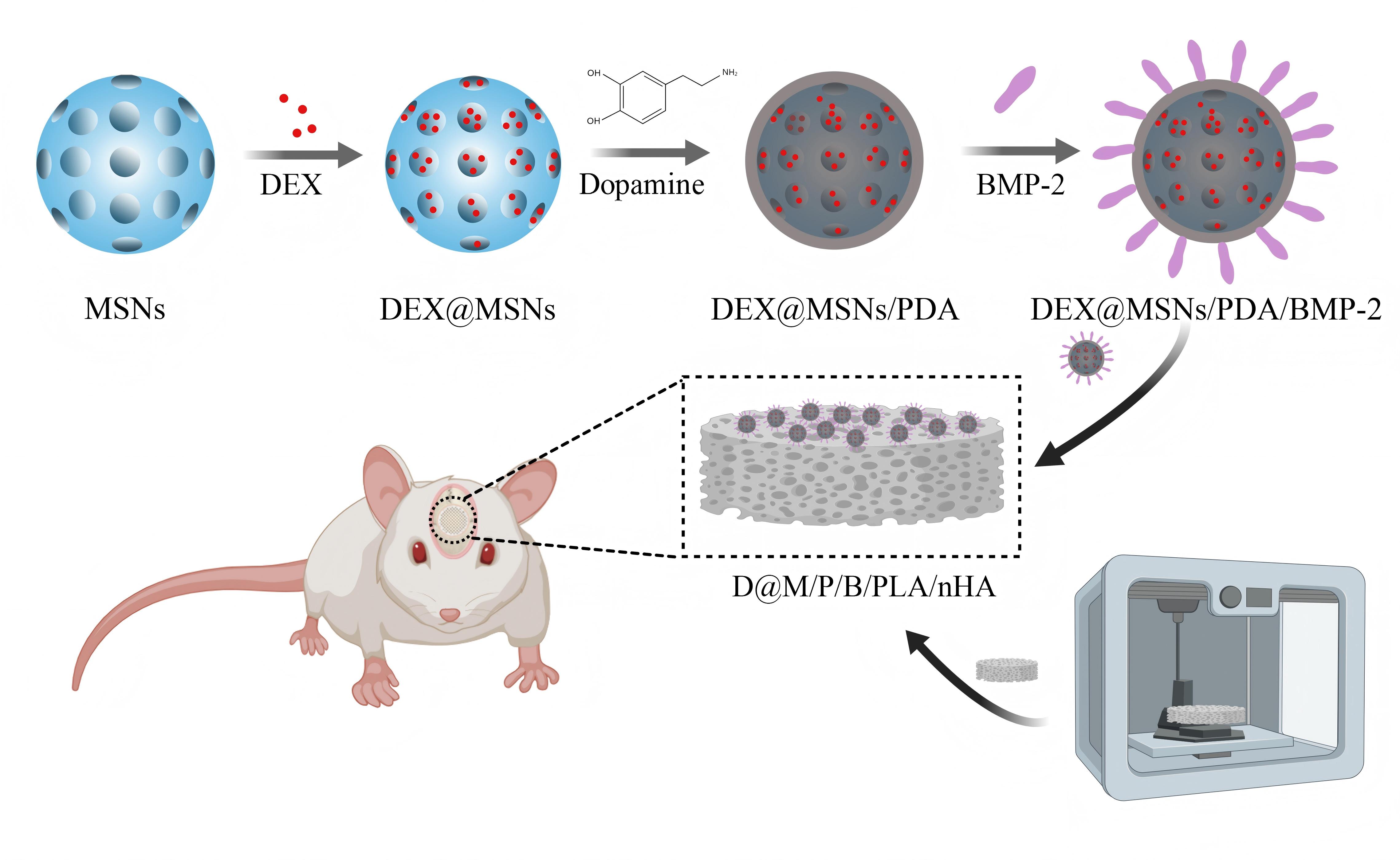
Integrating stimuli-responsive nanoplatforms into 3D-printed scaffolds offers a sophisticated approach to mimicking the complex microenvironment of bone healing while minimizing the side effects associated with high-dose growth factor therapy. This study reports the design of a mesoporous silica-based dual-drug delivery system co-loaded with dexamethasone (DEX) and bone morphogenetic protein-2 (BMP-2) to harness their synergistic osteogenic potential while minimizing BMP-2-associated side effects. Mesoporous silica nanoparticles (MSNs) were synthesized to encapsulate DEX, followed by a polydopamine (PDA) coating formed via self-polymerization under mild alkaline conditions. BMP-2 was subsequently immobilized on the PDA layer, yielding pH-responsive DEX@MSNs/PDA/BMP-2 nanoparticles. Characterization confirmed uniform morphology, efficient loading, and controlled release, with accelerated release under acidic conditions, mimicking bone-defect environments. In vitro, dual-drug nanoparticles promoted osteogenic differentiation of preosteoblasts in a concentration-dependent manner, as evidenced by increased alkaline phosphatase activity, enhanced calcium deposition, and upregulated osteogenic genes. The nanoparticles were incorporated into three-dimensionally (3D)-printed polylactic acid/nano-hydroxyapatite scaffolds via freeze-drying, yielding composites with favorable porosity, mechanical properties, hydrophilicity, and biodegradability. In a rat calvarial defect model, implantation of the composite scaffolds significantly improved bone regeneration and neovascularization relative to controls, as demonstrated by micro-computed tomography and histological analyses. The results demonstrate that PDA-coated MSNs co-delivering DEX and BMP-2, integrated into 3D-printed scaffolds, provide a biocompatible and effective platform for bone tissue engineering. This approach combines pH-responsive release, dual-drug synergy, and structural support, offering translational potential for mandibular defect repair.
- Zhang Q, Wu W, Qian C, et al. Advanced biomaterials for repairing and reconstruction of mandibular defects. Mater Sci Eng C Mater Biol Appl. 2019;103:109858. doi: 10.1016/j.msec.2019.109858
- Dalfino S, Savadori P, Piazzoni M, et al. Regeneration of Critical-Sized Mandibular Defects Using 3D-Printed Composite Scaffolds: A Quantitative Evaluation of New Bone Formation in In Vivo Studies. Adv Healthc Mater. 2023;12(21):e2300128. doi: 10.1002/adhm.202300128
- Sun H, Dong J, Wang Y, et al. Polydopamine-Coated Poly(l-lactide) Nanofibers with Controlled Release of VEGF and BMP-2 as a Regenerative Periosteum. ACS Biomater Sci Eng. 2021;7(10):4883-4897. doi: 10.1021/acsbiomaterials.1c00246
- Yang Z, Xie L, Zhang B, et al. Preparation of BMP-2/PDA-BCP Bioceramic Scaffold by DLP 3D Printing and its Ability for Inducing Continuous Bone Formation. Front Bioeng Biotechnol. 2022;10:854693. doi: 10.3389/fbioe.2022.854693
- Adel IM, ElMeligy MF, Amer MS, Elkasabgy NA. Polymeric nanocomposite hydrogel scaffold for jawbone regeneration: The role of rosuvastatin calcium-loaded silica nanoparticles. Int J Pharm X. 2023;6:100213. doi: 10.1016/j.ijpx.2023.100213
- Bertsch C, Marechal H, Gribova V, et al. Biomimetic Bilayered Scaffolds for Tissue Engineering: From Current Design Strategies to Medical Applications. Adv Healthc Mater. 2023;12(17):e2203115. doi: 10.1002/adhm.202203115
- Gillman CE, Jayasuriya AC. FDA-approved bone grafts and bone graft substitute devices in bone regeneration. Mater Sci Eng C Mater Biol Appl. 2021;130:112466. doi: 10.1016/j.msec.2021.112466
- Howard MT, Wang S, Berger AG, et al. Sustained release of BMP-2 using self-assembled layer-by-layer film-coated implants enhances bone regeneration over burst release. Biomaterials. 2022;288:121721. doi: 10.1016/j.biomaterials.2022.121721
- Ma D, An G, Liang M, Liu Y, Zhang B, Wang Y. A composited PEG-silk hydrogel combining with polymeric particles delivering rhBMP-2 for bone regeneration. Mater Sci Eng C Mater Biol Appl. 2016;65:221-231. doi: 10.1016/j.msec.2016.04.043
- Gelebart P, Cuenot S, Sinquin C, et al. Microgels based on Infernan, a glycosaminoglycan-mimetic bacterial exopolysaccharide, as BMP-2 delivery systems. Carbohydr Polym. 2022;284:119191. doi: 10.1016/j.carbpol.2022.119191
- Oliver-Cervello L, Martin-Gomez H, Mandakhbayar N, et al. Mimicking Bone Extracellular Matrix: From BMP-2- Derived Sequences to Osteogenic-Multifunctional Coatings. Adv Healthc Mater. 2022;11(20):e2201339. doi: 10.1002/adhm.202201339
- Stamnitz S, Krawczenko A, Szalaj U, et al. Osteogenic Potential of Sheep Mesenchymal Stem Cells Preconditioned with BMP-2 and FGF-2 and Seeded on an nHAP-Coated PCL/HAP/beta-TCP Scaffold. Cells. 2022;11(21). doi: 10.3390/cells11213446
- Nedorubova IA, Bukharova TB, Mokrousova VO, et al. Comparative Efficiency of Gene-Activated Matrices Based on Chitosan Hydrogel and PRP Impregnated with BMP2 Polyplexes for Bone Regeneration. Int J Mol Sci. 2022;23(23). doi: 10.3390/ijms232314720
- Liu K, Meng CX, Lv ZY, et al. Enhancement of BMP-2 and VEGF carried by mineralized collagen for mandibular bone regeneration. Regen Biomater. 2020;7(4):435-440. doi: 10.1093/rb/rbaa022
- Geng Y, Duan H, Xu L, et al. BMP-2 and VEGF-A modRNAs in collagen scaffold synergistically drive bone repair through osteogenic and angiogenic pathways. Commun Biol. 2021;4(1):82. doi: 10.1038/s42003-020-01606-9
- Huang Y, Lin Y, Rong M, Liu W, He J, Zhou L. 20(S)-hydroxycholesterol and simvastatin synergistically enhance osteogenic differentiation of marrow stromal cells and bone regeneration by initiation of Raf/MEK/ERK signaling. J Mater Sci Mater Med. 2019;30(8):87. doi: 10.1007/s10856-019-6284-0
- Bakshi R, Hokugo A, Zhou S, et al. Application of Hydroxycholesterols for Alveolar Cleft Osteoplasty in a Rodent Model. Plast Reconstr Surg. 2019;143(5):1385-1395. doi: 10.1097/PRS.0000000000005528
- Park JB. Combination of simvastatin and bone morphogenetic protein-2 enhances the differentiation of osteoblasts by regulating the expression of phospho- Smad1/5/8. Exp Ther Med. 2012;4(2):303-306. doi: 10.3892/etm.2012.590
- Wei A, Leong A, Williams L, et al. BMP-7 in combination with estrogen enhances bone formation in a fracture callus explant culture. Tohoku J Exp Med. 2010;221(1):61-68. doi: 10.1620/tjem.221.61
- Chen PY, Sun JS, Tsuang YH, Chen MH, Weng PW, Lin FH. Simvastatin promotes osteoblast viability and differentiation via Ras/Smad/Erk/BMP-2 signaling pathway. Nutr Res. 2010;30(3):191-199. doi: 10.1016/j.nutres.2010.03.004
- Pauly S, Luttosch F, Morawski M, Haas NP, Schmidmaier G, Wildemann B. Simvastatin locally applied from a biodegradable coating of osteosynthetic implants improves fracture healing comparable to BMP-2 application. Bone. 2009;45(3):505-511. doi: 10.1016/j.bone.2009.05.010
- Zou Y, Huang B, Cao L, Deng Y, Su J. Tailored Mesoporous Inorganic Biomaterials: Assembly, Functionalization, and Drug Delivery Engineering. Adv Mater. 2021;33(2):e2005215. doi: 10.1002/adma.202005215
- Xu B, Li S, Shi R, Liu H. Multifunctional mesoporous silica nanoparticles for biomedical applications. Signal Transduct Target Ther. 2023;8(1):435. doi: 10.1038/s41392-023-01654-7
- Vivero-Escoto JL, Slowing, II, Trewyn BG, Lin VS. Mesoporous silica nanoparticles for intracellular controlled drug delivery. Small. 2010;6(18):1952-1967. doi: 10.1002/smll.200901789
- Tang F, Li L, Chen D. Mesoporous silica nanoparticles: synthesis, biocompatibility and drug delivery. Adv Mater. 2012;24(12):1504-1534. doi: 10.1002/adma.201104763
- Wen J, Yang K, Liu F, Li H, Xu Y, Sun S. Diverse gatekeepers for mesoporous silica nanoparticle based drug delivery systems. Chem Soc Rev. 2017;46(19):6024-6045. doi: 10.1039/c7cs00219j
- Wang Y, Gou K, Guo X, Ke J, Li S, Li H. Advances in regulating physicochemical properties of mesoporous silica nanocarriers to overcome biological barriers. Acta Biomater. 2021;123:72-92. doi: 10.1016/j.actbio.2021.01.005
- Wang Z, Jia Z, Jiang Y, et al. Mussel-inspired nano-building block assemblies for mimicking extracellular matrix microenvironments with multiple functions. Biofabrication. 2017;9(3):035005. doi: 10.1088/1758-5090/aa7fdc
- Salve R, Kumar P, Ngamcherdtrakul W, Gajbhiye V, Yantasee W. Stimuli-responsive mesoporous silica nanoparticles: A custom-tailored next generation approach in cargo delivery. Mater Sci Eng C Mater Biol Appl. 2021;124:112084. doi: 10.1016/j.msec.2021.112084
- Lerida-Viso A, Estepa-Fernandez A, Garcia-Fernandez A, Marti-Centelles V, Martinez-Manez R. Biosafety of mesoporous silica nanoparticles; towards clinical translation. Adv Drug Deliv Rev. 2023;201:115049. doi: 10.1016/j.addr.2023.115049
- Ding L, Zhu X, Wang Y, et al. Intracellular Fate of Nanoparticles with Polydopamine Surface Engineering and a Novel Strategy for Exocytosis-Inhibiting, Lysosome Impairment-Based Cancer Therapy. Nano Lett. 2017;17(11):6790-6801. doi: 10.1021/acs.nanolett.7b03021
- Chang D, Gao Y, Wang L, et al. Polydopamine-based surface modification of mesoporous silica nanoparticles as pH-sensitive drug delivery vehicles for cancer therapy. J Colloid Interface Sci. 2016;463:279-287. doi: 10.1016/j.jcis.2015.11.001
- Baptista R, Guedes M. Morphological and mechanical characterization of 3D printed PLA scaffolds with controlled porosity for trabecular bone tissue replacement. Mater Sci Eng C Mater Biol Appl. 2021;118:111528. doi: 10.1016/j.msec.2020.111528
- Li Z, Tang S, Shi Z, et al. Multi-scale cellular PLA-based bionic scaffold to promote bone regrowth and repair. Int J Biol Macromol. 2023;245:125511. doi: 10.1016/j.ijbiomac.2023.125511
- Hwangbo H, Lee J, Kim G. Mechanically and biologically enhanced 3D-printed HA/PLLA/dECM biocomposites for bone tissue engineering. Int J Biol Macromol. 2022;218:9-21. doi: 10.1016/j.ijbiomac.2022.07.040
- Zhou K, Yu P, Shi X, et al. Hierarchically Porous Hydroxyapatite Hybrid Scaffold Incorporated with Reduced Graphene Oxide for Rapid Bone Ingrowth and Repair. ACS Nano. 2019;13(8):9595-9606. doi: 10.1021/acsnano.9b04723
- Hassanajili S, Karami-Pour A, Oryan A, Talaei-Khozani T. Preparation and characterization of PLA/PCL/HA composite scaffolds using indirect 3D printing for bone tissue engineering. Mater Sci Eng C Mater Biol Appl. 2019;104:109960. doi: 10.1016/j.msec.2019.109960
- Wang W, Junior JRP, Nalesso PRL, et al. Engineered 3D printed poly(varepsilon-caprolactone)/graphene scaffolds for bone tissue engineering. Mater Sci Eng C Mater Biol Appl. 2019;100:759-770. doi: 10.1016/j.msec.2019.03.047
- Daly AC, Freeman FE, Gonzalez-Fernandez T, Critchley SE, Nulty J, Kelly DJ. 3D Bioprinting for Cartilage and Osteochondral Tissue Engineering. Adv Healthc Mater. 2017;6(22). doi: 10.1002/adhm.201700298
- Zhou X, Feng W, Qiu K, et al. BMP-2 Derived Peptide and Dexamethasone Incorporated Mesoporous Silica Nanoparticles for Enhanced Osteogenic Differentiation of Bone Mesenchymal Stem Cells. ACS Appl Mater Interfaces. 2015;7(29):15777-15789. doi: 10.1021/acsami.5b02636
- Zhou X, Zhang Q, Chen L, et al. Versatile Nanocarrier Based on Functionalized Mesoporous Silica Nanoparticles to Codeliver Osteogenic Gene and Drug for Enhanced Osteodifferentiation. ACS Biomater Sci Eng. 2019;5(2):710- 723. doi: 10.1021/acsbiomaterials.8b01110
- Zhao X, Han Y, Li J, et al. BMP-2 immobilized PLGA/ hydroxyapatite fibrous scaffold via polydopamine stimulates osteoblast growth. Mater Sci Eng C Mater Biol Appl. 2017;78:658-666. doi: 10.1016/j.msec.2017.03.186
- Singhawannurat S, Lawtae P, Rojviriya C, Phoovasawat C. Development of PLA/HA porous scaffolds with controlled pore sizes using the combined freeze drying and sucrose leaching technique for bone tissue engineering. J Met Mater Miner. 2024;34(2). doi: 10.55713/jmmm.v34i2.1928
- Razavi M, Primavera R, Kevadiya BD, et al. Controlled Nutrient Delivery to Pancreatic Islets Using Polydopamine- Coated Mesoporous Silica Nanoparticles. Nano Lett. 2020;20(10):7220-7229. doi: 10.1021/acs.nanolett.0c02576
- Gu J, Liu J, Li Y, Zhao W, Shi J. One-pot synthesis of mesoporous silica nanocarriers with tunable particle sizes and pendent carboxylic groups for cisplatin delivery. Langmuir. 2013;29(1):403-410. doi: 10.1021/la3036264
- Dias DR, Moreira AF, Correia IJ. The effect of the shape of gold core-mesoporous silica shell nanoparticles on the cellular behavior and tumor spheroid penetration. J Mater Chem B. 2016;4(47):7630-7640. doi: 10.1039/c6tb02668k
- Wang LS, Wu LC, Lu SY, et al. Biofunctionalized phospholipid-capped mesoporous silica nanoshuttles for targeted drug delivery: improved water suspensibility and decreased nonspecific protein binding. ACS Nano. 2010;4(8):4371-4379. doi: 10.1021/nn901376h
- Lynge ME, van der Westen R, Postma A, Stadler B. Polydopamine--a nature-inspired polymer coating for biomedical science. Nanoscale. 2011;3(12):4916-4928. doi: 10.1039/c1nr10969c
- Liu Y, Ai K, Lu L. Polydopamine and its derivative materials: synthesis and promising applications in energy, environmental, and biomedical fields. Chem Rev. 2014;114(9):5057-5115. doi: 10.1021/cr400407a
- Feng W, Nie W, He C, et al. Effect of pH-responsive alginate/chitosan multilayers coating on delivery efficiency, cellular uptake and biodistribution of mesoporous silica nanoparticles based nanocarriers. ACS Appl Mater Interfaces. 2014;6(11):8447-8460. doi: 10.1021/am501337s
- Zhao R, Tao L, Qiu S, et al. Melatonin rescues glucocorticoid-induced inhibition of osteoblast differentiation in MC3T3-E1 cells via the PI3K/AKT and BMP/Smad signalling pathways. Life Sci. 2020;257:118044. doi: 10.1016/j.lfs.2020.118044
- Huang W, Jin S, Yang W, et al. Protective effect of Agrimonia pilosa polysaccharides on dexamethasone-treated MC3T3-E1 cells via Wnt/beta-Catenin pathway. J Cell Mol Med. 2020;24(3):2169-2177. doi: 10.1111/jcmm.14868
- Bi Z, Cai Y, Shi X, et al. Macrophage-mediated immunomodulation in biomaterial-assisted bone repair: Molecular insights and therapeutic prospects. Chem Eng J. 2024;488. doi: 10.1016/j.cej.2024.150631
- Han P, Wu C, Xiao Y. The effect of silicate ions on proliferation, osteogenic differentiation and cell signalling pathways (WNT and SHH) of bone marrow stromal cells. Biomater Sci. 2013;1(4):379-392. doi: 10.1039/c2bm00108j
- Lin KF, He S, Song Y, et al. Low-Temperature Additive Manufacturing of Biomimic Three-Dimensional Hydroxyapatite/Collagen Scaffolds for Bone Regeneration. ACS Appl Mater Interfaces. 2016;8(11):6905-6916. doi: 10.1021/acsami.6b00815
- Wubneh A, Tsekoura EK, Ayranci C, Uludag H. Current state of fabrication technologies and materials for bone tissue engineering. Acta Biomater. 2018;80:1-30. doi: 10.1016/j.actbio.2018.09.031
- Kirillova A, Yeazel TR, Asheghali D, et al. Fabrication of Biomedical Scaffolds Using Biodegradable Polymers. Chem Rev. 2021;121(18):11238-11304. doi: 10.1021/acs.chemrev.0c01200