
Gender-specific associations between dietary inflammatory and antioxidant indices and gallstone risk and their mediating mechanisms: A cross-sectional analysis

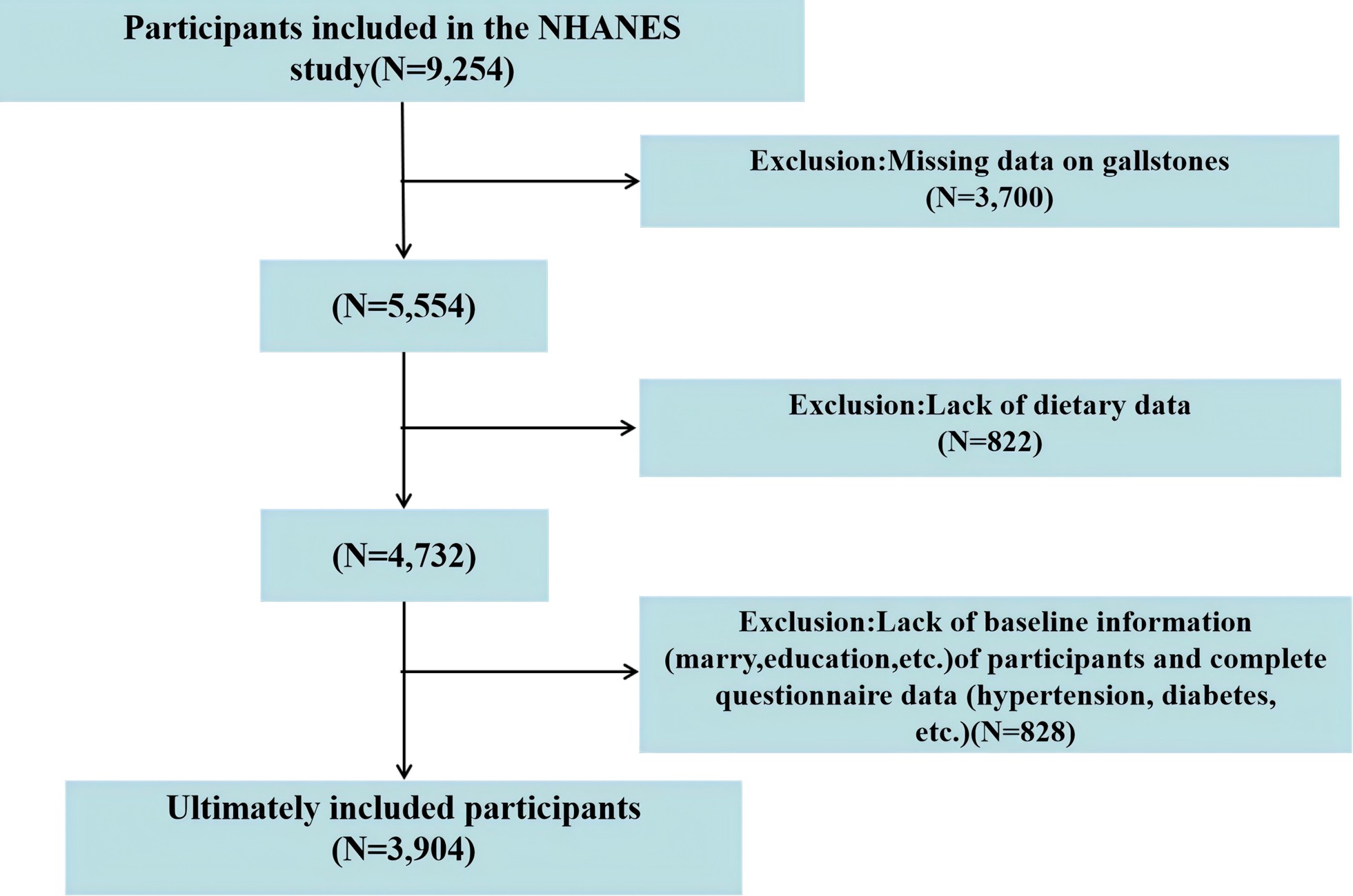
Gallstones are common, and dietary inflammatory and antioxidant characteristics may influence their development, but sex-specific associations remain unclear. We evaluated three dietary indices in relation to gallstone prevalence and explored potential obesity-related pathways. This cross-sectional analysis included 3,904 adults from the 2017–2018 National Health and Nutrition Examination Survey. The Healthy Eating Index-2015 (HEI-2015), Dietary Inflammatory Index (DII), and Comprehensive Dietary Antioxidant Index (CDAI) were derived from two 24-h dietary recalls. Survey-weighted sex-stratified logistic regression, curve fitting, threshold and subgroup analyses, and exploratory mediation analyses of body mass index (BMI) and body fat percentage (BFP) were performed. Overall, 426 participants (10.91%) reported gallstones. In females, compared with the lowest tertile, the highest DII tertile was associated with higher gallstone odds (odds ratio [OR] = 1.45, 95% confidence interval [CI] 1.04–2.01; p = 0.0282), whereas the highest CDAI tertile was associated with lower odds (OR = 0.68, 95% CI 0.49–0.95; p = 0.0219). HEI-2015 was not significantly associated with gallstones. No significant associations were observed in males. In females, BMI and BFP showed exploratory indirect effects in the DII and CDAI associations, with mediated proportions of 19.47% and 26.35% for DII and 10.91% and 15.84% for CDAI, respectively. Fully adjusted models yielded an area under the curve of approximately 0.71. Higher dietary inflammatory potential and lower dietary antioxidant capacity were associated with gallstones in females, but not males. Prospective studies are needed to confirm temporality and causality.
- Wei C, Zhang G. Association between body roundness index (BRI) and gallstones: results of the 2017-2020 national health and nutrition examination survey (NHANES). BMC Gastroenterol. 2024;24(1):192. doi: 10.1186/s12876-024-03280-1
- Wang X, Yu W, Jiang G, et al. Global epidemiology of gallstones in the 21st century: a systematic review and meta-analysis. Clin Gastroenterol Hepatol. 2024;22(8):1586–1595. doi: 10.1016/j.cgh.2024.01.051
- Alsaigh SH, Aloqla AA, Alzaaqi FO, et al. Effect of seasonal variation on the incidence of gallbladder stone complications. Cureus. 2025;17:e83964. doi: 10.7759/cureus.83964
- Tran A, Hoff C, Polireddy K, Neymotin A, Maddu K. Beyond acute cholecystitis-gallstone-related complications and what the emergency radiologist should know. Emerg Radiol. 2022;29(1):173–186. doi: 10.1007/s10140-021-01999-y
- Morrison S, Mokoena T. Routine upper gastro-intestinal tract endoscopy before elective cholecystectomy for symptomatic gallstones-justified. Sci Rep. 2024;14(1):14042. doi: 10.1038/s41598-024-64019-2
- Mikhaleva LM, Mikhalev AI, Shapovaliants SG, et al. Severe complications of chronic cholelithiasis treatment. Am J Emerg Med. 2021;48:374.e5-374.e12. doi: 10.1016/j.ajem.2021.03.052
- Ma R, Li W, Peng Q, et al. Association between gallstones and depressive symptoms: results from NHANES and mendelian randomization study. Psychol Res Behav Manag. 2024;17:3659–3676. doi: 10.2147/PRBM.S477449
- Wang B, Huang Q, Xiong Y, Huang N, Li J, Zhang S. Association between sarcopenia and the prevalence of gallstone in US adults: a cross-sectional analysis of NHANES. BMC Gastroenterol. 2025;25(1):207. doi: 10.1186/s12876-025-03808-z
- Chen H-Y, Chang C-J, Yang Y-C, Lu F-H, Sun Z-J, Wu J-S. Renal stones and gallstones correlated with the ten-year risk estimation of atherosclerotic cardiovascular disease based on the pooled cohort risk assessment of males aged 40-79. J Clin Med. 2023;12(6):2309. doi: 10.3390/jcm12062309
- Lin J, Wang Q, Liu X, et al. Causal inference framework reveals mediterranean diet superiority and inflammatory mediation pathways in mortality prevention: a comparative analysis of nine common dietary patterns. Foods. 2025;14(17):3122. doi: 10.3390/foods14173122
- Wu W, Pei Y, Wang J, Liang Q, Chen W. Association of dietary quality indicators with gallstones in the US: NHANES 2017-2020. BMC Public Health. 2025;25(1):976. doi: 10.1186/s12889-025-21783-8
- Luo Y, Gao X, Xiao M, et al. Association between dietary inflammatory index and gallstones in US adults. Front Nutr. 2024;11:1403438. doi: 10.3389/fnut.2024.1403438
- Cheng J, Zhuang Q, Wang W, et al. Association of pro-inflammatory diet with increased risk of gallstone disease: a cross-sectional study of NHANES january 2017-march 2020. Front Nutr. 2024;11:1344699. doi: 10.3389/fnut.2024.1344699
- Wang K, Zhao Y, Nie J, Xu H, Yu C, Wang S. Higher HEI-2015 score is associated with reduced risk of depression: result from NHANES 2005-2016. Nutrients. 2021;13:348. doi: 10.3390/nu13020348
- Mao Y, Weng J, Xie Q, et al. Association between dietary inflammatory index and stroke in the US population: evidence from NHANES 1999-2018. BMC Public Health. 2024;24(1):50. doi: 10.1186/s12889-023-17556-w
- Zhang J, Chen L, Shen K, et al. Association between metabolically healthy overweight/obesity and gallstones in chinese adults. Nutr Metab. 2023;20(1):20. doi: 10.1186/s12986-023-00741-4
- Shi X, Li Y, Jin L, Xuan Q, Yu Q. Associations between exposure to brominated flame retardants and gallstones risk in U.S. adults. Ecotoxicol Environ Saf. 2025;304:119113. doi: 10.1016/j.ecoenv.2025.119113
- Su Q, Yang S, Liu Q. The relationship between the C-reactive protein-triglyceride glucose index and gallstones in american adults: results from NHANES 2017 to 2020. Medicine. 2025;104(38):e44650. doi: 10.1097/MD.0000000000044650
- Zheng Y, Liu W, Zhu X, Xu M, Lin B, Bai Y. Associations of dietary inflammation index and composite dietary antioxidant index with preserved ratio impaired spirometry in US adults and the mediating roles of triglyceride-glucose index: NHANES 2007-2012. Redox Biol. 2024;76:103334. doi: 10.1016/j.redox.2024.103334
- Wu M, Si J, Liu Y, Kang L, Xu B. Association between composite dietary antioxidant index and hypertension: insights from NHANES. Clin Exp Hypertens (N Y NY: 1993). 2023;45(1):2233712. doi: 10.1080/10641963.2023.2233712
- Jiang C, Shao Y. Characterizing the relationships between dietary indices, gallstone prevalence and the need for gallbladder surgery in the general US population. Front Nutr. 2024;11:1392960. doi: 10.3389/fnut.2024.1392960
- Jin K, Mi N, He W, et al. Dietary patterns, genetic predisposition, and risk of cholelithiasis: a large-scale prospective cohort study. Front Nutr. 2024;11:1469789. doi: 10.3389/fnut.2024.1469789
- Ghorbani M, Sadeghi A, Asghari-Jafarabadi M, Alipour B. The association between healthy eating index-2015 and serum metabolic parameters in women with gallstone disease: a case-control study. Iran J Public HEALTH. 2024;53:1137–1145. doi: 10.18502/ijph.v53i5.15595
- Ghorbani M, Hekmatdoost A, Darabi Z, Sadeghi A, Yari Z. Dietary inflammatory index and risk of gallstone disease in iranian women: a case-control study. BMC Gastroenterol. 2023;23(1):311. doi: 10.1186/s12876-023-02943-9
- Liu S, Ma H, Zhang H, Deng C, Xin P. Recent advances on signaling pathways and their inhibitors in rheumatoid arthritis. Clin Immunol. 2021;230:108793. doi: 10.1016/j.clim.2021.108793
- Al-Qusous MN, Al Madanat WKJ, Mohamed Hussein R. Association of vitamins D, B6, and B12 deficiencies with hyperlipidemia among jordanian adults. Rep Biochem Mol Biol. 2023;12(3):415–424. doi: 10.61186/rbmb.12.3.415
- Chen P, Yang C, Ding J, Li Y, Hu W, Zhang Q. Association of dietary vitamin intake with gallstone risk in US adults: a cross-sectional NHANES study. Eur J Med Res. 2025;30(1):535. doi: 10.1186/s40001-025-02841-8
- Liu J, Wang Y, Xue L, et al. Novel metabolic regulation of bile acid responses to low cholesterol in whole-grain-diet-fed mice. J Agric Food Chem. 2021;69(30):8440–8447. doi: 10.1021/acs.jafc.1c02662
- Mio K, Iida-Tanaka N, Togo-Ohno M, Tadenuma N, Yamanaka C, Aoe S. Barley consumption under a high-fat diet suppresses lipogenic genes through altered intestinal bile acid composition. J Nutr Biochem. 2024;125:109547. doi: 10.1016/j.jnutbio.2023.109547