
Key regulators of Alzheimer’s disease: Network biology and in silico analysis with acetylcholinesterase and glutamate inhibitors

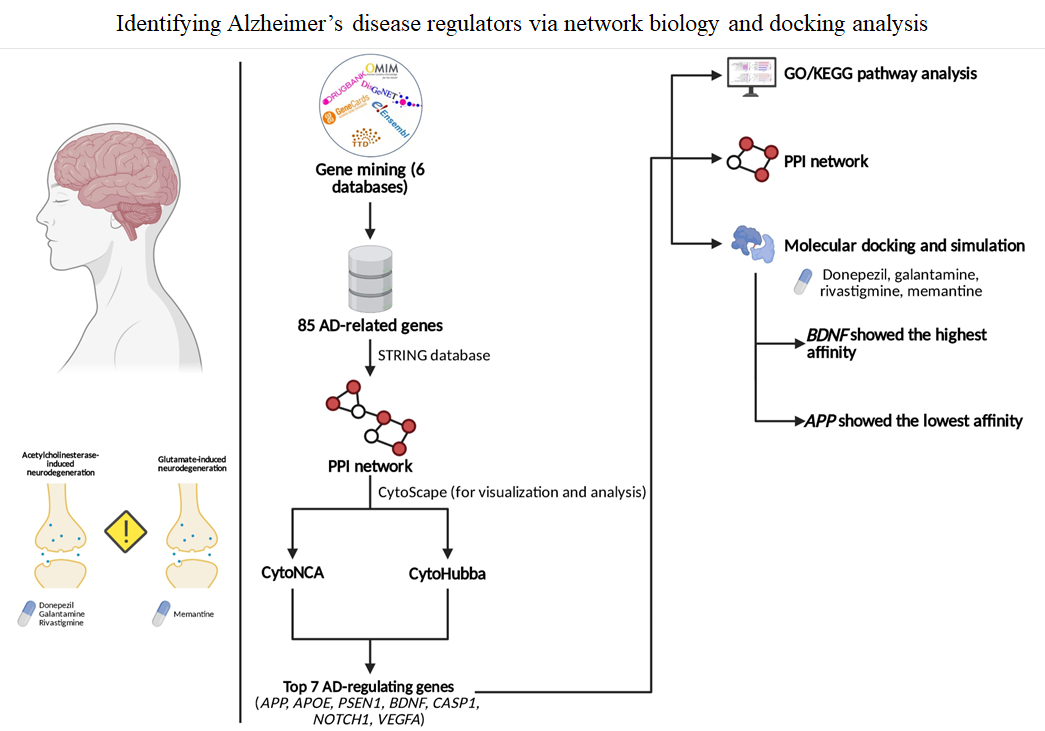
Alzheimer’s disease (AD) is a complex, progressive neurodegenerative disorder driven by both genetic and environmental factors, with hallmark features including amyloid-β plaques and neurofibrillary tangles. Despite substantial research, the majority of currently licensed medications are still symptomatic, highlighting the need for multi-target and network-based treatment approaches. This study employed a systems biology approach to identify important regulatory proteins implicated in AD development and to assess their interaction patterns with approved glutamate and cholinesterase inhibitors. A protein–protein interaction network was developed using the 85 overlapping genes identified when AD-associated genes were selected from six significant biomedical databases. Seven major regulators were identified using centrality and hub analyses, including APP, APOE, BDNF, VEGFA, PSEN1, CASP1, and NOTCH1. Their participation in axon formation, signal transduction, neuroinflammatory processes, and neurodegenerative pathways was revealed by Gene Ontology and Kyoto Encyclopedia of Genes and Genomes pathway enrichment analysis. The binding affinities of donepezil, galantamine, rivastigmine, and memantine toward these targets were evaluated by molecular docking using AutoDock Vina. While APP demonstrated relatively weaker affinities, BDNF demonstrated the strongest overall binding interactions, especially with donepezil. Memantine showed significant binding to PSEN1, indicating that amyloidogenic processes may be indirectly modulated. These results demonstrate the usefulness of integrated computational techniques in identifying new therapeutic interaction networks and support a multi-target pharmacological paradigm. This study offers a systems-level basis for medication repurposing and precision intervention strategies in AD, although additional experimental validation is needed.
- Scheltens P, De Strooper B, Kivipelto M, et al. Alzheimer’s disease. Lancet. 2021;397(10284):1577-1590. doi: 10.1016/S0140-6736(20)32205-4
- 2024 Alzheimer’s disease facts and figures. Alzheimers Dement. 2024;20(5):3708-3821. doi: 10.1002/alz.13809
- Montine TJ, Monsell SE, Beach TG, et al. Multisite assessment of NIA-AA guidelines for the neuropathologic evaluation of Alzheimer’s disease. Alzheimers Dement. 2016;12(2):164-169. doi: 10.1016/j.jalz.2015.07.492
- Di Benedetto G, Burgaletto C, Bellanca CM, Munafò A, Bernardini R, Cantarella G. Role of Microglia and Astrocytes in Alzheimer’s Disease: From Neuroinflammation to Ca2+ Homeostasis Dysregulation. Cells. 2022;11(17):2728. doi: 10.3390/cells11172728
- Varadharajan A, Davis AD, Ghosh A, et al. Guidelines for pharmacotherapy in Alzheimer’s disease - A primer on FDA-approved drugs. J Neurosci Rural Pract. 2023;14(4):566-573. doi: 10.25259/JNRP_356_2023
- Beach TG, Monsell SE, Phillips LE, Kukull W. Accuracy of the clinical diagnosis of Alzheimer disease at National Institute on Aging Alzheimer Disease Centers, 2005-2010. J Neuropathol Exp Neurol. 2012;71(4):266-273. doi: 10.1097/NEN.0b013e31824b211b
- Schneider JA, Arvanitakis Z, Leurgans SE, Bennett DA. The neuropathology of probable Alzheimer disease and mild cognitive impairment. Ann Neurol. 2009;66(2):200-208. doi: 10.1002/ana.21706
- Serrano-Pozo A, Qian J, Monsell SE, et al. Mild to moderate Alzheimer dementia with insufficient neuropathological changes. Ann Neurol. 2014;75(4):597-601. doi: 10.1002/ana.24125
- Andrade-Guerrero J, Santiago-Balmaseda A, Jeronimo- Aguilar P, et al. Alzheimer’s Disease: An Updated Overview of Its Genetics. Int J Mol Sci. 2023;24(4):3754. doi: 10.3390/ijms24043754
- Bekris LM, Yu CE, Bird TD, Tsuang DW. Genetics of Alzheimer disease. J Geriatr Psychiatry Neurol. 2010;23(4):213-227. doi: 10.1177/0891988710383571
- Strang KH, Golde TE, Giasson BI. MAPT mutations, tauopathy, and mechanisms of neurodegeneration. Lab Invest. 2019;99(7):912-928. doi: 10.1038/s41374-019-0197-x
- Hampel H, Vassar R, De Strooper B, et al. The β-Secretase BACE1 in Alzheimer’s Disease. Biol Psychiatry. 2021;89(8):745-756. doi: 10.1016/j.biopsych.2020.02.001
- Selkoe DJ. Biochemistry and molecular biology of amyloid beta-protein and the mechanism of Alzheimer’s disease. Handb Clin Neurol. 2008;89:245-260. doi: 10.1016/S0072-9752(07)01223-7
- Hardy J. Amyloid, the presenilins and Alzheimer’s disease. Trends Neurosci. 1997;20(4):154-159. doi: 10.1016/s0166-2236(96)01030-2
- Surguchov A, Emamzadeh FN, Titova M, Surguchev AA. Controversial Properties of Amyloidogenic Proteins and Peptides: New Data in the COVID Era. Biomedicines. 2023;11(4):1215. doi: 10.3390/biomedicines11041215
- Cole SL, Vassar R. The role of amyloid precursor protein processing by BACE1, the beta-secretase, in Alzheimer disease pathophysiology. J Biol Chem. 2008;283(44):29621- 29625. doi: 10.1074/jbc.R800015200
- Wang Y, Mandelkow E. Tau in physiology and pathology. Nat Rev Neurosci. 2016;17(1):5-21. doi: 10.1038/nrn.2015.1
- Husain MA, Laurent B, Plourde M. APOE and Alzheimer’s Disease: From Lipid Transport to Physiopathology and Therapeutics. Front Neurosci. 2021;15:630502. doi: 10.3389/fnins.2021.630502
- Farrer LA, Cupples LA, Haines JL, et al. Effects of age, sex, and ethnicity on the association between apolipoprotein E genotype and Alzheimer disease. A meta-analysis. APOE and Alzheimer Disease Meta Analysis Consortium. JAMA. 1997;278(16):1349-1356. doi: 10.1001/jama.278.16.1349
- Kim BH, Kim S, Nam Y, Park YH, Shin SM, Moon M. Second-generation anti-amyloid monoclonal antibodies for Alzheimer’s disease: current landscape and future perspectives. Transl Neurodegener. 2025;14(1):6. doi: 10.1186/s40035-025-00465-w
- Sam C, Bordoni B. Physiology, Acetylcholine. In: StatPearls. Treasure Island (FL): StatPearls Publishing. 2023. Available from https://www.ncbi.nlm.nih.gov/books/NBK557825/ [Last accessed on].
- Puranik N, Song M. Glutamate: Molecular Mechanisms and Signaling Pathway in Alzheimer’s Disease, a Potential Therapeutic Target. Molecules. 2024;29(23):5744. doi: 10.3390/molecules29235744
- Barabási AL, Oltvai ZN. Network biology: understanding the cell’s functional organization. Nat Rev Genet. 2004;5(2):101- 113. doi: 10.1038/nrg1272
- Shannon P, Markiel A, Ozier O, et al. Cytoscape: a software environment for integrated models of biomolecular interaction networks. Genome Res. 2003;13(11):2498-2504. doi: 10.1101/gr.1239303
- Kulkarni VS, Alagarsamy V, Solomon VR, Jose PA, Murugesan S. Drug Repurposing: An Effective Tool in Modern Drug Discovery. Russ J Bioorg Chem. 2023;49(2):157-166. doi: 10.1134/S1068162023020139
- Talevi A. Multi-target pharmacology: possibilities and limitations of the “skeleton key approach” from a medicinal chemist perspective. Front Pharmacol. 2015;6:205. doi: 10.3389/fphar.2015.00205
- Kitchen DB, Decornez H, Furr JR, Bajorath J. Docking and scoring in virtual screening for drug discovery: methods and applications. Nat Rev Drug Discov. 2004;3(11):935-949. doi: 10.1038/nrd1549
- Genheden S, Ryde U. The MM/PBSA and MM/GBSA methods to estimate ligand-binding affinities. Expert Opin Drug Discov. 2015;10(5):449-461. doi: 10.1517/17460441.2015.1032936
- De Strooper B, Karran E. The Cellular Phase of Alzheimer’s Disease. Cell. 2016;164(4):603-615. doi: 10.1016/j.cell.2015.12.056
- Swerdlow RH. Mitochondria and Mitochondrial Cascades in Alzheimer’s Disease. J Alzheimers Dis. 2018;62(3):1403- 1416. doi: 10.3233/JAD-170585
- Heneka MT, Carson MJ, El Khoury J, et al. Neuroinflammation in Alzheimer’s disease. Lancet Neurol. 2015;14(4):388-405. doi: 10.1016/S1474-4422(15)70016-5
- Xu LZ, Li FY, Xu J, Li BQ, Li Y, Jia JP. Vascular endothelial growth factor is an effective biomarker for vascular dementia, not for Alzheimer’s disease: A meta-analysis. Alzheimers Dement. 2024;16(2):e12612.doi: 10.1002/dad2.12612
- Heberle H, Meirelles GV, da Silva FR, Telles GP, Minghim R. InteractiVenn: a web-based tool for the analysis of sets through Venn diagrams. BMC Bioinform. 2015;16(1):169. doi: 10.1186/s12859-015-0611-3
- Braschi B, Denny P, Gray K, et al. Genenames.org: the HGNC and VGNC resources in 2019. Nucleic Acids Res. 2019;47(D1):D786-D792. doi: 10.1093/nar/gky930
- Barrett T, Wilhite SE, Ledoux P, et al. NCBI GEO: archive for functional genomics data sets--update. Nucleic Acids Res. 2013;41(Database issue):D991-D995. doi: 10.1093/nar/gks1193
- Budni J, Bellettini-Santos T, Mina F, Garcez ML, Zugno AI. The involvement of BDNF, NGF and GDNF in aging and Alzheimer’s disease. Aging Dis. 2015;6(5):331-341. doi: 10.14336/AD.2015.0825
- Bendix I, Serdar M, Herz J, et al. Inhibition of acetylcholinesterase modulates NMDA receptor antagonist mediated alterations in the developing brain. Int J Mol Sci. 2014;15(3):3784-3798. doi: 10.3390/ijms15033784
- Mishchenko TA, Mitroshina EV, Usenko AV, et al. Features of Neural Network Formation and Their Functions in Primary Hippocampal Cultures in the Context of Chronic TrkB Receptor System Influence. Front Physiol. 2019;9:1925. doi: 10.3389/fphys.2018.01925
- Haass C, Selkoe DJ. Soluble protein oligomers in neurodegeneration: lessons from the Alzheimer’s amyloid beta-peptide. Nat Rev Mol Cell Biol. 2007;8(2):101-112. doi: 10.1038/nrm2101
- Xiao X, Liu H, Liu X, Zhang W, Zhang S, Jiao B. APP, PSEN1, and PSEN2 Variants in Alzheimer’s Disease: Systematic Re-evaluation According to ACMG Guidelines. Front Aging Neurosci. 2021;13:695808. doi: 10.3389/fnagi.2021.695808
- Targa Dias Anastacio H, Matosin N, Ooi L. Familial Alzheimer’s Disease Neurons Bearing Mutations in PSEN1 Display Increased Calcium Responses to AMPA as an Early Calcium Dysregulation Phenotype. Life. 2024;14(5):625. doi: 10.3390/life14050625
- Cheung KH, Shineman D, Müller M, et al. Mechanism of Ca2+ disruption in Alzheimer’s disease by presenilin regulation of InsP3 receptor channel gating. Neuron. 2008;58(6):871-883. doi: 10.1016/j.neuron.2008.04.015
- Bezprozvanny I, Mattson MP. Neuronal calcium mishandling and the pathogenesis of Alzheimer’s disease. Trends Neurosci. 2008;31(9):454-463. doi: 10.1016/j.tins.2008.06.005
- Tang BC, Wang YT, Ren J. Basic information about memantine and its treatment of Alzheimer’s disease and other clinical applications. Ibrain. 2023;9(3):340-348. doi: 10.1002/ibra.12098
- Parsons CG, Stöffler A, Danysz W. Memantine: a NMDA receptor antagonist that improves memory by restoration of homeostasis in the glutamatergic system--too little activation is bad, too much is even worse. Neuropharmacology. 2007;53(6):699-723. doi: 10.1016/j.neuropharm.2007.07.013
- Shankar GM, Li S, Mehta TH, et al. Amyloid-beta protein dimers isolated directly from Alzheimer’s brains impair synaptic plasticity and memory. Nat Med. 2008;14(8):837- 842. doi: 10.1038/nm1782
- Sarasija S, Norman KR. A γ-Secretase Independent Role for Presenilin in Calcium Homeostasis Impacts Mitochondrial Function and Morphology in Caenorhabditis elegans. Genetics. 2015;201(4):1453-1466. doi: 10.1534/genetics.115.182808
- Zhang C, Wu B, Beglopoulos V, et al. Presenilins are essential for regulating neurotransmitter release. Nature. 2009;460(7255):632-636. doi: 10.1038/nature08177
- Venkatraman L, Claesson-Welsh L. The role of VEGF in controlling vascular permeability. In: Tumor Angiogenesis: A Key Target for Cancer Therapy. Cham, Switzerland: Springer; 2019; 33-50. doi: 10.1007/978-3-319-31215-6_37-1
- Quaggin SE. A half-century of VEGFA: from theory to practice. J Clin Invest. 2024;134(15):e184205. doi: 10.1172/JCI184205
- Lee C, Kim MJ, Kumar A, Lee HW, Yang Y, Kim Y. Vascular endothelial growth factor signaling in health and disease: from molecular mechanisms to therapeutic perspectives. Signal Transduct Target Ther. 2025;10(1):170. doi: 10.1038/s41392-025-02249-0
- Shibuya M. Vascular Endothelial Growth Factor (VEGF) and Its Receptor (VEGFR) Signaling in Angiogenesis: A Crucial Target for Anti- and Pro-Angiogenic Therapies. Genes Cancer. 2011;2(12):1097–1105. doi: 10.1177/1947601911423031
- Yang HS, Yau WW, Carlyle BC, et al. Plasma VEGFA and PGF impact longitudinal tau and cognition in preclinical Alzheimer’s disease. Brain. 2024;147(6):2158-2168. doi: 10.1093/brain/awae034
- Zhang M, Zhang Z, Li H, et al. Blockage of VEGF function by bevacizumab alleviates early-stage cerebrovascular dysfunction and improves cognitive function in a mouse model of Alzheimer’s disease. Transl Neurodegener. 2024;13(1):1. doi: 10.1186/s40035-023-00388-4
- Fukumura D, Gohongi T, Kadambi A, et al. Predominant role of endothelial nitric oxide synthase in vascular endothelial growth factor-induced angiogenesis and vascular permeability. Proc Natl Acad Sci USA. 2001;98(5):2604- 2609. doi: 10.1073/pnas.041359198
- Figueroa XF, González DR, Martínez AD, Durán WN, Boric MP. ACh-induced endothelial NO synthase translocation, NO release and vasodilatation in the hamster microcirculation in vivo. J Physiol. 2002;544(3):883-896. doi: 10.1113/jphysiol.2002.021972
- Jackson RJ, Meltzer JC, Nguyen H, et al. APOE4 derived from astrocytes leads to blood-brain barrier impairment. Brain. 2022;145(10):3582-3593. doi: 10.1093/brain/awab478
- Wang C, Xiong M, Gratuze M, et al. Selective removal of astrocytic APOE4 strongly protects against tau-mediated neurodegeneration and decreases synaptic phagocytosis by microglia. Neuron. 2021;109(10):1657-1674.e7. doi: 10.1016/j.neuron.2021.03.024
- Williams T, Borchelt DR, Chakrabarty P. Therapeutic approaches targeting Apolipoprotein E function in Alzheimer’s disease. Mol Neurodegener. 2020;15(1):8. doi: 10.1186/s13024-020-0358-9
- Waring JF, Tang Q, Robieson WZ, et al. APOE-ɛ4 Carrier Status and Donepezil Response in Patients with Alzheimer’s Disease. J Alzheimers Dis. 2015;47(1):137-148. doi: 10.3233/JAD-142589
- De Beaumont L, Pelleieux S, Lamarre-Théroux L, Dea D, Poirier J. Butyrylcholinesterase K and Apolipoprotein E-ɛ4 Reduce the Age of Onset of Alzheimer’s Disease, Accelerate Cognitive Decline, and Modulate Donepezil Response in Mild Cognitively Impaired Subjects. J Alzheimers Dis. 2016;54(3):913-922. doi: 10.3233/JAD-160373
- Cheng YC, Huang YC, Liu HC. Effect of Apolipoprotein E ɛ4 Carrier Status on Cognitive Response to Acetylcholinesterase Inhibitors in Patients with Alzheimer’s Disease: A Systematic Review and Meta-Analysis. Dement Geriatr Cogn Disord. 2018;45(5-6):335-352. doi: 10.1159/000490175
- Han YH, Liu XD, Jin MH, Sun HN, Kwon T. Role of NLRP3 inflammasome-mediated neuronal pyroptosis and neuroinflammation in neurodegenerative diseases. Inflamm Res. 2023;72(9):1839-1859. doi: 10.1007/s00011-023-01790-4
- Lu B, Kwan K, Levine YA, et al. α7 nicotinic acetylcholine receptor signaling inhibits inflammasome activation by preventing mitochondrial DNA release. Mol Med. 2014;20(1):350-358. doi: 10.2119/molmed.2013.00117
- Ke P, Shao BZ, Xu ZQ, Chen XW, Wei W, Liu C. Activating α7 nicotinic acetylcholine receptor inhibits NLRP3 inflammasome through regulation of β-arrestin-1. CNS Neurosci Ther. 2017;23(11):875-884. doi: 10.1111/cns.12758
- Ye X, Song G, Huang S, et al. Caspase-1: A Promising Target for Preserving Blood-Brain Barrier Integrity in Acute Stroke. Front Mol Neurosci. 2022;15:856372. doi: 10.3389/fnmol.2022.856372
- Sachan N, Sharma V, Mutsuddi M, Mukherjee A. Notch signalling: multifaceted role in development and disease. FEBS J. 2024;291(14):3030-3059. doi: 10.1111/febs.16815
- Brai E, Marathe S, Astori S, et al. Notch1 Regulates Hippocampal Plasticity Through Interaction with the Reelin Pathway, Glutamatergic Transmission and CREB Signaling. Front Cell Neurosci. 2015;9:447. doi: 10.3389/fncel.2015.00447
- Giniger E. Notch signaling and neural connectivity. Curr Opin Genet Dev. 2012;22(4):339-346. doi: 10.1016/j.gde.2012.04.003
- Lleó A, Berezovska O, Ramdya P, et al. Notch1 competes with the amyloid precursor protein for gamma-secretase and down-regulates presenilin-1 gene expression. J Biol Chem. 2003;278(48):47370-47375. doi: 10.1074/jbc.M308480200
- Kim WY, Snider WD. Functions of GSK-3 Signaling in Development of the Nervous System. Front Mol Neurosci. 2011;4:44. doi: 10.3389/fnmol.2011.00044
- Liu YW, Luo JL, Ren H, et al. Inhibition of NMDA-gated ion channels by bis(7)-tacrine: whole-cell and single-channel studies. Neuropharmacology. 2008;54(7):1086-1094. doi: 10.1016/j.neuropharm.2008.02.015
- Bajda, M., Guzior, N., Ignasik, M., & Malawska, B. Multi-target-directed ligands in Alzheimer’s disease treatment. Curr Med Chem. 2011; 18(32), 4949–4975. doi: 10.2174/092986711797535245
- Kabir MT, Uddin MS, Mamun AA, et al. Combination Drug Therapy for the Management of Alzheimer’s Disease. Int J Mol Sci. 2020;21(9):3272. doi: 10.3390/ijms21093272
- Cummings JL, Osse AML, Kinney JW, Cammann D, Chen J. Alzheimer’s Disease: Combination Therapies and Clinical Trials for Combination Therapy Development. CNS Drugs. 2024;38(8):613-624. doi: 10.1007/s40263-024-01103-1
- Ferreira LG, Dos Santos RN, Oliva G, Andricopulo AD. Molecular docking and structure-based drug design strategies. Molecules. 2015;20(7):13384-13421. doi: 10.3390/molecules200713384
- Tycko R. Amyloid polymorphism: structural basis and neurobiological relevance. Neuron. 2015;86(3):632-645. doi: 10.1016/j.neuron.2015.03.017
- Mahley RW. Apolipoprotein E: from cardiovascular disease to neurodegenerative disorders. J Mol Med. 2016;94(7):739- 746. doi: 10.1007/s00109-016-1427-y
- Ferrara N, Kerbel RS. Angiogenesis as a therapeutic target. Nature. 2005;438(7070):967-974. doi: 10.1038/nature04483
- Chao MV. Neurotrophins and their receptors: a convergence point for many signalling pathways. Nat Rev Neurosci. 2003;4(4):299-309. doi: 10.1038/nrn1078
- Pagadala NS, Syed K, Tuszynski J. Software for molecular docking: a review. Biophys Rev. 2017;9(2):91-102. doi: 10.1007/s12551-016-0247-1
- Kim SH, Kandiah N, Hsu JL, Suthisisang C, Udommongkol C, Dash A. Beyond symptomatic effects: potential of donepezil as a neuroprotective agent and disease modifier in Alzheimer’s disease. Br J Pharmacol. 2017;174(23):4224- 4232. doi: 10.1111/bph.14030
- Jelinek M, Jurajda M, Duris K. Oxidative Stress in the Brain: Basic Concepts and Treatment Strategies in Stroke. Antioxidants. 2021;10(12):1886. doi: 10.3390/antiox10121886
- Urrutia J, Arrizabalaga-Iriondo A, Sanchez-Del-Rey A, et al. Therapeutic role of voltage-gated potassium channels in age-related neurodegenerative diseases. Front Cell Neurosci. 2024;18:1406709. doi: 10.3389/fncel.2024.1406709
85. Baumgartner TJ, Haghighijoo Z, Goode NA, Dvorak NM, Arman P, Laezza F. Voltage-Gated Na+ Channels in Alzheimer’s Disease: Physiological Roles and Therapeutic Potential. Life. 2023;13(8):1655. doi: 10.3390/life13081655