
Beyond carbon footprints: Four methodological extensions for environmental sustainability assessment in health technology assessment

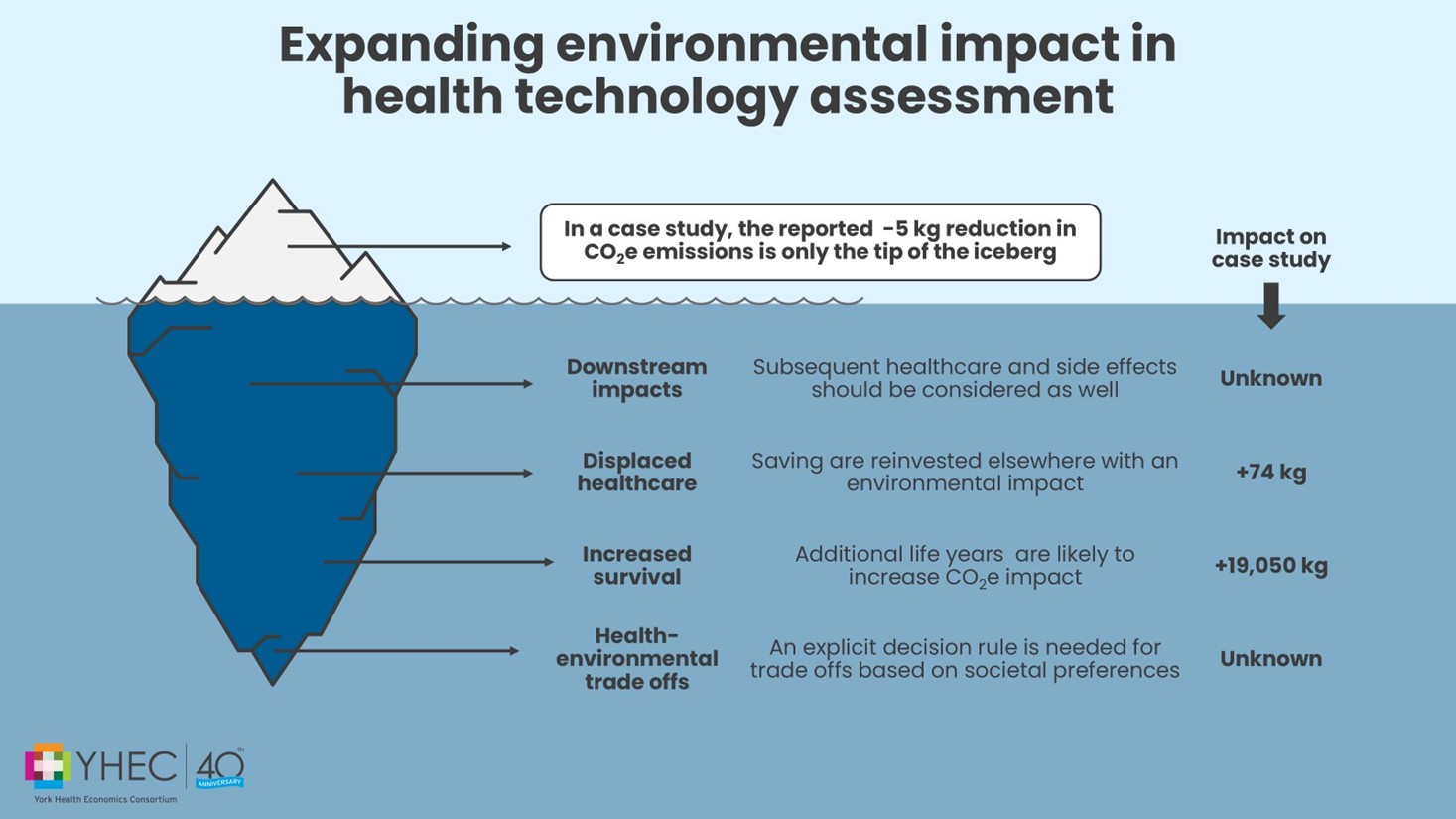
When environmental outcomes are included in health economic analyses, many studies tend to focus only on the direct carbon footprint of the technologies being assessed. However, this narrow approach ignores several highly important factors. This article is intended to be an opening proposition rather than claiming to have fully formed answers. It proposes four additions to the environmental evaluation of healthcare interventions. The first is to include all downstream impacts. The second is to account for the environmental impact of displaced healthcare funding. The third is to account for the environmental impact of changes in life expectancy. Finally, the fourth recommendation is to use a decision rule to compare trade-offs between health gains (or losses) and environmental harm (or benefit). A hypothetical case study is used to illustrate how each of these recommendations can change the results of an evaluation. It is demonstrated that, whilst the narrow approach implied that a new technology might reduce environmental harm (a 5 kg reduction in CO2 equivalent emissions), the wider considerations demonstrate that the impact may be far larger (an increase of 19,119 kg CO2 equivalent emissions). Although the case study is hypothetical, the principles demonstrate that ignoring the wider impacts of health policies may miss important consequences.
Berners-Lee, M. (2010). How Bad are Bananas?: The Carbon Footprint of Everything. Greystone Books.
Bressler, R. D. (2021). The mortality cost of carbon. Nature Communications, 12(1), 4467. https://doi.org/10.1038/s41467-021-24487-w
BSI. (2006). ISO 14040:2006. Environmental management — Life cycle assessment — Principles and framework.
Cristea, M., Noja, G. G., Stefea, P., & Sala, A. L. (2020). The Impact of Population Aging and Public Health Support on EU Labor Markets. Int J Environ Res Public Health, 17(4). https://doi.org/10.3390/ijerph17041439
Cui, K., Li, X., & Li, G. (2023). What kind of fiscal policies and natural resources efficiency promotes green economic growth? Evidence from regression analysis. Resources Policy, 85, 103941. https://doi.org/10.1016/j.resourpol.2023.103941
Drummond, M. E., Sculpher, M. J., Torrance, G. W., O’Brien, B. J., & Stoddart, G. L. (2005). Methods for the Economic Evaluation of Health Care Programmes. Oxford University Press. https://doi.org/10.1093/oso/9780198529446.001.0001
Eckelman, M., Romanello, M., Sherman, J., & Watts, N. (2020). The health-care sector's role in climate stabilisation - Authors' reply. Lancet, 396(10244), 92–93. https://doi.org/10.1016/s0140-6736(20)30802-3
Fordham, R., Dhatariya, K., Stancliffe, R., Lloyd, A., Chatterjee, M., Mathew, M., Taneja, L., Gains, M., & Haagen Panton, U. (2020). Effective diabetes complication management is a step toward a carbon-efficient planet: an economic modeling study. BMJ Open Diabetes Res Care, 8(1), e001017. https://doi.org/10.1136/bmjdrc-2019-001017
Guirado-Fuentes, C., Abt-Sacks, A., Trujillo-Martín, M. D. M., García-Pérez, L., Rodríguez-Rodríguez, L., Carrion, I. R. C., & Serrano-Aguilar, P. (2023). Main Challenges of Incorporating Environmental Impacts in the Economic Evaluation of Health Technology Assessment: A Scoping Review. Int J Environ Res Public Health, 20(6), 4949. https://doi.org/10.3390/ijerph20064949
Health Care Without Harm. (2019). Health care's climate footprint. https://global.noharm.org/sites/default/files/documents-files/5961/HealthCaresClimateFootprint_092319.pdf
Hensher, M. (2020). Incorporating environmental impacts into the economic evaluation of health care systems: Perspectives from ecological economics. Resources, Conservation and Recycling, 154, 104623. https://doi.org/10.1016/j.resconrec.2019.104623
HM Treasury. (2024). The Green Book. https://www.gov.uk/government/publications/the-green-book-appraisal-and-evaluation-in-central-government/the-green-book-2020
MacNeill, A. J., McGain, F., & Sherman, J. D. (2021). Planetary health care: a framework for sustainable health systems. Lancet Planetary Health, 5(2), e66–e68. https://doi.org/10.1016/s2542-5196(21)00005-x
Mortimer, F., Isherwood, J., Wilkinson, A., & Vaux, E. (2018). Sustainability in quality improvement: redefining value. Future Healthc J, 5(2), 88–93. https://doi.org/10.7861/futurehosp.5-2-88
NHS England. (2023). Our 2023/24 business plan. https://www.england.nhs.uk/long-read/our-2023-24-business-plan/
NHS England. (2024). Evergreen Sustainable Supplier Assessment. https://www.england.nhs.uk/nhs-commercial/central-commercial-function-ccf/evergreen/
Pegg, M., Mistry, C., Barker, E., & Taylor, M. (2024). Eliciting trade-offs between population health and environmental outcomes: A pilot study. European Journal of Environment and Public Health, 8(4), em0163. https://doi.org/10.29333/ejeph/15212
Pharma Pollution Hub. (2024). Homepage. https://www.pharmapollution.org/
Pinho-Gomes, A. C., Yoo, S. H., Allen, A., Maiden, H., Shah, K., & Toolan, M. (2022). Incorporating environmental and sustainability considerations into health technology assessment and clinical and public health guidelines: a scoping review. Int J Technol Assess Health Care, 38(1), e84. https://doi.org/10.1017/s0266462322003282
Polisena, J., De Angelis, G., Kaunelis, D., & Gutierrez-Ibarluzea, I. (2018). Environmental impact assessment of a health technology: A scoping review. Int J Technol Assess Health Care, 34(3), 317–326. https://doi.org/10.1017/s0266462318000351
Robb, H. D., & Pegna, V. (2023). The Intercollegiate Green Theatre Checklist. The Bulletin of the Royal College of Surgeons of England, 105(2), 64–67. https://doi.org/10.1308/rcsbull.2023.25
Sherman, J. D., MacNeill, A., & Thiel, C. (2019). Reducing Pollution From the Health Care Industry. JAMA, 322(11), 1043–1044. https://doi.org/10.1001/jama.2019.10823
Tennison, I., Roschnik, S., Ashby, B., Boyd, R., Hamilton, I., Oreszczyn, T., Owen, A., Romanello, M., Ruyssevelt, P., Sherman, J. D., Smith, A. Z. P., Steele, K., Watts, N., & Eckelman, M. J. (2021). Health care's response to climate change: a carbon footprint assessment of the NHS in England. Lancet Planetary Health, 5(2), e84–e92. https://doi.org/10.1016/s2542-5196(20)30271-0
Thiel, C. L., Schehlein, E., Ravilla, T., Ravindran, R. D., Robin, A. L., Saeedi, O. J., Schuman, J. S., & Venkatesh, R. (2017). Cataract surgery and environmental sustainability: Waste and lifecycle assessment of phacoemulsification at a private healthcare facility. J Cataract Refract Surg, 43(11), 1391–1398. https://doi.org/10.1016/j.jcrs.2017.08.017
Toolan, M., Walpole, S., Shah, K., Kenny, J., Jónsson, P., Crabb, N., & Greaves, F. (2023). Environmental impact assessment in health technology assessment: principles, approaches, and challenges. Int J Technol Assess Health Care, 39(1), e13. https://doi.org/10.1017/s0266462323000041
Williams, J. T. W., Bell, K. J. L., Morton, R. L., & Dieng, M. (2024). Methods to Include Environmental Impacts in Health Economic Evaluations and Health Technology Assessments: A Scoping Review. Value Health, 27(6), 794–804. https://doi.org/10.1016/j.jval.2024.02.019