
Lifestyle determinants of health and well-being in middle-aged and older adults: A narrative review

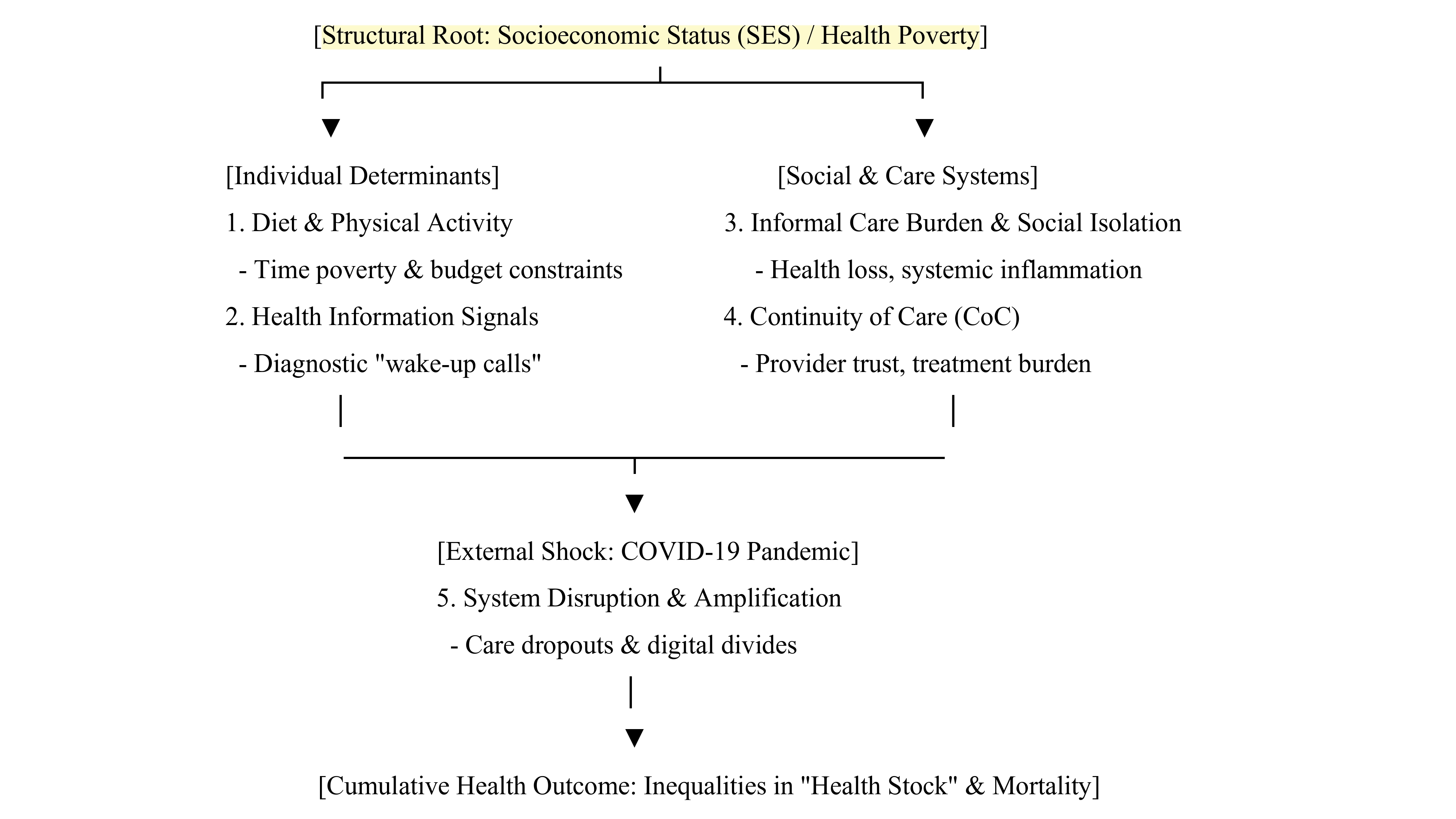
The global epidemiological transition from communicable to non-communicable diseases presents an unprecedented challenge to modern healthcare systems, particularly as populations age rapidly. This narrative review synthesizes evidence on the multifaceted lifestyle determinants of health and well-being among middle-aged and older adults. While previous reviews have examined individual risk factors or delivery models in isolation, this review uniquely synthesizes individual lifestyle behaviors with structural care systems under the unifying lens of socioeconomic health poverty. Primary lifestyle factors, including diet and regular physical activity, are essential for maintaining “health stock,” yet their persistence is heavily influenced by socioeconomic status and “time poverty.” Health information signals, such as diagnoses of chronic conditions, can serve as critical “wake-up calls” that prompt healthier behaviors, though their effectiveness varies across income and education levels. This review also focuses on the social and structural dimensions of health, specifically informal caregiving burdens and social isolation. Informal care often leads to health deterioration for caregivers, while living alone is linked to increased long-term care needs. Continuity of care is a vital longitudinal framework for managing chronic diseases like hypertension and diabetes, reinforcing medication adherence and reducing mortality. However, the COVID-19 pandemic introduced substantial disruptions to these healthcare pathways, revealing deep-seated socioeconomic disparities in health outcomes and well-being. By integrating longitudinal survey data and systematic reviews, this review underscores the necessity of integrated, person-centered care models. Effective policy design must prioritize mitigating socioeconomic barriers and addressing “health poverty” to support healthy aging and ensure the sustainability of healthcare systems.
Bambra, C., Riordan, R., Ford, J., & Matthews, F. (2020). The COVID-19 pandemic and health inequalities. Journal of Epidemiology and Community Health, 74(11), 964-968. https://doi.org/10.1136/jech-2020-214401
Barnett, K., Mercer, S. W., Norbury, M., Watt, G., Wyke, S., & Guthrie, B. (2012). Epidemiology of multimorbidity and implications for health care, research, and medical education: A cross-sectional study. The Lancet, 380(9839), 37-43. https://doi.org/10.1016/S0140-6736(12)60240-2
Bloom, D. E., Cafiero, E. T., Jané-Llopis, E., Abrahams-Gessel, S., Bloom, L. R., Fathima, S., Feigl, A. B., Gaziano, T., Hamzani, M., Mowafi, M., O’Farrell, D., McGovern, M. E., San Jose, R., Stanciole, A., Alleyne, A., & Weinstein, C. (2011). The global economic burden of noncommunicable diseases. World Economic Forum. https://www3.weforum.org/docs/WEF_Harvard_HE_GlobalEconomicBurdenNonCommunicableDiseases_2011.pdf
Bratsberg, B., Godøy, A., Hart, R. K., Reme, B. A., Raaum, O., & Wörn, J. (2023). Work loss and mental health during the COVID-19 pandemic. IZA Discussion Paper, No. 15913. https://www.iza.org/publications/dp/15913/work-loss-and-mental-health-during-the-covid-19-pandemic
Bress, A. P., Bellows, B. K., King, J. B., Hess, R., Beddhu, S., Zhang, Z., Berlowitz, D. R., Conroy, M. B., Fine, L., Oparil, S., Morisky, D. E., Kazis, L. E., Ruiz-Negrón, N., Powell, J., Tamariz, L., Whittle, J., Wright, J. T., Jr., Supiano, M. A., Cheung, A. K., Weintraub, W. S., & Moran, A. E. (2017). Cost-effectiveness of intensive versus standard blood-pressure control. The New England Journal of Medicine, 377(8), 745-755. https://doi.org/10.1056/NEJMsa1616035
Brindley, C., Van Ourti, T., Bonfrer, I., & O’Donnell, O. (2025). Association of socioeconomic inequality in cardiovascular disease risk with economic development across 57 low- and middle-income countries: Cross-sectional analysis of nationally representative individual-level data. Social Science & Medicine, 365, 117591. https://doi.org/10.1016/j.socscimed.2024.117591
Chan, K. S., Wan, E. Y. F., Chin, W. Y., Cheng, W. H. G., Ho, M. K., Yu, E. Y. T., & Lam, C. L. K. (2021). Effects of continuity of care on health outcomes among patients with diabetes mellitus and/or hypertension: A systematic review. BMC Family Practice, 22(1), 145. https://doi.org/10.1186/s12875-021-01493-x
Chen, C. C., & Cheng, S. H. (2011). Better continuity of care reduces costs for diabetic patients. Am J Manag Care, 17(6), 420–427. https://www.ajmc.com/view/ajmc_11jun_chenchen_420to27
Chen, C. C., & Cheng, S. H. (2016). Potentially Inappropriate Medication and Health Care Outcomes: An Instrumental Variable Approach. Health Services Research, 51(4), 1670-1691. https://doi.org/10.1111/1475-6773.12417
Choi, N. G., & Kim, J. (2011). The effect of time volunteering and charitable donations in later life on psychological wellbeing. Ageing & Society, 31(4), 590-610. https://doi.org/10.1017/S0144686X10001224
Clarke, P., & Erreygers, G. (2020). Health poverty. Social Science & Medicine, 244, 112633. https://doi.org/10.1016/j.socscimed.2019.112633
Courtin, E., & Knapp, M. (2017). Social isolation, loneliness and health in old age: A scoping review. Health & Social Care in the Community, 25(3), 799-812. https://doi.org/10.1111/hsc.12311
Cunningham, C., O’ Sullivan, R., Caserotti, P., & Tully, M. A. (2020). Consequences of physical inactivity in older adults: A systematic review of reviews. Scandinavian Journal of Medicine & Science in Sports, 30(5), 816-827. https://doi.org/10.1111/sms.13616
Delgado, J., Sidaway-Lee, K., & Gray, D. P. (2022). Continuity of GP care for patients with dementia: A retrospective cohort study. British Journal of General Practice, 72(715), e91-e98. https://doi.org/10.3399/BJGP.2021.0413
Eberly, L. A., Khatana, S. A. M., Nathan, A. S., Snider, C., Julien, H., Adusumalli, A. S., & Adusumalli, S. (2020). Telemedicine Outpatient Cardiovascular Care During the COVID-19 Pandemic: Bridging or Opening the Digital Divide? Circulation, 142(5), 510-512. https://doi.org/10.1161/CIRCULATIONAHA.120.048185
Estruch, R., Ros, E., Salas-Salvadó, J., Covas, M. I., Corella, D., Arós, F., Gómez-Gracia, E., Ruiz-Gutiérrez, V., Fiol, M., Lapetra, J., Lamuela-Raventós, R. M., Serra-Majem, L., Pintó, X., Basora, J., Muñoz, M. A., Sorlí, J. V., Martínez, J. A., & Martínez-González, M. A. (2018). Primary prevention of cardiovascular disease with a Mediterranean diet supplemented with extra-virgin olive oil or nuts. The New England Journal of Medicine, 378(25), e34. https://doi.org/10.1056/NEJMoa1800389
Eton, D. T., Ramalho de Oliveira, D., Egginton, J. S., Ridgeway, J. L., Odell, L., May, C. R., & Montori, V. M. (2012). Building a measurement framework of burden of treatment in complex patients with chronic conditions: a qualitative study. Patient Related Outcome Measures, 3, 39-49. https://doi.org/10.2147/PROM.S34681
Fu, R., Le, D. D., & Ibuka, Y. (2025). The impact of reducing formal care benefits on caregivers’ well-being: evidence from Japan. Review of Economics of the Household, 23, 1221-1249. https://doi.org/10.1007/s11150-024-09699-5
GBD 2019 Diseases and Injuries Collaborators. (2020). Global burden of 369 diseases and injuries in 204 countries and territories, 1990–2019: A systematic analysis for the Global Burden of Disease Study 2019. The Lancet, 396(10258), 1204-1222. https://doi.org/10.1016/S0140-6736(20)30925-9
Holt-Lunstad, J., Smith, T. B., Baker, M., Harris, T., & Stephenson, D. (2015). Loneliness and social isolation as risk factors for mortality: a meta-analytic review. Perspectives on Psychological Science, 10(2), 227-237. https://doi.org/10.1177/1745691614568352
Hu, Y., Chen, Q., & Zhang, B. (2022). Effects of chronic disease diagnoses on alcohol consumption among elderly individuals: Longitudinal evidence from China. BMJ Open, 12(10), e062920. https://doi.org/10.1136/bmjopen-2022-062920
Iizuka, T., Nishiyama, K., Chen, B., & Eggleston, K. (2021). False alarm? Estimating the marginal value of health signals. Journal of Public Economics, 195, 104368. https://doi.org/10.1016/j.jpubeco.2021.104368
Inzucchi, S. E., Bergenstal, R. M., Buse, J. B., Diamant, M., Ferrannini, E., Nauck, M., Peters, A. L., Tsapas, A., Wender, R., & Matthews, D. R. (2015). Management of Hyperglycemia in Type 2 Diabetes, 2015: A Patient-Centered Approach: Update to a Position Statement of the American Diabetes Association and the European Association for the Study of Diabetes. Diabetes Care, 38(1), 140-149. https://doi.org/10.2337/dc14-2441
Izquierdo, M., Merchant, R. A., Morley, J. E., Anker, S. D., Aprahamian, I., Arai, H., Aubertin-Leheudre, M., Bernabei, R., Cesari, M., Chen, L. K., de Souto Barreto, P., Fried, L. P., Guralnik, J. M., Heuer, B. G., Rodríguez-Mañas, L., Sinclair, A. J., Studenski, S., Vellas, B., & Fiatarone Singh, M. A. (2021). International Exercise Recommendations in Older Adults (ICFSR): Consensus guidelines. The Journal of Nutrition, Health & Aging, 25(7), 824-853. https://doi.org/10.1007/s12603-021-1665-8
Jakovljevic, M., Chang, H., & Kumagai, N. (2023). Editorial: Global excellence in health economics: Asia and Australasia. Frontiers in Public Health, 11, 1172632. https://doi.org/10.3389/fpubh.2023.1172632
Jakovljevic, M., Kumagai, N., & Ogura, S. (2023). Editorial: Global population aging – Health care, social and economic consequences, volume II. Frontiers in Public Health, 11, 1184950. https://doi.org/10.3389/fpubh.2023.1184950
Jakovljevic, M., Sharma, T., Kumagai, N., & Ogura, S. (2021). Editorial: NCDs – Core Challenge of Modern Day Health Care Establishments. Frontiers in Public Health, 9, 692926. https://doi.org/10.3389/fpubh.2021.692926
Jenkinson, C. E., Dickens, A. P., Jones, K., Thompson-Coon, J., Taylor, R. S., Rogers, M., Bambra, C. L., Lang, I., & Richards, S. H. (2013). Is volunteering a public health intervention? A systematic review and meta-analysis of the health and survival of volunteers. BMC Public Health, 13, 773. https://doi.org/10.1186/1471-2458-13-773
Khanam, M. A., Kitsos, A., Stankovich, J., & Jose, M. (2019). Association of continuity of care with blood pressure control. Australian Journal of General Practice, 48(5), 300-306. https://doi.org/10.31128/AJGP-05-18-4592
Kim, W., Lee, S. A., & Chun, S. Y. (2021). A cost-effectiveness analysis of the Chronic Disease Management Program in Korea. International Journal for Quality in Health Care, 33(2), mzab073. https://doi.org/10.1093/intqhc/mzab073
Kumagai, N. (2017). Distinct impacts of high intensity caregiving on caregivers’ mental health and continuation of caregiving. Health Economics Review, 7(1), 15. https://doi.org/10.1186/s13561-017-0151-9
Kumagai, N. (2018). Care Preferences of Elderly People Living Alone in Japan. Health Education and Public Health, 1(2), 101-109. https://doi.org/10.31488/heph.107
Kumagai, N. (2021). The Impact of the COVID-19 Pandemic on Physician Visits in Japan. Frontiers in Public Health, 9, 743371. https://doi.org/10.3389/fpubh.2021.743371
Kumagai, N., & Fukuda, H. (2023). Distinct effects of community-based activities on long-term care needs: A study using zero-inflated Poisson regression. Global Health Economics and Sustainability, 1, 891. https://doi.org/10.36922/ghes.0891
Kumagai, N., Nishimura, S., & Jakovljevic, M. (2023). Could high continuity of care (COC) have a negative impact on subjective health of hypertensive patients? A Japanese perspective. Cost Effectiveness and Resource Allocation, 21(1), 39. https://doi.org/10.1186/s12962-023-00448-6
Kumagai, N., & Ogura, S. (2014). Persistence of physical activity in middle age: A nonlinear dynamic panel approach. The European Journal of Health Economics, 15(7), 717-735. https://doi.org/10.1007/s10198-013-0518-8
Kumagai, N., Tajika, A., & Jakovljevic, M. (2025). Valuation of health losses among Japanese workers with children during the COVID-19 pandemic. BMC Health Services Research, 25(1), 1045. https://doi.org/10.1186/s12913-025-13183-w
Kwak, S., Lee, Y., Baek, S., & Shin, J. (2022). Effects of subjective health perception on health behavior and cardiovascular disease risk factors in patients with prediabetes and diabetes. International Journal of Environmental Research and Public Health, 19(13), 7900. https://doi.org/10.3390/ijerph19137900
Leigh-Hunt, N., Bagguley, D., Bash, K., Turner, V., Turnbull, S., Valtorta, N., & Caan, W. (2017). An overview of systematic reviews on the public health implications of social isolation and loneliness. Public Health, 152, 157-171. https://doi.org/10.1016/j.puhe.2017.07.035
Livingston, G., Huntley, J., Sommerlad, A., Ames, D., Ballard, C., Banerjee, S., et al. (2020). Dementia prevention, intervention, and care: 2020 report of the Lancet Commission. The Lancet, 396(10248), 413-446. https://doi.org/10.1016/S0140-6736(20)30367-6
Maher, R. L., Hanlon, J., & Hajjar, E. R. (2014). Clinical consequences of polypharmacy in elderly. Expert Opinion on Drug Safety, 13(1), 57-65. https://doi.org/10.1517/14740338.2013.827660
Marmot, M., & Allen, J. J. (2020). COVID-19: Exposing and amplifying inequalities. Journal of Epidemiology and Community Health, 74(9), 681-682. https://doi.org/10.1136/jech-2020-214720
McDaid, D., & Park, A. L. (2022). The economic case for investing in the prevention of mental health conditions in the UK. London School of Economics and Political Science. https://www.mentalhealth.org.uk/sites/default/files/2022-06/MHF-Investing-in-Prevention-Full-Report.pdf
Meador, M., Coronado, F., Roy, D., Bay, R. C., Lewis, J. H., Chen, J., Cheung, R., Utman, C., & Hannan, J. A. (2022). Impact of COVID-19-related care disruptions on blood pressure management and control in community health centers. BMC Public Health, 22(1), 2295. https://doi.org/10.1186/s12889-022-14763-9
Moynihan, R., Sanders, S., Michaleff, Z. A., Scott, A. M., Clark, J., To, E. J., Jones, M., Kitchener, E., Brennan, M., & Johansson, M. (2021). Impact of COVID-19 pandemic on utilisation of healthcare services: A systematic review. BMJ Open, 11(3), e045343. https://doi.org/10.1136/bmjopen-2020-045343
Nicolet, A., Al-Gobari, M., Perraudin, C., Wagner, J., Peytremann-Bridevaux, I., & Marti, J. (2022). Association between continuity of care (COC), healthcare use and costs: what can we learn from claims data? A rapid review. BMC Health Services Research, 22(1), 658. https://doi.org/10.1186/s12913-022-07953-z
Noah, B., Keller, M. S., Mosadeghi, S., Stein, L., Johl, S., Delshad, S., Tashjian, V. C., Lew, D., Levin, D., Bhaumik, R., & Spiegel, B. M. R. (2018). Impact of remote patient monitoring on clinical outcomes: an updated meta-analysis of randomized controlled trials. npj Digital Medicine, 1, 20172. https://doi.org/10.1038/s41746-017-0002-4
Nowak, D. A., Sheikhan, N. Y., & Upshur, R. E. G. (2021). Why does continuity of care with family doctors matter? A qualitative systematic review. Canadian Family Physician, 67(9), 679-688. https://doi.org/10.46747/cfp.6709679
Okamoto, S., & Komamura, K. (2022). Towards universal health coverage in the context of population ageing: A narrative review on the implications from the long-term care system in Japan. Archives of Public Health, 80(1), 210. https://doi.org/10.1186/s13690-022-00970-8
Osawa, I., Goto, T., Asami, Y., Itoh, N., Kaga, Y., Yamamoto, Y., & Tsugawa, Y. (2021). Physician visits and medication prescriptions for major chronic diseases during the COVID-19 pandemic in Japan: Retrospective cohort study. BMJ Open, 11(10), e050938. https://doi.org/10.1136/bmjopen-2021-050938
Patel, J. A., Nielsen, F. B. H., Badiani, A. A., Assi, S., Unadkat, V. A., Patel, B., Ravindrane, R., & Wardle, H. (2020). Poverty, inequality and COVID-19: The forgotten vulnerable. Public Health, 183, 110-111. https://doi.org/10.1016/j.puhe.2020.05.006
Pedron, S., Hanselmann, M., Burns, J., Rich, A., Peters, A., Heier, M., Schwettmann, L., Bor, J. H., Bärnighausen, T., & Laxy, M. (2022). The effect of population-based blood pressure screening on long-term cardiometabolic morbidity and mortality in Germany: A regression discontinuity analysis. PLoS Medicine, 19(12), e1004151. https://doi.org/10.1371/journal.pmed.1004151
Pereira Gray, D. J., Sidaway-Lee, K., White, E., Thorne, A., & Evans, P. H. (2018). Continuity of care with doctors—a matter of life and death? A systematic review of continuity of care and mortality. BMJ Open, 8(6), e021161. https://doi.org/10.1136/bmjopen-2017-021161
Pinquart, M., & Sörensen, S. (2003). Differences between caregivers and noncaregivers in psychological and physical health: A meta-analysis. Psychology and Aging, 18(2), 250-267. https://doi.org/10.1037/0882-7974.18.2.250
Power, K. (2020). The COVID-19 pandemic has increased the care burden of women and families. Sustain Sci Pract Policy, 16(1), 67-73. https://doi.org/10.1080/15487733.2020.1776561
Ramezani-Doroh, V., Karimi, F., Rangchian, M., & Hamidi, Y. (2023). Monetary valuation of COVID-19 informal care: caregivers’ willingness to pay and willingness to accept. Cost Effectiveness and Resource Allocation, 21(1), 22. https://doi.org/10.1186/s12962-023-00437-9
Rogers, E. A., Abi, H., Linzer, M., & Eton, D. T. (2021). Treatment Burden in People with Hypertension is Correlated with Patient Experience with Self-Management. Journal of the American Board of Family Medicine, 34(6), 1243-1245. https://doi.org/10.3122/jabfm.2021.06.210191
Sallis, J. F., Cerin, E., Conway, T. L., Adams, M. A., Frank, L. D., Pratt, M., Salvo, D., Schipperijn, J., Chow, C. K., Davey, R., Reis, R. S., Du, J., & Owen, N. (2016). Physical activity in relation to urban environments in 14 cities worldwide: A cross-sectional study. The Lancet, 387(10034), 2207–2217. https://doi.org/10.1016/S0140-6736(15)01284-2
Sörensen, S., Pinquart, M., & Duberstein, P. (2002). How effective are interventions with caregivers? An updated meta-analysis. The Gerontologist, 42(3), 356-372. https://doi.org/10.1093/geront/42.3.356
Tucker, K. L., Sheppard, J. P., Stevens, R., Bosworth, H. B., Bove, A., Bray, E. P., et al. (2017). Self-monitoring of blood pressure in hypertension: A systematic review and individual patient data meta-analysis. PLoS Medicine, 14(9), e1002389. https://doi.org/10.1371/journal.pmed.1002389
Vitaliano, P. P., Zhang, J., & Scanlan, J. M. (2003). Is caregiving hazardous to one’s physical health? A meta-analysis. Psychological Bulletin, 129(6), 946-972. https://doi.org/10.1037/0033-2909.129.6.946
World Health Organization. (2015). World report on ageing and health. World Health Organization. https://www.who.int/publications/i/item/9789241565042
World Health Organization. (2017). Integrated care for older people: Guidelines on community-level interventions to manage declines in intrinsic capacity. World Health Organization. https://www.who.int/publications/i/item/9789241550109
Yoshikawa, Y., & Kawachi, I. (2021). Association of socioeconomic characteristics with disparities in COVID-19 outcomes in Japan. JAMA Network Open, 4(7), e2117060. https://doi.org/10.1001/jamanetworkopen.2021.17060
Yuan, L., Yu, B., Gao, L., Du, M., Lv, Y., Liu, X., & Sun, J. (2023). Decomposition analysis of health inequalities between the urban and rural oldest-old populations in China: Evidence from a national survey. SSM-Population Health, 21, 101325. https://doi.org/10.1016/j.ssmph.2022.101325
Zhao, M., Konishi, Y., & Glewwe, P. (2013). Does information on health status lead to a healthier lifestyle? Evidence from China on the effect of hypertension diagnosis on food consumption. Journal of Health Economics, 32(2), 367-385. https://doi.org/10.1016/j.jhealeco.2012.11.007