
STAT1 as a potential diagnostic biomarker for gastric cancer

Introduction: Gastric cancer is a major contributor to cancer‑related mortality across the globe. The discovery of novel molecular biomarkers is critical for achieving early diagnosis and developing targeted therapeutic strategies for this disease. The role of STAT1 in gastric cancer has not been fully elucidated.
Objective: This research was designed to analyze the expression profile of STAT1 in gastric cancer and explore its feasibility as a diagnostic biomarker.
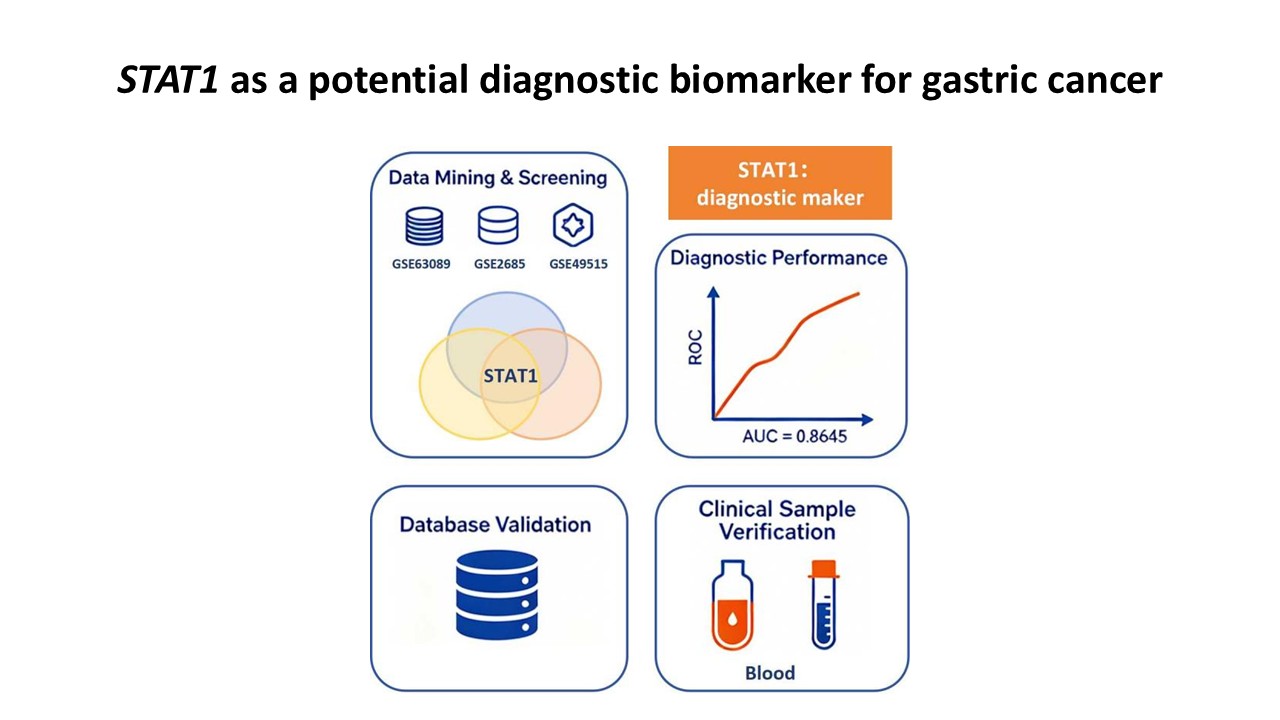
Methods: We screened differentially expressed genes (DEGs) between gastric cancer specimens and normal controls using GSE63089 and GSE2685. Common upregulated DEGs were identified using Venn diagram analysis and further evaluated in GSE49515. STAT1 expression was examined using the Gene Expression Profiling Interactive Analysis (GEPIA) database and validated in clinical gastric cancer samples and paired adjacent normal tissues. Receiver operating characteristic (ROC) curve analysis was conducted to evaluate the diagnostic value of STAT1.
Results: A total of 8,058 DEGs were detected in GSE63089 and 2,139 DEGs in GSE2685. Venn diagram analysis revealed that 94 common upregulated DEGs were shared between the two datasets. Analysis of GSE49515 identified STAT1 as the only consistently upregulated gene among these common DEGs. Bioinformatics analysis confirmed that STAT1 levels were notably higher in gastric cancer, especially in diffuse‑type samples, than in normal samples. Validation using clinical samples confirmed significant upregulation of STAT1 in gastric cancer blood samples compared with normal controls. ROC curve analysis showed an area under the curve of 0.8645, indicating favorable diagnostic performance.
Conclusion: These findings indicate that STAT1 has potential as a diagnostic biomarker for gastric cancer.
- Sung H, Ferlay J, Siegel RL, et al. Global Cancer Statistics 2020: GLOBOCAN Estimates of Incidence and Mortality Worldwide for 36 Cancers in 185 Countries. CA Cancer J Clin. 2021;71(3):209-249. doi: 10.3322/caac.21660
- Sundar R, Nakayama I, Markar SR, et al. Gastric cancer. Lancet. 2025;405(10494):2087-2102. doi: 10.1016/S0140-6736(25)00052-2
- Patel AK, Sethi NS, Park H. Gastric Cancer: A Review. JAMA. 2026;335(5):439-450. doi: 10.1001/jama.2025.20034
- Reich NC. STAT dynamics. Cytokine Growth Factor Rev. 2007;18(5-6):511-518. doi: 10.1016/j.cytogfr.2007.06.021
- Xue C, Yao Q, Gu X, et al. Evolving cognition of the JAK-STAT signaling pathway: autoimmune disorders and cancer. Signal Transduct Target Ther. 2023;8(1):204. doi: 10.1038/s41392-023-01468-7
- Au-Yeung N, Mandhana R, Horvath CM. Transcriptional regulation by STAT1 and STAT2 in the interferon JAK-STAT pathway. JAKSTAT. 2013;2(3):e23931. doi: 10.4161/jkst.23931
- Wang F, Xu X, Guan B, et al. Regulation and reversal of paclitaxel resistance via the STAT1-mediated apoptotic pathway in ovarian cancer. Int J Oncol. 2026;68(2):1-15. doi: 10.3892/ijo.2025.5832
- Han Z, Jia Q, Bai G, et al. Lactate Activates the HCAR1/β- Arrestin2/PP2A Signaling Axis to Mediate STAT1/2 Dephosphorylation and Drive Osteosarcoma Progression. Adv Sci. 2025;12(45):e06214. doi: 10.1002/advs.202506214
- Wang J, Jia Y, Liu T, et al. Tumor cell-intrinsic BIN1 deficiency promotes the immunosuppression and impedes ferroptosis of non-small cell lung cancer via G3BP1- mediated degradation of STAT1. J Exp Clin Cancer Res. 2025;44(1):141. doi: 10.1186/s13046-025-03404-9
- Shimizu M, Shimamura M, Owaki T, et al. Antiangiogenic and antitumor activities of IL-27. J Immunol. 2006;176(12):7317- 7324. doi: 10.4049/jimmunol.176.12.7317
- Kachroo P, Lee MH, Zhang L, et al. IL-27 inhibits epithelial-mesenchymal transition and angiogenic factor production in a STAT1-dominant pathway in human non-small cell lung cancer. J Exp Clin Cancer Res. 2013;32(1):97. doi: 10.1186/1756-9966-32-97
- Palakurthi B, Fross SR, Guldner IH, et al. Targeting CXCL16 and STAT1 augments immune checkpoint blockade therapy in triple-negative breast cancer. Nat Commun. 2023;14(1):2109. doi: 10.1038/s41467-023-37727-y
- Peng X, Zhu Y, Han Y, Cai C. Enhancing anti-tumor immunity by targeting BATF and the STAT1/PD-L1 pathway in cervical carcinoma. Cell Mol Life Sci. 2025;82(1):353. doi: 10.1007/s00018-025-05792-9
- Su YC, Chen YC, Tseng YL, et al. The Pro-Survival Oct4/ Stat1/Mcl-1 Axis Is Associated with Poor Prognosis in Lung Adenocarcinoma Patients. Cells. 2021;10(10):2642. doi: 10.3390/cells10102642
- Wang S, Diao S, Kim H, Zou JY, Li KK, Koromilas AE. A feedforward loop between STAT1 and YAP1 stimulates lipid biosynthesis, accelerates tumor growth, and promotes chemotherapy resistance in mutant KRAS colorectal cancer. Commun Biol. 2025;8(1):1278. doi: 10.1038/s42003-025-08740-2
- Li W, Wei H, Liu J, et al. Exosomal Biglycan promotes gastric cancer progression via M2 polarization and CXCL10-mediated JAK/STAT1 activation. Cancer Lett. 2025;626:217758. doi: 10.1016/j.canlet.2025.217758
- Zhang Z, Yu K, Cao Y, Xie P, Wang L, Shen Z, Qin J. TREM2 facilitates gastric cancer progression and immune evasion via inhibiting TRIM21-mediated STAT1 degradation in tumor-associated macrophages. Cell Death Dis. 2025;16(1):845. doi: 10.1038/s41419-025-08198-4
- Tang Z, Li C, Kang B, Gao G, Li C, Zhang Z. GEPIA: a web server for cancer and normal gene expression profiling and interactive analyses. Nucleic Acids Res. 2017;45(W1):W98-W102. doi: 10.1093/nar/gkx247
- Li T, Fu J, Zeng Z, et al. TIMER2.0 for analysis of tumor-infiltrating immune cells. Nucleic Acids Res. 2020;48(W1):W509-W514. doi: 10.1093/nar/gkaa407
- Yasuda T, Wang YA. Gastric cancer immunosuppressive microenvironment heterogeneity: implications for therapy development. Trends Cancer. 2024;10(7):627-642. doi: 10.1016/j.trecan.2024.03.008
- López MJ, Carbajal J, Alfaro AL, et al. Characteristics of gastric cancer around the world. Crit Rev Oncol Hematol. 2023;181:103841. doi: 10.1016/j.critrevonc.2022.103841
- Guan WL, He Y, Xu RH. Gastric cancer treatment: recent progress and future perspectives. J Hematol Oncol. 2023;16(1):57. doi: 10.1186/s13045-023-01451-3
- Choo J, Sargsyan A, Khachatryan V, et al. Advances in the management of metastatic gastric cancer: current strategies and emerging therapeutics. Nat Rev Clin Oncol. 2026. doi: 10.1038/s41571-026-01134-1
- Lv Y, Qi J, Babon JJ, Cao L, et al. The JAK-STAT pathway: from structural biology to cytokine engineering. Signal Transduct Target Ther. 2024;9(1):221.doi: 10.1038/s41392-024-01934-w
- Platanias LC. Mechanisms of type-I- and type-II-interferon-mediated signalling. Nat Rev Immunol. 2005;5(5):375-386. doi: 10.1038/nri1604
- Chin YE, Kitagawa M, Su WC, You ZH, Iwamoto Y, Fu XY. Cell growth arrest and induction of cyclin-dependent kinase inhibitor p21 WAF1/CIP1 mediated by STAT1. Science. 1996;272(5262):719-722. doi: 10.1126/science.272.5262.719
- Klover PJ, Muller WJ, Robinson GW, Pfeiffer RM, Yamaji D, Hennighausen L. Loss of STAT1 from mouse mammary epithelium results in an increased Neu-induced tumor burden. Neoplasia. 2010;12(11):899-905. doi: 10.1593/neo.10716
- Widschwendter A, Tonko-Geymayer S, Welte T, Daxenbichler G, Marth C, Doppler W. Prognostic significance of signal transducer and activator of transcription 1 activation in breast cancer. Clin Cancer Res. 2002;8(10):3065-3074.
- Rane SG, Reddy EP. JAKs, STATs and Src kinases in hematopoiesis. Oncogene. 2002;21(21):3334-3358. doi: 10.1038/sj.onc.1205398
- Adham AN, Abdelfatah S, Naqishbandi AM, Mahmoud N, Efferth T. Cytotoxicity of apigenin toward multiple myeloma cell lines and suppression of iNOS and COX-2 expression in STAT1-transfected HEK293 cells. Phytomedicine. 2021;80:153371. doi: 10.1016/j.phymed.2020.153371
- Zhao Y, Huang S, Tan X, et al. N6 -Methyladenosine- Modified CBX1 Regulates Nasopharyngeal Carcinoma Progression Through Heterochromatin Formation and STAT1 Activation. Adv Sci. 2022;9(36):e2205091. doi: 10.1002/advs.202205091
- Huang S, Liang S, Huang J, Luo P, Mo D, Wang H. LINC01806 mediated by STAT1 promotes cell proliferation, migration, invasion, and stemness in non-small cell lung cancer through Notch signaling by miR-4428/NOTCH2 axis. Cancer Cell Int. 2022;22(1):198. doi: 10.1186/s12935-022-02560-8
- Chai Y, Xiang H, Ma Y, et al. S1PR1 suppresses lung adenocarcinoma progression through p-STAT1/miR-30c-5 p/FOXA1 pathway. J Exp Clin Cancer Res. 2024;43(1):304. doi: 10.1186/s13046-024-03230-5
- Tao Q, Liu N, Wu J, Chen J, Chen X, Peng C. Mefloquine enhances the efficacy of anti-PD-1 immunotherapy via IFN- γ-STAT1-IRF1-LPCAT3-induced ferroptosis in tumors. J Immunother Cancer. 2024;12(3):e008554. doi: 10.1136/jitc-2023-008554
- Wang Y, Shen Y, Liang J, et al. Neurons upregulate PD-L1 via IFN/STAT1/IRF1 to alleviate damage by CD8+ T cells in cerebral malaria. J Neuroinflammation. 2024;21(1):119. doi: 10.1186/s12974-024-03114-7
- Shi Q, Liu Y, Yang W, Li Y, Wang C, Gao K. The covalent modification of STAT1 cysteines by sulforaphane promotes antitumor immunity via blocking IFN-γ-induced PD-L1 expression. Redox Biol. 2025;81:103543. doi: 10.1016/j.redox.2025.103543
- Wu B, Song M, Dong Q, et al. UBR5 promotes tumor immune evasion through enhancing IFN-γ-induced PDL1 transcription in triple negative breast cancer. Theranostics. 2022;12(11):5086-5102. doi: 10.7150/thno.74989
- Yu H, Pardoll D, Jove R. STATs in cancer inflammation and immunity: a leading role for STAT3. Nat Rev Cancer. 2009;9(11):798-809. doi: 10.1038/nrc2734
- Fu Y, Xiang Y, Wang Y, et al. The STAT1/HMGB1/NF-κB pathway in chronic inflammation and kidney injury after cisplatin exposure. Theranostics. 2023;13(9):2757-2773. doi: 10.7150/thno.81406
- Qu B, Liu J, Peng Z, et al. CircSOD2 polarizes macrophages towards the M1 phenotype to alleviate cisplatin resistance in gastric cancer cells by targeting the miR-1296/STAT1 axis. Gene. 2023;887:147733. doi:10.1016/j.gene.2023.147733
- Wang K, Chen Y, Zhang M, et al. Metformin suppresses gastric cancer progression by disrupting the STAT1- PRMT1 axis. Biochem Pharmacol. 2024;226:116367. doi: 10.1016/j.bcp.2024.116367
- Wang Y, Wang F, Zhou B, et al. Sphingosine kinase 1 facilitates gastric cancer progression via STAT1 gene methylation-mediated mechanisms. Transl Cancer Res. 2025;14(5):3226-3238. doi: 10.21037/tcr-2025-948
- Liu Y, Huang Y, He Q, Shen Y, Wang Y. Dual regulation of gastrointestinal tumor progression by the IFN-γ/STAT1 pathway and prospects for targeted therapy. Front Oncol. 2025;15:1598170. doi: 10.3389/fonc.2025.1598170
- Fujishiro M. Advanced Diagnostic and Therapeutic Endoscopy for Early Gastric Cancer. Cancers. 2024;16(5):1039. doi: 10.3390/cancers16051039
- Lin X, Shi W, Zhou Z, Li D, Yao Q, Sun Y. Molecular features of early- vs. late-onset gastric cancer: a systematic review and meta-analysis. BMC Cancer. 2026;26(1):209.doi: 10.1186/s12885-026-15567-5
- Xu Y, Zhang P, Zhang K, Huang C. The application of CA72-4 in the diagnosis, prognosis, and treatment of gastric cancer. Biochim Biophys Acta Rev Cancer. 2021;1876(2):188634. doi: 10.1016/j.bbcan.2021.188634
- Teng TZJ, Sudharsan M, Yau JWK, Tan W, Shelat VG. Helicobacter pylori knowledge and perception among multi-ethnic Asians. Helicobacter. 2021;26(3):e12794. doi: 10.1111/hel.12794
- Rah B, Rather RA, Bhat GR, et al. JAK/STAT Signaling: Molecular Targets, Therapeutic Opportunities, and Limitations of Targeted Inhibitions in Solid Malignancies. Front Pharmacol. 2022;13:821344. doi: 10.3389/fphar.2022.821344
- Demirkaya DB, Colak BC, Sefer AP, Baris S. The JAK/ STAT conundrum with mutational heterogeneity, immune defects, and the emergence of targeted therapies. Expert Rev Clin Immunol. 2025;21(8):1083-1100. doi: 10.1080/1744666X.2025.2543475
- Ullah A, Zhou C, Xiao W, et al. Identification of a novel EphB4 inhibitor, Sanguinarine, which attenuates β-catenin signaling to inhibit tumor proliferation and migration in lung cancer. J Adv Res. 2026. doi: 10.1016/j.jare.2026.02.044