
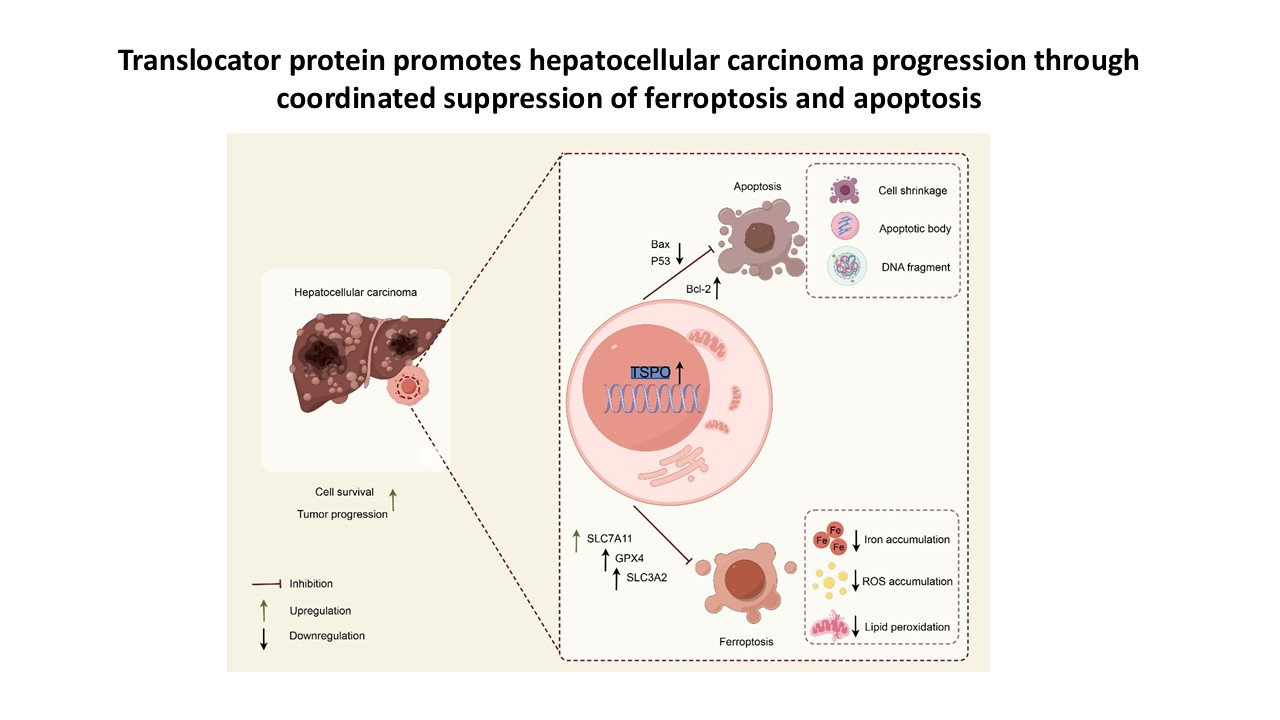
Translocator protein drives hepatocellular carcinoma progression through suppression of ferroptosis and apoptosis

Introduction: Hepatocellular carcinoma (HCC) is an aggressive, primary liver cancer with dismal survival rates and a scarcity of effective treatments. Ferroptosis, a regulated, iron-dependent cell death mechanism mediated by lipid peroxidation, has emerged as a critical contributor to tumor progression. However, the interplay between ferroptosis and apoptosis in HCC remains incompletely understood. The translocator protein (TSPO) is implicated in tumor progression; however, its specific contribution to HCC pathogenesis remains to be fully elucidated.
Objective: To explore the expression landscape, clinical relevance, and functional significance of TSPO in HCC, with a particular focus on its modulation of ferroptosis and apoptosis.
Methods: Ferroptosis-related differentially expressed genes (DEGs) were identified from GEO and FerrDb databases and analyzed using functional enrichment and protein–protein interaction networks. The Cancer Genome Atlas Liver Hepatocellular Carcinoma data were utilized to assess TSPO expression, correlation with clinical features, functional enrichment, and immune cell infiltration. In vitro experiments evaluated the effects of TSPO on HCC cell proliferation, ferroptosis and apoptosis markers, reactive oxygen species (ROS) levels, intracellular Fe2+, and lipid peroxidation.
Results: We identified 49 ferroptosis-related DEGs, which were predominantly enriched in pathways related to iron homeostasis, oxidative stress response, apoptosis, and mitochondrial function. TSPO expression was significantly upregulated in HCC tissues, correlating with poor overall survival (hazard ratio = 1.42, p < 0.05) and moderate diagnostic performance (area under the curve = 0.699). Functional assays showed that TSPO overexpression enhanced cell proliferation, elevated solute carrier family 7 member 11, solute carrier family 3 member 2, and glutathione peroxidase 4 levels, and reduced reactive oxygen species accumulation, intracellular Fe2+, and lipid peroxidation. Moreover, TSPO overexpression inhibited apoptosis by upregulating B-cell lymphoma 2 (Bcl-2) and downregulating Bcl-2-associated X protein and p53, with opposite effects observed upon TSPO knockdown.
Conclusion: Overall, TSPO drives HCC progression by inhibiting ferroptosis and apoptosis, underscoring its value as a prognostic indicator and potential therapeutic target.
- Toh MR, Wong EYT, Wong SH, et al. Global Epidemiology and Genetics of Hepatocellular Carcinoma. Gastroenterology. 2023;164(5):766-782. doi: 10.1053/j.gastro.2023.01.033
- Zeng H, Chen W, Zheng R, et al. Changing cancer survival in China during 2003-15: a pooled analysis of 17 population-based cancer registries. Lancet Glob Health. 2018;6(5):e555-e567. doi: 10.1016/s2214-109x(18)30127-x
- Dixon SJ, Lemberg KM, Lamprecht MR, et al. Ferroptosis: an iron-dependent form of nonapoptotic cell death. Cell. 2012;149(5):1060-1072. doi: 10.1016/j.cell.2012.03.042
- Cong T, Luo Y, Fu Y, Liu Y, Li Y, Li X. New perspectives on ferroptosis and its role in hepatocellular carcinoma. Chin Med J. 2022;135(18):2157-2166. doi: 10.1097/cm9.0000000000002327
- Wang Z, Liu M, Li GX, et al. A herbal pair of Scutellaria barbata D. Don and Scleromitrion diffusum (Willd.) R.J. Wang induced ferroptosis in ovarian cancer A2780 cells via inducing heme catabolism and ferritinophagy. J Integr Med. 2024;22(6):665-682. doi: 10.1016/j.joim.2024.10.001
- Jiang Z, Liu X, Peng L, et al. A Simpler, More Convenient and More Comfortable Approach for Treating Multiple Keratinocytic Carcinoma. Phenomics. 2025;5(3):333-337. doi: 10.1007/s43657-025-00220-1
- Yang WS, SriRamaratnam R, Welsch ME, et al. Regulation of ferroptotic cancer cell death by GPX4. Cell. 2014;156(1- 2):317-331. doi: 10.1016/j.cell.2013.12.010
- Li T, Yi J, Wu H, Wang K, Zhou B. SLC7A11 in hepatocellular carcinoma: potential mechanisms, regulation, and clinical significance. Am J Cancer Res. 2024;14(5):2326-2342. doi: 10.62347/kgcl7357
- Wang Z, Zhou C, Zhang Y, et al. From synergy to resistance: Navigating the complex relationship between sorafenib and ferroptosis in hepatocellular carcinoma. Biomed Pharmacother. 2024;170:116074. doi: 10.1016/j.biopha.2023.116074
- Zhao S, Zheng W, Yu C, et al. The Role of Ferroptosis in the Treatment and Drug Resistance of Hepatocellular Carcinoma. Front Cell Dev Biol. 2022;10:845232. doi: 10.3389/fcell.2022.845232
- Papadopoulos V, Baraldi M, Guilarte TR, et al. Translocator protein (18kDa): new nomenclature for the peripheral- type benzodiazepine receptor based on its structure and molecular function. Trends Pharmacol Sci. 2006;27(8):402-409. doi: 10.1016/j.tips.2006.06.005
- Zorova LD, Abramicheva PA, Andrianova NV, et al. Targeting Mitochondria for Cancer Treatment. Pharmaceutics. 2024;16(4):444. doi: 10.3390/pharmaceutics16040444
- Zhang D, Man D, Lu J, et al. Mitochondrial TSPO Promotes Hepatocellular Carcinoma Progression through Ferroptosis Inhibition and Immune Evasion. Adv Sci. 2023;10(15):e2206669. doi: 10.1002/advs.202206669
- Casolino R, Beer PA, Chakravarty D, et al. Interpreting and integrating genomic tests results in clinical cancer care: Overview and practical guidance. CA Cancer J Clin. 2024;74(3):264-285. doi: 10.3322/caac.21825
- Jiang X, Stockwell BR, Conrad M. Ferroptosis: mechanisms, biology and role in disease. Nat Rev Mol Cell Biol. 2021;22(4):266-282. doi: 10.1038/s41580-020-00324-8
- Zhao J, Zeng G, Lin E, et al. Combined HIF-1α and SHH Up-Regulation Is a Potential Biomarker to Predict Poor Prognosis in Postoperative Hepatocellular Carcinoma. J Investig Surg. 2022;35(8):1660-1667. doi: 10.1080/08941939.2022.2090034
- Cao J, Wu S, Zhao S, et al. USP24 promotes autophagy-dependent ferroptosis in hepatocellular carcinoma by reducing the K48-linked ubiquitination of Beclin1. Commun Biol. 2024;7(1):1279. doi: 10.1038/s42003-024-06999-5
- Zhang Z, Yao Z, Wang L, et al. Activation of ferritinophagy is required for the RNA-binding protein ELAVL1/HuR to regulate ferroptosis in hepatic stellate cells. Autophagy. 2018;14(12):2083-2103. doi: 10.1080/15548627.2018.1503146
- Wang B, Wang Y, Zhang J, et al. ROS-induced lipid peroxidation modulates cell death outcome: mechanisms behind apoptosis, autophagy, and ferroptosis. Arch Toxicol. 2023;97(6):1439-1451. doi: 10.1007/s00204-023-03476-6
- Scarf AM, Kassiou M. The translocator protein. J Nucl Med. 2011;52(5):677-80. doi: 10.2967/jnumed.110.086629
- Liu J, Huang J, Zhang Z, et al. Translocator Protein 18 kDa (TSPO) as a Novel Therapeutic Target for Chronic Pain. Neural Plast. 2022;2022:1-8. doi: 10.1155/2022/8057854
- Fu Y, Wang D, Wang H, et al. TSPO deficiency induces mitochondrial dysfunction, leading to hypoxia, angiogenesis, and a growth-promoting metabolic shift toward glycolysis in glioblastoma. Neuro Oncol. 2020;22(2):240-252. doi: 10.1093/neuonc/noz183
- Zeineh N, Nagler RM, Gabay M, et al. The TSPO Ligands MGV-1 and 2-Cl-MGV-1 Differentially Inhibit the Cigarette Smoke-Induced Cytotoxicity to H1299 Lung Cancer Cells. Biology. 2021;10(5):395. doi: 10.3390/biology10050395
- Morgan J, Oseroff AR, Cheney RT. Expression of the peripheral benzodiazepine receptor is decreased in skin cancers in comparison with normal skin. Br J Dermatol. 2004;151(4):846-856. doi: 10.1111/j.1365-2133.2004.06198.x
- Pan JH, Kang YQ, Li Q, et al. TSPO is a novel biomarker for prognosis that regulates cell proliferation through influencing mitochondrial functions in HCC. Heliyon. 2023;9(12):e22590. doi: 10.1016/j.heliyon.2023.e22590
- Sia D, Jiao Y, Martinez-Quetglas I, et al. Identification of an Immune-specific Class of Hepatocellular Carcinoma, Based on Molecular Features. Gastroenterology. 2017;153(3):812-826. doi: 10.1053/j.gastro.2017.06.007
- Zinnhardt B, Müther M, Roll W, et al. TSPO imaging-guided characterization of the immunosuppressive myeloid tumor microenvironment in patients with malignant glioma. Neuro Oncol. 2020;22(7):1030-1043. doi: 10.1093/neuonc/noaa023
- Zhang Y, Yu S, Li X, Yang B, Wu C. The ligands of translocator protein inhibit human Th1 responses and the rejection of murine skin allografts. Clin Sci. 2017;131(4):297-308. doi: 10.1042/cs20160547
- Lee YS, Lee DH, Choudry HA, Bartlett DL, Lee YJ. Ferroptosis-Induced Endoplasmic Reticulum Stress: Cross-talk between Ferroptosis and Apoptosis. Mol Cancer Res. 2018;16(7):1073-1076. doi: 10.1158/1541-7786.mcr-18-0055
- Bedoui S, Herold MJ, Strasser A. Emerging connectivity of programmed cell death pathways and its physiological implications. Nat Rev Mol Cell Biol. 2020;21(11):678-695. doi: 10.1038/s41580-020-0270-8
- Dodson M, Castro-Portuguez R, Zhang DD. NRF2 plays a critical role in mitigating lipid peroxidation and ferroptosis. Redox Biol. 2019;23:101107. doi: 10.1016/j.redox.2019.101107
32. Luo P, Zhang Q, Shen S, et al. Mechanistic engineering of celastrol liposomes induces ferroptosis and apoptosis by directly targeting VDAC2 in hepatocellular carcinoma. Asian J Pharm Sci. 2023;18(6):100874. doi: 10.1016/j.ajps.2023.100874