
Research trends in the clinical diagnostic applications of FAPI PET/CT: A bibliometric analysis from 2020 to 2025

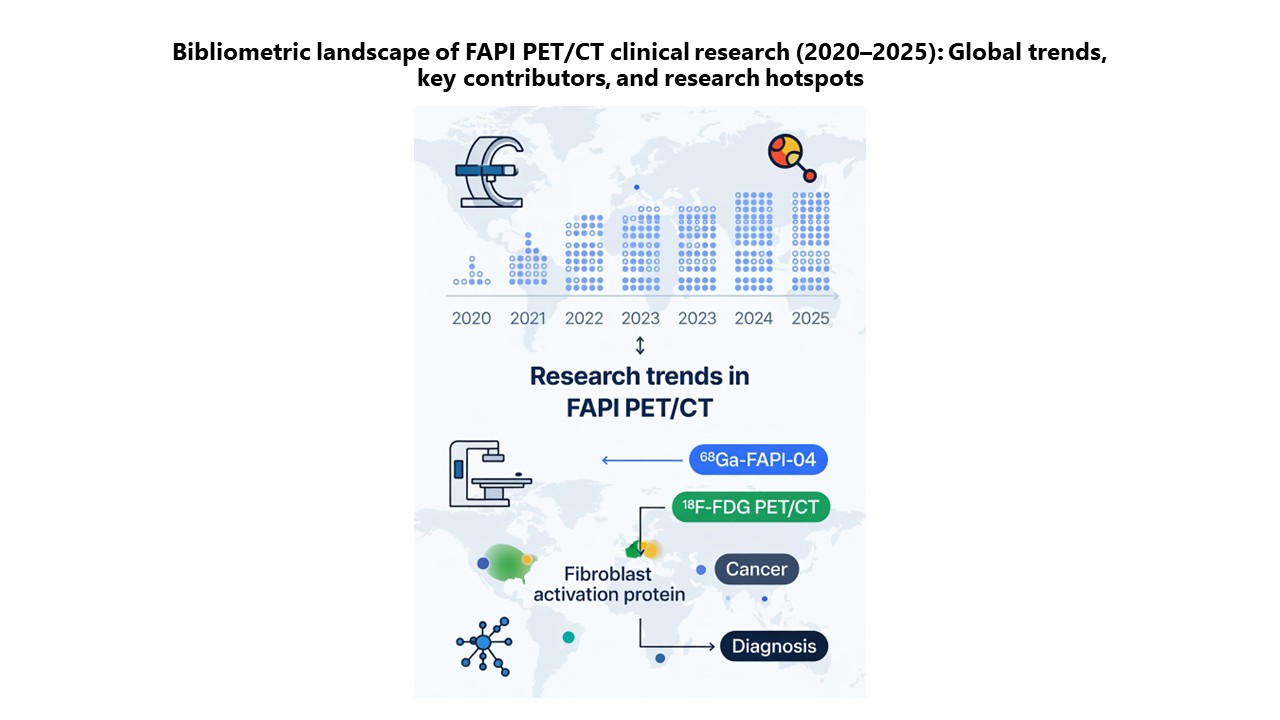
Introduction: The specificity of fibroblast activation protein (FAP) in cancer-associated fibroblasts (CAFs) has attracted significant attention in the nuclear medicine community. FAP is highly expressed in malignant tumor cells, while it is rarely expressed in healthy tissues under physiological conditions. Radionuclide-labeled fibroblast activation protein inhibitors (FAPIs) have shown significant progress as molecular probes for positron emission tomography/computed tomography (PET/ CT) imaging.
Objective: The study aims to provide a comprehensive bibliometric analysis of scientific publications in this field.
Methods: A systematic search was conducted in the Web of Science Core Collection database to identify publications related to FAPI imaging and its clinical applications (last updated July 21, 2025). Visualization software, including VOSviewer, CiteSpace, and RStudio, was used to analyze contributions by countries/regions, institutions, journals, authors, citation patterns, and keyword distributions.
Results: A total of 194 papers were published in this field, with the annual number of publications showing a clear upward trend. China had the most publications (n = 96, 36.23% of 265 country occurrences), followed by Germany (n = 44, 16.60%), Turkey (n = 19, 7.17%), and the United States of America (n = 19, 7.17%) The most-cited article was published in the Journal of Nuclear Medicine (impact factor = 9.1). The German Cancer Research Center was the most prolific institution by publication count. Although Fujian Medical University published fewer articles (n = 10), it achieved the highest total citation count (454), reflecting its high-impact comparative studies. Fendler WP was the most prolific author, with 14 papers published since 2020, the highest H-index (n = 8), and the highest G-index (n = 14). “Fibroblast activation protein,” “PET/CT,” “68Ga-FAPI-04,” and “18F-FDG PET/CT” were the most frequently used keywords in this field.
Conclusion: Over the past five years, research on radiolabeled FAPI as a molecular probe for PET/CT imaging in disease diagnosis and treatment has grown substantially. This bibliometric analysis systematically reveals global trends, collaborative networks, and research hotspots in FAPI PET/CT research from 2020 to 2025, providing valuable data to support further exploration in nuclear medicine.
- Bray F, Laversanne M, Sung H, et al. Global cancer statistics 2022: GLOBOCAN estimates of incidence and mortality worldwide for 36 cancers in 185 countries. CA Cancer J Clin. 2024;74(3):229-263. doi: 10.3322/caac.21834
- Imlimthan S, Moon ES, Rathke H, et al. New Frontiers in Cancer Imaging and Therapy Based on Radiolabeled Fibroblast Activation Protein Inhibitors: A Rational Review and Current Progress. Pharmaceuticals (Basel). 2021;14(10):1023. doi: 10.3390/ph14101023
- Kalluri R. The biology and function of fibroblasts in cancer. Nat Rev Cancer. 2016;16(9):582-598. doi: 10.1038/nrc.2016.73
- Kalluri R, Zeisberg M. Fibroblasts in cancer. Nat Rev Cancer. 2006;6(5):392-401. doi: 10.1038/nrc1877
- Fitzgerald AA, Weiner LM. The role of fibroblast activation protein in health and malignancy. Cancer Metastasis Rev. 2020;39(3):783-803. doi: 10.1007/s10555-020-09909-3
- LeBleu VS, Kalluri R. A peek into cancer-associated fibroblasts: origins, functions and translational impact. Dis Model Mech. 2018;11(4):dmm029447. doi: 10.1242/dmm.029447
- Ziani L, Chouaib S, Thiery J. Alteration of the Antitumor Immune Response by Cancer-Associated Fibroblasts. Front Immunol. 2018;9:414. doi: 10.3389/fimmu.2018.00414
- O’Brien P, O’Connor BF. Seprase: an overview of an important matrix serine protease. Biochim Biophys Acta. 2008;1784(9):1130-1145. doi: 10.1016/j.bbapap.2008.01.006
- Park JE, Lenter MC, Zimmermann RN, Garin-Chesa P, Old LJ, Rettig WJ. Fibroblast activation protein, a dual specificity serine protease expressed in reactive human tumor stromal fibroblasts. J Biol Chem. 1999;274(51):36505-36512. doi: 10.1074/jbc.274.51.36505
- Rettig WJ, Chesa PG, Beresford HR, et al. Differential expression of cell surface antigens and glial fibrillary acidic protein in human astrocytoma subsets. Cancer Res. 1986;46(12 Pt 1):6406-6412.
- Acharya PS, Zukas A, Chandan V, Katzenstein AL, Puré E. Fibroblast activation protein: a serine protease expressed at the remodeling interface in idiopathic pulmonary fibrosis. Hum Pathol. 2006;37(3):352-360. doi: 10.1016/j.humpath.2005.11.020
- Kelly T. Fibroblast activation protein-alpha and dipeptidyl peptidase IV (CD26): cell-surface proteases that activate cell signaling and are potential targets for cancer therapy. Drug Resist Updat. 2005;8(1-2):51-58. doi: 10.1016/j.drup.2005.03.002
- Chen H, Yang WW, Wen QT, Xu L, Chen M. TGF-beta induces fibroblast activation protein expression; fibroblast activation protein expression increases the proliferation, adhesion, and migration of HO-8910PM [corrected]. Exp Mol Pathol. 2009;87(3):189-194. doi: 10.1016/j.yexmp.2009.09.001
- Yazbeck R, Jaenisch SE, Abbott CA. Potential disease biomarkers: dipeptidyl peptidase 4 and fibroblast activation protein. Protoplasma. 2018;255(1):375-386. doi: 10.1007/s00709-017-1129-5
- Brennen WN, Rosen DM, Wang H, Isaacs JT, Denmeade SR. Targeting carcinoma-associated fibroblasts within the tumor stroma with a fibroblast activation protein-activated prodrug. J Natl Cancer Inst. 2012;104(17):1320-1334. doi: 10.1093/jnci/djs336
- LeBeau AM, Brennen WN, Aggarwal S, Denmeade SR. Targeting the cancer stroma with a fibroblast activation protein-activated promelittin protoxin. Mol Cancer Ther. 2009;8(5):1378-1386. doi: 10.1158/1535-7163.Mct-08-1170
- Lee J, Fassnacht M, Nair S, Boczkowski D, Gilboa E. Tumor immunotherapy targeting fibroblast activation protein, a product expressed in tumor-associated fibroblasts. Cancer Res. 2005;65(23):11156-11163. doi: 10.1158/0008-5472.Can-05-2805
- Lo A, Wang LS, Scholler J, et al. Tumor-Promoting Desmoplasia Is Disrupted by Depleting FAP-Expressing Stromal Cells. Cancer Res. 2015;75(14):2800-2810. doi: 10.1158/0008-5472.Can-14-3041
- Ostermann E, Garin-Chesa P, Heider KH, et al. Effective immunoconjugate therapy in cancer models targeting a serine protease of tumor fibroblasts. Clin Cancer Res. 2008;14(14):4584-4592. doi: 10.1158/1078-0432.Ccr-07-5211
- Teichgräber V, Monasterio C, Chaitanya K, et al. Specific inhibition of fibroblast activation protein (FAP)-alpha prevents tumor progression in vitro. Adv Med Sci. 2015;60(2):264-272. doi: 10.1016/j.advms.2015.04.006
- Wang LC, Lo A, Scholler J, et al. Targeting fibroblast activation protein in tumor stroma with chimeric antigen receptor T cells can inhibit tumor growth and augment host immunity without severe toxicity. Cancer Immunol Res. 2014;2(2):154-166. doi: 10.1158/2326-6066.Cir-13-0027
- Blodgett TM, Meltzer CC, Townsend DW. PET/CT: form and function. Radiology. 2007;242(2):360-385. doi: 10.1148/radiol.2422051113
- Kratochwil C, Flechsig P, Lindner T, et al. (68)Ga-FAPI PET/ CT: Tracer Uptake in 28 Different Kinds of Cancer. J Nucl Med. 2019;60(6):801-805. doi: 10.2967/jnumed.119.227967
- Ostman A, Augsten M. Cancer-associated fibroblasts and tumor growth--bystanders turning into key players. Curr Opin Genet Dev. 2009;19(1):67-73. doi: 10.1016/j.gde.2009.01.003
- Luo Y, Pan Q, Yang H, Peng L, Zhang W, Li F. Fibroblast Activation Protein-Targeted PET/CT with (68)Ga-FAPI for Imaging IgG4-Related Disease: Comparison to (18)F-FDG PET/CT. J Nucl Med. 2021;62(2):266-271. doi: 10.2967/jnumed.120.244723
- Dendl K, Koerber SA, Finck R, et al. 68Ga-FAPI-PET/CT in patients with various gynecological malignancies. Eur J Nucl Med Mol Imaging. 2021;48(12):4089-4100. doi: 10.1007/s00259-021-05378-0
- Zhao L, Pang Y, Luo Z, et al. Role of [68Ga]Ga-DOTA- FAPI-04 PET/CT in the evaluation of peritoneal carcinomatosis and comparison with [18F]-FDG PET/ CT. Eur J Nucl Med Mol Imaging. 2021;48(6):1944-1955. doi: 10.1007/s00259-020-05146-6
- Yang X, Liu Y, Chen J, Chen Y, Liu H. 68Ga-FAPI PET/CT Imaging of Baastrup Disease in a Patient With Esophageal Cancer. Clin Nucl Med. 2021;46(12):1024-1025. doi: 10.1097/rlu.0000000000003902
- Zheng Y, Wang Y, Zhang X. (68)Ga-FAPI-04 PET/CT for the Assessment of Light-Chain Cardiac Amyloidosis: A Promising Risk-Stratification Imaging Modality. Curr Cardiol Rep. 2025;27(1):83. doi: 10.1007/s11886-025-02230-x
- Wei J, Chen X. 68 Ga-FAPI-04 PET/CT Imaging of Mesenteric Aggressive Fibromatosis. Clin Nucl Med. 2024;49(7):664-665. doi: 10.1097/rlu.0000000000005219
- Af Burén S, Tran TA, Klevebro F, Holstensson M, Axelsson R. A 68Ga-FAPI-46 PET/CT Imaging Pitfall in Assessing Residual Gastric Cancer Early After Chemotherapy. Clin Nucl Med. 2022;47(7):644-645. doi: 10.1097/rlu.0000000000004143
- Serfling S, Zhi Y, Schirbel A, et al. Improved cancer detection in Waldeyer’s tonsillar ring by (68)Ga-FAPI PET/ CT imaging. Eur J Nucl Med Mol Imaging. 2021;48(4):1178- 1187. doi: 10.1007/s00259-020-05055-8
- Li Y, Zhou Y, He J, et al. Head to head comparison of (18) F-FDG and Al(18)F-NOTA-FAPI-04 PET/CT imaging used in diagnosis of autoimmune rheumatic diseases. Clin Rheumatol. 2024;43(11):3497-3505. doi: 10.1007/s10067-024-07155-4
- Wen P, Liu R, Wang J, Wang Y, Song W, Zhang Y. Bibliometric insights from publications on subchondral bone research in osteoarthritis. Front Physiol. 2022;13:1095868. doi: 10.3389/fphys.2022.1095868
- Yang Z, Lin J, Li H, et al. Bibliometric and visualization analysis of macrophages associated with osteoarthritis from 1991 to 2021. Front Immunol. 2022;13:1013498. doi: 10.3389/fimmu.2022.1013498
- Li D, Yu D, Li Y, Yang R. A bibliometric analysis of PROTAC from 2001 to 2021. Eur J Med Chem. 2022;244:114838. doi: 10.1016/j.ejmech.2022.114838
- Chen C. CiteSpace II: Detecting and visualizing emerging trends and transient patterns in scientific literature. J Am Soc Inf Sci Technol. 2005;57(3):359-377. doi: 10.1002/asi.20317
- Jiang S, Liu Y, Zheng H, et al. Evolutionary patterns and research frontiers in neoadjuvant immunotherapy: a bibliometric analysis. Int J Surg. 2023;109(9):2774-2783. doi: 10.1097/js9.0000000000000492
- Song Y, Jin Y, Wang S, et al. Global research trends in the teacher evaluation of medical college: A bibliometric and visualized study. Heliyon. 2024;10(23):e39370. doi: 10.1016/j.heliyon.2024.e39370
- Matuszczak M, Kiljańczyk A, Marciniak W, et al. Antioxidant Properties of Zinc and Copper—Blood Zinc-to-Copper- Ratio as a Marker of Cancer Risk BRCA1 Mutation Carriers. Antioxidants (Basel). 2024;13(7):841. doi: 10.3390/antiox13070841
- Hamson EJ, Keane FM, Tholen S, Schilling O, Gorrell MD. Understanding fibroblast activation protein (FAP): substrates, activities, expression and targeting for cancer therapy. Proteomics Clin Appl. 2014;8(5-6):454-463. doi: 10.1002/prca.201300095