

Nomogram model for mortality risk of hemangiosarcoma: A Surveillance, Epidemiology, and End Results population-based study

Introduction: Hemangiosarcoma is a malignancy that can develop in many parts of the human body. The overall prognosis of this disease remains unclear.
Objective: This study aims to develop and validate a prognostic model for mortality in patients with hemangiosarcoma.
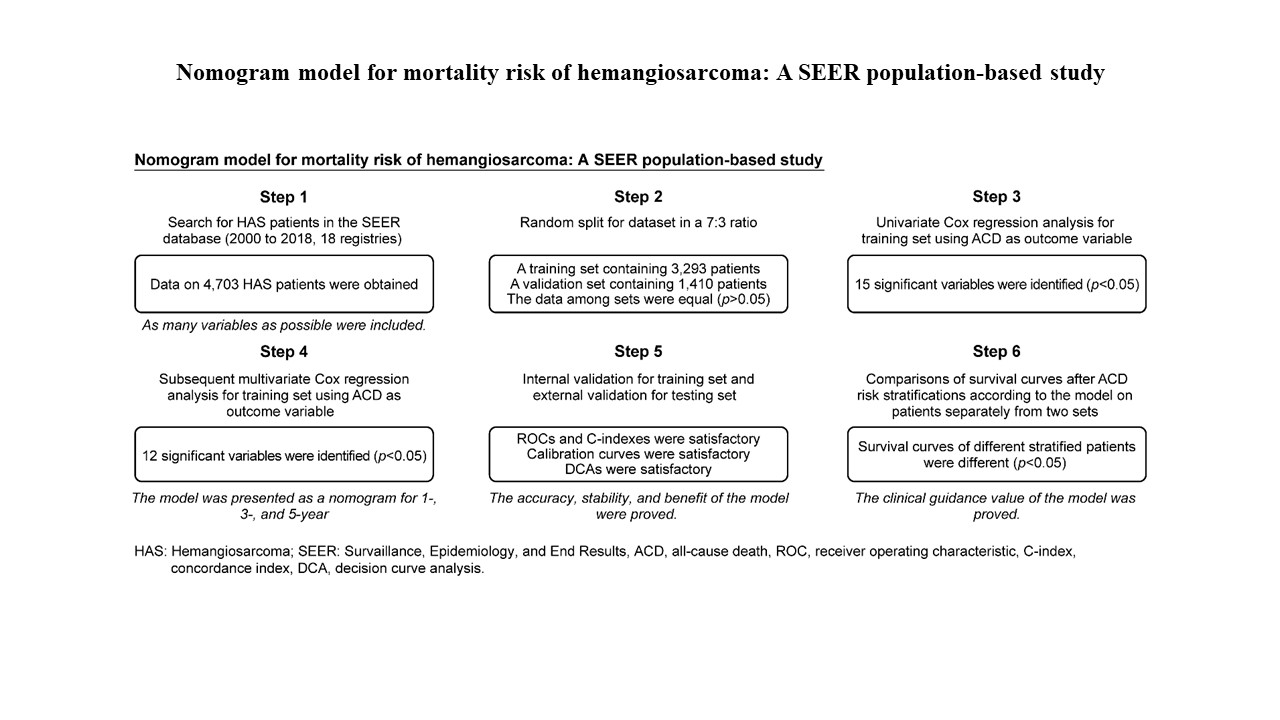
Methods: Data were retrieved from the Surveillance, Epidemiology, and End Results database. Samples with critical missing values were removed. A dataset was established, which was subsequently split randomly into training and testing sets at a ratio of 7:3. Cox regression analyses of all-cause death were performed on the training set to identify statistically significant variables for developing a prognostic model. The nomogram was drawn, and the model was internally and externally validated separately.
Results: A dataset containing 4,703 patients with hemangiosarcoma was obtained. There were no statistical differences in the distributions of all variables between the training and testing sets (p > 0.05). After univariate and multivariate Cox regression analyses, the following variables were considered as risk factors for death in hemangiosarcoma patients (p < 0.05): age, gender, primary site, laterality, tumor size, grade, stage, first malignant primary indicator, primary site surgery (PSS), removal of regional lymph nodes, radiotherapy, and radiotherapy sequence with PSS. After including the above variables, a prognostic model was developed and presented as a nomogram (1-, 3-, and 5-year survival). The model was validated using various methods, yielding favorable results.
Conclusion: Hemangiosarcoma has a poor prognosis. The prognostic model presented in this study can be used to predict overall survival and guide more effective treatments.
- Young RJ, Brown NJ, Reed MW, et al. Angiosarcoma. Lancet Oncol. 2010;11(10):983-991. doi: 10.1016/S1470-2045(10)70023-1
- Rouhani P, Fletcher CDM, Devesa SS, et al. Cutaneous soft tissue sarcoma incidence patterns in the U.S.: an analysis of 12,114 cases. Cancer. 2008;113(3):616-627. doi: 10.1002/cncr.23571
- Young RJ, Woll PJ. Anti-angiogenic therapies for the treatment of angiosarcoma: a clinical update. Memo. 2017;10(4):190-193.doi: 10.1007/s12254-017-0365-x
- Shon W, Sukov WR, Jenkins SM, et al. MYC amplification and overexpression in primary cutaneous angiosarcoma: a fluorescence in-situ hybridization and immunohistochemical study. Mod Pathol. 2014;27(4):509-515. doi: 10.1038/modpathol.2013.163
- Behjati S, Tarpey PS, Sheldon H, et al. Recurrent PTPRB and PLCG1 mutations in angiosarcoma. Nat Genet. 2014;46(4):376-379. doi: 10.1038/ng.2921
- Laé M, Lebel A, Hamel-Viard F, et al. Can c-myc amplification reliably discriminate postradiation from primary angiosarcoma of the breast? Cancer Radiother. 2015;19(3):168-174. doi: 10.1016/j.canrad.2015.01.001
- Yasir S, Torbenson MS. Angiosarcoma of the Liver: Clinicopathologic Features and Morphologic Patterns. Am J Surg Pathol. 2019;43(5):581-590. doi: 10.1097/PAS.0000000000001228
- Pawlik TM, Paulino AF, McGinn CJ, et al. Cutaneous angiosarcoma of the scalp: a multidisciplinary approach. Cancer. 2003;98(8):1716-1726. doi: 10.1002/cncr.11667
- Deyrup AT, McKenney JK, Tighiouart M, et al. Sporadic cutaneous angiosarcomas: a proposal for risk stratification based on 69 cases. Am J Surg Pathol. 2008;32(1):72-77. doi: 10.1097/PAS.0b013e3180f633a3
- Lahat G, Dhuka AR, Hallevi H, et al. Angiosarcoma: clinical and molecular insights. Ann Surg. 2010;251(6):1098-1106. doi: 10.1097/SLA.0b013e3181dbb75a
- Holden CA, Spittle MF, Jones EW. Angiosarcoma of the face and scalp, prognosis and treatment. Cancer. 1987;59(5):1046- 1057. doi: 10.1002/1097-0142(19870301)59:5<1046::AID-CNCR2820590533>3.0.CO;2-6
- Oashi K, Namikawa K, Tsutsumida A, et al. Surgery with curative intent is associated with prolonged survival in patients with cutaneous angiosarcoma of the scalp and face -a retrospective study of 38 untreated cases in the Japanese population. Eur J Surg Oncol. 2018;44(6):823-829. doi: 10.1016/j.ejso.2018.02.246
- Patel SH, Hayden RE, Hinni ML, et al. Angiosarcoma of the scalp and face: the Mayo Clinic experience. JAMA Otolaryngol Head Neck Surg. 2015;141(4):335-340. doi: 10.1001/jamaoto.2014.3584
- Fujisawa Y, Yoshino K, Kadono T, et al. Chemoradiotherapy with taxane is superior to conventional surgery and radiotherapy in the management of cutaneous angiosarcoma: a multicentre, retrospective study. Br J Dermatol. 2014;171(6):1493-1500. doi: 10.1111/bjd.13110
- Sher T, Hennessy BT, Valero V, et al. Primary angiosarcomas of the breast. Cancer. 2007;110(1):173-178. doi: 10.1002/cncr.22784
- Lahat G, Dhuka AR, Lahat S, et al. Outcome of locally recurrent and metastatic angiosarcoma. Ann Surg Oncol. 2009;16(9):2502-2509. doi: 10.1245/s10434-009-0569-3
- Abraham JA, Hornicek FJ, Kaufman AM, et al. Treatment and outcome of 82 patients with angiosarcoma. Ann Surg Oncol. 2007;14(6):1953-1967. doi: 10.1245/s10434-006-9335-y
- Fayette J, Martin E, Piperno-Neumann S, et al. Angiosarcomas, a heterogeneous group of sarcomas with specific behavior depending on primary site: a retrospective study of 161 cases. Ann Oncol. 2007;18(12):2030-2036. doi: 10.1093/annonc/mdm381
- Eitan T, Damico NJ, Pidikiti R, et al. Reirradiation for Recurrent Scalp Angiosarcoma: Dosimetric Advantage of PBT over VMAT and EBT. Int J Part Ther. 2020;6(3):13-18. doi: 10.14338/IJPT-19-00074
- Yan Q, Fernandez RA, Elmi M, et al. Outcomes of Interventions for Angiosarcoma. Front Surg. 2022;9:819099. doi: 10.3389/fsurg.2022.819099
- Cronin KA, Ries LA, Edwards BK. The Surveillance, Epidemiology, and End Results (SEER) Program of the National Cancer Institute. Cancer. 2014;120(Suppl 23):3755- 3757. doi: 10.1002/cncr.29049
- Surveillance, Epidemiology, and End Results (SEER) Program. SEER Stat Database: Incidence - SEER Research Plus Data, 18 Registries, Nov 2020 Sub (2000–2018) - Linked To County Attributes - Total U.S., 1969–2019 Counties. National Cancer Institute, DCCPS, Surveillance Research Program. Released April 2021.
- Cox DR. Regression Models and Life-Tables. J R Stat Soc Series B Stat Methodol. 1972;34(2):187-202. doi: 10.1111/j.2517-6161.1972.tb00899.x
- Sternberg CN. Are nomograms better than currently available stage groupings for bladder cancer? J Clin Oncol. 2006;24(24):3819-3820. doi: 10.1200/JCO.2006.07.1290
- Harrell FE, Califf RM, Pryor DB, Lee KL, Rosati R. Evaluating the Yield of Medical Tests. JAMA. 1982;247(18):2543. doi: 10.1001/jama.1982.03320430047030
- Alba AC, Agoritsas T, Walsh M, et al. Discrimination and Calibration of Clinical Prediction Models: Users’ Guides to the Medical Literature. JAMA. 2017;318(14):1377-1384. doi: 10.1001/jama.2017.12126
- Vickers AJ, Elkin EB. Decision curve analysis: a novel method for evaluating prediction models. Med Decis Making. 2006;26(6):565-574. doi: 10.1177/0272989X06295361
- Zeng D, Zeng X, Duan J, et al. Clinical characteristics of primary hepatic angiosarcoma outcomes: a SEER database analysis. Transl Cancer Res. 2021;10(1):110-125. doi: 10.21037/tcr-20-2780
- Mao J, Hu J, Chen Y, et al. Development and validation of a prognostic nomogram model in primary cutaneous and subcutaneous soft tissue angiosarcoma. J Dermatolog Treat. 2022;33(5):2466-2474. doi: 10.1080/09546634.2021.1968333
- Jiang T, Ye Z, Shao T, et al. Prognostic nomograms for predicting overall survival and cancer-specific survival in patients with angiosarcoma, a SEER population-based study. Sci Rep. 2022;12(1):3479-3488. doi: 10.1038/s41598-022-07444-5
- Fury MG, Antonescu CR, Van Zee KJ, et al. A 14-year retrospective review of angiosarcoma: clinical characteristics, prognostic factors, and treatment outcomes with surgery and chemotherapy. Cancer J. 2005;11(3):241-247. doi: 10.1097/00130404-200505000-00011
- Mullin C, Clifford CA. Histiocytic sarcoma and hemangiosarcoma update. Vet Clin North Am Small Anim Pract. 2019;49(5):855-879. doi: 10.1016/j.cvsm.2019.04.009
- Pereira ES, Moraes ET, Siqueira DM, et al. Stewart Treves syndrome. An Bras Dermatol. 2015;90(3 Suppl 1):229-231. doi: 10.1590/abd1806-4841.20153685
- Tran Minh M, Mazzola A, Perdigao F, et al. Primary hepatic angiosarcoma and liver transplantation: radiological, surgical, histological findings and clinical outcome. Clin Res Hepatol Gastroenterol. 2018;42(1):17-23. doi: 10.1016/j.clinre.2017.02.006
- Cao J, Wang J, He C, Fang M. Angiosarcoma: a review of diagnosis and current treatment. Am J Cancer Res. 2019;9(11):2303-2313.
- Conic RRZ, Damiani G, Frigerio A, et al. Incidence and outcomes of cutaneous angiosarcoma: A SEER population-based study. J Am Acad Dermatol. 2020;83(3):809-816. doi: 10.1016/j.jaad.2019.07.024
- Florou V, Wilky BA. Current and Future Directions for Angiosarcoma Therapy. Curr Treat Options Oncol. 2018;19(3):14-27. doi: 10.1007/s11864-018-0531-3
- Chen TW, Burns J, Jones RL, et al. Optimal Clinical Management and the Molecular Biology of Angiosarcomas. Cancers (Basel). 2020;12(11):3321-3343. doi: 10.3390/cancers12113321
- Singla S, Papavasiliou P, Powers B, et al. Challenges in the treatment of angiosarcoma: a single institution experience. Am J Surg. 2014;208(2):254-259. doi: 10.1016/j.amjsurg.2014.01.007
- Shin JY, Roh SG, Lee NH, et al. Predisposing factors for poor prognosis of angiosarcoma of the scalp and face: systematic review and meta-analysis. Head Neck. 2017;39(2):380-386. doi: 10.1002/hed.24554
- Odintsov I, Papke DJ, George S, Padera RF, Hornick JL, Siegmund SE. Genomic profiling of cardiac angiosarcoma reveals novel targetable KDR variants, recurrent MED12 Mutations, and a high burden of germline POT1 alterations. Clin Cancer Res. 2025;31(6):1091-1102. doi: 10.1158/1078-0432.CCR-24-3277
- Li R, Li M, Zhang LF, et al. Clinical Characteristics and Prognostic Factors of Primary Splenic Angiosarcoma: A Retrospective Clinical Analysis from China. Cell Physiol Biochem. 2018;49(5):1959-1969. doi: 10.1159/000493656
- Murali R, Chandramohan R, Möller I, et al. Targeted massively parallel sequencing of angiosarcomas reveals frequent activation of the mitogen activated protein kinase pathway. Oncotarget. 2015;6(34):36041-36052. doi: 10.18632/oncotarget.5936
- Manner J, Radlwimmer B, Hohenberger P, et al. MYC high level gene amplification is a distinctive feature of angiosarcomas after irradiation or chronic lymphedema. Am J Pathol. 2010;176(1):34-39. doi: 10.2353/ajpath.2010.090637
- Espejo-Freire A, Elliott A, Rosenberg A, et al. Genomic Landscape of Angiosarcoma: A Targeted and Immunotherapy Biomarker Analysis. Cancers (Basel). 2021;13(19):4816. doi: 10.3390/cancers13194816
- Roohani S, Rotermund T, Ehret F, et al. Angiosarcoma: clinical outcomes and prognostic factors, a single-center analysis. J Cancer Res Clin Oncol. 2024;150(6):326. doi: 10.1007/s00432-024-05835-x
- Wang L, Lao IW, Yu L, et al. Clinicopathological features and prognostic factors in angiosarcoma: A retrospective analysis of 200 patients from a single Chinese medical institute. Oncol Lett. 2017;14(5):5370-5378. doi: 10.3892/ol.2017.6892
- Jridi I, Catacchio I, Majdoub H, et al. The small subunit of Hemilipin2, a new heterodimeric phospholipase A2 from Hemiscorpius lepturus scorpion venom, mediates the antiangiogenic effect of the whole protein. Toxicon. 2017;126:38-46. doi: 10.1016/j.toxicon.2016.12.001