

Machine learning-based prediction of tumor volume changes in MRIdian-based adaptive radiotherapy for prostate cancer

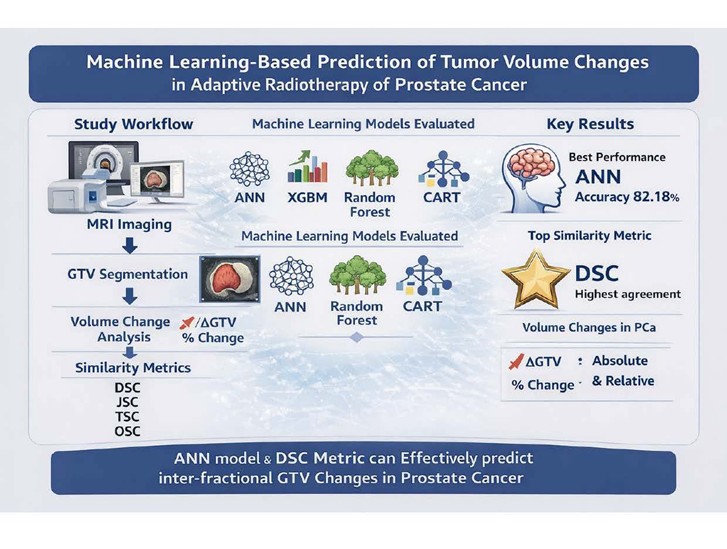
Accurate prediction of inter-fractional tumor volume changes may improve the efficiency and personalization of magnetic resonance-guided adaptive radiotherapy in prostate cancer (PCa). This study investigates the feasibility of using machine learning algorithms to predict inter-fraction gross tumor volume (GTV) changes in PCa during adaptive radiotherapy (ART), aiming to identify the optimal similarity coefficient and model to improve ART decision-making. Retrospective magnetic resonance images from 22 PCa patients treated using the ViewRay MRIdian LINAC system were analyzed. The GTV of each patient was recorded before treatment (GTV0) and during five fractions (GTV1–5). Four different similarity coefficients—dice, Jaccard, Tanimoto, and Ochiai similarity coefficients (DSC, JSC, TSC, and OSC)—were calculated to evaluate inter-fractional GTV variations. Machine learning models—artificial neural networks (ANNs), extreme gradient boosting machine, random forests, classification and regression trees, and k-nearest neighbors—were trained with appropriate hyperparameters to predict tumor volume changes between fractions. Their predictive performances were compared to determine the most effective algorithm. The ANN model demonstrated superior performance in predicting GTV variations across treatment fractions. Among the similarity coefficients, DSC contributed most to predicting inter-fractional tumor volume changes, while OSC had the least impact. The ANN model achieved the highest predictive performance on the independent test dataset (R2 = 0.822). These findings indicate that ANN models can successfully predict inter-fractional GTV variations in PCa, thereby providing valuable support for ART decision-making. Incorporating DSC-based similarity analysis may facilitate ART planning and improve clinical outcomes. The study supports integrating AI-based methods into the ART workflow.
- Sung H, Ferlay J, Siegel RL, et al. Global Cancer Statistics 2020: GLOBOCAN estimates of incidence and mortality worldwide for 36 cancers in 185 countries. CA Cancer J Clin. 2021;71(3):209-249. doi: 10.3322/caac.21660
- Sekhoacha M, Riet K, Motloung P, Gumenku L, Adegoke A, Mashele S. Prostate cancer review: Genetics, diagnosis, treatment options, and alternative approaches. Molecules. 2022;27(17):5730. doi: 10.3390/molecules27175730
- Batista V, Richter D, Chaudhri N, Naumann P, Herfarth K, Jäkel O. Significance of intra-fractional motion for pancreatic patients treated with charged particles. Radiat Oncol. 2018;13(1). doi: 10.1186/s13014-018-1060-8
- Dial C, Weiss E, Siebers JV., Hugo GD. Benefits of adaptive radiation therapy in lung cancer as a function of replanning frequency. Med Phys. 2016;43(4):1787-1794. doi: 10.1118/1.4943564
- Finazzi T, Palacios MA, Haasbeek CJA, et al. Stereotactic MR-guided adaptive radiation therapy for peripheral lung tumors. Radiother Oncol. 2020;144:46-52. doi: 10.1016/j.radonc.2019.10.013
- Green OL, Henke LE, Hugo GD. Practical clinical workflows for online and offline adaptive radiation therapy. Semin Radiat Oncol. 2019;29(3):219-227. doi: 10.1016/j.semradonc.2019.02.004
- Li Y, Hoisak JDP, Li N, et al. Dosimetric benefit of adaptive re-planning in pancreatic cancer stereotactic body radiotherapy. Med Dosim. 2015;40(4):318-324. doi: 10.1016/j.meddos.2015.04.002
- Mannerberg A, Persson E, Jonsson J, et al. Dosimetric effects of adaptive prostate cancer radiotherapy in an MR-linac workflow. Radiat Oncol. 2020;15(1). doi: 10.1186/s13014-020-01604-5
- Nierer L, Eze C, da Silva Mendes V, et al. Dosimetric benefit of MR-guided online adaptive radiotherapy in different tumor entities: liver, lung, abdominal lymph nodes, pancreas and prostate. Radiat Oncol. 2022;17(1). doi: 10.1186/s13014-022-02021-6
- Rudra S, Jiang N, Rosenberg SA, et al. Using adaptive magnetic resonance image-guided radiation therapy for treatment of inoperable pancreatic cancer. Cancer Med. 2019;8(5):2123-2132. doi: 10.1002/cam4.2100
- Sonke JJ, Aznar M, Rasch C. Adaptive radiotherapy for anatomical changes. Semin Radiat Oncol. 2019;29(3):245- 257. doi: 10.1016/j.semradonc.2019.02.007
- Yan D, Vicini F, Wong J, Martinez A. Adaptive radiation therapy. Phys Med Biol. 1997;42(1):123-132. doi: 10.1088/0031-9155/42/1/008
- Jeong S, Cheon W, Kim S, Park W, Han Y. Deep-learning-based segmentation using individual patient data on prostate cancer radiation therapy. PLoS ONE. 2024;19(7):e0308181. doi: 10.1371/journal.pone.0308181
- Derbal Y. Adaptive treatment of metastatic prostate cancer using generative artificial intelligence. Clin Med Insights Oncol. 2025;19:11795549241311408. doi: 10.1177/11795549241311408
- Hwang J, Eum H, Kim JS, Lee E, Kang BH, Park Y. Personalized deep learning model for target volume based on CBCT for prostate adaptive SBRT patients. Int J Radiat Oncol Biol Phys. 2024;120(2):e539-e540. doi: 10.1016/j.ijrobp.2024.07.1196
- Brand VJ, Milder MTW, Christianen MEMC, et al. First-in-men online adaptive robotic stereotactic body radiation therapy: toward ultrahypofractionation for high-risk prostate cancer patients. Adv Radiat Oncol. 2025;10(2):101701. doi: 10.1016/j.adro.2024.101701
- Khalifa A, Winter JD, Tadic T, Purdie TG, McIntosh C. Machine learning automated treatment planning for online magnetic resonance guided adaptive radiotherapy of prostate cancer. Phys Imaging Radiat Oncol. 2024;32:100649. doi: 10.1016/j.phro.2024.100649
- Radici L, Piva C, Casanova Borca V, et al. Clinical evaluation of a deep learning CBCT auto-segmentation software for prostate adaptive radiation therapy. Clin Transl Radiat Oncol. 2024;47:100796. doi: 10.1016/j.ctro.2024.100796
- Kim JI, Park JM, Choi CH, An HJ, Kim YJ, Kim JH. Retrospective study comparing MR-guided radiation therapy (MRgRT) setup strategies for prostate treatment: Repositioning vs. replanning. Radiat Oncol. 2019;14(1). doi: 10.1186/s13014-019-1349-2
- Ma C, Tian Z, Wang R, et al. A prediction model for dosimetric-based lung adaptive radiotherapy. Med Phys. 2022;49(10):6319-6333. doi: 10.1002/mp.15714
- Brown E, Owen R, Harden F, et al. Predicting the need for adaptive radiotherapy in head and neck cancer. Radiother Oncol. 2015;116(1):57-63. doi: 10.1016/j.radonc.2015.06.025
- Guidi G, Maffei N, Vecchi C, et al. A support vector machine tool for adaptive tomotherapy treatments: Prediction of head and neck patients criticalities. Phys Med. 2015;31(5):442- 451. doi: 10.1016/j.ejmp.2015.04.009
- Guidi G, Maffei N, Meduri B, et al. A machine learning tool for re-planning and adaptive RT: A multicenter cohort investigation. Phys Med. 2016;32(12):1659-1666. doi: 10.1016/j.ejmp.2016.10.005
- Nasief H, Omari E, Zhang Y, et al. Automatically determining necessity of online adaptive replanning based on MRI wavelet multiscale texture features for MRI-guided adaptive radiation therapy. Int J Radiat Oncol Biol Phys. 2021;111(3):S55. doi: 10.1016/j.ijrobp.2021.07.142
- Nasief HG, Parchur AK, Omari E, et al. Predicting necessity of daily online adaptive replanning based on wavelet image features for MRI guided adaptive radiation therapy. Radiother Oncol. 2022;176:165-171. doi: 10.1016/j.radonc.2022.10.001
- Kavanaugh J, Roach M, Ji Z, Fontenot J, Hugo GD. A method for predictive modeling of tumor regression for lung adaptive radiotherapy. Med Phys. 2021;48(5):2083- 2094. doi: 10.1002/mp.14529
- Parchur AK, Lim S, Nasief HG, et al. Auto-detection of necessity for MRI-guided online adaptive replanning using a machine learning classifier. Med Phys. 2023;50(1):440-448. doi: 10.1002/mp.16047
- Rachi T, Ariji T, Takahashi S. Development of machine-learning prediction programs for delivering adaptive radiation therapy with tumor geometry and body shape changes in head and neck volumetric modulated Arc therapy. Adv Radiat Oncol. 2023;8(4):101172. doi: 10.1016/j.adro.2023.101172
- Dice LR. Measures of the amount of ecologic association between species. Ecology. 1945;26(3):297-302. doi: 10.2307/1932409
- Jaccard P. The distribution of the flora in the alpine zone. N Phytol. 1912;11(2):37-50. doi: 10.1111/j.1469-8137.1912.tb05611.x
- Tanimoto TT. An elementary mathematical theory of classification and prediction. Proc IBM Intern Rep. Preprint posted online 1958.
- Romesburg HC. Cluster Analysis for Researchers. Lifetime Learning Publications; 1984.
- Thomas MA, Fu Y, Yang D. Development and evaluation of machine learning models for voxel dose predictions in online adaptive magnetic resonance guided radiation therapy. J Appl Clin Med Phys. 2020;21(7):60-69. doi: 10.1002/acm2.12884
- Kai Y, Arimura H, Ninomiya K, et al. Semi-automated prediction approach of target shifts using machine learning with anatomical features between planning and pretreatment CT images in prostate radiotherapy. J Radiat Res. 2020;61(2):285-297. doi: 10.1093/jrr/rrz105