
Research progress on prostate-specific membrane antigen-targeted small-molecule radioligands

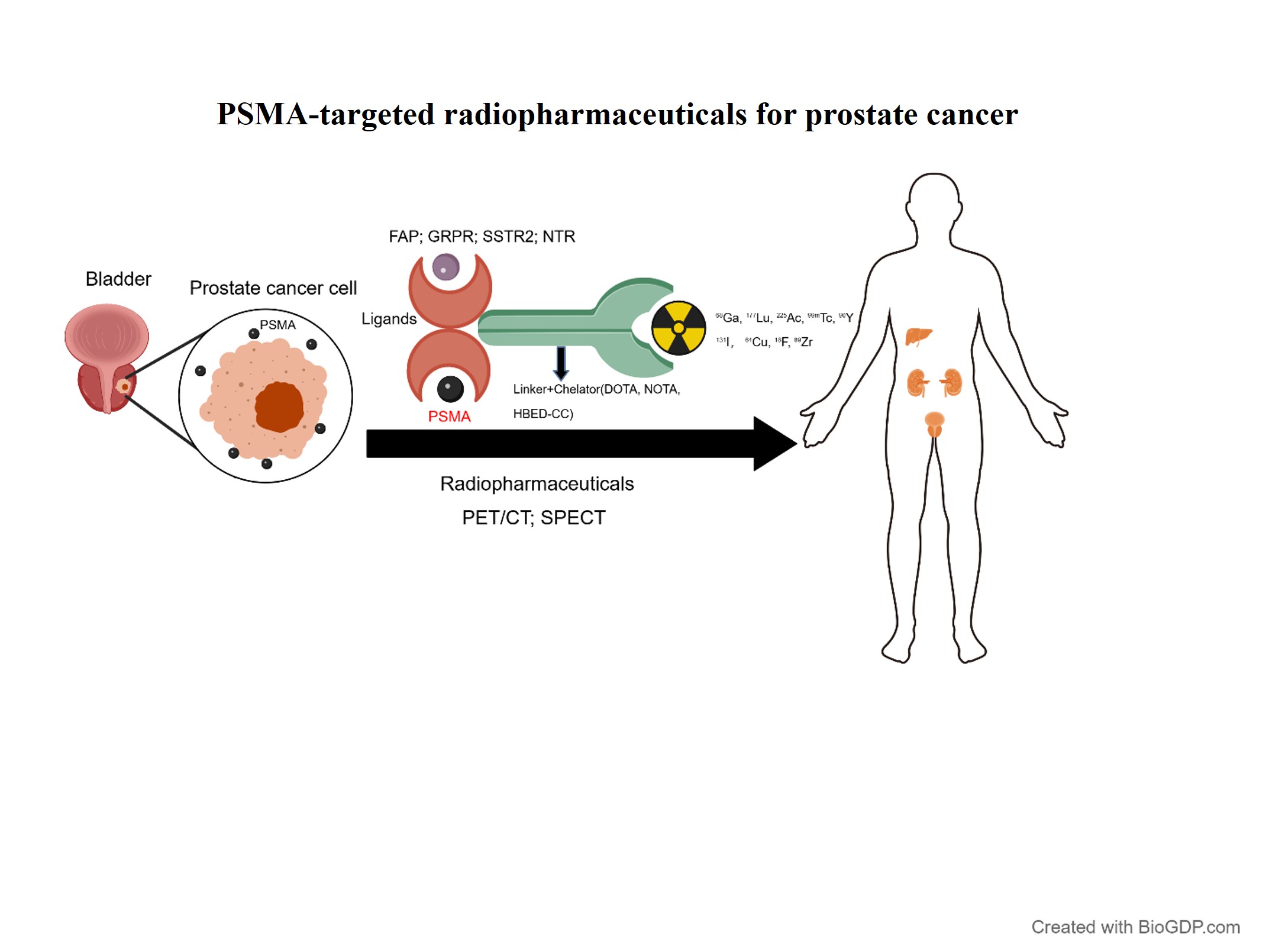
Prostate-specific membrane antigen (PSMA) is markedly overexpressed on prostate cancer cell membranes—particularly in advanced, metastatic, and metastatic castration-resistant prostate cancer (mCRPC) lesions—but is present at only low levels in healthy tissues and organs, such as the salivary glands, kidneys, and proximal small intestine. This unique characteristic makes PSMA a highly promising target for precision radiopharmaceutical-based theranostics of prostate cancer. In recent years, the rapid development of radionuclides, such as 68Ga, 18F, 90Y, 64Cu, 177Lu, and 225Ac, together with continuous advances in bifunctional chelators including 1,4,7,10-tetraazacyclododecane-1,4,7,10-tetraacetic acid (DOTA) and 1,4,7-triazacyclononane-1,4,7-triacetic acid (NOTA), has enabled a seamless transition from diagnosis to therapy for targeted radiotheranostic strategies. Notably, [177Lu]Lu-PSMA-617 (brand name: Pluvicto) has been approved by the United States Food and Drug Administration for the treatment of patients with PSMA-positive mCRPC based on the groundbreaking findings from the Phase III VISION trial, which has fundamentally transformed the treatment landscape of this disease. Nevertheless, current PSMA-targeted radiopharmaceuticals still face multiple challenges: temporal and spatial heterogeneity of tumor PSMA expression, mechanisms of acquired drug resistance, and adverse reactions induced by dose-limiting toxicities. This review systematically reviews the latest preclinical advances and clinical translation outcomes of PSMA-targeted ligands, covering molecular design strategies, optimization of pharmacokinetic profiles, exploration of novel radionuclides, and evaluation of radiopharmaceuticals. It aims to provide a valuable reference for researchers engaged in PSMA-targeted theranostic studies.
- Bray F, Laversanne M, Sung H, et al. Global cancer statistics 2022: GLOBOCAN estimates of incidence and mortality worldwide for 36 cancers in 185 countries. CA Cancer J Clin. 2024;74:229-263. doi: 10.3322/caac.21834
- James ND, Tannock I, N’Dow J, et al. The Lancet Commission on prostate cancer: planning for the surge in cases. Lancet. 2024;403(10437):1683-1722. doi: 10.1016/S0140-6736(24)00651-2
- Chakrabarti D, Albertsen P, Adkins A, et al. The contemporary management of prostate cancer. CA Cancer J Clin. 2025;75(6):552-586. doi: 10.3322/caac.70020
- Malik SS, Batool R, Masood N, Yasmin A. Risk factors for prostate cancer: a multifactorial case-control study. Curr Probl Cancer. 2018;42(3):337-343. doi: 10.1016/j.currproblcancer.2018.01.014
- Oczkowski M, Dziendzikowska K, Pasternak-Winiarska A, Włodarek D, Gromadzka-Ostrowska J. Dietary factors and prostate cancer development, progression, and reduction. Nutrients. 2021;13(2):496. doi: 10.3390/nu13020496
- Almeeri MNE, Awies M, Constantinou C. Prostate cancer, pathophysiology and recent developments in management: a narrative review. Curr Oncol Rep. 2024;26(11):1511-1519. doi: 10.1007/s11912-024-01614-6
- Tortorella E, Giantulli S, Sciarra A, Silvestri I. AR and PI3K/AKT in prostate cancer: a tale of two interconnected pathways. Int J Mol Sci. 2023;24(3):2046. doi: 10.3390/ijms24032046
- Tzelepi V. Prostate cancer: pathophysiology, pathology and therapy. Cancers. 2022;15(1):281. doi: 10.3390/cancers15010281
- Jiang S, Li H, Zhang L. Generic Diagramming Platform (GDP): a comprehensive database of high-quality biomedical graphics. Nucleic Acids Res. 2025;53(D1):D1670-D1676. doi: 10.1093/nar/gkae973
- Nikfarjam Z, Zargari F, Nowroozi A, Bavi O. Metamorphosis of prostate specific membrane antigen (PSMA) inhibitors. Biophys Rev. 2022;14(1):303-315. doi: 10.1007/s12551-021-00919-1
- Maes J, Gesquière S, De Spiegeleer A, Maes A, Van de Wiele C. Prostate-specific membrane antigen biology and pathophysiology in prostate carcinoma, an update: potential implications for targeted imaging and therapy. Int J Mol Sci. 2024;25(17):9755. doi: 10.3390/ijms25179755
- Jiao J, Kang F, Zhang J, et al. Establishment and prospective validation of an SUVmax cutoff value to discriminate clinically significant prostate cancer from benign prostate diseases in patients with suspected prostate cancer by 68Ga-PSMA PET/CT: a real-world study. Theranostics. 2021;11(17):8396-8411. doi: 10.7150/thno.58140
- Mei R, Bracarda S, Emmett L, et al. Androgen deprivation therapy and its modulation of PSMA expression in prostate cancer: mini review and case series of patients studied with sequential [68Ga]-Ga-PSMA-11 PET/CT. Clin Transl Imaging. 2021;9(3):215-220. doi: 10.1007/s40336-021-00421-4
- Pabst KM, Mei R, Lückerath K, et al. Detection of tumour heterogeneity in patients with advanced, metastatic castration-resistant prostate cancer on [68Ga]Ga-/[18F] F-PSMA-11/-1007, [68Ga]Ga-FAPI-46 and 2-[18F] FDG PET/CT: a pilot study. Eur J Nucl Med Mol Imaging. 2024;52(1):342-353. doi: 10.1007/s00259-024-06891-8
- Meller B, Bremmer F, Sahlmann CO, et al. Alterations in androgen deprivation enhanced prostate-specific membrane antigen (PSMA) expression in prostate cancer cells as a target for diagnostics and therapy. EJNMMI Res. 2015;5(1):66. doi: 10.1186/s13550-015-0145-8
- Afshar-Oromieh A, Debus N, Uhrig M, et al. Impact of long-term androgen deprivation therapy on PSMA ligand PET/ CT in patients with castration-sensitive prostate cancer. Eur J Nucl Med Mol Imaging. 2018;45(12):2045-2054. doi: 10.1007/s00259-018-4079-z
- Maylin ZR, Smith C, Classen A, Asim M, Pandha H, Wang Y. Therapeutic exploitation of neuroendocrine transdifferentiation drivers in prostate cancer. Cells. 2024;13(23):1999. doi: 10.3390/cells13231999
- Bakht MK, Derecichei I, Li Y, et al. Neuroendocrine differentiation of prostate cancer leads to PSMA suppression. Endocr Relat Cancer. 2019;26(2):131-146. doi: 10.1530/ERC-18-0226
- Zaidi S, Park J, Chan JM, et al. Single-cell analysis of treatment-resistant prostate cancer: implications of cell state changes for cell surface antigen-targeted therapies. Proc Natl Acad Sci U S A. 2024;121(28):e2322203121. doi: 10.1073/pnas.2322203121
- Yamada Y, Beltran H. Clinical and biological features of neuroendocrine prostate cancer. Curr Oncol Rep. 2021;23(2):15. doi: 10.1007/s11912-020-01003-9
- Kułakowski A. The contribution of Marie Skłodowska- Curie to the development of modern oncology. Anal Bioanal Chem. 2011;400(6):1583-1586. doi: 10.1007/s00216-011-4712-1
- Borges de Souza P, McCabe CJ. Radioiodine treatment: an historical and future perspective. Endocr Relat Cancer. 2021;28(10):T121-T124. doi: 10.1530/ERC-21-0037
- Salih S, Alkatheeri A, Alomaim W, Elliyanti A. Radiopharmaceutical treatments for cancer therapy, radionuclides characteristics, applications, and challenges. Molecules. 2022;27(16):5231. doi: 10.3390/molecules27165231
- Tan H, Gu Y, Yu H. Total-body PET/CT: current applications and future perspectives. AJR Am J Roentgenol. 2020;215(2):325-337. doi: 10.2214/AJR.19.22705
- Garg P, Singhal G, Horne D, Kulkarni P, Salgia R, Singhal SS. Molecular PET imaging: unlocking the secrets of cancer metabolism. Biochem Pharmacol. 2025;242:117202. doi: 10.1016/j.bcp.2025.117202
- Sutherland DEK, Azad AA, Murphy DG, Eapen RS, Kostos L, Hofman MS. Role of FDG PET/CT in management of patients with prostate cancer. Semin Nucl Med. 2024;54(1):4-13. doi: 10.1053/j.semnuclmed.2023.06.005
- Hirata K, Tamaki N. Quantitative FDG PET assessment for oncology therapy. Cancers. 2021;13(4):869. doi: 10.3390/cancers13040869
- Shen Z, Li Z, Li Y, et al. PSMA PET/CT for prostate cancer diagnosis: current applications and future directions. J Cancer Res Clin Oncol. 2025;151(5):155. doi: 10.1007/s00432-025-06184-z
- Rahman WT, Wale DJ, Viglianti BL, et al. The impact of infection and inflammation in oncologic 18F-FDG PET/CT imaging. Biomed Pharmacother. 2019;117:109168. doi: 10.1016/j.biopha.2019.109168
- Gillett D, MacFarlane J, Bashari W, et al. Molecular imaging of pituitary tumors. Semin Nucl Med. 2023;53(4):530-538. doi: 10.1053/j.semnuclmed.2023.02.005
- Schaafsma M, Berends AMA, Links TP, Brouwers AH, Kerstens MN. The diagnostic value of 18F-FDG PET/CT scan in characterizing adrenal tumors. J Clin Endocrinol Metab. 2023;108(9):2435-2445. doi: 10.1210/clinem/dgad138
- Finessi M, Bisi G, Deandreis D. Hyperglycemia and 18F-FDG PET/CT, issues and problem solving: a literature review. Acta Diabetol. 2020;57(3):253-262. doi: 10.1007/s00592-019-01385-8
- Kornberg A, Schernhammer M, Friess H. 18F-FDG-PET for assessing biological viability and prognosis in liver transplant patients with hepatocellular carcinoma. J Clin Transl Hepatol. 2017;5(3):224-234. doi: 10.14218/JCTH.2017.00014
- Sheikh A, Anolik J, Maurer AH. Update on serum glucose and metabolic management of clinical nuclear medicine studies: current status and proposed future directions. Semin Nucl Med. 2019;49(5):411-421. doi: 10.1053/j.semnuclmed.2019.06.001
- Van den Wyngaert T, Elvas F, De Schepper S, Kennedy JA, Israel O. SPECT/CT: standing on the shoulders of giants, it is time to reach for the sky! J Nucl Med. 2020;61(9):1284- 1291. doi: 10.2967/jnumed.119.236943
- Sgouros G, Bodei L, McDevitt MR, Nedrow JR. Radiopharmaceutical therapy in cancer: clinical advances and challenges. Nat Rev Drug Discov. 2020;19(9):589-608. doi: 10.1038/s41573-020-0073-9
- Ren X, Zhang L, An R, Song H, Shi M, Wang Z. Focusing on prostate-specific membrane antigen in precision diagnosis and treatment of prostate cancer. Biomedicines. 2026;14(2):482. doi: 10.3390/biomedicines14020482
- Iacovitti CM, Cuzzocrea M, Rizzo A, et al. Diagnostic value of dual-tracer PET/CT with [18F]FDG and PSMA ligands in prostate cancer: an updated systematic review. Front Med (Lausanne). 2025;12:1607227. doi: 10.3389/fmed.2025.1607227
- Hennrich U, Eder M. [68Ga]Ga-PSMA-11: the first FDA-approved 68Ga-radiopharmaceutical for PET imaging of prostate cancer. Pharmaceuticals. 2021;14(9):713. doi: 10.3390/ph14080713
- Eder M, Schäfer M, Bauder-Wüst U, et al. 68Ga-complex lipophilicity and the targeting property of a urea-based PSMA inhibitor for PET imaging. Bioconjug Chem. 2012;23(4):688-697. doi: 10.1021/bc200279b
- Ahmadzadehfar H, Seifert R, Afshar-Oromieh A, Kratochwil C, Rahbar K. Prostate cancer theranostics with 177Lu-PSMA. Semin Nucl Med. 2024;54(4):581-590. doi: 10.1053/j.semnuclmed.2024.02.007
- Kratochwil C, Bruchertseifer F, Giesel FL, et al. 225Ac-PSMA-617 for PSMA-targeted α-radiation therapy of metastatic castration-resistant prostate cancer. J Nucl Med. 2016;57(12):1941-1944. doi: 10.2967/jnumed.116.178673
- Kratochwil C, Haberkorn U, Giesel FL. 225Ac-PSMA-617 for therapy of prostate cancer. Semin Nucl Med. 2020;50:133- 140. doi: 10.1053/j.semnuclmed.2020.02.004
- Jeitner TM, Babich JW, Kelly JM. Advances in PSMA theranostics. Transl Oncol. 2022;22:101450. doi: 10.1016/j.tranon.2022.101450
- Sun M, Niaz MJ, Niaz MO, Tagawa ST. Prostate-specific membrane antigen (PSMA)-targeted radionuclide therapies for prostate cancer. Curr Oncol Rep. 2021;23(5):59. doi: 10.1007/s11912-021-01042-w
- Wester HJ, Schottelius M. PSMA-targeted radiopharmaceuticals for imaging and therapy. Semin Nucl Med. 2019;49(4):302-312. doi: 10.1053/j.semnuclmed.2019.02.008
- Hu M, Zhang C, Fan D, Yang R, Bai Y, Shi H. Advances in preclinical research of theranostic radiopharmaceuticals in nuclear medicine. ACS Appl Mater Interfaces. 2025;17(3):4337-4353. doi: 10.1021/acsami.4c20602
- Benešová M, Schäfer M, Bauder-Wüst U, et al. Preclinical evaluation of a tailor-made DOTA-conjugated PSMA inhibitor with optimized linker moiety for imaging and endoradiotherapy of prostate cancer. J Nucl Med. 2015;56(6):914-920. doi: 10.2967/jnumed.114.147413
- Weineisen M, Schottelius M, Simecek J, et al. 68Ga- and 177Lu-labeled PSMA I&T: optimization of a PSMA-targeted theranostic concept and first proof-of-concept human studies. J Nucl Med. 2015;56(8):1169-1176. doi: 10.2967/jnumed.115.158550
- Umbricht CA, Benešová M, Schibli R, Müller C. Preclinical development of novel PSMA-targeting radioligands: modulation of albumin-binding properties to improve prostate cancer therapy. Mol Pharm. 2018;15(6):2297-2306. doi: 10.1021/acs.molpharmaceut.8b00152
- Wang Z, Tian R, Niu G, et al. Single low-dose injection of Evans blue modified PSMA-617 radioligand therapy eliminates prostate-specific membrane antigen positive tumors. Bioconjug Chem. 2018;29(9):3213-3221. doi: 10.1021/acs.bioconjchem.8b00556
- Liu T, Liu C, Xu X, et al. Preclinical evaluation and pilot clinical study of Al18F-PSMA-BCH for prostate cancer PET imaging. J Nucl Med. 2019;60(9):1284-1292. doi: 10.2967/jnumed.118.221671
- Fu H, He H, Wang Y, et al. Preliminary evaluation of a novel PSMA-targeting radiopharmaceutical [68Ga]Ga/[177Lu] Lu-NYM032 for theranostic use in prostate cancer. Eur J Nucl Med Mol Imaging. 2025;52(5):1671-1684. doi: 10.1007/s00259-024-07046-5
- Meyer C, Prasad V, Stuparu A, et al. Comparison of PSMA-TO-1 and PSMA-617 labeled with gallium-68, lutetium-177 and actinium-225. EJNMMI Res. 2022;12(1):65. doi: 10.1186/s13550-022-00935-6
- Hu K, Li L, Huang Y, et al. Radiosynthesis and preclinical evaluation of bispecific PSMA/FAP heterodimers for tumor imaging. Pharmaceuticals. 2022;15(3):383. doi: 10.3390/ph15030383
- Boinapally S, Lisok A, Lofland G, et al. Hetero-bivalent agents targeting FAP and PSMA. Eur J Nucl Med Mol Imaging. 2022;49(13):4369-4381. doi: 10.1007/s00259-022-05933-3
- Wang X, Zhang X, Zhang X, et al. Design, preclinical evaluation, and first-in-human PET study of [68Ga] Ga-PSFA-01: a PSMA/FAP heterobivalent tracer. Eur J Nucl Med Mol Imaging. 2025;52(3):1166-1176. doi: 10.1007/s00259-024-06965-7
- Wang P, Wang S, Liu F, et al. Preclinical evaluation of a fibroblast activation protein and a prostate-specific membrane antigen dual-targeted probe for noninvasive prostate cancer imaging. Mol Pharm. 2023;20(2):1415-1425. doi: 10.1021/acs.molpharmaceut.2c01000
- Hou H, Gao J, Ma Y, et al. Development and biological evaluation of PSMA/FAP dual targeting radiotracers for prostate cancer imaging. Inorg Chem Front. 2024;11(19):6476-6485. doi: 10.1039/D4QI01503G
- Wang Y, Li X, Li C, Xing H, Gao R, Jia B. A novel PSMA/ FAP-specific radiotracer 99mTc-HFaPSMA for diagnosis of PSMA-negative prostate cancer: from preclinical validation to clinical translation. J Med Chem. 2025;68(16):17598- 17610. doi: 10.1021/acs.jmedchem.5c01294
- Liolios C, Bouziotis D, Sihver W, et al. Synthesis and preclinical evaluation of a bispecific PSMA-617/RM2 heterodimer targeting prostate cancer. ACS Med Chem Lett. 2024;15(11):1970-1978. doi: 10.1021/acsmedchemlett.4c00324
- Mitran B, Varasteh Z, Abouzayed A, et al. Bispecific GRPR-antagonistic anti-PSMA/GRPR heterodimer for PET and SPECT diagnostic imaging of prostate cancer. Cancers. 2019;11(9):1371. doi: 10.3390/cancers11091371
- Lundmark F, Abouzayed A, Mitran B, et al. Heterodimeric radiotracer targeting PSMA and GRPR for imaging of prostate cancer-optimization of the affinity towards PSMA by linker modification in murine model. Pharmaceutics. 2020;12(7):614. doi: 10.3390/pharmaceutics12070614
- Jin W, Yan L, Li L, et al. PSMA and SSTR2 dual-targeting theranostic agents for neuroendocrine-differentiated prostate cancer (NEPC). J Med Chem. 2025;68(2):1984- 1993. doi: 10.1021/acs.jmedchem.4c02768
- Ma X, Wang M, Wang H, et al. Development of bispecific NT-PSMA heterodimer for prostate cancer imaging: a potential approach to address tumor heterogeneity. Bioconjug Chem. 2019;30(5):1314-1322. doi: 10.1021/acs.bioconjchem.9b00252
- Schäfer M, Bauder-Wüst U, Leotta K, et al. A dimerized urea-based inhibitor of the prostate-specific membrane antigen for 68Ga-PET imaging of prostate cancer. EJNMMI Res. 2012;2(1):23. doi: 10.1186/2191-219X-2-23
- Ruigrok EAM, van Vliet N, Dalm SU, et al. Extensive preclinical evaluation of lutetium-177-labeled PSMA-specific tracers for prostate cancer radionuclide therapy. Eur J Nucl Med Mol Imaging. 2021;48(5):1339-1350. doi: 10.1007/s00259-020-05057-6
- Gühne F, Radke S, Winkens T, et al. Differences in distribution and detection rate of the [68Ga]Ga-PSMA ligands PSMA-617, -I&T and -11-inter-individual comparison in patients with biochemical relapse of prostate cancer. Pharmaceuticals. 2021;15(1):9. doi: 10.3390/ph15010009
- Lau J, Jacobson O, Niu G, Lin KS, Bénard F, Chen X. Bench to bedside: albumin binders for improved cancer radioligand therapies. Bioconjug Chem. 2019;30(3):487-502. doi: 10.1021/acs.bioconjchem.8b00919
- Liu Z, Chen X. Simple bioconjugate chemistry serves great clinical advances: albumin as a versatile platform for diagnosis and precision therapy. Chem Soc Rev. 2016;45(5):1432-1456. doi: 10.1039/c5cs00158g
- Benešová M, Umbricht CA, Schibli R, Müller C. Albumin-binding PSMA ligands: optimization of the tissue distribution profile. Mol Pharm. 2018;15(3):934-946. doi: 10.1021/acs.molpharmaceut.7b00877
- Kramer V, Fernández R, Lehnert W, et al. Biodistribution and dosimetry of a single dose of albumin-binding ligand [177Lu]Lu-PSMA-ALB-56 in patients with mCRPC. Eur J Nucl Med Mol Imaging. 2021;48(3):893-903. doi: 10.1007/s00259-020-05022-3
- Cornelio DB, Roesler R, Schwartsmann G. Gastrin-releasing peptide receptor as a molecular target in experimental anticancer therapy. Ann Oncol. 2007;18(9):1457-1466. doi: 10.1093/annonc/mdm058
- Wang Q, Li Z, Huang Y, et al. A novel androgen-independent radiotracer with dual targeting of NTSR1 and PSMA for PET/CT imaging of prostate cancer. Eur J Med Chem. 2024;282:117050. doi: 10.1016/j.ejmech.2024.117050