
The impact of domestic greywater irrigation on soil quality in Swartland Municipality, Western Cape, South Africa

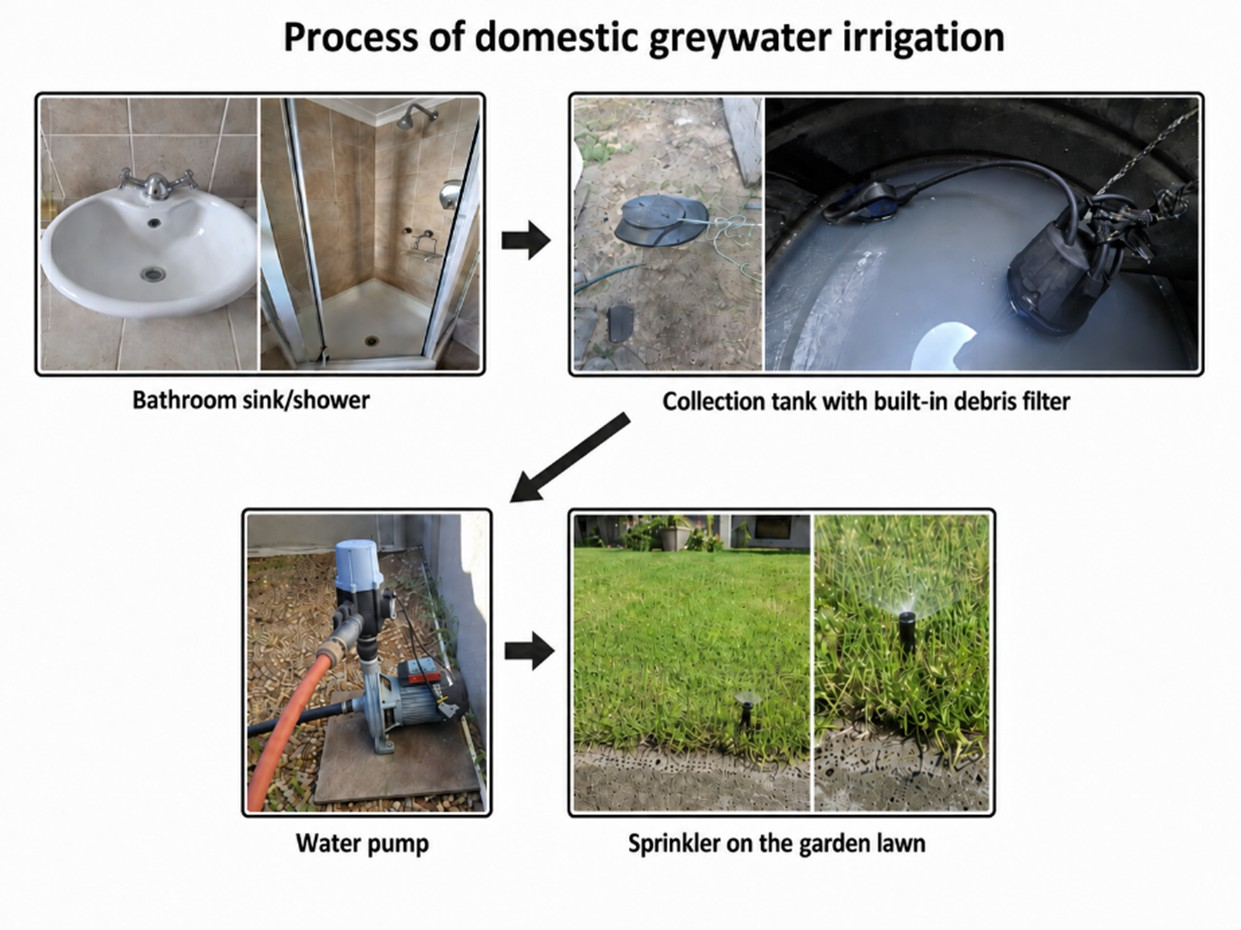
The sustainable reuse of greywater for irrigation is increasingly important in water-scarce regions, but prolonged application may alter soil chemical properties and influence plant growth. Understanding these changes is particularly relevant in municipalities such as Swartland, South Africa, where alternative water sources are considered to supplement conventional irrigation. This study evaluated soil chemistry and Kikuyu grass (Cenchrus clandestinus) performance after approximately eight months of outdoor irrigation in Swartland Municipality, South Africa. Four irrigation treatments—untreated greywater (UGW), sodium-hypochlorite-treated greywater (TGW), municipal tap water (MTW), and borehole water (BW)—and one non-irrigated control planter box (CPB) were set up in wooden boxes. Soil was sampled at 0–5 cm and 5–10 cm. Because there was only one independent box per irrigation, the results are descriptive, and treatment-level inferential statistics were not used. In the initial phase, phosphorus was 31–37 mg/kg. In the first post-initial growth comparison, recorded growth rate was 3.22 cm/week for UGW, 1.77 cm/week for MTW, 1.56 cm/week for BW, 1.18 cm/week for TGW, and 0 cm/week for CPB. Soil sodium increased from approximately 1.6%–5.5% initially to about 17%–28% in the highest MTW and BW observations; calcium declined from approximately 82%–89% to about 50%–66%, while magnesium increased from 6.7%–7.1% to about 18%–26%. Phosphorus also increased in the CPB, reaching 150 mg/kg at the surface, showing that temporal changes cannot be attributed to irrigation sources alone. Grass growth was highest in UGW, and the observed soil chemical changes support monitoring during continued greywater reuse.
- Filali H, Barsan N, Souguir D, Nedeff V, Tomozei C, Hachicha M. Greywater as an alternative solution for sustainable management of water resources—a review. Sustainability (Basel). 2022;14(2):665. doi: 10.3390/su14020665
- Travis MJ, Wiel-Shafran A, Weisbrod N, Adar E, Gross A. Greywater reuse for irrigation: effect on soil properties. Sci Total Environ. 2010;408(12):2501-2508. doi: 10.1016/j.scitotenv.2010.03.005
- Turner RD, Will GD, Dawes LA, Gardner EA, Lyons DJ. Phosphorus as a limiting factor on sustainable greywater irrigation. Sci Total Environ. 2013;456-457:287-298. doi: 10.1016/j.scitotenv.2013.02.061
- Radingoana MP, Dube T, Mazvimavi D. An assessment of irrigation water quality and potential of reusing greywater in home gardens in water-limited environments. Phys Chem Earth Parts A/B/C. 2020;116:102857. doi: 10.1016/j.pce.2020.102857
- Republic of South Africa. National Water Act (No. 36 of 1998). Government Gazette 19182. Pretoria, South Africa: Office of the President; 1998. Accessed November 17, 2026. https://www.gov.za/sites/default/files/gcis_document/201409/a36-98.pdf
- Republic of South Africa. National Health Act (No. 61 of 2003). Government Gazette 26595. Pretoria, South Africa: The Presidency; 2004. Accessed November 17, 2026. https://www.gov.za/sites/default/files/gcis_document/201409/a61-03.pdf
- Department of Water and Sanitation. National Sanitation Policy 2016. Pretoria, South Africa: Department of Water and Sanitation, Republic of South Africa; 2016.
- Ilemobade AA, Olanrewaju OO, Griffioen ML. Greywater Reuse for Toilet Flushing in High-Density Urban Buildings in South Africa: A Pilot Study. WRC Report No. 1821/1/11. Pretoria, South Africa: Water Research Commission; 2012. Accessed November 17, 2026. https://www.wrc.org.za/wp-content/uploads/mdocs/TB_1821_Greywater%20reuse%20for%20toilet%20flushing.pdf
- Department of Water and Sanitation. National Norms and Standards for Domestic Water and Sanitation Services. Version 3—Final. Government Notice R982, Government Gazette 41100. Pretoria, South Africa: Department of Water and Sanitation; 2017. Accessed November 17, 2026. https://www.gov.za/sites/default/files/gcis_document/201709/41100gon982.pdf
- Shafran AW, Gross A, Ronen Z, Weisbrod N, Adar E. Effects of surfactants originating from reuse of greywater on capillary rise in the soil. Water Sci Technol. 2005;52(10-11):157-166. doi: 10.2166/wst.2005.0690
- Bakare BF, Mtsweni S, Rathilal S. Characteristics of greywater from different sources within households in a community in Durban, South Africa. J Water Reuse Desalin. 2017;7(4):520-528. doi: 10.2166/wrd.2016.092
- Li F, Wichmann K, Otterpohl R. Evaluation of appropriate technologies for grey water treatments and reuses. Water Sci Technol. 2009;59(2):249-260. doi: 10.2166/wst.2009.854
- Ottoson J, Stenström TA. Faecal contamination of greywater and associated microbial risks. Water Res. 2003;37(3):645-655. doi: 10.1016/S0043-1354(02)00352-4
- O'Toole J, Sinclair M, Malawaraarachchi M, Hamilton A, Barker SF, Leder K. Microbial quality assessment of household greywater. Water Res. 2012;46(13):4301-4313. doi: 10.1016/j.watres.2012.05.001
- Siggins A, Burton V, Ross C, Lowe H, Horswell J. Effects of long-term greywater disposal on soil: a case study. Sci Total Environ. 2016;557-558:627-635. doi: 10.1016/j.scitotenv.2016.03.084
- Tal T, Sathasivan A, Bal Krishna KC. Effect of different disinfectants on grey water quality during storage. J Water Sustain. 2011;1(1):127-137.
- Meteostat. Langebaanweg: weather history and climate. Accessed August 6, 2026. https://meteostat.net/en/station/68714
- Kesar S, Bhatti MS. Chlorination of secondary treated wastewater with sodium hypochlorite (NaOCl): an effective single alternate to other disinfectants. Heliyon. 2022;8(11):e11162. doi: 10.1016/j.heliyon.2022.e11162
- Republic of South Africa. National Environmental Management: Waste Act, 2008 (Act No. 59 of 2008). Government Notice 278, Government Gazette 32000. Pretoria, South Africa: The Presidency; 2009. Accessed November 17, 2026. https://www.gov.za/sites/default/files/gcis_document/201409/32000278.pdf
- Department of Environmental Affairs. National Norms and Standards for the Remediation of Contaminated Land and Soil Quality. Government Notice 331, Government Gazette 37603. Pretoria, South Africa: Government Printer; May 2, 2014. Accessed November 17, 2026. https://www.gov.za/sites/default/files/gcis_document/201409/37603gon331.pdf
- Swanepoel PA, Botha PR, Snyman HA, du Preez CC. Impact of cultivation method on productivity and botanical composition of a kikuyu-ryegrass pasture. Afr J Range Forage Sci. 2014;31(3):215-220. doi: 10.2989/10220119.2014.903999
- Swanepoel PA, du Preez CC, Botha PR, Snyman HA. A critical view on the soil fertility status of minimum-till kikuyu-ryegrass pastures in South Africa. Afr J Range Forage Sci. 2015;32(2):113-124. doi: 10.2989/10220119.2015.1008043
- Liu S, Cen B, Yu Z, Qiu R, Gao T, Long X. The key role of biochar in amending acidic soil: reducing soil acidity and improving soil acid buffering capacity. Biochar. 2025;7(1):52. doi: 10.1007/s42773-025-00432-8
- Siatwiinda SM, Ros GH, Yerokun OA, de Vries W. Options to reduce ranges in critical soil nutrient levels used in fertilizer recommendations by accounting for site conditions and methodology: a review. Agron Sustain Dev. 2024;44(1):9. doi: 10.1007/s13593-023-00943-3
- Aishah RM, Elssaidi MA. Effect of greywater irrigation on soil available-phosphorus. Sirte Univ Sci J. 2021;11(2):28-41. doi: 10.37375/susj.v11i2.808
- Pinto U, Maheshwari BL, Grewal HS. Effects of greywater irrigation on plant growth, water use and soil properties. Resour Conserv Recycl. 2010;54(7):429-435. doi: 10.1016/j.resconrec.2009.09.007
- Kopittke PM, Menzies NW. A review of the use of the basic cation saturation ratio and the "ideal" soil. Soil Sci Soc Am J. 2007;71(2):259-265. doi: 10.2136/sssaj2006.0186
- Wakeel A, Ishfaq M. Potassium dynamics in soils. In: Potash Use and Dynamics in Agriculture. Singapore: Springer; 2022:7-17. doi: 10.1007/978-981-16-6883-8_2
- Bader BR, Taban SK, Fahmi AH, Abood MA, Hamdi GJ. Potassium availability in soil amended with organic matter and phosphorous fertiliser under water stress during maize (Zea mays L) growth. J Saudi Soc Agric Sci. 2021;20(6):390-394. doi: 10.1016/j.jssas.2021.04.006
- Olaniyan FT, Alori ET, Adekiya AO, et al. The use of soil microbial potassium solubilizers in potassium nutrient availability in soil and its dynamics. Ann Microbiol. 2022;72(1):45. doi: 10.1186/s13213-022-01701-8
- Musinguzi P, Ebanyat P, Tenywa JS, Basamba TA, Tenywa MM, Mubiru DN. Critical soil organic carbon range for optimal crop response to mineral fertiliser nitrogen on a Ferralsol. Exp Agric. 2016;52(4):635-653. doi: 10.1017/S0014479715000307
- Wang L, Blanchy G, Cornelis W, Garré S. Changes in soil hydraulic and physio-chemical properties under treated wastewater irrigation: a meta-analysis. Agric Water Manag. 2024;295:108752. doi: 10.1016/j.agwat.2024.108752
- Sumner ME. Sodic soils: new perspectives. Aust J Soil Res. 1993;31(6):683-750. doi: 10.1071/SR9930683
- Phogat V, Mallants D, Šimůnek J, Cox JW, Petrie PR, Pitt T. Modelling salinity and sodicity risks of long-term use of recycled water for irrigation of horticultural crops. Soil Syst. 2021;5(3):49. doi: 10.3390/soilsystems5030049
- Dikinya O, Hinz C, Aylmore G. Influence of sodium adsorption ratio on sodium and calcium breakthrough curves and hydraulic conductivity in soil columns. Aust J Soil Res. 2007;45(8):586-597. doi: 10.1071/SR06100
- Rengasamy P. Importance of calcium in irrigation with saline-sodic water—a viewpoint. Agric Water Manag. 1987;12(3):207-219. doi: 10.1016/0378-3774(87)90013-8
- Syromiatnykov Y, Mamatov F, Sholoiko A, et al. Geometry-optimized strip tillage for improving soil physical quality and hydraulic function in semi-arid vineyards. Agriculture (Basel). 2026;16(7):751. doi: 10.3390/agriculture16070751
- Lozano LA, Soracco CG, Villarreal R, Ressia JM, Sarli GO, Filgueira RR. Soil physical quality and soybean yield as affected by chiseling and subsoiling of a no-till soil. Rev Bras Cienc Solo. 2016;40:e0150160. doi: 10.1590/18069657rbcs20150160
- Cucci G, Lacolla G. Irrigation with saline-sodic water: effects on two clay soils. Ital J Agron. 2013;8(2):e13. doi: 10.4081/ija.2013.e13
- Rodda N, Salukazana L, Jackson SAF, Smith MT. Use of domestic greywater for small-scale irrigation of food crops: effects on plants and soil. Phys Chem Earth Parts A/B/C. 2011;36(14-15):1051-1062. doi: 10.1016/j.pce.2011.08.002
- Mir AR, Pichtel J, Hayat S. Copper: uptake, toxicity and tolerance in plants and management of Cu-contaminated soil. Biometals. 2021;34(4):737-759. doi: 10.1007/s10534-021-00306-z
- Shabbir Z, Sardar A, Shabbir A, et al. Copper uptake, essentiality, toxicity, detoxification and risk assessment in soil-plant environment. Chemosphere. 2020;259:127436. doi: 10.1016/j.chemosphere.2020.127436
- Neupane A, Herndon EM, DeBruyn JM, Chhetri A, Jagadamma S. Manganese concentration influences nitrogen cycling in agricultural soil. Appl Soil Ecol. 2025;215:106460. doi: 10.1016/j.apsoil.2025.106460
- Vélez-Bermúdez IC, Schmidt W. Plant strategies to mine iron from alkaline substrates. Plant Soil. 2023;483(1-2):1-25. doi: 10.1007/s11104-022-05746-1
- Saleem A, Zulfiqar A, Saleem MZ, et al. Alkaline and acidic soil constraints on iron accumulation by rice cultivars in relation to several physio-biochemical parameters. BMC Plant Biol. 2023;23(1):397. doi: 10.1186/s12870-023-04400-x
- Chen C, Thompson A. The influence of native soil organic matter and minerals on ferrous iron oxidation. Geochim Cosmochim Acta. 2021;292:254-270. doi: 10.1016/j.gca.2020.10.002
- Liu L, Zheng N, Yu Y, Zheng Z, Yao H. Soil carbon and nitrogen cycles driven by iron redox: a review. Sci Total Environ. 2024;918:170660. doi: 10.1016/j.scitotenv.2024.170660