
Microbiological quality of inland and coastal springs: Escherichia coli, other coliforms, and implications for public health

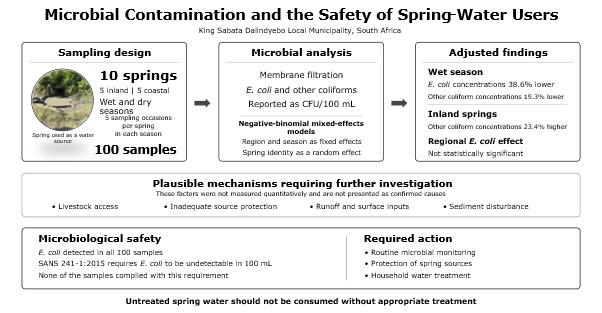
Untreated springs remain important domestic water sources in rural communities, yet their microbial safety and spatial and seasonal variability are insufficiently characterised. This study evaluated concentrations of Escherichia coli and other coliforms in inland and coastal springs within the King Sabata Dalindyebo Local Municipality, South Africa. Ten springs, five inland and five coastal, were sampled on five occasions during both wet and dry seasons, producing 100 water samples. Microorganisms were enumerated by membrane filtration, and concentrations were expressed as colony-forming units per 100 mL (CFU/100 mL). Separate negative binomial generalised linear mixed-effects models were fitted for each microbial indicator, with region and season as fixed effects and spring identity as a random intercept to account for repeated observations. E. coli was detected in all samples at concentrations ranging from 4 to 470 CFU/100 mL. After adjustment for region and repeated observations within springs, expected E. coli concentrations were 38.6% lower during the wet season than during the dry season (incidence rate ratio [IRR] = 0.614, 95% confidence interval [CI]: 0.468–0.805, p < 0.001). The adjusted inland–coastal difference in E. coli was not statistically significant (IRR = 1.346, 95% CI: 0.912–1.987, p = 0.135). Expected other-coliform concentrations were 19.3% lower during the wet season (IRR = 0.807, 95% CI: 0.720–0.905, p < 0.001) and 23.4% higher in inland springs compared with coastal springs (IRR = 1.234, 95% CI: 1.019–1.494, p = 0.031). None of the samples complied with the South African National Standard 241-1:2015 requirement for E. coli to be undetectable in 100 mL of drinking water. The findings demonstrate persistent faecal contamination across the investigated springs, with seasonal variation showing a more consistent association with microbial concentrations than broad inland–coastal classification. Routine microbial monitoring, improved spring protection, and effective household water treatment are required to reduce exposure to E. coli in communities that depend on untreated spring water.
- Keegan-Treloar R, Irvine DJ, Solórzano-Rivas SC, Werner AD, Banks EW, Currell MJ. Fault-controlled springs: a review. Earth Sci Rev. 2022;230:104058. doi: 10.1016/j.earscirev.2022.104058
- Kouassi KJM, Lachassagne P, Mangoua OMJ, Sombo AP, Dibi B. Identifying the origin of springs in weathered-fractured crystalline aquifers using a hydrogeophysical approach. Sci Rep. 2024;14(1):12977. doi: 10.1038/s41598-024-63748-8
- Ansari F, Dewantoro A, Putri I. Assessment of communities' water springs in Gowa Regency, South Sulawesi Province, Indonesia. IOP Conf Ser Earth Environ Sci. 2021;909(1):012008. doi: 10.1088/1755-1315/909/1/012008
- Dumaru B, Kayastha SP, Pandey VP. Spring water assessment for quality and suitability for various uses: the case of Thuligaad watershed, western Nepal. Environ Earth Sci. 2021;80(17):586. doi: 10.1007/s12665-021-09826-w
- Ranjan P, Pandey P, Pandey V, Lepcha P. Development of seepage spring for rural water security. IOP Conf Ser Mater Sci Eng. 2021;1070(1):012047. doi: 10.1088/1757-899X/1070/1/012047
- Cabral JPS. Water microbiology: bacterial pathogens and water. Int J Environ Res Public Health. 2010;7(10):3657-3703. doi: 10.3390/ijerph7103657
- Odonkor ST, Ampofo JK. Escherichia coli as an indicator of bacteriological quality of water: an overview. Microbiol Res (Pavia). 2013;4(1):e2. doi: 10.4081/mr.2013.e2
- World Health Organization. Guidelines for Drinking-Water Quality: Fourth Edition Incorporating the First and Second Addenda. Geneva, Switzerland: World Health Organization; 2022. Accessed September 19, 2026. https://www.who.int/publications/i/item/9789240045064
- Bain R, Cronk R, Wright J, Yang H, Slaymaker T, Bartram J. Fecal contamination of drinking-water in low- and middle-income countries: a systematic review and meta-analysis. PLoS Med. 2014;11(5):e1001644. doi: 10.1371/journal.pmed.1001644
- Raina UM, Shafi N, Shahid N, et al. Assessing rural drinking water quality, sanitation and hygiene practices in Muzaffar Garh District, Pakistan. J Health Wellness Community Res. 2025;3(9):e454. doi: 10.61919/0whdys10
- Ekici G, Dümen E. Escherichia coli and food safety. In: Starčič Erjavec M, ed. The Universe of Escherichia coli. London, England: IntechOpen; 2019. doi: 10.5772/intechopen.82375
- Elmonir W, Remela EMA, Alwakil YS. Diversity, virulence and antibiogram traits of Escherichia coli recovered from potable water sources in Gharbia, Egypt. J Water Health. 2020;18(3):430-438. doi: 10.2166/wh.2020.239
- Megchún-García JV, Landeros-Sánchez C, Soto-Estrada A, et al. Total coliforms and Escherichia coli in surface and subsurface water from a sugarcane agroecosystem in Veracruz, Mexico. J Agric Sci. 2015;7(6):110-119. doi: 10.5539/jas.v7n6p110
- Gwimbi P, George M, Ramphalile M. Bacterial contamination of drinking water sources in rural villages of Mohale Basin, Lesotho: exposures through neighbourhood sanitation and hygiene practices. Environ Health Prev Med. 2019;24(1):33. doi: 10.1186/s12199-019-0790-z
- Odonkor ST, Mahami T. Escherichia coli as a tool for disease risk assessment of drinking water sources. Int J Microbiol. 2020;2020:2534130. doi: 10.1155/2020/2534130
- Tallon P, Magajna B, Lofranco C, Leung KT. Microbial indicators of faecal contamination in water: a current perspective. Water Air Soil Pollut. 2005;166(1-4):139-166. doi: 10.1007/s11270-005-7905-4
- Health Canada. Guidelines for Canadian Drinking Water Quality: Guideline Technical Document—Total Coliforms. Ottawa, Canada: Government of Canada; 2020. Accessed September 19, 2026. https://www.canada.ca/en/health-canada/services/publications/healthy-living/guidelines-canadian-drinking-water-quality-guideline-technical-document-total-coliforms.html
- Akita LG, Laudien J, Biney CA, Akrong MO. A baseline study of spatial variability of bacteria (total coliform, E. coli, and Enterococcus spp.) as biomarkers of pollution in ten tropical Atlantic beaches: concern for environmental and public health. Environ Sci Pollut Res Int. 2021;28(36):50941-50965. doi: 10.1007/s11356-021-15432-x
- Riley LW. Distinguishing pathovars from nonpathovars: Escherichia coli. Microbiol Spectr. 2020;8(4):AME-0014-2020. doi: 10.1128/microbiolspec.AME-0014-2020
- Zamxaka M, Pironcheva G, Muyima NYO. Bacterial community patterns of domestic water sources in the Gogogo and Nkonkobe areas of the Eastern Cape Province, South Africa. Water SA. 2004;30(3):341-346. doi: 10.4314/wsa.v30i3.5082
- Edokpayi JN, Rogawski ET, Kahler DM, et al. Challenges to sustainable safe drinking water: a case study of water quality and use across seasons in rural communities in Limpopo Province, South Africa. Water (Basel). 2018;10(2):159. doi: 10.3390/w10020159
- Awuah F. Application of microorganisms to determine the impact of infiltration layer and season on pit latrine groundwater contamination. Sustinere J Environ Sustain. 2024;8(3):357-367. doi: 10.22515/sustinere.jes.v8i3.425
- Buckerfield SJ, Quilliam RS, Bussière L, et al. Chronic urban hotspots and agricultural drainage drive microbial pollution of karst water resources in rural developing regions. Sci Total Environ. 2020;744:140898. doi: 10.1016/j.scitotenv.2020.140898
- Mogane B, Kachienga L, Kamika I, Ngobeni-Nyambi R, Momba MNB. Distribution of host-specific Bacteroidales marker genes in water sources of selected rural areas of Vhembe District, South Africa. Sci Rep. 2024;14(1):19758. doi: 10.1038/s41598-024-68771-3
- Wilson AM, Martin SL, Verhougstraete MP, et al. Detangling seasonal relationships of fecal contamination sources and correlates with indicators in Michigan watersheds. Microbiol Spectr. 2022;10(3):e00415-22. doi: 10.1128/spectrum.00415-22
- Maželienė Ž, Jarienė G, Aleksandravičienė A. Microbial and chemical contamination in springs of Northern and Central Lithuania. Microbiol Res (Pavia). 2025;16(11):229. doi: 10.3390/microbiolres16110229
- Montiel M, Villalba-Briones R, Berruz J, et al. Assessment of spatio-temporal variation in microbial quality of groundwater for irrigation and drinking water: a case study in Santa Lucia canton, Ecuador. Groundw Sustain Dev. 2023;23:101033. doi: 10.1016/j.gsd.2023.101033
- Zhang Z, Tang J, Wang L, Zhu C, Xun Q, Rosado D. Amplified impacts of human activities: non-linear responses of riverine microbial communities to distribution of land use. J Environ Manage. 2025;373:123937. doi: 10.1016/j.jenvman.2024.123937
- Potgieter S, Pinto A, Sigudu M, du Preez HH, Ncube E, Venter SN. Long-term spatial and temporal microbial community dynamics in a large-scale drinking water distribution system with multiple disinfectant regimes. Water Res. 2018;139:406-419. doi: 10.1016/j.watres.2018.03.077
- Walsh JF, Hunt RJ, Anderson AC, Owens DW, Rice N. Temporally dense monitoring of pathogen occurrence at four drinking-water well sites—insights and implications. Water Res. 2024;259:121809. doi: 10.1016/j.watres.2024.121809
- American Public Health Association, American Water Works Association, Water Environment Federation. Standard Methods for the Examination of Water and Wastewater. 20th ed. Washington, DC: American Public Health Association; 1998.
- Pineau L, Cordier V. Water sample stability. Environ Technol Innov. 2025;38:104080. doi: 10.1016/j.eti.2025.104080
- Harmel RD, Wagner K, Martin E, et al. Effects of field storage method on E. coli concentrations measured in storm water runoff. Environ Monit Assess. 2016;188(3):170. doi: 10.1007/s10661-016-5183-9
- Wright RC. The seasonality of bacterial quality of water in a tropical developing country (Sierra Leone). J Hyg (Lond). 1986;96(1):75-82. doi: 10.1017/S0022172400062550
- Abia ALK, James C, Ubomba-Jaswa E, Momba MNB. Microbial remobilisation on riverbed sediment disturbance in experimental flumes and a human-impacted river: implication for water resource management and public health in developing sub-Saharan African countries. Int J Environ Res Public Health. 2017;14(3):306. doi: 10.3390/ijerph14030306
- Kumpel E, Cock-Esteb A, Duret M, de Waal D, Khush R. Seasonal variation in drinking and domestic water sources and quality in Port Harcourt, Nigeria. Am J Trop Med Hyg. 2017;96(2):437-445. doi: 10.4269/ajtmh.16-0175
- Savio D, Stadler P, Reischer GH, et al. Spring water of an alpine karst aquifer is dominated by a taxonomically stable but discharge-responsive bacterial community. Front Microbiol. 2019;10:28. doi: 10.3389/fmicb.2019.00028
- Martin NH, Trmčić A, Hsieh TH, Boor KJ, Wiedmann M. The evolving role of coliforms as indicators of unhygienic processing conditions in dairy foods. Front Microbiol. 2016;7:1549. doi: 10.3389/fmicb.2016.01549
- Paruch AM, Mæhlum T. Specific features of Escherichia coli that distinguish it from coliform and thermotolerant coliform bacteria and define it as the most accurate indicator of faecal contamination in the environment. Ecol Indic. 2012;23:140-142. doi: 10.1016/j.ecolind.2012.03.026
- Devane ML, Moriarty EM, Weaver L, Cookson A, Gilpin BJ. Fecal indicator bacteria from environmental sources: strategies for identification to improve water quality monitoring. Water Res. 2020;185:116204. doi: 10.1016/j.watres.2020.116204
- Ishii S, Sadowsky MJ. Escherichia coli in the environment: implications for water quality and human health. Microbes Environ. 2008;23(2):101-108. doi: 10.1264/jsme2.23.101
- Pachepsky YA, Shelton DR. Escherichia coli and fecal coliforms in freshwater and estuarine sediments. Crit Rev Environ Sci Technol. 2011;41(12):1067-1110. doi: 10.1080/10643380903392718
- Gebrewahd A, Adhanom G, Gebremichail G, et al. Bacteriological quality and associated risk factors of drinking water in Eastern Zone, Tigrai, Ethiopia, 2019. Trop Dis Travel Med Vaccines. 2020;6(1):15. doi: 10.1186/s40794-020-00116-0
- Ashuro Z, Aregu MB, Kanno GG, et al. Bacteriological quality of drinking water and associated factors at internally displaced people sites, Gedeo Zone, Southern Ethiopia: a cross-sectional study. Environ Health Insights. 2021;15:11786302211026469. doi: 10.1177/11786302211026469
- Murphy CM, Strawn LK, Chapin TK, et al. Factors associated with E. coli levels in and Salmonella contamination of agricultural water differed between North and South Florida waterways. Front Water. 2022;3:750673. doi: 10.3389/frwa.2021.750673
- Murphy CM, Weller D, Ovissipour R, Boyer R, Strawn LK. Spatial versus nonspatial variance in fecal indicator bacteria differs within and between ponds. J Food Prot. 2023;86(3):100045. doi: 10.1016/j.jfp.2023.100045
- Lutterodt G, Miyittah M, Addy B, Ansa E, Takase M. Groundwater pollution assessment in a coastal aquifer in Cape Coast, Ghana. Heliyon. 2021;7(4):e06751. doi: 10.1016/j.heliyon.2021.e06751