
Spatial dynamics of river salinity and vegetation cover in the Tigris–Euphrates Basin, Iraq

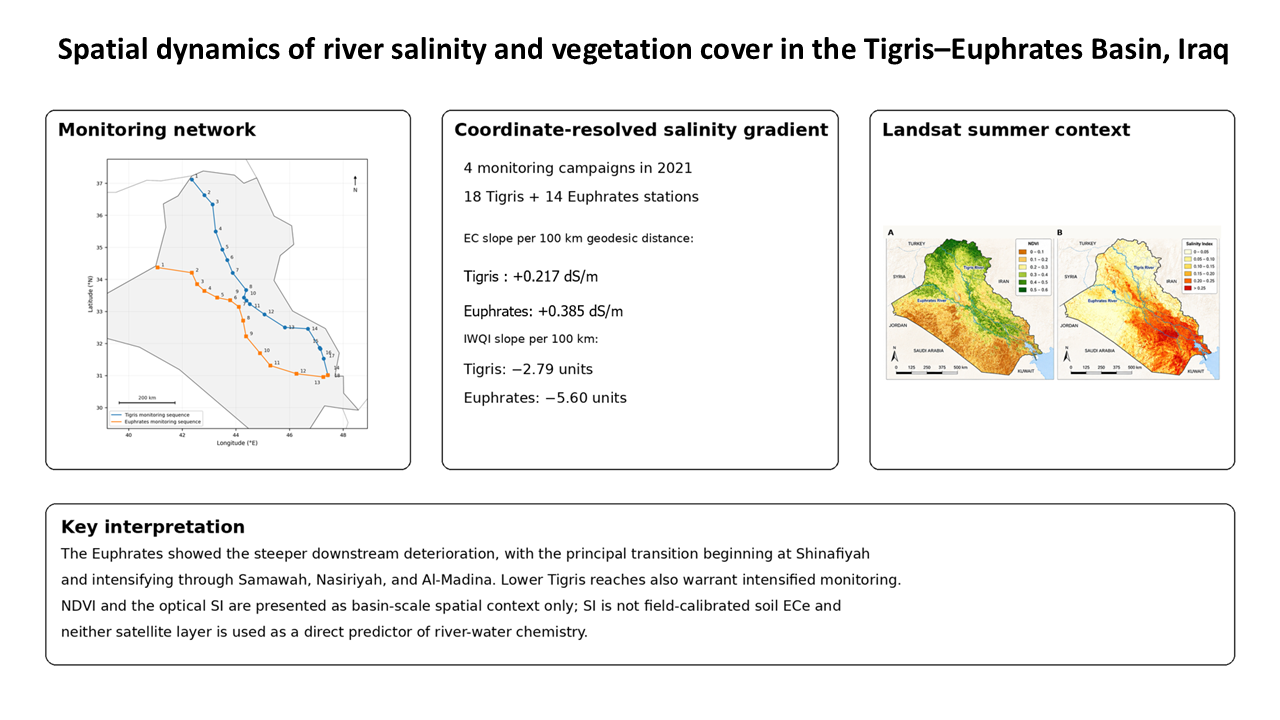
Water scarcity in the Tigris–Euphrates basin is increasingly accompanied by deteriorating irrigation-water salinity and strong spatial contrasts in land cover. This study evaluates river-salinity gradients together with Landsat-derived vegetation-cover patterns using four 2021 monitoring campaigns (March, April, June, and July), exact WGS 84 coordinates for 18 Tigris and 14 Euphrates locations, irrigation water quality index (IWQI) scores, and distance-based repeated-measures models. The updated coordinate–electrical conductivity (EC) workbooks contained 125 non-missing EC observations, all of which matched the quality-controlled analytical archive. Cumulative inter-station geodesic distance was 897.48 km for the Tigris monitoring sequence and 779.16 km for the Euphrates sequence. Mean EC was 1.08 ± 0.65 dS/m in the Tigris and 1.55 ± 1.06 dS/m in the Euphrates; mean IWQI was 87.78 ± 8.60 and 82.53 ± 15.47, respectively. Linear mixed-effects models with station random intercepts and campaign fixed effects estimated EC increases of 0.217 dS/m per 100 km in the Tigris (95% confidence interval: 0.174–0.259) and 0.385 dS/m per 100 km in the Euphrates (0.251–0.520), with corresponding IWQI declines of 2.79 and 5.60 units per 100 km (all p < 0.001). The Euphrates distance slope was significantly steeper for EC, total dissolved solids, and IWQI (river × distance p = 0.007, 0.004, and 0.002, respectively). First-order autoregressive correlation generalized estimating equations, leave-one-station-out analyses, omission of the three lower-Euphrates April gaps, exclusion of the disputed Al-Baghdadi IWQI value, and removal of Al-Madina independently preserved the downstream signal. Both marginal and conditional first-neighbor residual Moran tests showed no evidence of remaining longitudinal autocorrelation after false-discovery rate control. Landsat-derived normalized difference vegetation index mapped the basin-scale summer vegetation-cover pattern, whereas the optical salinity index was retained as environmental context rather than treated as a calibrated predictor of river chemistry. The results identify the lower Tigris and, more specifically, the Shinafiyah–Al-Madina sector of the Euphrates as priority reaches for salinity surveillance and adaptive irrigation-water management.
- Zlati ML, Antohi VM, Ionescu RV, Iticescu C, Georgescu LP. Quantifying the impact of the water security index on socio-economic development in EU27. Socioecon Plann Sci. 2024;93:101912. doi: 10.1016/j.seps.2024.101912
- Darvishi BA, Papi R, Soleimani M, Neysani Samani N, et al. Human interventions and climate change trigger water crisis in the Tigris and Euphrates Basin. Environ Sci Policy. 2026;177:104300. doi: 10.1016/j.envsci.2025.104300
- Haghighi AT, Akbari M, Noori R, et al. The impact of Turkey's water resources development on the flow regime of the Tigris River in Iraq. J Hydrol Reg Stud. 2023;48:101454. doi: 10.1016/j.ejrh.2023.101454
- Delavar M, Kuchak VS, Morid S, Zaghiyan MR, Babbaeian F. Country-base analyses of agriculture water consumption in the Tigris-Euphrates basin using modified SWAT model and water accounting plus framework. Agric Water Manag. 2026;332:110465. doi: 10.1016/j.agwat.2026.110465
- Luan W, Li X, Kuang W, et al. Quantitative assessment of the water stress in the Tigris-Euphrates River Basin driven by anthropogenic impacts. Remote Sens. 2025;17(4):662. doi: 10.3390/rs17040662
- Al-Ansari N, Ali A, Knutsson S. Present conditions and future challenges of water resources problems in Iraq. J Water Resour Prot. 2014;6(12):1066-1098. doi: 10.4236/jwarp.2014.612102
- Al-Ansari N. Hydro-politics of the Tigris and Euphrates Basins. Engineering. 2016;8(3):140-172. doi: 10.4236/eng.2016.83015
- Oleiwi AS, Al-Dabbas M. The parameters discharge, salinity and dissolved loads of Tigris River from Mosul to Baghdad, Iraq. Iraqi J Sci. 2024;65(6):3176-3194. doi: 10.24996/ijs.2024.65.6.19
- Al-Sekar H, Al-Dabbas M. The influence of the Tigris River discharge on the hydrochemistry with time, from Baghdad to Amara, Southern Iraq. Iraqi Geol J. 2022;55(2D):140-156. doi: 10.46717/igj.55.2d.12ms-2022-10-28
- Muhammed M, Al-Dabbas M. Impact of climatic change and shortage of water flow on the Euphrates River water salinity between Al-Hindyia and Al-Nasiriya, Southern Iraq. Iraqi Geol J. 2022;55(2A):139-152. doi: 10.46717/igj.55.2a.10ms-2022-07-26
- Seeyan S, Mahdi K, Diwan T, et al. Hydrochemical assessment and spatiotemporal variations for water quality in the Euphrates River in the western, central and southern of Iraq. Environ Earth Sci. 2026;85(6):151. doi: 10.1007/s12665-026-12887-4
- Nassrullah SA, Saihood SK, Mahmood W, Ismail AH, Farhan AA, Hussein FM. Water quality and hydrochemistry of Tigris River in a metropolitan city: long-term assessment. Case Stud Chem Environ Eng. 2026;13:101375. doi: 10.1016/j.cscee.2026.101375
- Awadh SM, Al-Kubaisi MHD, Anees MT, Abu Bakar AF, Bin Arif MR. Transboundary hydrogeology and controlling factors of Euphrates water chemistry: Insights from hydrochemistry, stable isotopes, and residence times in Syria and Western Iraq. Environ Earth Sci. 2026;85(9):335. doi: 10.1007/s12665-026-12922-4
- Al-Meini AJK. A proposed index of water quality assessment for irrigation. Eng Technol J. 2010;28(22):6557-6579. doi: 10.30684/etj.28.22.9
- Saloom HS, Oleiwi IAM. Evaluation of irrigation water quality index (IWQI) for main Iraqi rivers (Tigris, Euphrates, Shatt Al-Arab and Diyala). Iraqi J Agric Sci. 2017;48(4):1010-1020. doi: 10.36103/ijas.v48i4.358
- Ayers RS, Westcot DW. Water Quality for Agriculture. FAO Irrigation and Drainage Paper 29 Rev. 1. Rome, Italy: Food and Agriculture Organization of the United Nations; 1994.
- Iticescu C, Murariu G, Georgescu LP, Burada A, Topa CM. Seasonal variation of the physico-chemical parameters and water quality index (WQI) of Danube water in the transboundary Lower Danube area. Rev Chim. 2016;67(9):1843-1849.
- Metternicht G, Zinck JA. Remote sensing of soil salinity: potentials and constraints. Remote Sens Environ. 2003;85(1):1-20. doi: 10.1016/S0034-4257(02)00188-8
- Corwin DL, Scudiero E. Review of soil salinity assessment for agriculture across multiple scales using proximal and/or remote sensors. In: Advances in Agronomy. Vol 158. Amsterdam, Netherlands: Elsevier; 2019:1-130. doi: 10.1016/bs.agron.2019.07.001
- Allbed A, Kumar L, Aldakheel YY. Assessing soil salinity using soil salinity and vegetation indices derived from IKONOS high-spatial resolution imageries: applications in a date palm dominated region. Geoderma. 2014;230-231:1-8. doi: 10.1016/j.geoderma.2014.03.025
- Scudiero E, Skaggs TH, Corwin DL. Regional-scale soil salinity assessment using Landsat ETM+ canopy reflectance. Remote Sens Environ. 2015;169:335-343. doi: 10.1016/j.rse.2015.08.026
- Sahbeni G, Ngabire M, Musyimi PK, Szekely B. Challenges and opportunities in remote sensing for soil salinization mapping and monitoring: a review. Remote Sens. 2023;15(10):2540. doi: 10.3390/rs15102540
- Wang F, Han L, Liu L, et al. Advancements and perspective in the quantitative assessment of soil salinity utilizing remote sensing and machine learning algorithms: a review. Remote Sens. 2024;16(24):4812. doi: 10.3390/rs16244812
- Amin G, Pourret O, Dupin V, Guérin-Rechdaoui S, Dujany A. Comparing AI-driven approaches for predicting river water quality: a systematic review of water quality indices and remote sensing methods. Water Res. 2026;301:126047. doi: 10.1016/j.watres.2026.126047
- Montazeri A, Mazaheri M, Morid S, Mosaddeghi M. Effects of upstream activities of Tigris-Euphrates River Basin on water and soil resources of Shatt al-Arab Border River. Sci Total Environ. 2023;858:159751. doi: 10.1016/j.scitotenv.2022.159751
- Olson KR, Speidel DR. Tigris, Euphrates, and Shatt Al-Arab River system: historic and modern attempts to manage and restore Iraq's lifeline. Open J Soil Sci. 2024;14(1):28-63. doi: 10.4236/ojss.2024.141003
- Qiao X, Hao Z, Liu H, Liu Y. A global meta-analysis of the effects of irrigation with water containing salts on saline-alkali soils. Agric Water Manag. 2026;325:110202. doi: 10.1016/j.agwat.2026.110202
- Al Gburi HF, Al Ali IA, Majeed AH, Mouhamad R. Groundwater quality assessment for irrigation purposes: case study Badra Region, North East Wasit Governorate, southeast of Iraq. Asian J Water Environ Pollut. 2026;23(4):026140096. doi: 10.36922/AJWEP026140096
- Ismail AH, Ghanim H, Sarhan AH. Hydrochemistry of shallow groundwater and its assessment for drinking and irrigation purposes in Tarmiah district, Baghdad governorate, Iraq. Groundw Sustain Dev. 2020;10:100300. doi: 10.1016/j.gsd.2019.100300
- Hasan N, Pushpalatha R, Roshni T, Sruthy S. State of the art review of recent trends and challenges and future directions in building water resilience. Discov Sustain. Published online 2026. doi: 10.1007/s43621-026-04222-5
- Antohi VM, Barbuta-Misu N, Georgescu PL, Zlati ML, Fortea C. Digital transformation, innovation, and green transitions: A panel data analysis of structural drivers in the European economy. Green Finance. 2026;8(3):468-500. doi: 10.3934/gf.2026017
- Camli AY, Virlanuta FO, Palamutcuoglu BT, Barbuta-Misu N, Guler S, Zungun D. A study on developing a communicative rational action scale. Sustainability. 2021;13(11):6317. doi: 10.3390/su13116317
- Atiyah AH, Ati AS, AL-Halfi KM, Dawod SS, Mouhamad RS. Integrated effects of controlled traffic farming and irrigation scheduling on water productivity and yield of pumpkin under semi-arid sprinkler irrigation. Asian J Water Environ Pollut. 2026;23(4):026200145. doi: 10.36922/AJWEP026200145