

Driving factors of chlorinated OPEs pollution in industrial soils: an empirical study based on machine learning and a novel petrochemical source

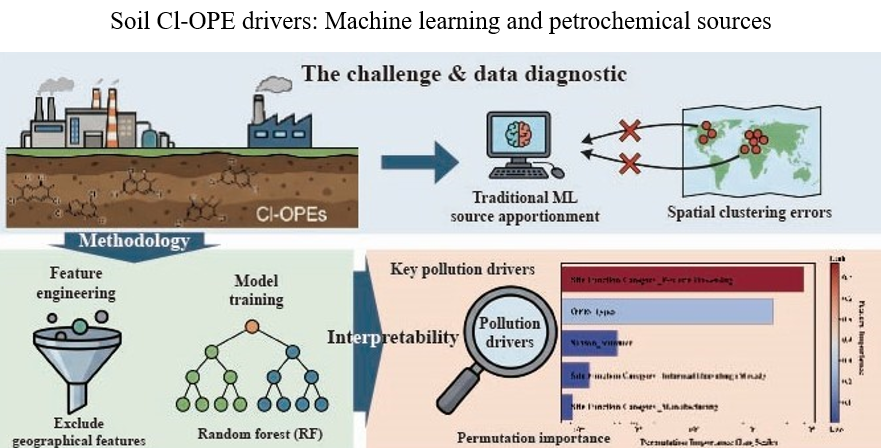
Chlorinated organophosphate esters (Cl-OPEs), a major class of organophosphate ester pollutants, are ubiquitously detected in industrial soils, yet quantitatively apportioning these contaminants remains a critical challenge. Traditional machine learning-based source apportionment approaches are often undermined by the spatial clustering of monitoring data, a phenomenon known as geographical bias. To address this limitation, this study first identified geographical bias through exploratory data diagnostics and subsequently constructed a robust random forest-based machine learning prediction framework that excludes geographical features to eliminate the confounding effect of spatial bias. The optimized model exhibited excellent reliability in predicting soil Cl-OPEs concentrations (test set R2 = 0.90). Model interpretability analysis via feature importance assessment confirmed E-waste processing (site function category_E-waste processing) as the primary driver of Cl-OPEs pollution. To validate the model and explore overlooked sources, we also conducted an empirical case study of the petrochemical industry. Comparative analysis not only confirmed E-waste processing areas as the primary source but also identified the petrochemical industry as a previously underestimated yet significant source of emissions, with its coil Cl-OPEs levels markedly exceeding those of other traditional industrial areas. Overall, this study proposes a novel, geographical-bias-free machine learning source apportionment method and provides new preliminary empirical evidence supporting pollution control of Cl-OPEs.
- Ye L, Li J, Gong S, et al. Established and emerging organophosphate esters (OPEs) and the expansion of an environmental contamination issue: A review and future directions. J Hazard Mater. 2023;459:132095. doi: 10.1016/j.jhazmat.2023.132095
- Zhao F, Tian S, Liu J, et al. Traditional and novel organophosphate esters in atmosphere of greenhouse covered with mulch films: Seasonal variations, partitioning and exposure risks. J Hazard Mater. 2025;494:138633. doi: 10.1016/j.jhazmat.2025.138633
- Hu N, Liu X, Zeshan M, et al. Unveiling sources of organophosphate esters in marine environments utilizing multi-factor multi-modal high-dimensional clustering algorithm. Water Res. 2025;283:123886. doi: 10.1016/j.watres.2025.123886
- Li B, Yang H, Zhang Y, et al. Pollution characteristics and health risk assessment of organophosphate esters in agricultural products from different regions of China. Environ Res. 2025;278:121675. doi: 10.1016/j.envres.2025.121675
- Mo WQ, Huang ZS, Li QQ, et al. Spatial variation, emissions, transport, and risk assessment of organophosphate esters in two large petrochemical complexes in southern China. J Environ Manag. 2024;367:122106. doi: 10.1016/j.jenvman.2024.122106
- Gong S, Ren K, Ye L, Deng Y, Su G. Suspect and nontarget screening of known and unknown organophosphate esters (OPEs) in soil samples. J Hazard Mater. 2022;436:129273. doi: 10.1016/j.jhazmat.2022.129273
- Zhong M, Zhou M, Tang J, Ren J, Ma R, Li X. Occurrence, spatial distributions, sources, and potential risks of organophosphate esters in Yarlung Tsangpo River and its main tributaries on the Tibetan Plateau. Environ Pollut. 2025;376:126385. doi: 10.1016/j.envpol.2025.126385
- Hoang AQ, Karyu R, Tue NM, et al. Comprehensive characterization of halogenated flame retardants and organophosphate esters in settled dust from informal e-waste and end-of-life vehicle processing sites in Vietnam: Occurrence, source estimation, and risk assessment. Environ Pollut. 2022;310:119809. doi: 10.1016/j.envpol.2022.119809
- Zhu C, Yu Z, Chen Y, et al. Distribution patterns and origins of organophosphate esters in soils from different climate systems on the Tibetan Plateau. Environ Pollut. 2024;351:124085. doi: 10.1016/j.envpol.2024.124085
- Zhou L, Wang X, Zhang X, et al. Besides traditional organophosphate esters: The ecological risks of emerging organophosphate esters in the Yangtze River basin cannot be ignored. Environ Pollut. 2025;367:125585. doi: 10.1016/j.envpol.2024.125585
- Teshome FT, Bayabil HK, Schaffer B, Ampatzidis Y, Hoogenboom G. Improving soil moisture prediction with deep learning and machine learning models. Comput Electron Agric. 2024;226:109414. doi: 10.1016/j.compag.2024.109414
- Duan D, Wang P, Rao X, et al. Identifying interactive effects of spatial drivers in soil heavy metal pollutants using interpretable machine learning models. Sci Total Environ. 2024;934:173284. doi: 10.1016/j.scitotenv.2024.173284
- Siqueira RG, Moquedace CM, Fernandes-Filho EI, et al. Modelling and prediction of major soil chemical properties with Random Forest: Machine learning as tool to understand soil-environment relationships in Antarctica. CATENA. 2024;235:107677. doi: 10.1016/j.catena.2023.107677
- Withana PA, Li J, Senadheera SS, Fan C, Wang Y, Ok YS. Machine learning prediction and interpretation of the impact of microplastics on soil properties. Environ Pollut. 2024;341:122833. doi: 10.1016/j.envpol.2023.122833
- Wang Y, Zhu H, Yao Y, et al. Distribution of Organophosphate Flame Retardants (OPFRs) in Soil and Outdoor Settled Dust from A Multi-waste Recycling Area. In: Proceedings of the POPs Forum 2017 and the 12th Symposium on Persistent Organic Pollutants. Wuhan, China; 2017:2.
- YYin H, Liu L, Xiong Y, Qiao Y. Pollution characteristics and risk assessment of organophosphate esters (OPEs) in typical industrial parks in Southwest China. Environ Sci Pollut Res. 2024;31(24):35206-35218. doi: 10.1007/s11356-024-33160-w
- Ge X, Ma S, Zhang X, Yang Y, Li G, Yu Y. Halogenated and organophosphorous flame retardants in surface soils from an e-waste dismantling park and its surrounding area: Distributions, sources, and human health risks. Environ Int. 2020;139:105741. doi: 10.1016/j.envint.2020.105741
- Sun Y, Zhu H. A pilot study of organophosphate esters in surface soils collected from Jinan City, China: implications for risk assessments. Environ Sci Pollut Res. 2021;28(3):3344-3353. doi: 10.1007/s11356-020-10730-2
- Kurt-Karakus P, Alegria H, Birgul A, Gungormus E, Jantunen L. Gungormus, and L. Jantunen. Organophosphate ester (OPEs) flame retardants and plasticizers in air and soil from a highly industrialized city in Turkey. Sci Total Environ. 2018;625:555-565. doi: 10.1016/j.scitotenv.2017.12.307
- Tang J, Sun J, Ke Z, et al. Organophosphate esters in surface soils from a heavily urbanized region of Eastern China: Occurrence, distribution, and ecological risk assessment. Environ Pollut. 2021;291:118200. doi: 10.1016/j.envpol.2021.118200
- Sun Y, Chen S, Jiang H, et al. Towards interpretable machine learning for observational quantification of soil heavy metal concentrations under environmental constraints. Sci Total Environ. 2024;926:171931. doi: 10.1016/j.scitotenv.2024.171931
- Wang J, Huang R, Liang Y, et al. Prediction of antibiotic sorption in soil with machine learning and analysis of global antibiotic resistance risk. J Hazard Mater. 2024;466:133563. doi: 10.1016/j.jhazmat.2024.133563
- Zhang L, Heuvelink GB, Mulder VL, Chen S, Deng X, Yang L. Using process-oriented model output to enhance machine learning-based soil organic carbon prediction in space and time. Sci Total Environ. 2024;922:170778. doi: 10.1016/j.scitotenv.2024.170778
- Yan Y, Yang Y. Revealing the synergistic spatial effects in soil heavy metal pollution with explainable machine learning models. J Hazard Mater. 2025;482:136578. doi: 10.1016/j.jhazmat.2024.136578
- Feng L, Khalil U, Aslam B, et al. Evaluation of soil texture classification from orthodox interpolation and machine learning techniques. Environ Res. 2024;246:118075. doi: 10.1016/j.envres.2023.118075
- Badounas I, Bozikas A, Pitselis G. A robust random coefficient regression representation of the chain-ladder method. Ann Actuar Sci 2022;16(1):151-182. doi: 10.1017/S1748499521000154
- Mohammed S, Arshad S, Bashir B, et al. Evaluating machine learning performance in predicting sodium adsorption ratio for sustainable soil-water management in the eastern Mediterranean. J Environ Manag. 2024;370:122640. doi: 10.1016/j.jenvman.2024.122640
- Wang YG, Wu J, Hu ZH, McLachlan GJ. A new algorithm for support vector regression with automatic selection of hyperparameters. Pattern Recognit. 2023;133:108989. doi: 10.1016/j.patcog.2022.108989
- Zhang Z. Introduction to machine learning: k-nearest neighbors. Ann Transl Med. 2016;4(11):218. doi: 10.21037/atm.2016.03.37
- Probst P, Wright MN, Boulesteix AL. Hyperparameters and tuning strategies for random forest. WIREs Data Min Knowl Discov. 2019;9(3):e1301. doi: 10.1002/widm.1301
- Yang L, Shami A. On hyperparameter optimization of machine learning algorithms: Theory and practice. Neurocomputing. 2020;415:295-316. doi: 10.1016/j.neucom.2020.07.061
- Occhipinti A, Rogers L, Angione C. A pipeline and comparative study of 12 machine learning models for text classification. Expert Syst Appl. 2022;201:117193. doi: 10.1016/j.eswa.2022.117193
- Belete DM, Huchaiah MD. Grid search in hyperparameter optimization of machine learning models for prediction of HIV/AIDS test results. Int J Comput Appl. 2022;44(9):875-886. doi: 10.1080/1206212X.2021.1974663
- Karl F, Pielok T, Moosbauer J, et al. Multi-Objective Hyperparameter Optimization in Machine Learning—An Overview. ACM Trans. Evol Learn Optim. 2023;3(4):1-50. doi: 10.1145/3610536
- Rengasamy D, Mase JM, Kumar A, et al. Feature importance in machine learning models: A fuzzy information fusion approach. Neurocomputing. 2022;511:163-174. doi: 10.1016/j.neucom.2022.09.053
- JJebarathinam C, Home D, Sinha U. Pearson correlation coefficient as a measure for certifying and quantifying high-dimensional entanglement. Phys Rev A 2020;101(2):022112. doi: 10.1103/PhysRevA.101.022112
- Kenny M, Schoen I. Violin SuperPlots: visualizing replicate heterogeneity in large data sets. Mol Biol Cell 2021;32(15):1333-1334. doi: 10.1091/mbc.E21-03-0130