
Ecotourism as a sustainable livelihood for fishermen: A systematic review of global fishing bans and implications for the Yangtze River Ten-Year Fishing Ban

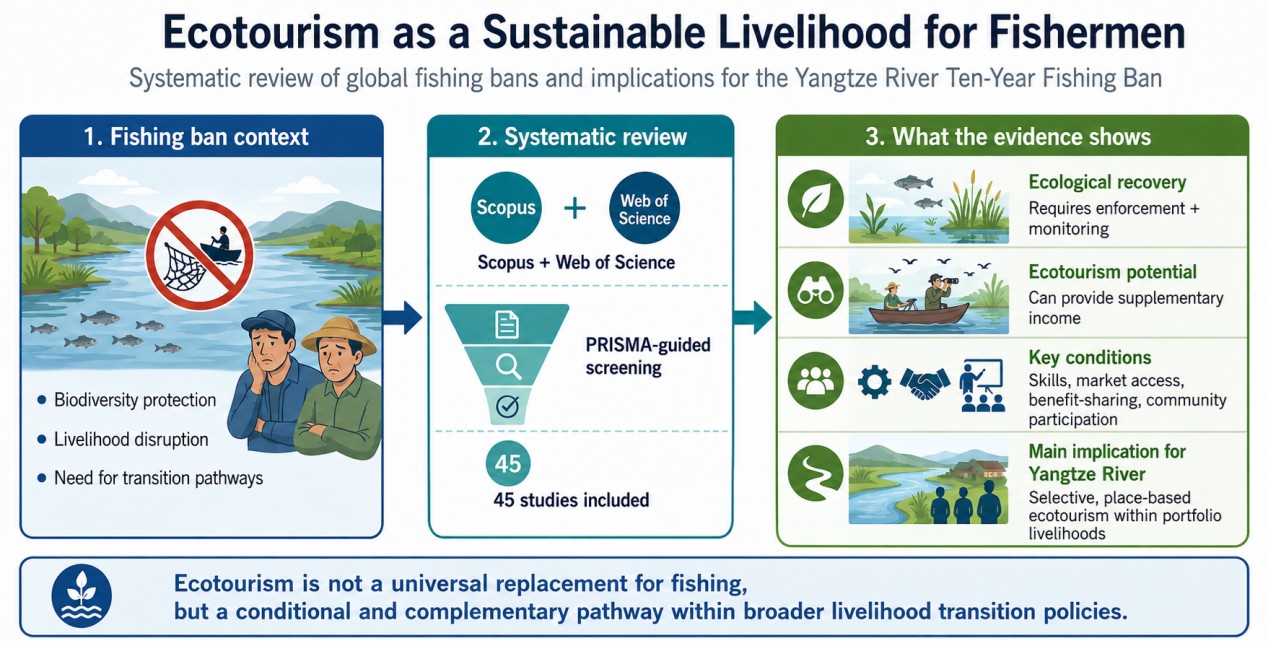
Fishing bans are increasingly used to restore aquatic biodiversity, yet they often impose substantial livelihood pressures on fishing-dependent communities. This study examines whether ecotourism can function as a sustainable alternative livelihood under different fishing restriction regimes and explores the implications for China’s Yangtze River Ten-Year Fishing Ban. Using a systematic literature review guided by the Preferred Reporting Items for Systematic Reviews and Meta-Analyses (PRISMA) 2020, we synthesized peer-reviewed studies retrieved from Scopus and Web of Science, along with Chinese policy documents and China-focused academic evidence. After de-duplication, eligibility screening, and full-text review, 45 studies were included in the core synthesis. The findings show that ecological improvements are most consistent under strict and well-enforced protection regimes, especially in no-take areas, but outcomes remain context-specific. Ecotourism can provide supplementary income and strengthen conservation incentives, yet it rarely replaces fishing livelihoods on its own. Its effectiveness depends on ecological quality, market access, skills, start-up capital, and equitable benefit-sharing institutions. In some cases, poorly designed tourism transitions may even intensify overall fishing pressure. For the Yangtze River, ecotourism should therefore be treated not as a stand-alone substitute, but as part of a broader livelihood transition strategy embedded in compensation, vocational training, community-based benefit-sharing, and long-term ecological and social monitoring.
- Yang SL, Xu KH, Milliman JD, Yang HF, Wu CS. Decline of Yangtze River Water and Sediment Discharge: Impact from Natural and Anthropogenic Changes. Sci Rep. 2015;5(1):12581. doi: 10.1038/srep12581
- Xiong F, Li Z, Brosse S, et al. Fishing Ban Halts Seven Decades of Biodiversity Decline in the Yangtze River. Science. 2026;391(6786):719-723. doi: 10.1126/science.adu5160
- Ministry of Ecology and Environment of the People’s Republic of China. The Yangtze River Protection Law of the People’s Republic of China. Accessed April 7, 2021. https:// english.mee.gov.cn/Resources/laws/environmental_ laws/202104/t20210407_827604.shtml
- Chen Y, Qu X, Xiong F, Lu Y, Wang L, Hughes RM. Challenges to Saving China’s Freshwater Biodiversity: Fishery Exploitation and Landscape Pressures. Ambio. 2020;49(4):926-938. doi: 10.1007/s13280-019-01246-2
- The State Council of the People’s Republic of China. China Achieves Key Results in 10-Year Fishing Ban on Yangtze River. December 10, 2025. Accessed April 29, 2026. https://english.www.gov.cn/news/202512/10/content_ WS69397100c6d00ca5f9a0806c.html
- Edgar GJ, Stuart-Smith RD, Willis TJ, et al. Global Conservation Outcomes Depend on Marine Protected Areas with Five Key Features. Nature. 2014;506(7487):216- 220. doi: 10.1038/nature13022
- Sanabria-Fernandez JA, Alday JG, Lazzari N, Riera R, Becerro MA. Marine Protected Areas Are More Effective but Less Reliable in Protecting Fish Biomass Than Fish Diversity. Mar Pollut Bull. 2019;143:24-32. doi: 10.1016/j.marpolbul.2019.04.015
- Goetze JS, Wilson S, Radford B, et al. Increased Connectivity and Depth Improve the Effectiveness of Marine Reserves. Glob Change Biol. 2021;27(15):3432-3447. doi: 10.1111/gcb.15635
- Cusack C, Sethi SA, Rice AN, et al. Marine Ecotourism for Small Pelagics as a Source of Alternative Income Generating Activities to Fisheries in a Tropical Community. Biol Conserv. 2021;261:109242. doi: 10.1016/j.biocon.2021.109242
- Roe D, Booker F, Day M, et al. Are Alternative Livelihood Projects Effective at Reducing Local Threats to Specified Elements of Biodiversity and/or Improving or Maintaining the Conservation Status of Those Elements? Environ Evid. 2015;4(1):22. doi: 10.1186/s13750-015-0048-1
- Ministry of Agriculture and Rural Affairs of the People’s Republic of China. Yangtze River Fishing Ban Yields Notable Phased Results. April 1, 2026. Accessed April 29, 2026. https://english.moa.gov.cn/news_522/202604/ t20260402_301590.html
- Page MJ, McKenzie JE, Bossuyt PM, et al. The PRISMA 2020 Statement: An Updated Guideline for Reporting Systematic Reviews. BMJ. 2021;372:n71. doi: 10.1136/bmj.n71
- Page MJ, Moher D, Bossuyt PM, et al. PRISMA 2020 Explanation and Elaboration: Updated Guidance and Exemplars for Reporting Systematic Reviews. BMJ. 2021;372:n160. doi: 10.1136/bmj.n160
- Vieira ES, Gomes JANF. A Comparison of Scopus and Web of Science for a Typical University. Scientometrics. 2009;81(2):587-600. doi: 10.1007/s11192-009-2178-0
- Chambers R, Conway G. Sustainable Rural Livelihoods: Practical Concepts for the 21st Century. Discussion Paper 296. Brighton, UK: Institute of Development Studies; 1992. Accessed April 29, 2026. https://www.ids.ac.uk/files/ Dp296.pdf
- Scoones I. Sustainable Rural Livelihoods: A Framework for Analysis. IDS Working Paper 72. Brighton, UK: Institute of Development Studies; 1998. Accessed April 29, 2026. https:// hdl.handle.net/20.500.12413/3390
- Ajzen I. The Theory of Planned Behavior. Organ Behav Hum Decis Process. 1991;50(2):179-211. doi: 10.1016/0749-5978(91)90020-T
- Sala E, Giakoumi S. No-Take Marine Reserves Are the Most Effective Protected Areas in the Ocean. ICES J Mar Sci. 2018;75(3):1166-1168. doi: 10.1093/icesjms/fsx059
- Lester S, Halpern B, Grorud-Colvert K, et al. Biological Effects Within No-Take Marine Reserves: A Global Synthesis. Mar Ecol Prog Ser. 2009;384:33-46. doi: 10.3354/meps08029
- Claudet J, Osenberg CW, Benedetti-Cecchi L, et al. Marine Reserves: Size and Age Do Matter. Ecol Lett. 2008;11(5):481- 489. doi: 10.1111/j.1461-0248.2008.01166.x
- Gill DA, Mascia MB, Ahmadia GN, et al. Capacity Shortfalls Hinder the Performance of Marine Protected Areas Globally. Nature. 2017;543(7647):665-669. doi: 10.1038/nature21708
- Campbell SJ, Hoey AS, Maynard J, et al. Weak Compliance Undermines the Success of No-Take Zones in a Large Government-Controlled Marine Protected Area. PLoS One. 2012;7(11):e50074. doi: 10.1371/journal.pone.0050074
- Bergseth BJ, Arias A, Barnes ML, et al. Closing the Compliance Gap in Marine Protected Areas with Human Behavioural Sciences. Fish Fish. 2023;24(4):695-704. doi: 10.1111/faf.12749
- Babcock RC, Shears NT, Alcala AC, et al. Decadal Trends in Marine Reserves Reveal Differential Rates of Change in Direct and Indirect Effects. Proc Natl Acad Sci USA. 2010;107(43):18256-18261. doi: 10.1073/pnas.0908012107
- Aburto-Oropeza O, Erisman B, Galland GR, Mascareñas- Osorio I, Sala E, Ezcurra E. Large Recovery of Fish Biomass in a No-Take Marine Reserve. PLoS One. 2011;6(8):e23601. doi: 10.1371/journal.pone.0023601
- Yang SF, Ye SW, Xu J, Li MZ, Liu HZ. Jiyu Ecopath moxing de boyanghu shengtai xitong “shinian jinyu” xiaoguo pinggu [Evaluation of the Effects on “10-Year Fishing Ban” in Poyang Lake Ecosystem Based on Ecopath Model]. Acta Hydrobiol Sin. 2024;48(8):1402-1413. [In Chinese] doi: 10.7541/2024.2023.0429
- Masri N, Hanafiah MH, Md Zain NA, Ibrahim MR. Sustainable Livelihood in Coastal and Marine Tourism Destinations: A Systematic Literature Review and Future Research Agenda. Aust J Marit Ocean Aff. Published online August 19, 2025:1-22. doi: 10.1080/18366503.2025.2548081
- Praptiwi RA, Maharja C, Fortnam M, et al. Tourism-Based Alternative Livelihoods for Small Island Communities Transitioning Towards a Blue Economy. Sustainability. 2021;13(12):6655. doi: 10.3390/su13126655
- Suradja I, Asih TS, Basir, et al. Alternating Livelihoods and Coping with Shocks: An Examination of Coastal Tourism in Indonesia Amidst COVID-19. Mar Policy. 2024;170:106379. doi: 10.1016/j.marpol.2024.106379
- Martins S, Marco A, Clarke LJ. Conservation and Ecotourism Increase Natural Capital Asset Value: An Economic Assessment of Sea Turtles on Boa Vista Island, Cabo Verde. Ocean Coast Manag. 2025;268:107764. doi: 10.1016/j.ocecoaman.2025.107764
- Pham TTT. Tourism in Marine Protected Areas: Can It Be Considered as an Alternative Livelihood for Local Communities? Mar Policy. 2020;115:103891. doi: 10.1016/j.marpol.2020.103891
- Wright JH, Hill NAO, Roe D, et al. Reframing the Concept of Alternative Livelihoods. Conserv Biol. 2016;30(1):7-13. doi: 10.1111/cobi.12607
- He Y, Chen T. Does the 10-Year Fishing Ban Compensation Policy in the Yangtze River Basin Improve the Livelihoods of Fishing Households? Evidence from Ma’anshan City, China. Agriculture. 2022;12(12):2088. doi: 10.3390/agriculture12122088
- Wu Z, Tian G, Li Y, Xia Q. Compensation Mechanisms for Fishermen Quit Fishing: A Case of Jiangsu Province, China. Heliyon. 2023;9(7):e17648. doi: 10.1016/j.heliyon.2023.e17648
- Feng J, Wen Y, Zhang H, Hou Y, Zhang Z. Trap or Opportunity: Impact of the Fishing Ban Compensation Policy on the Income of Returning Fishermen in China. Sustainability. 2024;16(11):4401. doi: 10.3390/su16114401
- Bennett NJ, Dearden P. Why Local People Do Not Support Conservation: Community Perceptions of Marine Protected Area Livelihood Impacts, Governance and Management in Thailand. Mar Policy. 2014;44:107-116. doi: 10.1016/j.marpol.2013.08.017
- Ostrom E. Governing the Commons: The Evolution of Institutions for Collective Action. Cambridge, UK: Cambridge University Press; 1990.
- Nahuelhual L, Segovia NI, Jullian C, et al. Unveiling Inequalities Among Small-Scale Fishers. Ocean Coast Manag. 2025;268:107761. doi: 10.1016/j.ocecoaman.2025.107761
- Buckley R. Sustainable Tourism: Research and Reality. Ann Tour Res. 2012;39(2):528-546. doi: 10.1016/j.annals.2012.02.003
- Miller KM. Disentangling Tourism Impacts on Small-Scale Fishing Pressure. Mar Policy. 2022;137:104960. doi: 10.1016/j.marpol.2022.104960
- Hall CM. Tourism and fishing. Scand J Hosp Tour. 2021;21(4):361-373. doi: 10.1080/15022250.2021.1955739
- Arlinghaus R, Cooke SJ, Lyman J, et al. Understanding the Complexity of Catch-and-Release in Recreational Fishing: An Integrative Synthesis of Global Knowledge from Historical, Ethical, Social, and Biological Perspectives. Rev Fish Sci. 2007;15(1-2):75-167. doi: 10.1080/10641260601149432
- Brownscombe JW, Danylchuk AJ, Chapman JM, Gutowsky LFG, Cooke SJ. Best Practices for Catch-and-Release Recreational Fisheries – Angling Tools and Tactics. Fish Res. 2017;186:693-705. doi: 10.1016/j.fishres.2016.04.018
- Lopes PFM, Mendes L, Fonseca V, Villasante S. Tourism as a Driver of Conflicts and Changes in Fisheries Value Chains in Marine Protected Areas. J Environ Manage. 2017;200:123- 134. doi: 10.1016/j.jenvman.2017.05.080
- Wang H, Wang P, Xu C, et al. Can the “10-Year Fishing Ban” Rescue Biodiversity of the Yangtze River? The Innovation. 2022;3(3):100235. doi: 10.1016/j.xinn.2022.100235
- Zhilong W, Limiao Q, Tian Z, et al. Effective Maintenance of the Ten-Year Fishing Ban in the Yangtze River, China: An Analysis Based on Evolutionary Game Theory. J Resour Ecol. 2026;17(1). doi: 10.5814/j.issn.1674-764x.2026.01.013
- Ma H, Zhong Y, Ou M, Wang W, Feng X. The Transformation of Fishermen’s Livelihoods in the Context of a Comprehensive Fishing Ban: A Case Study of Datang Village at the Poyang Lake Region, China. Land. 2022;11(12):2262. doi: 10.3390/land11122262
- Zhai J, Yao J, Hu X, et al. Integrating Ecological Cognition and Compensation Strategies for Livelihood Transitions: Insights from the Poyang Lake Fishing Ban Policy. Sustainability. 2025;17(6):2539. doi: 10.3390/su17062539
- Armitage DR, Plummer R, Berkes F, et al. Adaptive Co‐ Management for Social–Ecological Complexity. Front Ecol Environ. 2009;7(2):95-102. doi: 10.1890/070089
- Olsson P, Folke C, Berkes F. Adaptive Comanagement for Building Resilience in Social-ecological Systems. Environ Manage. 2004;34(1). doi: 10.1007/s00267-003-0101-7
- Sayer CA, Fernando E, Jimenez RR, et al. One-Quarter of Freshwater Fauna Threatened with Extinction. Nature. 2025;638(8049):138-145. doi: 10.1038/s41586-024-08375-z
- Maasri A, Jähnig SC, Adamescu MC, et al. A Global Agenda for Advancing Freshwater Biodiversity Research. Ecol Lett. 2022;25(2):255-263. doi: 10.1111/ele.13931
- Dudgeon D. Prospects for Sustaining Freshwater Biodiversity in the 21st Century: Linking Ecosystem Structure and Function. Curr Opin Environ Sustain. 2010;2(5-6):422-430. doi: 10.1016/j.cosust.2010.09.001
- Ding N, Xie Z, Wang X, et al. Freshwater Biodiversity Impacts of Global Hydropower Dams. Commun Earth Environ. 2026;7(1):241. doi: 10.1038/s43247-026-03263-y
- Lynch AJ, Hyman AA, Cooke SJ, et al. Future- Proofing the Emergency Recovery Plan for Freshwater Biodiversity. Environ Rev. 2024;32(3):350-365. doi: 10.1139/er-2022-0116
- Bergseth B, Moltzen C, Arias A, et al. A Practical, Adaptive Compliance Management Framework for Improving Marine Protected Area Effectiveness. Conserv Biol. Published online March 18, 2026:e70246. doi: 10.1111/cobi.70246
- Trotman FGV, Berggren P. A Roadmap for Effective and Sustainable Marine Protected Areas: Beyond Paper Parks. J Environ Manage. 2026;401:128956. doi: 10.1016/j.jenvman.2026.128956
- Relano V, Pauly D. The ‘Paper Park Index’: Evaluating Marine Protected Area Effectiveness Through a Global Study of Stakeholder Perceptions. Mar Policy. 2023;151:105571. doi: 10.1016/j.marpol.2023.105571
- Claudet J, Loiseau C, Pebayle A. Critical gaps in the protection of the second largest exclusive economic zone in the world. Mar Policy. 2021;124:104379. doi: 10.1016/j.marpol.2020.104379
- Aminian-Biquet J, Gorjanc S, Sletten J, et al. Over 80% of the European Union’s Marine Protected Area Only Marginally Regulates Human Activities. One Earth. 2024;7(9):1614- 1629. doi: 10.1016/j.oneear.2024.07.010
- Zetterlind V, Sletten J, Colegrove C, et al. Navigator - a Global Database of Verified Marine Protected and Managed Area Regulations and Boundaries. Sci Data. 2025;12(1):1212. doi: 10.1038/s41597-025-05535-2
- Favoretto F, Kumagai JA, López-Sagástegui C, et al. High- Capacity Nations Can Unlock Momentum for Quality Marine Protection. iScience. 2026;29(3):115043. doi: 10.1016/j.isci.2026.115043
- Bryce K, Hunter KL. Enhancing Climate Change Planning and Adaptive Management in Marine Protected Areas Through Targets, Thresholds, and Social-Ecological Objectives. Front Mar Sci. 2024;11:1339871. doi: 10.3389/fmars.2024.1339871
- Da Silva AE, Maracajá KFB, Batalhão ACS, Silva VF, Borges IMS. Ecotourism and Co-Management: Strengthening Socio- Ecological Resilience in Local Food Systems. Sustainability. 2025;17(6):2443. doi: 10.3390/su17062443
- Opondo FA, Chagwiza C, Ouko KO, Mkandawire E. Diversification of Small-Scale Fishing Activities in Exploring Entrepreneurial Opportunities Along the Tourism Value Chain in South Africa. Cogent Soc Sci. 2024;10(1):2286751. doi: 10.1080/23311886.2023.2286751
- Wei C, Xu H, Wall G. Asset Assemblages and Livelihood Resilience in a Coastal Community. J Sustain Tour. 2024;32(5):904-922. doi: 10.1080/09669582.2023.2186826
- Singha P, Pal S. Wetland Transformation and Its Impact on the Livelihood of the Fishing Community in a Flood Plain River Basin of India. Sci Total Environ. 2023;858:159547. doi: 10.1016/j.scitotenv.2022.159547
- Singh OK, Mistri A. Wetland Ecology Deterioration and Livelihood Diversification as a Coping Strategy: A Study from Ramsar Wetland, Loktak, India. Discov Sustain. 2025;6(1):1322. doi: 10.1007/s43621-025-02187-5
- Czarkowski TK, Kapusta A, Nowosad J, Hakuć-Błażowska A, Duda A, Kupren K. Catch-and-Release Fishing: A Case Study in Poland. Water. 2025;17(10):1448. doi: 10.3390/w17101448
- Erbay M, Carlson A, Grati F. Evaluating the Unexplored Recreational Fishing in the Turkish Black Sea: Socio- Economic Significance and Environmental Impact. Front Mar Sci. 2024;11:1386911. doi: 10.3389/fmars.2024.1386911
- Butler EC, Childs AR, Saayman A, Potts WM. Can Fishing Tourism Contribute to Conservation and Sustainability Via Ecotourism? A Case Study of the Fishery for Giant African Threadfin Polydactylus Quadrifilis on the Kwanza Estuary, Angola. Sustainability. 2020;12(10):4221. doi: 10.3390/su12104221
- Barnett A, Abrantes KG, Baker R, et al. Sportfisheries, Conservation and Sustainable Livelihoods: A Multidisciplinary Guide to Developing Best Practice. Fish Fish. 2016;17(3):696-713. doi: 10.1111/faf.12140
- Mascia MB, Claus CA, Naidoo R. Impacts of Marine Protected Areas on Fishing Communities. Conserv Biol. 2010;24(5):1424-1429. doi: 10.1111/j.1523-1739.2010.01523.x
- Leleu K, Alban F, Pelletier D, Charbonnel E, Letourneur Y, Boudouresque CF. Fishers’ Perceptions as Indicators of the Performance of Marine Protected Areas (MPAs). Mar Policy. 2012;36(2):414-422. doi: 10.1016/j.marpol.2011.06.002
- García-Lorenzo I, Amigo-Dobaño L, Garza-Gil MD, Varela- Lafuente M. Perceptions in Small-Scale Fisheries Regarding Institutional, Economic, Technological and Environmental Factors. Case Study in North-Western Spain. Mar Policy. 2023;150:105530. doi: 10.1016/j.marpol.2023.105530
- Salafsky N, Wollenberg E. Linking Livelihoods and Conservation: A Conceptual Framework and Scale for Assessing the Integration of Human Needs and Biodiversity. World Dev. 2000;28(8):1421-1438. doi: 10.1016/S0305-750X(00)00031-0
- Ficke AD, Myrick CA, Hansen LJ. Potential Impacts of Global Climate Change on Freshwater Fisheries. Rev Fish Biol Fish. 2007;17(4):581-613. doi: 10.1007/s11160-007-9059-5
- Free CM, Thorson JT, Pinsky ML, Oken KL, Wiedenmann J, Jensen OP. Impacts of Historical Warming on Marine Fisheries Production. Science. 2019;363(6430):979-983. doi: 10.1126/science.aau1758
- Sowman M, Sunde J. A Just Transition? Navigating the Process of Policy Implementation in Small-Scale Fisheries in South Africa. Mar Policy. 2021;132:104683. doi: 10.1016/j.marpol.2021.104683
- Georgescu LP, Balsalobre-Lorente D, Zlati ML, Fortea C, Antohi V, Barbuta-Misu N. Cluster Analysis of the Transition to Climate Neutrality in the European Union. Sustain Dev. 2025;33(S1):1498-1519. doi: 10.1002/sd.70064
- Allison EH, Ellis F. The Livelihoods Approach and Management of Small-Scale Fisheries. Mar Policy. 2001;25(5):377-388.doi: 10.1016/S0308-597X(01)00023-9
- Béné C, Al-Hassan RM, Amarasinghe O, et al. Is Resilience Socially Constructed? Empirical Evidence from Fiji, Ghana, Sri Lanka, and Vietnam. Glob Environ Change. 2016;38:153- 170. doi: 10.1016/j.gloenvcha.2016.03.005
- Sun Y, Sun Z, Zhang Y, Qiao Q. How Can Governments and Fishermen Collaborate to Participate in a Fishing Ban for Ecological Restoration? J Environ Manage. 2024;360:120958. doi: 10.1016/j.jenvman.2024.120958
- Du J, Tian H, Xiang Z, et al. Impact of the Fishing Ban on Fish Diversity and Population Structure in the Middle Reaches of the Yangtze River, China. Front Environ Sci. 2025;12:1530716. doi: 10.3389/fenvs.2024.1530716
- Liu S, Islam H, Ghosh T, Ali MSE, Afrin KH. Exploring the Nexus Between Economic Growth and Tourism Demand: The Role of Sustainable Development Goals. Humanit Soc Sci Commun. 2025;12(1):441. doi: 10.1057/s41599-025-04733-y
- Liu J. From Contention to Clientelism: Evidence from the Ten-Year Fishing Ban in China. China Q. Published online April 13, 2026:1-15. doi: 10.1017/S030574102610215X
- Liu H. Changjiang shinian jinyu yu heliu shengtai xitong xiufu [Ten-Year Fishing Ban and River Ecosystem Restoration in the Yangtze River]. Chin Sci Bull. Published online April 1, 2026. [In Chinese] doi: 10.1360/CSB-2026-0021
- Zhang Y, Zhang H, Wu Z, Zhao M, Feng G. Community Structure Characteristics and Changes in Fish Species at Poyang Lake After the Yangtze River Fishing Ban. Fishes. 2024;9(7):281. doi: 10.3390/fishes9070281
- Yuan H. Fishing Bans in Chinese Waters: Effectiveness and Spillovers. J Environ Econ Manage. 2025;133:103202. doi: 10.1016/j.jeem.2025.103202
- Tonga A, Bwalya C, Hasimuna OJ, Mukuka KN, Mphande J. Perceptions of Fishers and Fisheries Officers of a Fishing Ban in Mpulungu, Lake Tanganyika, Zambia. Fish Manag Ecol. 2025;32(6):488-498. doi: 10.1111/fme.12820
- Enthoven L. How Do Local Communities Perceive Marine Protected Area Governance, Management, Surrounding Development, and Outcomes? A Systematic Review. J Environ Manage. 2025;391:126570. doi: 10.1016/j.jenvman.2025.126570
- Arif M, Behzad HM, Tahir M, Changxiao L. Nature- Based Tourism Influences Ecosystem Functioning Along Waterways: Implications for Conservation and Management. Sci Total Environ. 2022;842:156935. doi: 10.1016/j.scitotenv.2022.156935