

Big data-driven carbon footprint tracking and game-theoretic incentive design in green logistics supply chains

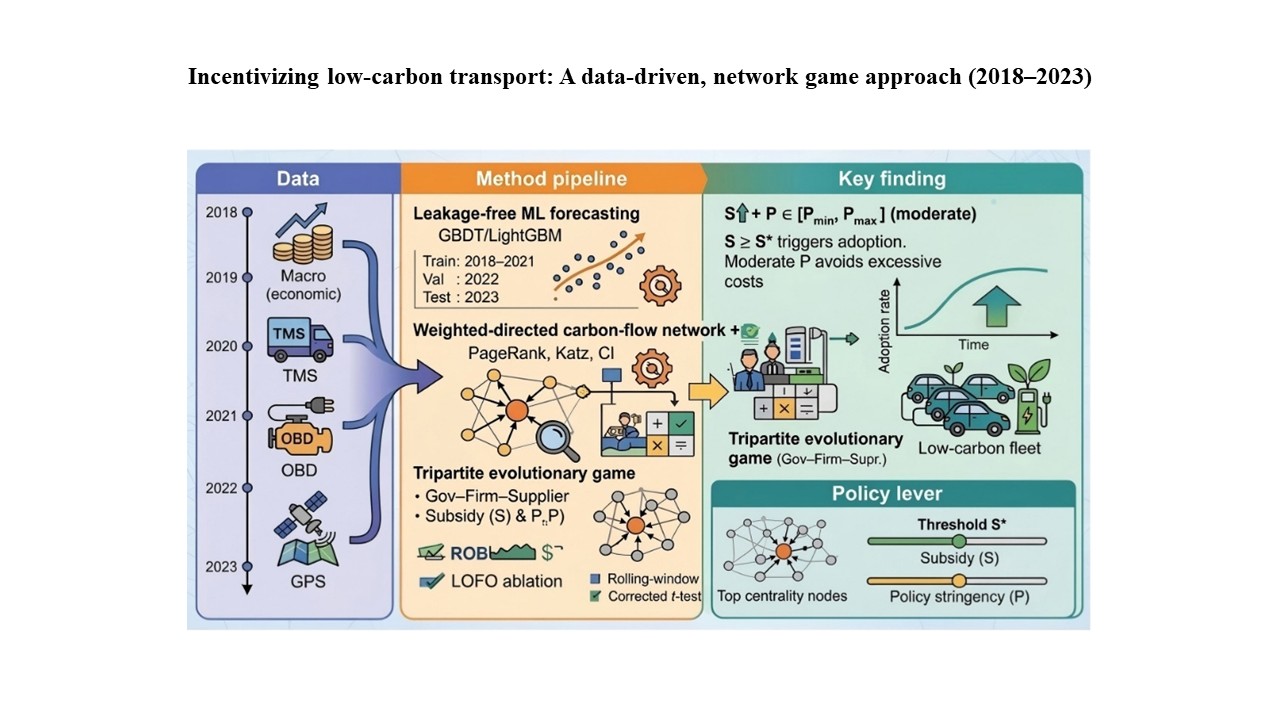
This study examines big data-driven carbon footprint tracking in green supply chains and the design of game-theoretic incentive mechanisms, with a focus on China’s logistics industry. We develop a comprehensive analytical framework integrating machine learning prediction, network topology analysis, and multi-agent evolutionary game theory. Using road freight statistics and operational data from 2018 to 2023, we model and forecast logistics carbon emission intensity through multiple regression and machine learning models. Complex network metrics were applied to characterize the interregional carbon emission correlation structures and identify high-emission nodes. Building on this, the study introduces three key actors—government regulators, logistics enterprises, and suppliers—and establishes functions for emission reduction subsidies and excess emission penalties. An evolutionary game model is formulated, and numerical simulations examine how subsidy intensity and penalty severity influence the system’s evolutionary equilibrium. Results indicate that China’s logistics carbon emissions exhibit a temporal pattern of initial growth followed by stabilization. Spatially, emissions cluster prominently in transportation- and industry-dense regions such as North China, the Yangtze River Delta, and the Pearl River Delta, with high-emission nodes exhibiting high centrality within the network. When incentive parameters are weak, enterprises tend to adopt passive emission reduction strategies. However, under scenarios with higher subsidies and moderate penalties, the proportion of enterprises adopting emission reduction strategies increases in an S-shaped manner over time, ultimately converging to a low-carbon stable equilibrium. The findings indicate that combining big data-driven carbon footprint tracking with differentiated subsidy–penalty policies helps identify regional priority emission reduction targets and critical links, providing quantitative support for designing collaborative emission reduction policies and incentive mechanisms tailored to logistics supply chains.
- World Economic Forum. Intelligent Transport, Greener Future: AI as a Catalyst to Decarbonize Global Logistics. White paper. January 2025.
- National Development and Reform Commission. Working Guidance for Carbon Dioxide Peaking and Carbon Neutrality in Full and Faithful Implementation of the New Development Philosophy. Published October 24, 2021. Accessed April 5, 2026.
- International Energy Agency. China. Accessed April 5, 2026.
- China Academy of Transportation Sciences. Report on Sustainable Transport in China. Beijing: Ministry of Transport of the People’s Republic of China; 2021. Available from: https://xxgk.mot.gov.cn/jigou/gjhzs/202112/ P020211214343055452953.pdf [Last accessed on March 17, 2026].
- Huang Y, Wang K, Zhang T, Pang C. Green supply chain coordination with greenhouse gases emissions management: a game-theoretic approach. J Clean Prod. 2016;112:2004- 2014. doi: 10.1016/j.jclepro.2015.05.137
- Tian J, Jia F, Chen L, Xing X. The impact of ISSB’s Scope 3 GHG emissions validation on US manufacturers’ stock valuations: analyzing the role of supplier complexity. Transp Res Part E Logist Transp Rev. 2025;193:103850. doi: 10.1016/j.tre.2024.103850
- Pan S, Ivanov D, Chutani A, et al. New normal, new norms: towards sustainable and resilient global logistics and supply chain management. Transp Res Part E Logist Transp Rev. 2025;201:104276. doi: 10.1016/j.tre.2025.104276
- Liew M, Cao J. Accounting for carbon emissions through green supply chain management: a systematic literature review. Bus Strategy Environ. 2025;34(7):8281-8304. doi: 10.1002/bse.70021
- Alves MYF, Vieira LM, Partyka RB. Suppliers’ GHG mitigation strategies (Scope 3): the case of a steelmaking company. J Manuf Technol Manag. 2024;35(2):383-402. doi: 10.1108/JMTM-05-2023-0162
- Ellram LM, Tate WL. Impact pathways: a call for impactful research in supply chain GHG emissions reduction. Int J Oper Prod Manag. 2025;45(1):236-245. doi: 10.1108/IJOPM-07-2023-0574
- Çapar İ, Rump CM, Sawaya W, et al. Green supply chain evolution: a multimodal logistics strategy for capping carbon emissions. Transp Res Part E Logist Transp Rev. 2025;202:104250. doi: 10.1016/j.tre.2025.104250
- Belhadi A, Venkatesh M, Kamble S, Abedin MZ. Data-driven digital transformation for supply chain carbon neutrality: insights from cross-sector supply chain. Int J Prod Econ. 2024;270:109178. doi: 10.1016/j.ijpe.2024.109178
- Hua J, Wang K, Lin J, Qian Y. Carbon tax vs. carbon cap-and-trade: implementation of carbon border tax in cross-regional production. Int J Prod Econ. 2024;274:109317. doi: 10.1016/j.ijpe.2024.109317
- Chen Y, Feng Y, Lai KH, Zhu Q. Value of blockchain for scope 3 carbon disclosure: the moderating role of data processing technologies. Int J Prod Econ. 2025;279:109445. doi: 10.1016/j.ijpe.2024.109445
- Zhang Y, Huang M, Wu Y, et al. Green fourth-party logistics network design under carbon cap-and-trade policy. Int J Prod Econ. 2025;282:109540. doi: 10.1016/j.ijpe.2025.109540
- Bui TD, Nguyen TTV, Wu KJ, Lim MK, Tseng ML. Green manufacturing performance improvement under uncertainties: an interrelationship hierarchical model. Int J Prod Econ. 2024;268:109117. doi: 10.1016/j.ijpe.2023.109117
- Saurav A, Yadav V, Shekhar C. An inventory optimization model for reliable and sustainable supply chains under trade credit and carbon constraints. Supply Chain Anal. 2025;11:100132. doi: 10.1016/j.sca.2025.100132
- Zhou X, Zhu Q, Xu L, et al. The effect of carbon tariffs and the associated coping strategies: a global supply chain perspective. Omega. 2024;122:102960. doi: 10.1016/j.omega.2023.102960
- Parupalli A. Sustainable supply chain practices for scope 3 emissions mitigation: an integrated modeling and optimization perspective. Int J Emerg Res Eng Technol. 2025;6(4):146-156. doi: 10.63282/3050-922X.IJERET-V6I4P118
- Harju A, Karttunen E, Hallikas J. Understanding the systemic sources of uncertainty for the management of greenhouse gas emissions in supply chains. Int J Oper Prod Manag. 2025;45(11):1884-1909. doi: 10.1108/IJOPM-04-2024-0349
- Mashud AHM, Chakrabortty RK, Hussain OK, Choi TM. Reducing emissions from production and distribution in three-echelon supply chains. Int J Prod Econ. 2024;271:109181. doi: 10.1016/j.ijpe.2024.109181
- Cheng J, Liao L, Lu S, et al. Effective MILP and matheuristic for multi-echelon green supply chain operations and financing considering carbon emission reduction investment. J Clean Prod. 2025;493:144816. doi: 10.1016/j.jclepro.2025.144816
- Kallionpää E, Viri R, Tiikkaja H, et al. The data logistics cannot deliver: emissions reporting of logistics in Finland. Liikenne-vuosikirja. 2025;8:9-58. doi: 10.58956/liikenne.178422
- Lu X, Xu X, Sun Y. Enhancing resilience in supply chains through resource orchestration and AI assimilation: an empirical exploration. Transp Res Part E Logist Transp Rev. 2025;195:103980. doi: 10.1016/j.tre.2025.103980
- Shmuel A, Glickman O, Lazebnik T. A comprehensive benchmark of machine and deep learning models on structured data for regression and classification. Neurocomputing. 2025;655:131337. doi: 10.1016/j.neucom.2025.131337
- Jiang J, Sheng D. Multi-period regional low-carbon logistics network planning with uncertain demand. Energy. 2025;331:137068. doi: 10.1016/j.energy.2025.137068
- Hasani Goodarzi A, Jabbarzadeh A, Fahimnia B, Paquet M. Evaluating the sustainability and resilience of an intermodal transport network leveraging consolidation strategies. Transp Res Part E Logist Transp Rev. 2024;188:103616. doi: 10.1016/j.tre.2024.103616
- Franco de la Peña MF, Perales Gómez ÁL, Fernández Maimó L. ShaTS: a Shapley-based explainability method for time series artificial intelligence models. Future Gener Comput Syst. 2026;176:108178. doi: 10.1016/j.future.2025.108178
- Nayebi A, Tipirneni S, Reddy CK, et al. WindowSHAP: an efficient framework for explaining time-series classifiers based on Shapley values. J Biomed Inform. 2023;144:104438. doi: 10.1016/j.jbi.2023.104438
- Li S, Tong Z, Haroon M. Estimation of transport CO₂ emissions using machine learning algorithm. Transp Res Part D Transp Environ. 2024;133:104276. doi: 10.1016/j.trd.2024.104276
- Li M, Tang Y, Wu K, Cheng H. Autonomous vehicle pollution monitoring: an innovative solution for policy and environmental management. Transp Res Part D Transp Environ. 2025;139:104542. doi: 10.1016/j.trd.2024.104542
- Zhong W, Zhai D, Xu W, et al. Accurate and efficient daily carbon emission forecasting based on improved ARIMA. Appl Energy. 2024;376:124232. doi: 10.1016/j.apenergy.2024.124232
- Luo H, Wang C, Li C, et al. Multi-scale carbon emission characterization and prediction based on land use and interpretable machine learning model: a case study of the Yangtze River Delta Region, China. Appl Energy. 2024;360:122819. doi: 10.1016/j.apenergy.2024.122819
- Yuan D, Tang L, Yang X, Xu F, Liu K. Explainable machine learning prediction of vehicle CO₂ emissions for sustainable energy and transport. Energies. 2025;18(20):5408. doi: 10.3390/en18205408
- Guo X, Kou R, He X. Towards carbon neutrality: machine learning analysis of vehicle emissions in Canada. Sustainability. 2024;16(23):10526. doi: 10.3390/su162310526
- Catret-Ruber P, Garcia-Rodriguez D, Iglesias Fuente DJ, et al. An open, reproducible benchmark of daily CO₂ forecasting models with applications to GHG monitoring. Environ Model Softw. 2026;196:106781. doi: 10.1016/j.envsoft.2025.106781
- Şahin V. Explainable machine learning-based prediction of CO₂ emissions from passenger vessels. Ocean Eng. 2025;341(Pt 3):122752. doi: 10.1016/j.oceaneng.2025.122752
- Zhang SR, Farooq B. Interpretable and actionable vehicular greenhouse gas emission prediction at road link-level. Sustain Cities Soc. 2023;92:104493. doi: 10.1016/j.scs.2023.104493
- Qiao Q, Eskandari H, Saadatmand H, Sahraei MA. An interpretable multi-stage forecasting framework for energy consumption and CO₂ emissions for the transportation sector. Energy. 2024;286:129499. doi: 10.1016/j.energy.2023.129499
- Javanmard ME, Tang Y, Martínez-Hernández JA. Forecasting air transportation demand and its impacts on energy consumption and emission. Appl Energy. 2024;364:123031. doi: 10.1016/j.apenergy.2024.123031
- An M, Fu Y. Forecasting road freight demand and estimating carbon emissions using ConvLSTM: the Chengdu- Chongqing urban cluster case. Acad J Comput Inf Sci. 2025;8(1):71-79. doi: 10.25236/AJCIS.2025.080110
- Nam H, Byun J, Nam H. Prediction of greenhouse gas emissions from road freight flow in South Korea for sustainable transportation planning. Heliyon. 2025;11(2):e41937. doi: 10.1016/j.heliyon.2025.e41937
- Liu C, Chen K, Zhang S, et al. Optimizing right-of-way allocation in urban expressway ramp influence areas: placement of autonomous vehicle-dedicated lanes and buffer zones. IEEE Trans Intell Transp Syst. 2025;26(12):21684- 21696. doi: 10.1109/TITS.2025.3619819
- Zhao J, Kou L, Wang H, et al. Carbon emission prediction model and analysis in the Yellow River basin based on a machine learning method. Sustainability. 2022;14(10):6153. doi: 10.3390/su14106153
- Bao Z, Wang C, Innab N, et al. Evolutionary game theoretical approach for reducing carbon emissions in a complex supply chain organization. Manage Decis. 2024. doi: 10.1108/MD-10-2023-1962
- Li J, Gao L, Tu J. Evolutionary game analysis of governments’ and enterprises’ carbon-emission reduction. Sustainability. 2024;16(10):4216. doi: 10.3390/su16104216
- Wu X, Shu E, Ye D, et al. Study on green packaging diffusion in logistics enterprise clusters based on complex network evolutionary game. J Clean Prod. 2025;499:145166. doi: 10.1016/j.jclepro.2025.145166
- Zhu L, Zhou R, Li X, Zheng L. Analysis of tripartite evolutionary game for maritime supply chain collaboration considering carbon emission governance. Front Mar Sci. 2025;12:1552544. doi: 10.3389/fmars.2025.1552544
- Wu R, Zhu L, Jiang M. Research on the evolution game of low-carbon operations in cold chain logistics considering environmental regulations and green credit. Heliyon. 2024;10(9):e30559. doi: 10.1016/j.heliyon.2024.e30559
- Guo L, Zhang Q, Wu J. An evolutionary game model of manufacturers and consumers’ behavior strategies for green technology and government subsidy in supply chain platform. Comput Ind Eng. 2024;189:109918. doi: 10.1016/j.cie.2024.109918
- Xue J, He Y, Gao P, et al. Multi-agent evolutionary game model: corporate low-carbon manufacturing, Chinese government supervision, and public media investigation. Sustainability. 2022;14(9):5587. doi: 10.3390/su14095587
- Deng S, Zhou D, Wu G, et al. Evolutionary game analysis of three parties in logistics platforms and freight transportation companies’ behavioral strategies for horizontal collaboration considering vehicle capacity utilization. Complex Intell Syst. 2023;9(2):1617-1637. doi: 10.1007/s40747-022-00873-9
- Huang Y. Evolutionary game analysis of collaborative strategies in fresh e-commerce and cold chain logistics: the role of incentive mechanisms and supervision policies. Int Rev Econ Finance. 2025;104:104773. doi: 10.1016/j.iref.2025.104773
- Wang L, Ye Z, Lei T, et al. Green and low-carbon strategy of logistics enterprises under “dual carbon”: a tripartite evolutionary game simulation. Systems. 2025;13(7):590. doi: 10.3390/systems13070590
- Sun H, Wang K, Du X. Cooperative emission reduction behaviour of supply chain enterprises under cap-and-trade and government subsidies. Environ Dev Sustain. 2025;27(1):2549-2579. doi: 10.1007/s10668-023-03980-w
- Zhang C, Xu Y, Zheng Y. Blockchain traceability adoption in low-carbon supply chains: an evolutionary game analysis. Sustainability. 2024;16(5):1817. doi: 10.3390/su16051817
- Guo W, Meng T, Piao Z, et al. Research on the evolutionary game of government and enterprises in carbon emission reduction under multi-market coordinated trading. Front Sustain Energy Policy. 2024;3:1456264. doi: 10.3389/fsuep.2024.1456264
- Wang Y, Luo H, Zhang X, et al. Research on evolutionary game of low-carbon logistics in two-level supply chain under carbon tax policy. Sustain Futures. 2024;8:100387. doi: 10.1016/j.sftr.2024.100387
- Shen L, Yang Q, Hou Y, Lin J. Research on information sharing incentive mechanism of China’s port cold chain logistics enterprises based on blockchain. Ocean Coast Manag. 2022;225:106229. doi: 10.1016/j.ocecoaman.2022.106229
- Zhang G, Zhang Z. An evolutionary game model of a regional logistics service supply chain complex network in a blockchain environment. Systems. 2025;13(1):32. doi: 10.3390/systems13010032
- Qian X, Shen L, Wang Y, et al. Stability analysis of maritime logistics alliance based on blockchain. Transp Policy. 2025;163:219-231. doi: 10.1016/j.tranpol.2024.12.025
- Oh S, Kim S, Ryu D. Sequential game of an emissions trading scheme. Energy Econ. 2025;150:108824. doi: 10.1016/j.eneco.2025.108824
- Duggan JE, Ogland-Hand JD, Middleton RS. Modeling CCS policy support: implications for market performance, net emissions, and welfare. Appl Energy. 2025;389:125613. doi: 10.1016/j.apenergy.2025.125613
- Cheng L, Yu F, Huang P, et al. Game-theoretic evolution in renewable energy systems: advancing sustainable energy management and decision optimization in decentralized power markets. Renew Sustain Energy Rev. 2025;217:115776. doi: 10.1016/j.rser.2025.115776
- Chen D, Huang Y, Tan N, et al. Cross-regional economic impact of carbon emission regulations: a quantitative spatial equilibrium model for China. Struct Change Econ Dyn. 2024;69:438-462. doi: 10.1016/j.strueco.2024.03.001
- Vakili S, Manias P, Armstrong LM, Turnock S. Technical, economic, and environmental assessment of CO₂ ship transport in carbon capture and storage. J Environ Manage. 2025;373:123919. doi: 10.1016/j.jenvman.2024.123919
- Ma X, Zhao C, Song C, et al. The impact of regional policy implementation on the decoupling of carbon emissions and economic development. J Environ Manage. 2024;355:120472. doi: 10.1016/j.jenvman.2024.120472
- Qian Y, Zeng J, Hao W, et al. Spatiotemporal patterns and drivers of urban traffic carbon emissions in Shaanxi, China. Land. 2025;14(7):1355. doi: 10.3390/land14071355
- Wei H, Zheng C. Spatial network structure and influencing factors of carbon emission intensity in Guangdong- Hong Kong-Macao Greater Bay Area. Front Environ Sci. 2024;12:1380831. doi: 10.3389/fenvs.2024.1380831
- Sui F, Shi X, Ding C. Chinese urban carbon emission correlation network: construction, structural characteristics, and driving factors. Sustainability. 2025;17(17):7818. doi: 10.3390/su17177818
- Yin C, Zeng L, Fu X, Zhong M. Transition of multimodal transport network under different carbon price scenarios. Transp Policy. 2025;164:1-26. doi: 10.1016/j.tranpol.2025.01.027
- Wang Y, Yao J. Complex network analysis of carbon emission transfers under global value chains. Environ Sci Pollut Res Int. 2022;29(31):47673-47695. doi: 10.1007/s11356-022-19215-9
- Shan S, Li Y, Zhang Z, et al. Identification of key carbon emission industries and emission reduction control based on complex network of embodied carbon emission transfers: the case of Hei-Ji-Liao, China. Int J Environ Res Public Health. 2023;20(3):2603. doi: 10.3390/ijerph20032603
- Noferini V, Wood R. Efficient computation of Katz centrality for very dense networks via negative parameter Katz. J Complex Netw. 2024;12(5):cnae036. doi: 10.1093/comnet/cnae036
- Pei S, Teng X, Shaman J, et al. Efficient collective influence maximization in cascading processes with first-order transitions. Sci Rep. 2017;7:45240. doi: 10.1038/srep45240
- Morone F, Makse HA. Influence maximization in complex networks through optimal percolation. Nature. 2015;524(7563):65-68. doi: 10.1038/nature14604
- Morone F, Min B, Bo L, et al. Collective influence algorithm to find influencers via optimal percolation in massively large social media. Sci Rep. 2016;6:30062. doi: 10.1038/srep30062
- Liu X, Lu J, Zhou B. The impact of green finance on carbon emission intensity in China: mediating and spatial effects. Front Environ Sci. 2025;12:1403246. doi: 10.3389/fenvs.2024.1403246
- Wan M, Wei D, Yu C. Low-carbon pilot cities and financialization of listed companies: inhibitory effects and policy analysis. Finance Res Lett. 2025;71:106386. doi: 10.1016/j.frl.2024.106386
- Zhang SS, Yu X, Sun GQ, et al. Locating influential nodes in hypergraphs via fuzzy collective influence. Commun Nonlinear Sci Numer Simul. 2025;142:108574. doi: 10.1016/j.cnsns.2024.108574
- Zhu C, Su Y, Fan R, et al. Research on the optimal incentive and constraint mechanisms for corporate carbon information disclosure considering different market contexts: a network-based evolutionary game analysis. Energy Econ. 2025;142:108207. doi: 10.1016/j.eneco.2025.108207
- Zhang P, Wang T, Yan J. PageRank centrality and algorithms for weighted, directed networks. Physica A. 2022;586:126438. doi: 10.1016/j.physa.2021.126438
- Stamos I. Transportation networks in the face of climate change adaptation: a review of centrality measures. Future Transp. 2023;3(3):878-900. doi: 10.3390/futuretransp3030049
- Agryzkov T, Curado M, Pedroche F, et al. Extending the adapted PageRank algorithm centrality to multiplex networks with data using the PageRank two-layer approach. Symmetry. 2019;11(2):284. doi: 10.3390/sym11020284
- Nordhaus WD. Revisiting the social cost of carbon. Proc Natl Acad Sci USA. 2017;114(7):1518-1523. doi: 10.1073/pnas.1609244114
- Pizer WA. The optimal choice of climate change policy in the presence of uncertainty. Resour Energy Econ. 1999;21(3- 4):255-287. doi: 10.1016/S0928-7655(99)00005-6
- Li L, Loo BPY. Beyond short-term impact of COVID-19 on transport decarbonization: a scenario analysis of passenger and freight transport by mode in China, 2020-2030. Energ Sustain Soc. 2024;14:56.