
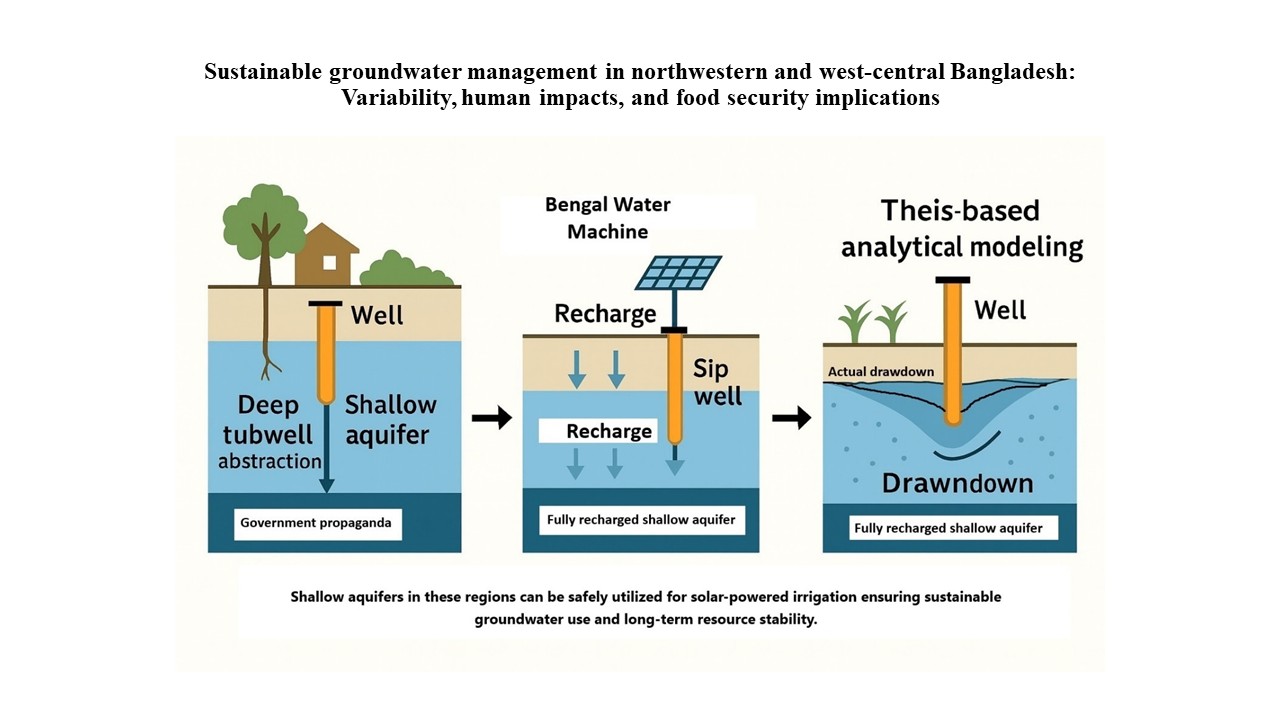
Sustainable groundwater management in northwestern and west-central Bangladesh: Variability, human impacts, and food security implications

Groundwater in Bangladesh exhibits significant spatial and temporal variability, driven by monsoon recharge, lithologic heterogeneity, and human extraction. Integrating long-term monitoring data with recent field and Geographic Information Systems analyses (2021–2023), this study quantifies groundwater responses across northwestern and west-central Bangladesh. Seasonal drawdowns in solar irrigation pump (SIP) wells averaged 4.38 ± 1.74 m, followed by full post-monsoon recovery, confirming a recharge–discharge balance. The Theis analytical model, applied with a pumping rate of 2,500 m3/day (representing the upper operational range of SIPs), an average aquifer material transmissivity of 1,800 m2/day, and a storage coefficient of 0.1, predicted maximum drawdowns of 0.68 m at a distance of 10 m from the pumping wells—well below the 5 m critical threshold for maintaining domestic water-supply sustainability. Data also reveal that transmissivity and storage coefficients vary by up to two orders of magnitude among physiographic regions, emphasizing the need for site-specific management. The relatively high transmissivity and storage coefficients of the aquifer materials enable the functioning of the Bengal Water Machine, in which irrigation-induced recharge enhances groundwater storage and helps maintain stable water levels. By applying the United States Geological Survey’s safe-yield concept alongside the Mandel–Shiftan sustainability framework, this study demonstrates that current SIP groundwater withdrawals remain well within sustainable limits. These findings support regionally adaptive groundwater governance that aligns pumping rates with recharge capacity. Such alignment is essential for maintaining irrigation viability and food security under changing climatic and hydrologic conditions. Overall, the results emphasize the importance of region-specific management strategies rather than generalized depletion narratives.
- Infrastructure Development Company Limited (IDCOL). Scaling Up Solar-Powered Irrigation to Ensure Food Security and Enhance Resilience in Drought-Prone Areas of Bangladesh. Bangladesh: Infrastructure Development Company Limited; 2024.
- Shah T, Rajan A, Rai GP, Verma S, Durga N. Solar pumps and South Asia’s energy-groundwater nexus: Exploring implications and reimagining its future. Environ Res Lett. 2018;13(11):115003. doi: 10.1088/1748-9326/aaeab4
- Gao X, Liu J, Zhang J, et al. Feasibility evaluation of solar photovoltaic pumping irrigation system based on analysis of dynamic variation of groundwater table. Appl Energy. 2013;105:182-193. doi: 10.1016/j.apenergy.2012.12.043
- Closas A, Rap E. Solar-based groundwater pumping for irrigation: Sustainability, policies, and limitations. Energy Policy. 2017;104:33-37. doi: 10.1016/j.enpol.2016.09.016
- Bastakoti R, Raut M, Thapa BR. Groundwater Governance and Adoption of Solar-Powered Irrigation Pumps: Experiences from the Eastern Gangetic Plains. Colombo: IWMI; 2020.
- Zahid A, Haque MA, Islam MS, Hasan MAFMR. The impact of shallow tubewells on irrigation water availability, access, crop productivity and farmers’ income in the Lower Gangetic Plain of Bangladesh. In: Mukherji A, Villholth KG, Sharma BR, and Wang J, editors. Groundwater Governance in the Indo-Gangetic and Yellow River Basins: Realities and Challenges. Boca Raton: CRC Press; 2009.
- British Geological Survey (BGS), Department of Public Health Engineering (DPHE). In: Kinniburgh DG, Smedley PL, editors. Arsenic Contamination of Groundwater in Bangladesh. BGS Technical Report WC/00/19. British Geological Survey; 2001. Available from: https://www2.bgs.ac.uk/groundwater/health/ arsenic/bangladesh/home.html [Last accessed on 2025 Sep 21].
- Monsur MH. Quaternary Geology of Bangladesh. Bangladesh: Department of Geology, University of Dhaka; 2020.
- Uddin A, Lundberg N. Cenozoic history of the Himalayan- Bengal system: Sand composition in the Bengal Basin, Bangladesh. Geol Soc Am Bull. 1998;110:497-511. doi: 10.1130/0016-7606(1998)110<0497:CHOTHB>2.3. CO;2
- Goodbred SL Jr., Kuehl SA. Holocene and modern sediment budgets for the Ganges-Brahmaputra river system. Geology. 1999;27:559-562.
doi: 10.1130/0091-7613(1999) 027<0559:HAMSBF>2.3. CO;2 11. Steckler MS, Akhter SH, Seeber L. Collision of the Ganges-Brahmaputra Delta with the Burma Arc: Implications for earthquake hazard. Earth Planet Sci Lett. 2008;273:367-378. doi: 10.1016/j.epsl.2008.06.026
- BWDB-UNDP. Groundwater Survey: The Hydrogeological Conditions of Bangladesh. UNDP Technical Report DP/UN/BGD-74-009/1; 1982.
- Jackson JA. Glossary of Geology. 4th ed. Virginia: American Geological Institute; 1997.
- Zahid A, Roy SK, Islam K, Nazir JT, Nowreen S. Aquifer Mapping and Nomenclature Guidelines for the Bengal Basin, Bangladesh. 2024.
- Fetter CW. Applied Hydrogeology. 5th ed. Illinois: Waveland Press; 2018.
- Jones B. Hydrogeological framework of Bangladesh. Geol Surv Bangladesh Bull. 1985;8:15-32.
- Master Plan Organization (MPO). Groundwater Resources of Bangladesh. Dhaka: MPO; 1987.
- BWDB, UNDP. Groundwater Studies for Irrigation Development in Bangladesh. Dhaka: BWDB; 1976.
- UNICEF. Safe Water for Rural Bangladesh: Progress Report. New York: UNICEF; 1998.
- Majumder RK, Shimada J. Groundwater flow systems in the Bengal Delta inferred from subsurface temperature. Hydrol Process. 2015;29(8):1953-1967. doi: 10.1002/hyp.10301
- Ouyang L, Zhao Z, Zhou D, et al. Study on the relationship between groundwater and land subsidence in Bangladesh Combining GRACE and InSAR. Remote Sens. 2024;16(19):3715. doi: 10.3390/rs16193715
- Rahman MM, et al. Long-term groundwater storage depletion and subsidence from GRACE-InSAR coupling. Remote Sens. 2024;16(19):3715. doi: 10.3390/rs16193715
- IDCOL. Personal Communication. Bangladesh: IDCOL; 2024.
- Joseph OA. Impacts of open dumpsite leachates on soil and groundwater quality. Groundw Sustain Dev. 2023;20:100877.doi: 10.1016/j.gsd.2022.100877
- Joseph OA. Understanding the interactions between uncaptured landfill plume contaminants, soil, groundwater resources, public health systems, and their implications. Environ Pollut. 2025;386:127190. doi: 10.1016/j.envpol.2025.127190
- Mukherji A, Villholth KG, Sharma BR, Wang J, editors. Groundwater Governance in the Indo-Gangetic and Yellow River Basins: Realities and Challenges. United States: CRC Press; 2009.
- Government of Bangladesh. Economic Review 2006. New Delhi: Ministry of Finance; 2006.
- Government of Bangladesh. National Strategy for Accelerated Poverty Reduction. Planning Commission. Bangladesh: Government of Bangladesh; 2005.
- Saif HB, Ruma KF, Ahmed I, et al. Generation change of cropping intensity in Bangladesh: A systematic review. Arch Curr Res Int. 2024;24(5):33-43.
- USDA Foreign Agricultural Service, GAIN. Grain and Feed Annual Report. Report No. BG2024-0002; 2024.
- Omeiza OA, Lawal HA, Nur M. Investigation of groundwater vulnerability to open dumpsites and its potential risk using electrical resistivity and water analysis. Heliyon. 2023;8:e09855. doi: 10.1016/j.heliyon.2023.e13265
- Alao JO, Eze SU, Onyenweife GI, et al. Enhancing water security through integrated storage mechanisms and rainwater harvesting for sustainable development. Discov Sustain. 2025;6:941. doi: 10.1007/s43621-025-01914-2
- The Daily Star. Northern Region Drying Amid Freshwater Loss; 2024. Available from: https://www. thedailystar.net/news/bangladesh/news/northern-region-drying-amid-freshwater-loss-3984476 [Last accessed on 2025 Sep 18].
- Chandanpurkar HA, Famiglietti JS, Gopalan K, et al. Unprecedented continental drying, shrinking freshwater availability, and increasing land contributions to sea level rise. Sci Adv. 2025;11(30):eadx0298. doi: 10.1126/sciadv.adx0298
- The Daily Star. Why We Need a Water Allocation Plan; 2024. Available from: https://www.thedailystar.net/ opinion/views/news/why-we-need-water-allocation-plan-3992276 [Last accessed on 2025 Sep 26].
- Asian Development Bank. Road Map to Scale Up Solar Irrigation Pumps in Bangladesh (2023–2031). ADB; 2023. Available from: https://www.adb.org/publications/ solar-irrigation-pumps-bangladesh-2023-2031 [Last accessed on 2025 Sep 21].
- Alley WM, Reilly T, Franke OL. Sustainability of Ground-Water Resources. United States: USGS Circular 1186; 1999.
- Loáiciga HA. The safe yield and climatic variability: Implications for groundwater management. Ground Water. 2017;55(3):334-345. doi: 10.1111/gwat.12464
- Meyland SJ. Examining safe yield and sustainable yield for groundwater supplies and moving to managed yield as water resource limits become a reality. WIT Trans Ecol Environ. 2011;145:813-823. doi: 10.2495/WRM110711
- Alley WM, Leake SA. The journey from safe yield to sustainability. Ground Water. 2004;42(1):12-16. doi: 10.1111/j.1745-6584.2004.tb02446.x
- Mandel S, Shiftan ZL. Ground-Water Resources: Investigation and Development. United States: Academic Press; 1981.
- Government of Bangladesh. Bangladesh Water Act, 2013 (Act No. 14 of 2013). Available from: https://oldweb. lged.gov.bd/uploadeddocument/UnitPublication/1/840/ Water%20Act%202013%20(English).pdf [Last accessed on 2025 Sep 21].
- Theis CV. The relation between the lowering of the piezometric surface and the rate and duration of discharge of a well using groundwater storage. Eos Trans AGU. 1935;16(2):519-524. doi: 10.1029/TR016i002p00519
- De Filippi FM, Sappa G, Robbins G. Unlocking the potential of low-flow sampling and purging activities through aquifer hydraulic conductivity estimation. Hydrogeol J. 2025;33:627-638. doi: 10.1007/s10040-025-02887-2
- Shamsudduha M, Taylor RG, Ahmed KM, Zahid A. Impact of intensive groundwater abstraction on recharge to a shallow regional aquifer system: Evidence from Bangladesh. Hydrogeol J. 2011;19:901-916. doi: 10.1007/s10040-011-0723-4
- Shamsudduha M, Joseph G, Haque SS, Khan MR, Zahid A, Ahmed KMU. Multi-hazard groundwater risks to water supply from shallow depths. Exposure Health. 2019;12:657-670. doi: 10.1007/s12403-019-00325-9
- Shamsudduha M, Taylor RG, Haq MI, Nowreen S, Zahid A, Ahmed KMU. The Bengal Water Machine: Quantified freshwater capture in Bangladesh. Science. 2022;377(6612):1315-1319. doi: 10.1126/science.abo7432
- Rushton KR, Zaman MA, Hasan M. Sustainable abstraction due to unconfined conditions in multi-layered aquifers: Examples from northwest Bangladesh. Groundw Sustain Dev. 2023;20:100901. doi: 10.1016/j.gsd.2022.100901
- Mainuddin M, Maniruzzaman MD, Alam MM, et al. Water usage and productivity of Boro rice and their impacts on sustainable groundwater irrigation in northwest Bangladesh. Agric Water Manag. 2020;240:106294. doi: 10.1016/j.agwat.2020.106294
- Rushton KR, Zaman MA. Inverted wells in unconsolidated aquifers of limited saturated thickness. Hydrogeol J. 2022;30(7):2163-2169.doi: 10.1007/s10040-022-02498-5
- Bangladesh Rural Advancement Committee. Sustainability of Groundwater Use for Irrigation in Northwest Bangladesh. Dhaka: Bangladesh Rural Advancement Committee; 2013.
- Alam AKMB, Fujii Y, Eidee SJ, Boeut S, Rahim AB. Prediction of mining-induced subsidence at Barapukuria longwall coal mine, Bangladesh. Sci Rep. 2022;12:14800. doi: 10.1038/s41598-022-19160-1
- Bangladesh Water Development Board. Groundwater Table Hydrograph of 38 Districts for the Year 2008 to 2018; 2020. Available from: https://www.hydrology. bwdb.gov.bd/img_upload/ongoing_project/781.pdf [Last accessed on 2025 Sep 03].
- Bangladesh Water Development Board. Compilation of Aquifer Test Analysis Results. Water Supply Paper- 502; 1988.
- Utah Division of Water Rights. Theis Well Drawdown Calculator. Available from: https://waterrights.utah.gov/ wellinfo/theis/theis_input.asp [Last accessed on 2025 Oct 01].
- Hart DL Jr., Hoffman GL, Goemaat RL. Geohydrology of the Oklahoma Panhandle: Beaver, Cimarron, and Texas Counties. USGS Water-Resources Investigations Report 75-25; 1976. doi: 10.3133/wri7525