

An asymmetric dual-layer electrospun membrane with potential for organoid encapsulation and transplantation

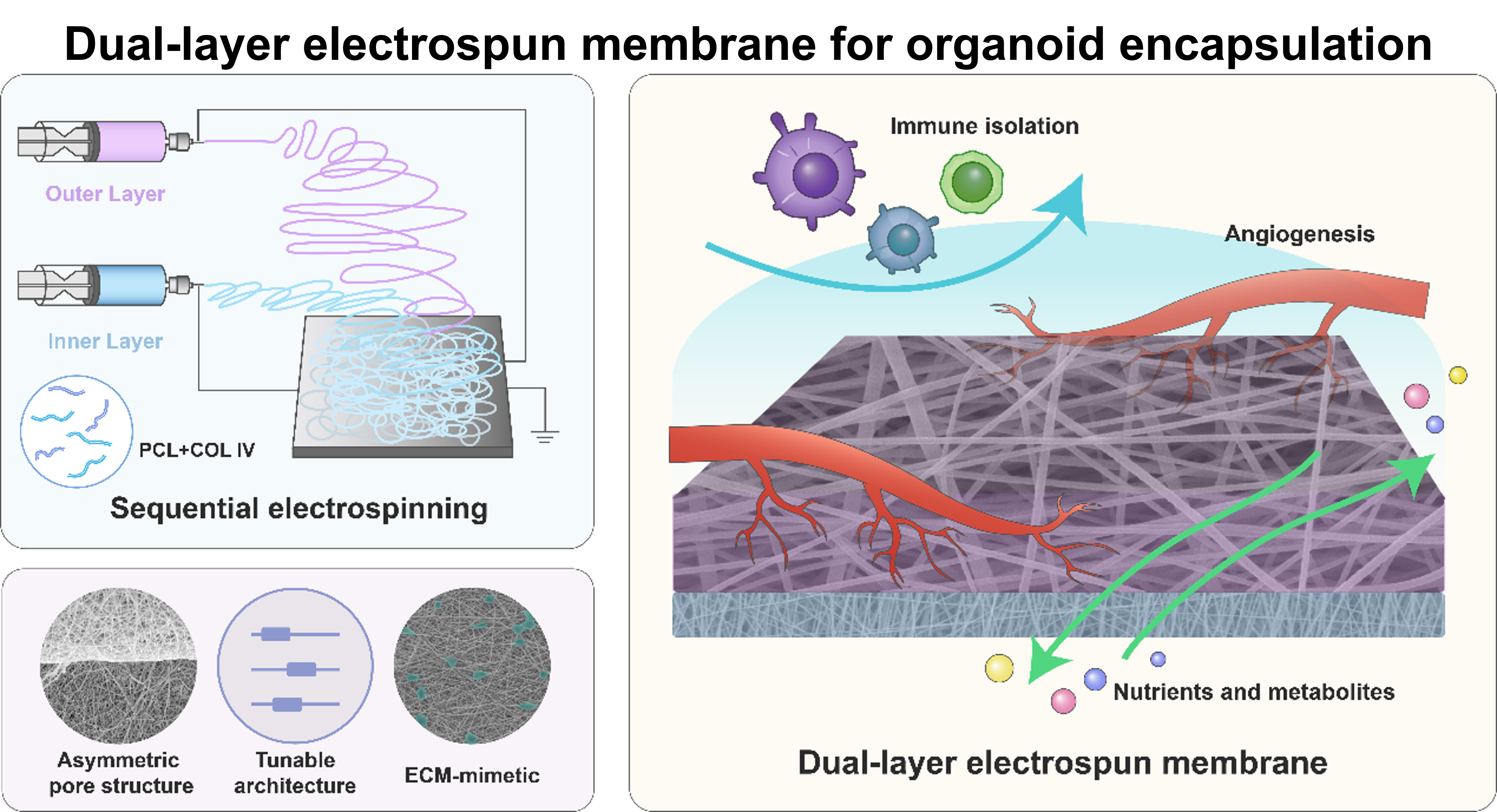
Organoid transplantation holds great promise for treating various diseases, but its therapeutic potential is limited by insufficient vascularization and host immune rejection. Conventional macroencapsulation strategies often face a fundamental trade-off between immune protection and efficient mass transport, while their fabrication can be complex. Here, we developed a simple, asymmetric, tunable dual-layer electrospun membrane to protect transplanted cells and organoid-derived therapeutic constructs. The membrane was fabricated by sequential electrospinning to generate two layers with distinct pore architectures, inspired by the hierarchical fibrous structure of the native extracellular matrix (ECM). The asymmetric pore structure enables functional separation, with the denser inner layer acting as a physical barrier to host-cell infiltration and promoting tubular structure formation by endothelial cells. Importantly, the fiber diameter and pore size of each layer can be tuned independently, providing flexibility to adapt the membrane to different cell or organoid systems. The ECM-mimetic fibrous architecture exhibited favorable surface wettability and mechanical properties, while maintaining good cytocompatibility. Its extracts promoted human umbilical vein endothelial cells tube formation in vitro, while cell-penetration and dextran-permeability assays demonstrated cellular exclusion and size-dependent molecular transport. Fourteen-day subcutaneous implantation indicated good short-term biocompatibility, with no apparent systemic toxicity and a hemolysis rate below 5%. In preliminary pancreatic islet transplantation experiments, encapsulated islets showed improved glycemic regulation compared with unencapsulated islets. Collectively, this asymmetric, tunable, and ECM-mimetic electrospun membrane provides a simple multifunctional platform that balances immune protection, molecular transport, and support for endothelial tube formation, offering potential for cell- or organoid-based transplantation.
- Lancaster MA, Knoblich JA. Organogenesis in a dish: Modeling development and disease using organoid technologies. Science. 2014;345(6194):1247125. doi: 10.1126/science.1247125
- Clevers H. Modeling Development and Disease with Organoids. Cell. 2016;165(7):1586-1597. doi: 10.1016/j.cell.2016.05.082
- Corsini NS, Knoblich JA. Human organoids: New strategies and methods for analyzing human development and disease. Cell. 2022;185(15):2756-2769. doi: 10.1016/j.cell.2022.06.051
- Zhao J, Shen F, Sheng S, et al. Cartilage-on-chip for osteoarthritis drug screening. Organoid Research. 2025;1(1):8461. doi: 10.36922/or.8461
- Kim J, Koo BK, Knoblich JA. Human organoids: model systems for human biology and medicine. Nat Rev Mol Cell Biol. 2020;21(10):571-584. doi: 10.1038/s41580-020-0259-3
- Bai L, Jing Y, Reis RL, Chen X, Su J, Liu C. Organoid research: Theory, technology, and therapeutics. Organoid Research. 2025;1(1):025040007. doi: 10.36922/OR025040007
- Yu X, Liu C, Kuang Z, Song S, Tian L, Wang Y. Islet organoids: a new hope for islet transplantation in diabetes. Front Immunol. 2025;15:1540209. doi: 10.3389/fimmu.2024.1540209
- Takebe T, Sekine K, Enomura M, et al. Vascularized and functional human liver from an iPSC-derived organ bud transplant. Nature. 2013;499(7459):481-484. doi: 10.1038/nature12271
- Song S, Zhang J, Fang Y, et al. Nerve–bone crosstalk manipulates bone organoid development and bone regeneration: A review and perspectives. Organoid Research. 2025;1(1):8294. doi: 10.36922/or.8294
- Sun T, Feng C, Huang T, et al. Liver metastatic cancer organoid models: From mechanistic insights to precision medicine. Organoid Research. 2025;1(4):025370029. doi: 10.36922/OR025370029
- Yang S, Hu H, Kung H, et al. Organoids: The current status and biomedical applications. MedComm. 2023;4(3):e274. doi: 10.1002/mco2.274
- Park S, Cho SW. Bioengineering toolkits for potentiating organoid therapeutics. Advanced Drug Delivery Reviews. 2024;208:115238. doi: 10.1016/j.addr.2024.115238
- Yang J, Yan Y, Yin X, et al. Bioengineering and vascularization strategies for islet organoids: advancing toward diabetes therapy. Metabolism. 2024;152:155786. doi: 10.1016/j.metabol.2024.155786
- Zhang YS, Khademhosseini A. Advances in engineering hydrogels. Science. 2017;356(6337):eaaf3627. doi: 10.1126/science.aaf3627
- Lutolf MP, Hubbell JA. Synthetic biomaterials as instructive extracellular microenvironments for morphogenesis in tissue engineering. Nat Biotechnol. 2005;23(1):47-55. doi: 10.1038/nbt1055
- Abraham N, Kolipaka T, Pandey G, Negi M, Srinivasarao DA, Srivastava S. Revolutionizing pancreatic islet organoid transplants: Improving engraftment and exploring future frontiers. Life Sciences. 2024;343:122545. doi: 10.1016/j.lfs.2024.122545
- Kavand A, Noverraz F, Gerber-Lemaire S. Recent Advances in Alginate-Based Hydrogels for Cell Transplantation Applications. Pharmaceutics. 2024;16(4):469. doi: 10.3390/pharmaceutics16040469
- Krishnan R, Alexander M, Robles L, Foster 3rd CE, Lakey JRT. Islet and Stem Cell Encapsulation for Clinical Transplantation. Rev Diabet Stud. 2014;11(1):84-101. doi: 10.1900/RDS.2014.11.84
- Vaithilingam V, Bal S, Tuch BE. Encapsulated Islet Transplantation: Where Do We Stand. Rev Diabet Stud. 2017;14(1):51-78. doi: 10.1900/rds.2017.14.51
- Orive G, Santos E, Poncelet D, et al. Cell encapsulation: technical and clinical advances. Trends in Pharmacological Sciences. 2015;36(8):537-546. doi: 10.1016/j.tips.2015.05.003
- Scharp DW, Marchetti P. Encapsulated islets for diabetes therapy: History, current progress, and critical issues requiring solution. Advanced Drug Delivery Reviews. 2014;67-68:35-73. doi: 10.1016/j.addr.2013.07.018
- Levey RE, Coulter FB, Scheiner KC, et al. Assessing the Effects of VEGF Releasing Microspheres on the Angiogenic and Foreign Body Response to a 3D Printed Silicone-Based Macroencapsulation Device. Pharmaceutics. 2021;13(12):2077. doi: 10.3390/pharmaceutics13122077
- Desai T, Shea LD. Advances in islet encapsulation technologies. Nat Rev Drug Discov. 2017;16(5):338-350. doi: 10.1038/nrd.2016.232
- Zhang Y, Zhang C, Li Y, et al. Evolution of biomimetic ECM scaffolds from decellularized tissue matrix for tissue engineering: A comprehensive review. International Journal of Biological Macromolecules. 2023;246:125672. doi: 10.1016/j.ijbiomac.2023.125672
- Phelps EA, Templeman KL, Thulé PM, García AJ. Engineered VEGF-releasing PEG-MAL hydrogel for pancreatic islet vascularization. Drug Deliv Transl Res. 2015;5:125-136. doi: 10.1007/s13346-013-0142-2
- Theocharis AD, Skandalis SS, Gialeli C, Karamanos NK. Extracellular matrix structure. Advanced Drug Delivery Reviews. 2016;97:4-27. doi: 10.1016/j.addr.2015.11.001
- Huch M, Koo BK. Modeling mouse and human development using organoid cultures. Development. 2015;142(18):3113-3125. doi: 10.1242/dev.118570
- Badylak SF, Freytes DO, Gilbert TW. Extracellular matrix as a biological scaffold material: Structure and function. Acta Biomaterialia. 2009;5(1):1-13. doi: 10.1016/j.actbio.2008.09.013
- Xue J, Wu T, Dai Y, Xia Y. Electrospinning and Electrospun Nanofibers: Methods, Materials, and Applications. Chem Rev. 2019;119(8):5298-5415. doi: 10.1021/acs.chemrev.8b00593
- Ding J, Zhang J, Li J, et al. Electrospun polymer biomaterials. Progress in Polymer Science. 2019;90:1-34. doi: 10.1016/j.progpolymsci.2019.01.002
- Liu H, Ding X, Zhou G, Li P, Wei X, Fan Y. Electrospinning of Nanofibers for Tissue Engineering Applications. Journal of Nanomaterials. 2013;2013:495708. doi: 10.1155/2013/495708
- Sill TJ, von Recum HA. Electrospinning: Applications in drug delivery and tissue engineering. Biomaterials. 2008;29(13):1989-2006. doi: 10.1016/j.biomaterials.2008.01.011
- Jin G, Prabhakaran MP, Ramakrishna S. Stem cell differentiation to epidermal lineages on electrospun nanofibrous substrates for skin tissue engineering. Acta Biomaterialia. 2011;7(8):3113-3122. doi: 10.1016/j.actbio.2011.04.017
- Gupta KC, Haider A, Choi Y, Kang IK. Nanofibrous scaffolds in biomedical applications. Biomaterials Research. 2014;18(1):5. doi: 10.1186/2055-7124-18-5
- Colton CK. Implantable biohybrid artificial organs. Cell Transplantation. 1995;4(4):415-436. doi: 10.1016/0963-6897(95)00025-S
- Avgoustiniatos ES, Colton CK. Effect of External Oxygen Mass Transfer Resistances on Viability of Immunoisolated Tissue. Annals of the New York Academy of Sciences. 1997;831(1):145-167. doi: 10.1111/j.1749-6632.1997.tb52192.x
- Lanza RP, Hayes JL, Chick WL. Encapsulated cell technology. Nat Biotechnol. 1996;14(9):1107-1111. doi: 10.1038/nbt0996-1107
- Laschke MW, Menger MD. Vascularization in Tissue Engineering: Angiogenesis versus Inosculation. Eur Surg Res. 2012;48(2):85-92. doi: 10.1159/000336876
- Stachewicz U, Szewczyk PK, Kruk A, Barber AH, Czyrska-Filemonowicz A. Pore shape and size dependence on cell growth into electrospun fiber scaffolds for tissue engineering: 2D and 3D analyses using SEM and FIB-SEM tomography. Materials Science and Engineering: C. 2019;95:397-408. doi: 10.1016/j.msec.2017.08.076
- Khademhosseini A, Langer R. A decade of progress in tissue engineering. Nat Protoc. 2016;11(10):1775-1781. doi: 10.1038/nprot.2016.123
- Jin Y, Chen Q, Gong L, et al. Organoids: Applications and challenges of advanced hydrogels in tissue systems. Organoid Research. 2025;1(2):8262. doi: 10.36922/or.8262
- Vegas AJ, Veiseh O, Doloff JC, et al. Combinatorial hydrogel library enables identification of materials that mitigate the foreign body response in primates. Nat Biotechnol. 2016;34(3):345-352. doi: 10.1038/nbt.3462
- Bochenek MA, Veiseh O, Vegas AJ, et al. Alginate encapsulation as long-term immune protection of allogeneic pancreatic islet cells transplanted into the omental bursa of macaques. Nat Biomed Eng. 2018;2(11):810-821. doi: 10.1038/s41551-018-0275-1
- Mei QJ, Wen JQ, Xu XX, Xie HQ. Generation of vascularized brain organoids: Technology, applications, and prospects. Organoid Research. 2025;1(2):8162. doi: 10.36922/or.8162
- Farina M, Alexander JF, Thekkedath U, Ferrari M, Grattoni A. Cell encapsulation: Overcoming barriers in cell transplantation in diabetes and beyond. Advanced Drug Delivery Reviews. 2019;139:92-115. doi: 10.1016/j.addr.2018.04.018
- Zhou Z, Li R, Ding X, Li Y, Luo Y, Liang S. Digital light processing-printed macroencapsulated human liver organoids preserve hepatic stellate cell quiescence for transplantation in immunocompetent mice. Int J Bioprint. 2026;12(3):026140130. doi: 10.36922/IJB026140130
- Wang H, Duan C, Luo R, et al. A Pro-Angiogenic Immunoprotective Membrane for Cell Therapies. Advanced Healthcare Materials. 2025;14(1):2400459. doi: 10.1002/adhm.202400459
- Pham TT, Tran PL, Tempelman LA, et al. A continuously oxygenated macroencapsulation system enables high-density packing and delivery of insulin-secreting cells. Nat Commun. 2025;16(1):7199. doi: 10.1038/s41467-025-62271-2
- Krishnan L, Clayton LR, Boland ED, Reed RM, Hoying JB, Williams SK. Cellular immunoisolation for islet transplantation by a novel dual porosity electrospun membrane. Transplant Proc. 2011;43(9):3256-3261. doi: 10.1016/j.transproceed.2011.10.031
- Bružauskaitė I, Bironaitė D, Bagdonas E, Bernotienė E. Scaffolds and cells for tissue regeneration: different scaffold pore sizes—different cell effects. Cytotechnology. 2016;68(3):355-369. doi: 10.1007/s10616-015-9895-4
- Omachi K, Fujiwara H. Exploring basement membrane dynamics through cross-scale imaging, manipulation, and molecular mapping. Matrix Biology. 2025;141:67-81. doi: 10.1016/j.matbio.2025.09.001
- Mun J, Pack SP, Lee H. Fabrication and characterization of electrospun polycaprolactone/Urechis unicinctus derived-ECM composite scaffolds for small-diameter vascular grafts. RSC Adv. 2025;15(38):31060-31075. doi: 10.1039/d5ra04406e
- Pang X, Li W, Chang L, Gautrot JE, Wang W, Azevedo HS. Hyaluronan (HA) Immobilized on Surfaces via Self-Assembled Monolayers of HA-Binding Peptide Modulates Endothelial Cell Spreading and Migration through Focal Adhesion. ACS Appl Mater Interfaces. 2021;13(22):25792-25804. doi: 10.1021/acsami.1c05574
- He X, Li W, Liu S, et al. Fabrication of high-strength, flexible, porous collagen-based scaffolds to promote tissue regeneration. Materials Today Bio. 2022;16:100376. doi: 10.1016/j.mtbio.2022.100376
- Ying P, Jin G, Tao Z. Competitive adsorption of collagen and bovine serum albumin—effect of the surface wettability. Colloids and Surfaces B: Biointerfaces. 2004;33(3-4):259-263. doi: 10.1016/j.colsurfb.2003.10.015
- Upreti T, Wolfe KM, Van Bavel N, Anikovskiy M, Labouta HI. Collagen – a newly discovered major player in protein corona formation on nanoparticles. Phys Chem Chem Phys. 2022;24(9):5610-5617. doi: 10.1039/d1cp03968g