
Bone organoid–derived extracellular vesicles promote angiogenesis and osteogenesis in vitro

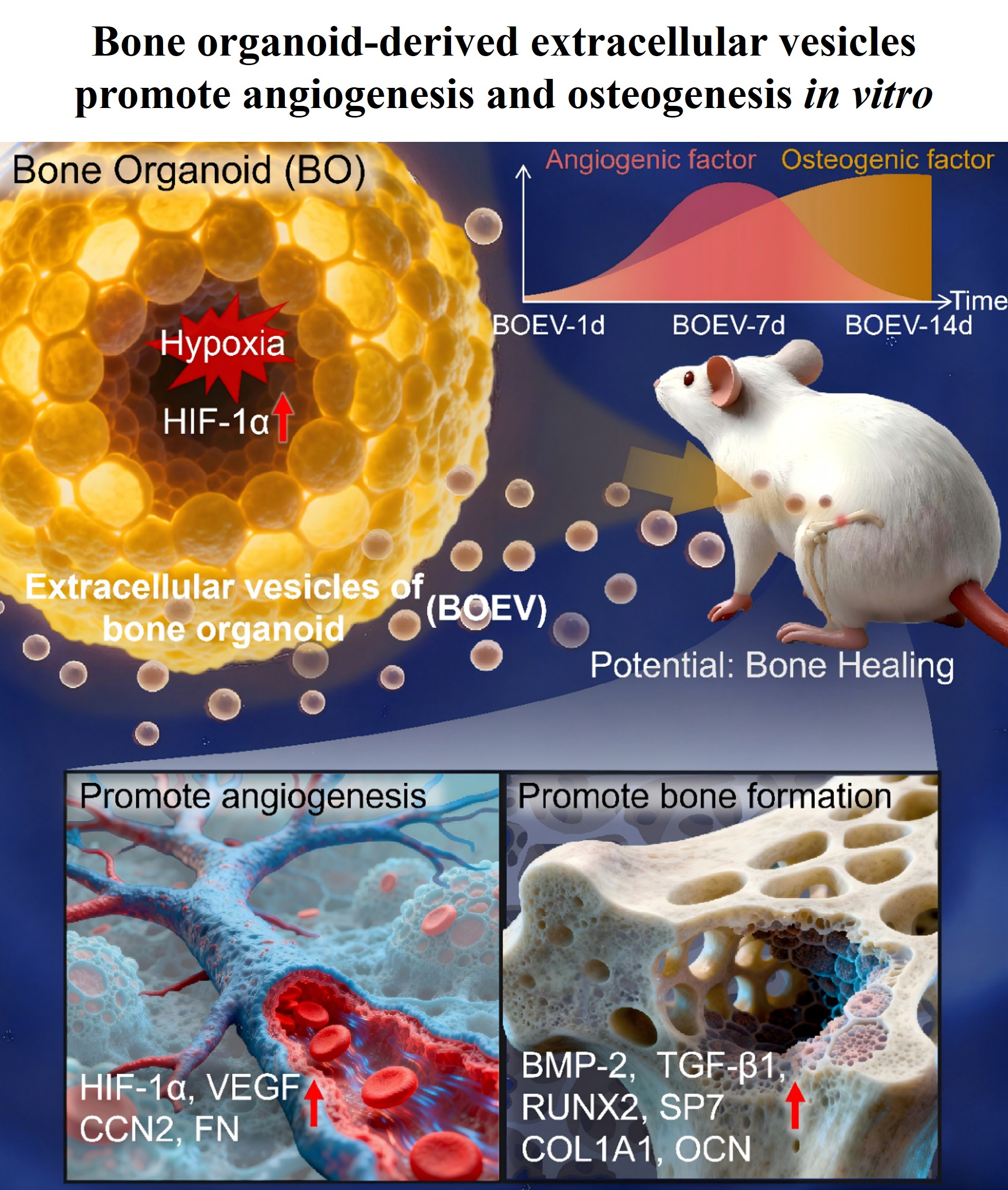
Bone organoids (BOs) demonstrate excellent therapeutic effects in bone defect transplantation, but their high cultivation difficulty and cost limit widespread adoption, prompting us to focus on their derivatives. Whether BO-derived extracellular vesicles (BOEVs) can promote bone regeneration and whether they offer greater advantages than stem cell-derived extracellular vesicles (EVs) remains unclear. In this study, we isolated rat bone marrow mesenchymal stem cells (BMSCs) and induced them into BOs. As culture duration increased, BO size gradually enlarged to 203.71 ± 45.30 μm, but the number of spheroids progressively decreased. Messenger RNA (mRNA) sequencing revealed that after seven days of culture, BOs exhibited hypoxic alterations, leading to increased expression of cytokines, including hypoxia-inducible factor-1α (HIF-1α). Subsequently, BOEVs were isolated from BO culture medium at corresponding time points. Both BOEVs cultured for seven days (BOEV-7d) and 14 days (BOEV-14d) were enriched with bone morphogenetic protein 2 (BMP-2), transforming growth factor beta 1 (TGF-β1), HIF-1α, and vascular endothelial growth factor (VEGF). Co-culturing BOEVs with human umbilical vein endothelial cells and hFOB1.19 cells revealed that BOEV-7d significantly promoted tube length and branching while upregulating VEGF and CCN2 mRNA, demonstrating superior effects compared to BOEV-1d and BOEV-14d. Concurrently, BOEV-7d enhanced alizarin red S staining levels in hFOB1.19 cells, while the expression of osteogenesis-related genes Runx2, Col1a1, and Ocn was positively correlated with culture duration. Notably, BOEVs demonstrated significantly greater osteogenic and angiogenic effects than BMSC-derived EVs in 2D culture. This study demonstrates, in vitro, that BOEVs play dual roles in bone and vascular regeneration and have the potential to modulate the vascularization–osteogenesis pathway in bone defects. It offers insights into bone defect treatment and inspires research on organoid-derived EVs.
- Hong Y, Li R, Sheng S, Zhou F, Bai L, Su J. Bone organoid construction and evolution. J Orthop Translat. 2025;53:260-273. doi: 10.1016/j.jot.2025.06.011
- Pengrui Zhang, Qiwei Qin, Xinna Cao, Honglin Xiang, Dechao Feng, Dilinaer Wusiman, Yuling Li. Hydrogel microspheres for bone regeneration through regulation of the regenerative microenvironment. Biomater Transl. 2024;5(3):205-235. doi: 10.12336/biomatertransl.2024.03.002
- Jingtao Huang, Aikang Li, Rongji Liang, Xiaohao Wu, Shicheng Jia, Jiayou Chen, Zilu Jiao, Canfeng Li, Xintao Zhang, Jianjing Lin. Future perspectives: advances in bone/cartilage organoid technology and clinical potential. Biomater Transl. 2024;5(4):425-443.doi: 10.12336/biomatertransl.2024.04.007
- Emma Steijvers, Armaan Ghei, Zhidao Xia. Manufacturing artificial bone allografts: a perspective. Biomater Transl. 2022;3(1):65-80.doi: 10.12336/biomatertransl.2022.01.007
- Zhong G, Miao Y, Zhou J, et al. Near-infrared light-induced photothermal and immunotherapy system for lung cancer bone metastasis treatment with simultaneous bone repair. Bioact Mater. 2025;52:182-199. doi: 10.1016/j.bioactmat.2025.06.008
- Zhao Z, Chen X, Dowbaj AM, et al. Organoids. Nat Rev Methods Primers. 2022;2:94. doi: 10.1038/s43586-022-00174-y
- Wang W, Zhang T, Wang J, Wang W, Sun H. Engineering bone organoids: Recent advances and future prospects. Organoid Res. 2025;1(4):025330027. doi: 10.36922/OR025330027
- Lancaster MA, Knoblich JA. Organogenesis in a dish: modeling development and disease using organoid technologies. Science. 2014;345(6194):1247125. doi: 10.1126/science.1247125
- Liu H, Su J. Organoid and organoid extracellular vesicles for osteoporotic fractures therapy: Current status and future perspectives. Interdiscip Med. 2023;1(3):e20230011.doi: 10.1002/inmd.20230011
- Li A, Liang R, Sheng W, et al. Global research trends in bone/cartilage organoids from 2010 to 2024: A bibliometric and visualization study. Organoid Res. 2025;1(3):8295. doi: 10.36922/or.8295
- Wang J, Xia Z, Su J. Organoid research breakthroughs in 2024: A review. Organoid Res. 2025;1(2):025040005. doi: 10.36922/OR025040005.
- Wang J, Chen X, Li R, et al. Standardization and consensus in the development and application of bone organoids. Theranostics. 2025;15(2):682-706. doi: 10.7150/thno.105840
- Wang J, Wu Y, Li G, et al. Engineering Large-Scale Self-Mineralizing Bone Organoids with Bone Matrix-Inspired Hydroxyapatite Hybrid Bioinks. Adv Mater. 2024;36(30):e2309875. doi: 10.1002/adma.202309875
- Dmitriev RI, Papkovsky DB. Multi-parametric O₂ imaging in three-dimensional neural cell models with the phosphorescent probes. Methods Mol Biol. 2015;1254:55-71. doi: 10.1007/978-1-4939-2152-2_5
- Song YS, Lin RL, Montesano G, et al. Engineered 3D tissue models for cell-laden microfluidic channels. Anal Bioanal Chem. 2009;395(1):185-193. doi: 10.1007/s00216-009-2935-1
- Maisumu G, Willerth S, Nestor MW, et al. Brain organoids: building higher-order complexity and neural circuitry models. Trends Biotechnol. 2025;43(7):1583-1598. doi: 10.1016/j.tibtech.2025.02.009
- Choe MS, Kim SJ, Oh ST, et al. A simple method to improve the quality and yield of human pluripotent stem cell-derived cerebral organoids. Heliyon. 2021;7(6):e07350. doi: 10.1016/j.heliyon.2021.e07350
- Li A, Sasaki JI, Abe GL, Katata C, Sakai H, Imazato S. Vascularization of a Bone Organoid Using Dental Pulp Stem Cells. Stem Cells Int. 2023;2023:5367887. doi: 10.1155/2023/5367887
- Bai L, Zhou D, Li G, Liu J, Chen X, Su J. Engineering bone/cartilage organoids: strategy, progress, and application. Bone Res. 2024;12(1):66. doi: 10.1038/s41413-024-00376-y
- Deng A, Zhang H, Hu Y, et al. Microsphere Strategy to Generate Conformal Bone Organoid Units with Osteoimmunomodulation and Sustainable Oxygen Supply for Bone Regeneration. Adv Sci. 2025;12(32):e01437. doi: 10.1002/advs.202501437
- Huang S, Wu Y, Zhao H, et al. Advancements in bone organoids: perspectives on construction methodologies and application strategies. J Adv Res. 2026;81:745-767. doi: 10.1016/j.jare.2025.06.011
- Zhang H, Yan Z, Zhu J, et al. Extracellular Mitochondrial-Derived Vesicles Affect the Progression of Diabetic Foot Ulcer by Regulating Oxidative Stress and Mitochondrial Dysfunction. Adv Sci. 2025;12(10):e2407574. doi: 10.1002/advs.202407574
- Prieto-Vila M, Yoshioka Y, Kuriyama N, et al. Adult cardiomyocytes-derived EVs for the treatment of cardiac fibrosis. J Extracell Vesicles. 2024;13(7):e12461. doi: 10.1002/jev2.12461
- Liu H, Su J. Organoid and organoid extracellular vesicles for osteoporotic fractures therapy: Current status and future perspectives. Interdiscip Med. 2023;1(3):e20230011. doi: 10.1002/inmd.20230011
- Rocha S, Carvalho J, Oliveira P, et al. 3D Cellular Architecture Affects MicroRNA and Protein Cargo of Extracellular Vesicles. Adv Sci. 2018;6(4):1800948. doi: 10.1002/advs.201800948
- Zhou G, Li R, Sheng S, et al. Organoids and organoid extracellular vesicles-based disease treatment strategies. J Nanobiotechnol. 2024;22(1):679. doi: 10.1186/s12951-024-02917-3
- Morales-Sanfrutos J, Etxeberria-Ugartemendia J, Barroso-Gomila O, et al. Defining the reference proteomes for small extracellular vesicles and non-vesicular components. Nat Cell Biol. 2026;28(3):622-639. doi: 10.1038/s41556-026-01878-z
- Chong Yin, Xingyu Wang, Jing Zhang, Yang Yu, Linfeng Liu, Hongqi Han, Guilin Luo, Zhuo Guo, Yingying Luo, Conghui Jiang, Ye Tian, Rui Pang, Jingxiang Li, Wei Chen, Bing Yang, Xundong Deng, Bin Guo, Guangrong Wang. Fortified trabeculae-like biomimetic bone-filling material organoids for repair of weight-bearing bone defects. Organoid Res. 2026;2(2):026110016.doi: 10.36922/OR026110016
- Liu J, Li J, Chen Y, et al. Advances in bone organoids research and future perspectives. Biofabrication. 2025;17(4):042005. doi: 10.1088/1758-5090/adffb9
- de Moraes VAF, Moreira FM, Dos Santos Santinoni C, de Souza Batista VE, Mori GG. Would Exosome Therapy be Effective for Bone Regeneration? Systematic Review and Meta-Analysis. Calcif Tissue Int. 2025;116(1):127.doi: 10.1007/s00223-025-01438-x
- Goto K, Watanabe D, Yanagida K, Takagi T, Mizushima A. Harnessing miRNA-Containing Extracellular Vesicles from Mesenchymal Stromal Cell-Derived Extracellular Vesicles for Regeneration of Bone Defects: A Narrative Review of Mechanisms, Biomaterials, and Clinical Translation. Cancers. 2025;17(15):2438. doi: 10.3390/cancers17152438
- Wu D, Qin H, Wang Z, et al. Bone Mesenchymal Stem Cell-Derived sEV-Encapsulated Thermosensitive Hydrogels Accelerate Osteogenesis and Angiogenesis by Release of Exosomal miR-21. Front Bioeng Biotechnol. 2022;9:829136. doi: 10.3389/fbioe.2021.829136
- Chen Z, Bo Q, Wang C, Xu Y, Fei X, Chen R. Single BMSC-derived cartilage organoids for gradient heterogeneous osteochondral regeneration by leveraging native vascular microenvironment. J Nanobiotechnol. 2025;23(1):325. doi: 10.1186/s12951-025-03403-0
- Lee JE, Lee YJ, Yoon JK. Advanced 3D In Vitro Liver Fibrosis Models: Spheroids, Organoids, and Liver-on-Chips. Biomimetics. 2025;10(10):639. doi: 10.3390/biomimetics10100639
- Zhao Z, Wijerathne H, Godwin AK, Soper SA. Isolation and analysis methods of extracellular vesicles (EVs). Extracell Vesicles Circ Nucl Acids. 2021;2(1):80-103. doi: 10.20517/evcna.2021.07
- Hao Z, Ren L, Zhang Z, et al. A multifunctional neuromodulation platform utilizing Schwann cell-derived exosomes orchestrates bone microenvironment via immunomodulation, angiogenesis and osteogenesis. Bioactive Materials. 2023;23:206-222. doi: 10.1016/j.bioactmat.2022.10.018
- Wang X, Huang J, Fan W, et al. Lactate-binding protein DNMT3A in HRMECs promotes angiogenesis by upregulating VEGFA through HIF-1α lactylation. Genome Biol. 2025;26(1):377. doi: 10.1186/s13059-025-03845-7
- Chen S, Lian J, Mathew R, et al. Vascular aging: implications, mechanisms, and interventions. Aging Res. 2024;2(4):9340039. doi: 10.26599/agr.2025.9340039
- Saberi A, Kouhjani M, Mohammadi M, Hosta-Rigau L. Novel scaffold platforms for simultaneous induction osteogenesis and angiogenesis in bone tissue engineering: a cutting-edge approach. J Nanobiotechnol. 2023;21(1):351. doi: 10.1186/s12951-023-02115-7
- Zhu M, Fan Z, Chen M, Xu K, Jiang Y, Su J. Biomineralization empowers bone organoids. Biomaterials. 2026;326:123703. doi: 10.1016/j.biomaterials.2025.123703
- Ansari S, de Wildt BWM, Vis MAM, et al. Matrix Vesicles: Role in Bone Mineralization and Potential Use as Therapeutics. Pharmaceuticals. 2021;14(4):289. doi: 10.3390/ph14040289
- Sheikh IA, Midura-Kiela MT, Herchuelz A, Sokolow S, Kiela PR, Ghishan FK. The Na+/Ca2+ exchanger NCX3 mediates Ca2+ entry into matrix vesicles to facilitate initial steps of mineralization in osteoblasts. J Extracell Vesicles. 2024;13(6):e12450. doi: 10.1002/jev2.12450
- Zhou D, Xia Z, Su J. Organoids: the future of disease modelling and therapeutics. Biomater Transl. 2024;5(4):335-336. doi: 10.12336/biomatertransl.2024.04.001
- Chen S, Chen X, Geng Z, Su J. The horizon of bone organoid: A perspective on construction and application. Bioact Mater. 2022;18:15-25. doi: 10.1016/j.bioactmat.2022.01.048