
Advances in skin organoid technology and their applications across biomedical fields: A review

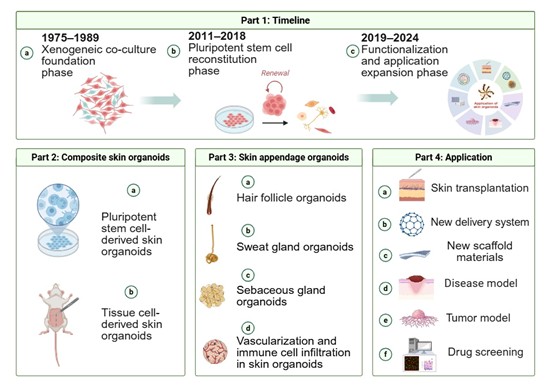
Organoids have revolutionized biomedical research by recapitulating the structural and functional complexity of human tissues. Enabled by advances in cell biology, innovative biomaterials, and three-dimensional (3D) bioprinting technologies, organoids are increasingly being utilized as reliable alternatives to traditional cell culture models and human skin explants. This review presents an overview of the methodologies and culture systems employed in the development of composite skin organoids and single-skin appendage organoids, covering a wide range of technical approaches from directed differentiation of induced pluripotent stem cells to the self-organization of adult stem cells. We also highlight recent progress in organoid generation driven by advanced engineering technologies, such as 3D printing and microfluidic systems. Furthermore, this review evaluates the diverse applications of skin organoids in the fields of developmental biology, disease modeling, regenerative medicine, and clinical translation, while addressing current challenges and future perspectives. By proposing a strategic developmental roadmap, this study aims to provide a translational framework for advancing regenerative dermatology and therapeutic innovation.
- Sambuy Y, De Angelis I. Formation of organoid structures and extracellular matrix production in an intestinal epithelial cell line during long-term in vitro culture. Cell Differ. 1986;19(2):139-147. doi: 10.1016/0045-6039(86)90071-0
- De Poel E, Lefferts JW, Beekman JM. Intestinal organoids for cystic fibrosis research. J Cyst Fibros. 2020;19 Suppl 1:S60-S64. doi: 10.1016/j.jcf.2019.11.002
- Huch M, Koo BK. Modeling mouse and human development using organoid cultures. Development. 2015;142(18):3113-25. doi: 10.1242/dev.118570
- Lancaster MA, Knoblich JA. Organogenesis in a dish: Modeling development and disease using organoid technologies. Science. 2014;345(6194):1247125. doi: 10.1126/science.1247125
- Sato T, Vries RG, Snippert HJ, et al. Single Lgr5 stem cells build crypt-villus structures in vitro without a mesenchymal niche. Nature. 2009;459(7244):262-5. doi: 10.1038/nature07935
- Barker N, Van Es JH, Kuipers J, et al. Identification of stem cells in small intestine and colon by marker gene Lgr5. Nature. 2007;449(7165):1003-7. doi: 10.1038/nature06196
- Jiang X, Oyang L, Peng Q, et al. Organoids: Opportunities and challenges of cancer therapy. Front Cell Dev Biol. 2023;11:1232528. doi: 10.3389/fcell.2023.1232528
- Lin H, Wang Y, Cheng C, et al. Standard: Human intestinal cancer organoids. Cell Regen. 2023;12(1):24. doi: 10.1186/s13619-023-00167-6
- Mei J, Liu X, Tian HX, et al. Tumour organoids and assembloids: Patient-derived cancer avatars for immunotherapy. Clin Transl Med. 2024;14(4):e1656. doi: 10.1002/ctm2.1656
- De Souza N. Organoids. Nat Methods. 2018;15(1):23-23. doi: 10.1038/nmeth.4576
- Ootani A, Toda S, Fujimoto K, Sugihara H. Foveolar differentiation of mouse gastric mucosa in vitro. Am J Pathol. 2003;162(6):1905-12. doi: 10.1016/S0002-9440(10)64324-6
- Lee J, Rabbani CC, Gao H, et al. Hair-bearing human skin generated entirely from pluripotent stem cells. Nature. 2020;582(7812):399-404. doi: 10.1038/s41586-020-2352-3
- Rheinwald JG, Green H. Serial cultivation of strains of human epidermal keratinocytes: The formation of keratinizing colonies from single cells. Cell. 1975;6(3):331-43. doi: 10.1016/s0092-8674(75)80001-8
- Shipley GD, Keeble WW, Hendrickson JE, Coffey RJ Jr., Pittelkow MR. Growth of normal human keratinocytes and fibroblasts in serum-free medium is stimulated by acidic and basic fibroblast growth factor. J Cell Physiol. 1989;138(3):511-518. doi: 10.1002/jcp.1041380310
- Itoh M, Kiuru M, Cairo MS, Christiano AM. Generation of keratinocytes from normal and recessive dystrophic epidermolysis bullosa-induced pluripotent stem cells. Proc Natl Acad Sci U S A. 2011;108(21):8797-8802. doi: 10.1073/pnas.1100332108
- Itoh M, Umegaki-Arao N, Guo Z, Liu L, Higgins CA, Christiano AM. Generation of 3D skin equivalents fully reconstituted from human induced pluripotent stem cells (iPSCs). PLoS One. 2013;8(10):e77673. doi: 10.1371/journal.pone.0077673
- Lee J, Bӧscke R, Tang PC, Hartman BH, Heller S, Koehler KR. Hair follicle development in mouse pluripotent stem cell-derived skin organoids. Cell Rep. 2018;22(1):242-254. doi: 10.1016/j.celrep.2017.12.007
- Boonekamp KE, Kretzschmar K, Wiener DJ, et al. Long-term expansion and differentiation of adult murine epidermal stem cells in 3D organoid cultures. Proc Natl Acad Sci U S A. 2019;116(29):14630-14638. doi: 10.1073/pnas.1715272116
- Feldman A, Mukha D, Maor, II, et al. Blimp1(+) cells generate functional mouse sebaceous gland organoids in vitro. Nat Commun. 2019;10(1):2348. doi: 10.1038/s41467-019-10261-6
- Li P, Pachis ST, Xu G, et al. Mpox virus infection and drug treatment modelled in human skin organoids. Nat Microbiol. 2023;8(11):2067-2079. doi: 10.1038/s41564-023-01489-6
- Kwak S, Song CL, Lee J, et al. Development of pluripotent stem cell-derived epidermal organoids that generate effective extracellular vesicles in skin regeneration. Biomaterials. 2024;307:122522. doi: 10.1016/j.biomaterials.2024.122522
- Langbein L, Yoshida H, Praetzel-Wunder S, Parry DA, Schweizer J. The keratins of the human beard hair medulla: The riddle in the middle. J Invest Dermatol. 2010;130(1):55-73. doi: 10.1038/jid.2009.192
- Kageyama T, Shimizu A, Anakama R, et al. Reprogramming of three-dimensional microenvironments for in vitro hair follicle induction. Sci Adv. 2022;8(42):eadd4603. doi: 10.1126/sciadv.add4603
- Diao J, Liu J, Wang S, et al. Sweat gland organoids contribute to cutaneous wound healing and sweat gland regeneration. Cell Death Dis. 2019;10(3):238. doi: 10.1038/s41419-019-1485-5
- Jensen KB, Driskell RR, Watt FM. Assaying proliferation and differentiation capacity of stem cells using disaggregated adult mouse epidermis. Nat Protoc. 2010;5(5):898-911. doi: 10.1038/nprot.2010.39
- Lei M, Schumacher LJ, Lai YC, et al. Self-organization process in newborn skin organoid formation inspires strategy to restore hair regeneration of adult cells. Proc Natl Acad Sci U S A. 2017;114(34):E7101-E7110. doi: 10.1073/pnas.1700475114
- Toyoshima KE, Asakawa K, Ishibashi N, et al. Fully functional hair follicle regeneration through the rearrangement of stem cells and their niches. Nat Commun. 2012;3:784. doi: 10.1038/ncomms1784
- Kadaja M, Keyes BE, Lin M, et al. SOX9: A stem cell transcriptional regulator of secreted niche signaling factors. Genes Dev. 2014;28(4):328-341. doi: 10.1101/gad.233247.113
- Wang M, Zhou X, Zhou S, et al. Mechanical force drives the initial mesenchymal-epithelial interaction during skin organoid development. Theranostics. 2023;13(9):2930-2945. doi: 10.7150/thno.83217
- Koehler KR, Mikosz AM, Molosh AI, Patel D, Hashino E. Generation of inner ear sensory epithelia from pluripotent stem cells in 3D culture. Nature. 2013;500(7461):217-221. doi: 10.1038/nature12298
- Koehler KR, Hashino E. 3D mouse embryonic stem cell culture for generating inner ear organoids. Nat Protoc. 2014;9(6):1229-1244. doi: 10.1038/nprot.2014.100
- Kageyama T, Yoshimura C, Myasnikova D, et al. Spontaneous hair follicle germ (HFG) formation in vitro, enabling the large-scale production of HFGs for regenerative medicine. Biomaterials. 2018;154:291-300. doi: 10.1016/j.biomaterials.2017.10.056
- Kageyama T, Yan L, Shimizu A, Maruo S, Fukuda J. Preparation of hair beads and hair follicle germs for regenerative medicine. Biomaterials. 2019;212:55-63. doi: 10.1016/j.biomaterials.2019.05.003
- Lee LF, Jiang TX, Garner W, Chuong CM. A simplified procedure to reconstitute hair-producing skin. Tissue Eng Part C Methods. 2011;17(4):391-400. doi: 10.1089/ten.TEC.2010.0477
- Rogers G, Martinet N, Steinert P, et al. Cultivation of murine hair follicles as organoids in a collagen matrix. J Invest Dermatol. 1987;89(4):369-379. doi: 10.1111/1523-1747.ep12471760
- Weber EL, Woolley TE, Yeh CY, Ou KL, Maini PK, Chuong CM. Self-organizing hair peg-like structures from dissociated skin progenitor cells: New insights for human hair follicle organoid engineering and Turing patterning in an asymmetric morphogenetic field. Exp Dermatol. 2019;28(4):355-366. doi: 10.1111/exd.13891
- Su Y, Wen J, Zhu J, et al. Pre-aggregation of scalp progenitor dermal and epidermal stem cells activates the WNT pathway and promotes hair follicle formation in in vitro and in vivo systems. Stem Cell Res Ther. 2019;10(1):403. doi: 10.1186/s13287-019-1504-6
- Gupta AC, Chawla S, Hegde A, et al. Establishment of an in vitro organoid model of dermal papilla of human hair follicle. J Cell Physiol. 2018;233(11):9015-9030. doi: 10.1002/jcp.26853
- Lee J, Van der Valk WH, Serdy SA, et al. Generation and characterization of hair-bearing skin organoids from human pluripotent stem cells. Nat Protoc. 2022;17(5):1266-1305. doi: 10.1038/s41596-022-00681-y
- Klaka P, Grudl S, Banowski B, et al. A novel organotypic 3D sweat gland model with physiological functionality. PLoS One. 2017;12(8):e0182752. doi: 10.1371/journal.pone.0182752
- Liu N, Huang S, Yao B, Xie J, Wu X, Fu X. 3D bioprinting matrices with controlled pore structure and release function guide in vitro self-organization of sweat gland. Sci Rep. 2016;6:34410. doi: 10.1038/srep34410
- Kurata R, Futaki S, Nakano I, et al. Isolation and characterization of sweat gland myoepithelial cells from human skin. Cell Struct Funct. 2014;39(2):101-112. doi: 10.1247/csf.14009
- Sun X, Xiang J, Chen R, et al. Sweat gland organoids originating from reprogrammed epidermal keratinocytes functionally recapitulated damaged skin. Adv Sci (Weinh). 2021;8(22):e2103079. doi: 10.1002/advs.202103079
- Zhang B, Chen T. Local and systemic mechanisms that control the hair follicle stem cell niche. Nat Rev Mol Cell Biol. 2024;25(2):87-100. doi: 10.1038/s41580-023-00662-3
- Müller-Röver S, Foitzik K, Paus R, et al. A comprehensive guide for the accurate classification of murine hair follicles in distinct hair cycle stages. J Invest Dermatol. 2001;117(1):3-15. doi: 10.1046/j.0022-202x.2001.01377.x
- Stenn KS, Paus R. Controls of hair follicle cycling. Physiol Rev. 2001;81(1):449-494. doi: 10.1152/physrev.2001.81.1.449
- Legue E, Nicolas JF. Hair follicle renewal: Organization of stem cells in the matrix and the role of stereotyped lineages and behaviors. Development. 2005;132(18):4143-4154. doi: 10.1242/dev.01975
- Paus R, Foitzik K. In search of the “hair cycle clock”: A guided tour. Differentiation. 2004;72(9-10):489-511. doi: 10.1111/j.1432-0436.2004.07209004.x
- Clayton RW, Langan EA, Ansell DM, et al. Neuroendocrinology and neurobiology of sebaceous glands. Biol Rev. 2020;95(3):592-624. doi: 10.1111/brv.12579
- Eckhart L, Tschachler E, Gruber F. Autophagic control of skin aging. Front Cell Dev Biol. 2019;7:143. doi: 10.3389/fcell.2019.00143
- Du H, Zhang T, Wang Q, et al. Traditional Chinese Medicine Shi-Bi-Man regulates lactic acid metabolism and drives hair follicle stem cell activation to promote hair regeneration. Chin Med. 2023;18(1):84. doi: 10.1186/s13020-023-00791-z
- Moltrasio C, Romagnuolo M, Marzano AV. Epigenetic mechanisms of epidermal differentiation. Int J Mol Sci. 2022;23(9):4874. doi: 10.3390/ijms23094874
- Lei M, Chuong CM. Stem cells. Aging, alopecia, and stem cells. Science. 2016;351(6273):559-560. doi: 10.1126/science.aaf1635
- Wu W, Yang J, Tao H, Lei M. Environmental regulation of skin pigmentation and hair regeneration. Stem Cells Dev. 2022;31(5-6):91-96. doi: 10.1089/scd.2022.29011.wwu
- Lei M, Lin SJ, Chuong CM. Editorial: Hair follicle stem cell regeneration in aging. Front Cell Dev Biol. 2021;9:799268. doi: 10.3389/fcell.2021.799268
- Chen CC, Chuong CM. Multi-layered environmental regulation on the homeostasis of stem cells: The saga of hair growth and alopecia. J Dermatol Sci. 2012;66(1):3-11. doi: 10.1016/j.jdermsci.2012.02.007
- Harn HI, Chen CC, Wang SP, Lei M, Chuong CM. Tissue mechanics in haired murine skin: Potential implications for skin aging. Front Cell Dev Biol. 2021;9:635340. doi: 10.3389/fcell.2021.635340
- Lei M, Lien WH, Li J. Editorial: Inflammation, stem cells and wound healing in skin aging. Front Cell Dev Biol. 2022;10:1046022. doi: 10.3389/fcell.2022.1046022
- Ungvari Z, Tarantini S, Donato AJ, Galvan V, Csiszar A. Mechanisms of vascular aging. Circ Res. 2018;123(7):849-867. doi: 10.1161/circresaha.118.311378
- Li KN, Jain P, He CH, Eun FC, Kang S, Tumbar T. Skin vasculature and hair follicle cross-talking associated with stem cell activation and tissue homeostasis. eLife. 2019;8:e45977. doi: 10.7554/eLife.45977
- Mostina M, Sun J, Sim SL, et al. Coordinated development of immune cell populations in vascularized skin organoids from human induced pluripotent stem cells. Adv Healthc Mater. 2025:e02108. doi: 10.1002/adhm.202502108
- Abilez OJ, Yang H, Guan Y, et al. Gastruloids enable modeling of the earliest stages of human cardiac and hepatic vascularization. Science. 2025;388(6751):eadu9375. doi: 10.1126/science.adu9375
- Gibot L, Galbraith T, Huot J, Auger FA. A preexisting microvascular network benefits in vivo revascularization of a microvascularized tissue-engineered skin substitute. Tissue Eng Part A. 2010;16(10):3199-3206. doi: 10.1089/ten.tea.2010.0189
- Baltazar T, Merola J, Catarino C, et al. Three dimensional bioprinting of a vascularized and perfusable skin graft using human keratinocytes, fibroblasts, pericytes, and endothelial cells. Tissue Eng Part A. 2020;26(5-6):227-238. doi: 10.1089/ten.TEA.2019.0201
- Tehranirokh M, Kouzani AZ, Francis PS, Kanwar JR. Microfluidic devices for cell cultivation and proliferation. Biomicrofluidics. 2013;7(5):51502. doi: 10.1063/1.4826935
- Quintard C, Tubbs E, Jonsson G, et al. A microfluidic platform integrating functional vascularized organoids-on-chip. Nat Commun. 2024;15(1):1452. doi: 10.1038/s41467-024-45710-4
- Kabashima K, Honda T, Ginhoux F, Egawa G. The immunological anatomy of the skin. Nat Rev Immunol. 2019;19(1):19-30. doi: 10.1038/s41577-018-0084-5
- Natsuaki Y, Egawa G, Nakamizo S, et al. Perivascular leukocyte clusters are essential for efficient activation of effector T cells in the skin. Nat Immunol. 2014;15(11):1064-1069. doi: 10.1038/ni.2992
- Arjmand B, Hamidpour SK, Tayanloo-Beik A, et al. Incorporating NK cells in a three-dimensional organotypic culture system for human skin stem cells: Modeling skin diseases and immune cell interplay. In: Methods in Molecular Biology. Springer US; 2023:161-171. doi: 10.1007/7651_2023_504
- Sun S, Jin L, Zheng Y, Zhu J. Modeling human HSV infection via a vascularized immune-competent skin-on-chip platform. Nat Commun. 2022;13(1):5481. doi: 10.1038/s41467-022-33114-1
- Supp DM, Supp AP, Bell SM, Boyce ST. Enhanced vascularization of cultured skin substitutes genetically modified to overexpress vascular endothelial growth factor. J Invest Dermatol. 2000;114(1):5-13. doi: 10.1046/j.1523-1747.2000.00824.x
- Rimal R, Muduli S, Desai P, et al. Vascularized 3D human skin models in the forefront of dermatological research. Adv Healthc Mater. 2024;13(9):e2303351. doi: 10.1002/adhm.202303351
- Brancati G, Treutlein B, Camp JG. Resolving neurodevelopmental and vision disorders using organoid single-cell multi-omics. Neuron. 2020;107(6):1000-1013. doi: 10.1016/j.neuron.2020.09.001
- Chen J, Lau BT, Andor N, et al. Single-cell transcriptome analysis identifies distinct cell types and niche signaling in a primary gastric organoid model. Sci Rep. 2019;9(1):4536. doi: 10.1038/s41598-019-40809-x
- Serra D, Mayr U, Boni A, et al. Self-organization and symmetry breaking in intestinal organoid development. Nature. 2019;569(7754):66-72. doi: 10.1038/s41586-019-1146-y
- Van den Brink SC, Alemany A, van Batenburg V, et al. Single-cell and spatial transcriptomics reveal somitogenesis in gastruloids. Nature. 2020;582(7812):405-409. doi: 10.1038/s41586-020-2024-3
- Gopee NH, Winheim E, Olabi B, et al. A prenatal skin atlas reveals immune regulation of human skin morphogenesis. Nature. 2024;635(8039):679-689. doi: 10.1038/s41586-024-08002-x
- Silva LMA, Hsieh R, Lourenco SV, Ottoni V, Valente N, Fernandes JD. Immunoexpression of adhesion molecules during human fetal hair development. Histol Histopathol. 2020;35(8):911-917. doi: 10.14670/HH-18-224
- Arita K, Akiyama M, Tsuji Y, McMillan JR, Eady RA, Shimizu H. Changes in gap junction distribution and connexin expression pattern during human fetal skin development. J Histochem Cytochem. 2002;50(11):1493-500. doi: 10.1177/002215540205001109
- Lee SC, Lee JB, Kook JP, et al. Expression of differentiation markers during fetal skin development in humans: Immunohistochemical studies on the precursor proteins forming the cornified cell envelope. J Invest Dermatol. 1999;112(6):882-886. doi: 10.1046/j.1523-1747.1999.00602.x
- Lee J, Koehler KR. Skin organoids: A new human model for developmental and translational research. Exp Dermatol. 2021;30(4):613-620. doi: 10.1111/exd.14292
- Stabell AR, Lee GE, Jia Y, et al. Single-cell transcriptomics of human-skin-equivalent organoids. Cell Rep. 2023; 42(5):112511. doi: 10.1016/j.celrep.2023.112511
- Aragona M, Dekoninck S, Rulands S, et al. Defining stem cell dynamics and migration during wound healing in mouse skin epidermis. Nat Commun. 2017;8:14684. doi: 10.1038/ncomms14684
- Joost S, Jacob T, Sun X, et al. Single-cell transcriptomics of traced epidermal and hair follicle stem cells reveals rapid adaptations during wound healing. Cell Rep. 2018;25(3):585-597.e7. doi: 10.1016/j.celrep.2018.09.059
- Kumar M, Keller B, Makalou N, Sutton RE. Systematic determination of the packaging limit of lentiviral vectors. Hum Gene Ther. 2001;12(15):1893-905. doi: 10.1089/104303401753153947
- Sada A, Jacob F, Leung E, et al. Defining the cellular lineage hierarchy in the interfollicular epidermis of adult skin. Nat Cell Biol. 2016;18(6):619-631. doi: 10.1038/ncb3359
- Xie Y, Chen D, Jiang K, et al. Hair shaft miniaturization causes stem cell depletion through mechanosensory signals mediated by a Piezo1-calcium-TNF- α axis. Cell Stem Cell. 2022;29(1):70-85.e6. doi: 10.1016/j.stem.2021.09.009
- Xue Y, Lyu C, Taylor A, et al. Mechanical tension mobilizes Lgr6+ epidermal stem cells to drive skin growth. Sci Adv. 2022;8(17):eabl8698. doi: 10.1126/sciadv.abl8698
- Aragona M, Sifrim A, Malfait M, et al. Mechanisms of stretch-mediated skin expansion at single-cell resolution. Nature. 2020;584(7820):268-273. doi: 10.1038/s41586-020-2555-7
- Heitman N, Saxena N, Rendl M. Advancing insights into stem cell niche complexities with next-generation technologies. Curr Opin Cell Biol. 2018;55:87-95. doi: 10.1016/j.ceb.2018.06.012
- Guillot C, Lecuit T. Mechanics of epithelial tissue homeostasis and morphogenesis. Science. 2013;340(6137):1185-1189. doi: 10.1126/science.1235249
- Jiang C, Javed A, Kaiser L, et al. Mechanochemical control of epidermal stem cell divisions by B-plexins. Nat Commun. 2021;12(1):1308. doi: 10.1038/s41467-021-21513-9
- Sedov E, Koren E, Chopra S, et al. THY1-mediated mechanisms converge to drive YAP activation in skin homeostasis and repair. Nat Cell Biol. 2022;24(7):1049-1063. doi: 10.1038/s41556-022-00944-6
- Biggs LC, Kim CS, Miroshnikova YA, Wickstrom SA. Mechanical forces in the skin: Roles in tissue architecture, stability, and function. J Invest Dermatol. 2020;140(2):284-290. doi: 10.1016/j.jid.2019.06.137
- Shyer AE, Rodrigues AR, Schroeder GG, Kassianidou E, Kumar S, Harland RM. Emergent cellular self-organization and mechanosensation initiate follicle pattern in the avian skin. Science. 2017;357(6353):811-815. doi: 10.1126/science.aai7868
- Martino PA, Heitman N, Rendl M. The dermal sheath: An emerging component of the hair follicle stem cell niche. Exp Dermatol. 2021;30(4):512-521. doi: 10.1111/exd.14204
- Harding KG, Morris HL, Patel GK. Science, medicine and the future: Healing chronic wounds. BMJ. 2002;324(7330):160-163. doi: 10.1136/bmj.324.7330.160
- Eming SA, Krieg T, Davidson JM. Inflammation in wound repair: Molecular and cellular mechanisms. J Invest Dermatol. 2007;127(3):514-525. doi: 10.1038/sj.jid.5700701
- Gurtner GC, Werner S, Barrandon Y, Longaker MT. Wound repair and regeneration. Nature. 2008;453(7193):314-321. doi: 10.1038/nature07039
- Sorg H, Tilkorn DJ, Hager S, Hauser J, Mirastschijski U. Skin wound healing: An update on the current knowledge and concepts. Eur Surg Res. 2017;58(1-2):81-94. doi: 10.1159/000454919
- Herndon DN, Barrow RE, Rutan RL, Rutan TC, Desai MH, Abston S. A comparison of conservative versus early excision. Therapies in severely burned patients. Ann Surg. 1989;209(5):547-552; discussion 552-553. doi: 10.1097/00000658-198905000-00006
- Brohem CA, Cardeal LB, Tiago M, Soengas MS, Barros SB, Maria-Engler SS. Artificial skin in perspective: Concepts and applications. Pigment Cell Melanoma Res. 2011;24(1):35-50. doi: 10.1111/j.1755-148X.2010.00786.x
- Takagi R, Ishimaru J, Sugawara A, et al. Bioengineering a 3D integumentary organ system from iPS cells using an in vivo transplantation model. Sci Adv. 2016;2(4):e1500887. doi: 10.1126/sciadv.1500887
- Bellu E, Medici S, Coradduzza D, Cruciani S, Amler E, Maioli M. Nanomaterials in skin regeneration and rejuvenation. Int J Mol Sci. 2021;22(13):7095. doi: 10.3390/ijms22137095
- Zhang T, Sheng S, Cai W, et al. 3-D bioprinted human-derived skin organoids accelerate full-thickness skin defects repair. Bioact Mater. 2024;42:257-269. doi: 10.1016/j.bioactmat.2024.08.036
- Ishibashi Y, Sugita T, Nishikawa A. Cytokine secretion profile of human keratinocytes exposed to Malassezia yeasts. FEMS Immunol Med Microbiol. 2006;48(3):400-409. doi: 10.1111/j.1574-695X.2006.00163.x
- Ma J, Liu J, Gao D, et al. Establishment of human pluripotent stem cell-derived skin organoids enabled pathophysiological model of SARS-CoV-2 infection. Adv Sci (Weinh). 2022;9(7):e2104192. doi: 10.1002/advs.202104192
- Kitisin T, Muangkaew W, Ampawong S, Sukphopetch P. Utilization of an in vitro biofabricated 3D skin as a pathological model of cutaneous candidiasis. New Microbiol. 2020;43(4):171-179.
- Burclaff J, Bliton RJ, Breau KA, et al. A proximal-to-distal survey of healthy adult human small intestine and colon epithelium by single-cell transcriptomics. Cell Mol Gastroenterol Hepatol. 2022;13(5):1554-1589. doi: 10.1016/j.jcmgh.2022.02.007
- Sriram G, Bigliardi PL, Bigliardi-Qi M. Full-thickness human skin equivalent models of atopic dermatitis. In: Methods in Molecular Biology. Springer New York; 2018:367-383. doi: 10.1007/7651_2018_163
- Elias MS, Wright SC, Nicholson WV, et al. Functional and proteomic analysis of a full thickness filaggrin-deficient skin organoid model. Wellcome Open Res. 2019;4:134. doi: 10.12688/wellcomeopenres.15405.2
- Jiang J, Shao X, Liu W, et al. The mechano-chemical circuit in fibroblasts and dendritic cells drives basal cell proliferation in psoriasis. Cell Rep. 2024;43(7):114513. doi: 10.1016/j.celrep.2024.114513
- Commandeur S, Van Drongelen V, De Gruijl FR, El Ghalbzouri A. Epidermal growth factor receptor activation and inhibition in 3D in vitro models of normal skin and human cutaneous squamous cell carcinoma. Cancer Sci. 2012;103(12):2120-2126. doi: 10.1111/cas.12026
- Gauci ML, Aristei C, Becker JC, et al. Diagnosis and treatment of Merkel cell carcinoma: European consensus-based interdisciplinary guideline - Update 2022. Eur J Cancer. 2022;171:203-231. doi: 10.1016/j.ejca.2022.03.043
- Perez M, Abisaad JA, Rojas KD, Marchetti MA, Jaimes N. Skin cancer: Primary, secondary, and tertiary prevention. Part I. J Am Acad Dermatol. 2022;87(2):255-268. doi: 10.1016/j.jaad.2021.12.066
- Kim K, Leutou AS, Jeong H, et al. Anti-pigmentary effect of (-)-4-hydroxysattabacin from the marine-derived bacterium Bacillus sp. Mar Drugs. 2017;15(5):138. doi: 10.3390/md15050138
- Loke ASW, Longley BJ, Lambert PF, Spurgeon ME. A novel in vitro culture model system to study merkel cell polyomavirus-associated mcc using three-dimensional organotypic raft equivalents of human skin. Viruses. 2021;13(1):138. doi: 10.3390/v13010138
- Xie X, Tong X, Li Z, et al. Use of mouse primary epidermal organoids for USA300 infection modeling and drug screening. Cell Death Dis. 2023;14(1):15. doi: 10.1038/s41419-022-05525-x
- Monteduro AG, Rizzato S, Caragnano G, Trapani A, Giannelli G, Maruccio G. Organs-on-chips technologies - a guide from disease models to opportunities for drug development. Biosens Bioelectron. 2023;231:115271. doi: 10.1016/j.bios.2023.115271
- Watson DE, Hunziker R, Wikswo JP. Fitting tissue chips and microphysiological systems into the grand scheme of medicine, biology, pharmacology, and toxicology. Exp Biol Med (Maywood). 2017;242(16):1559-1572. doi: 10.1177/1535370217732765
- Li J, Ma J, Cao R, et al. A skin organoid-based infection platform identifies an inhibitor specific for HFMD. Nat Commun. 2025;16(1):2513. doi: 10.1038/s41467-025-57610-2